Pages

Apr 30, 2018

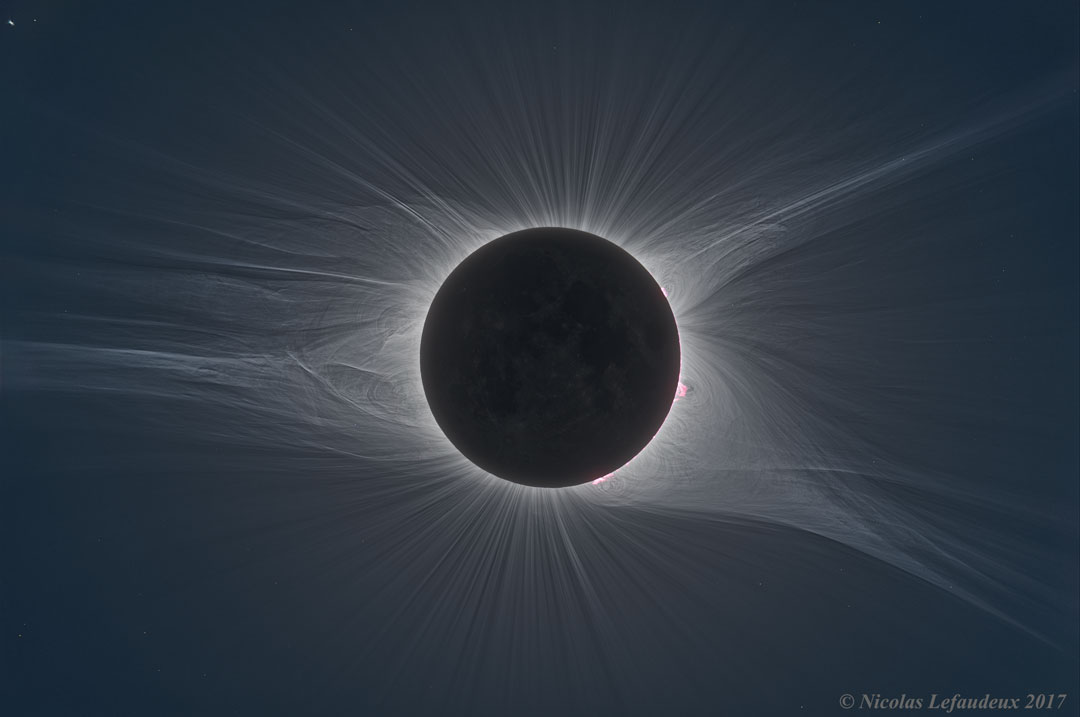
Total Solar Eclipse Corona in HDF Total Solar Eclipse Corona in HDF


How great was the Great American Eclipse? The featured HDR image shows it to be perhaps greater than we knew. On August 21 of last year, the Moon blocked the Sun for a few minutes along a narrow path across the USA. Although one of the most photographed events in human history, this image -- only recently completed after an extraordinary amount of digital processing -- shows one of the most detailed depictions of a solar corona ever taken. Composed of extremely hot gas, the solar corona is only visible to the unaided eye during a total solar eclipse. The featured image combined over 70 images of different time exposures. The series of complementary HDR images recovered enough detail to see motion of the solar corona. The images were taken in Unity, Oregon in the morning to get steady atmospheric seeing conditions. The next total solar eclipse visible on Earth will be in 2019 July, while the next one visible across North America and the USA will occur in 2024 April. via NASA https://ift.tt/2jhCWgq

Apr 28, 2018

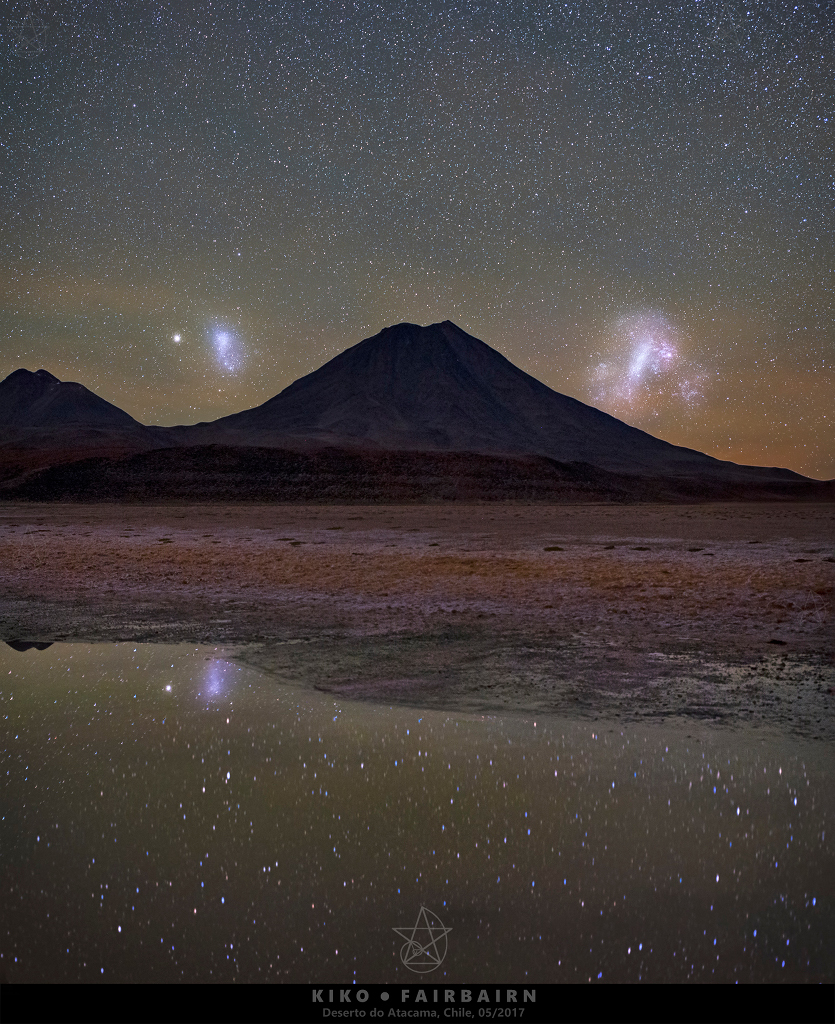
Magellanic Mountain Magellanic Mountain


Flanked by satellite galaxies of the Milky Way a volcanic peak rises from this rugged horizon. The southern night skyscape looks toward the south over Laguna Lejia and the altiplano of the Antofagasta Region of northern Chile. Extending the view across extragalactic space, the Large (right) and Small Magellanic Clouds are so named for the 16th century Portuguese explorer Ferdinand Magellan, leader of planet Earth's first circumnavigation. The larger cloud lies some 180,000 light-years, and the smaller 210,000 light-years beyond the mountaintop. Left of the Small Cloud of Magellan and also reflected in the foreground watery shallows on that starry night, 47 Tucanae shines like a bright star. A globular star cluster that roams the halo of the Milky Way, 47 Tucanae is about 13,000 light-years away. via NASA https://ift.tt/2KjMt2E

Apr 27, 2018

Gaia's Milky Way Gaia's Milky Way


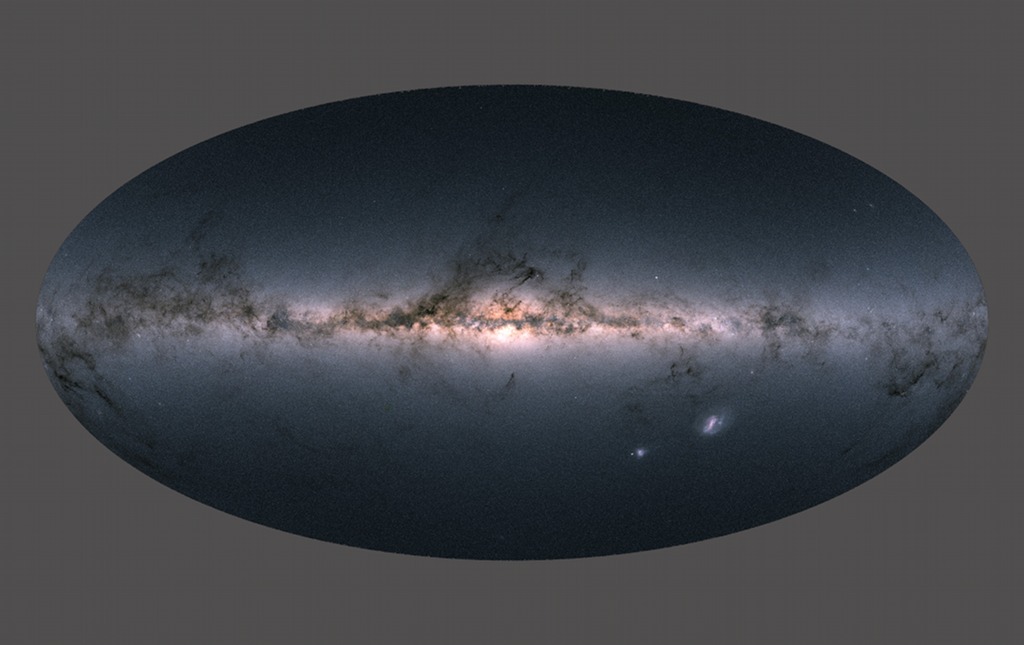
This grand allsky view of our Milky Way and nearby galaxies is not a photograph. It's a map based on individual measurements for nearly 1.7 billion stars. The astronomically rich data set used to create it, the sky-scanning Gaia satellite's second data release, includes remarkably precise determinations of position, brightness, colour, and parallax distance for 1.3 billion stars. Of course, that's about 1 percent of the total number of stars in the Milky Way. Still, the flat plane of our galaxy dominates the view. Home to most Milky Way stars it stretches across the center of Gaia's stellar data map. Voids and rifts along the galactic plane correspond to starlight-obscuring interstellar dust clouds. At lower right are stars of the Large and Small Magellanic Clouds, neighboring galaxies that lie just beyond the Milky Way. via NASA https://ift.tt/2r2I1N2

Apr 26, 2018

The Snows of Churyumov Gerasimenko The Snows of Churyumov Gerasimenko


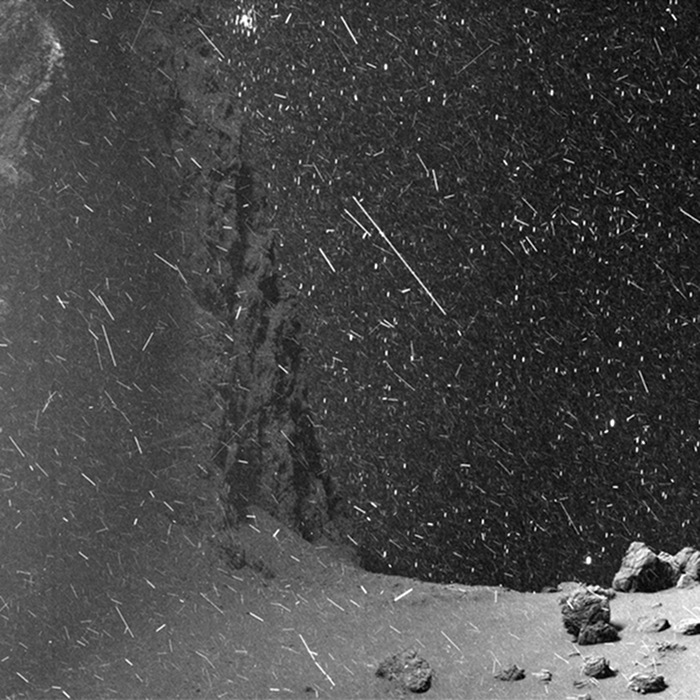
You couldn't really be caught in this blizzard while standing by a cliff on Churyumov-Gerasimenko, also known as comet 67P. Orbiting the comet in June of 2016 the Rosetta spacecraft's narrow angle camera did record streaks of dust and ice particles though, as they drifted across the field of view near the camera and above the comet's surface. Still, some of the bright specks in the scene are likely due to a rain of energetic charged particles or cosmic rays hitting the camera, and the dense background of stars in the direction of the constellation Canis Major. Click on this single frame to play and the background stars are easy to spot as they trail from top to bottom in an animated gif (7.7MB). The 33 frames of the time compressed animation span about 25 minutes of real time. The stunning gif was constructed from consecutive images taken while Rosetta cruised some 13 kilometers from the comet's nucleus. via NASA https://ift.tt/2vNeeO2

Apr 23, 2018

The Blue Horsehead Nebula in Infrared The Blue Horsehead Nebula in Infrared


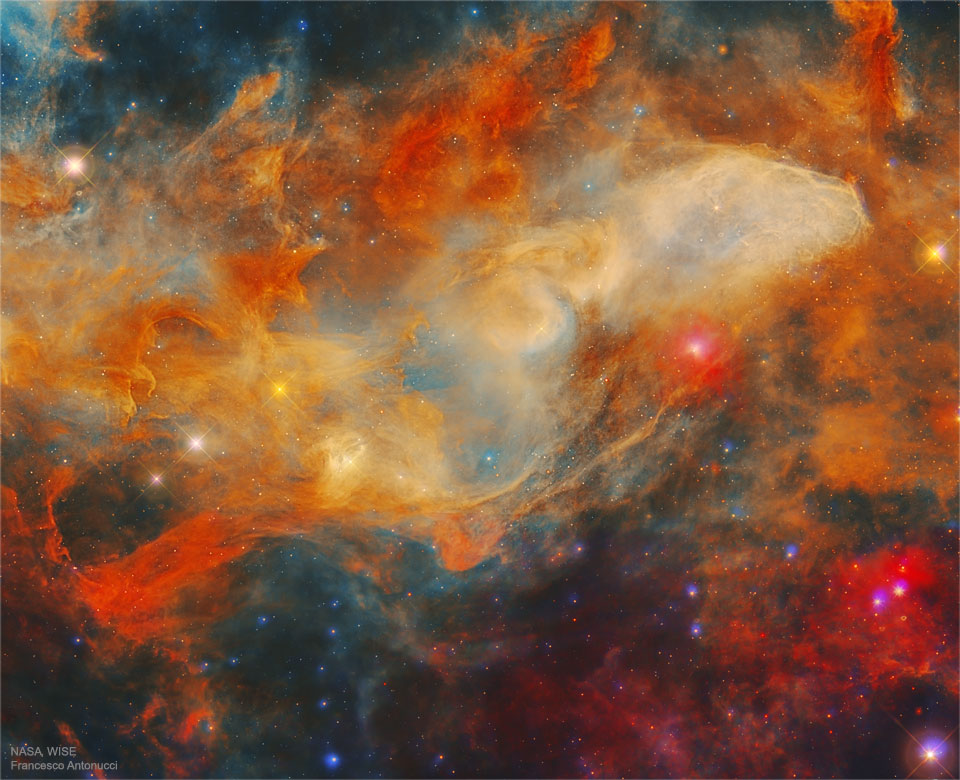
The Blue Horsehead Nebula looks quite different in infrared light. In visible light, the reflecting dust of the nebula appears blue and shaped like a horse's head. In infrared light, however, a complex labyrinth of filaments, caverns, and cocoons of glowing dust and gas emerges, making it hard to even identify the equine icon. The featured image of the nebula was created in three infrared colors (R=22, G=12, B=4.6 microns) from data taken by NASA's orbiting Wide Field Infrared Survey Explorer (WISE) spacecraft. The nebula is cataloged as IC 4592 and spans about 40 light years, lying about 400 light years away toward the constellation Scorpius along the plane of our Milky Way Galaxy. IC 4592 is fainter but covers an angularly greater region than the better known Horsehead Nebula of Orion. The star that predominantly illuminates and heats the dust is Nu Scorpii, visible as the yellow star left of center. via NASA https://ift.tt/2F8BXYj

Apr 22, 2018

Meteor Over Crater Lake Meteor Over Crater Lake


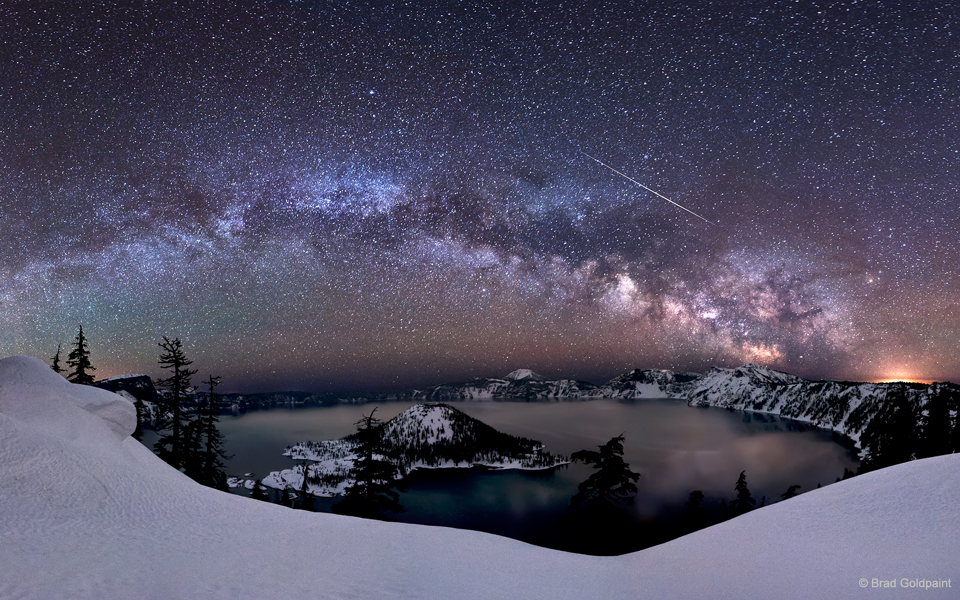
Did you see it? One of the more common questions during a meteor shower occurs because the time it takes for a meteor to flash is typically less than the time it takes for a head to turn. Possibly, though, the glory of seeing bright meteors shoot across and knowing that they were once small granules on another world might make it all worthwhile, even if your observing partner(s) could not share in every particular experience. Peaking late tonight, a dark sky should enable the Lyrids meteor shower to exhibit as many as 20 visible meteors per hour from some locations. In the featured composite of nine exposures taken during the 2012 shower, a bright Lyrid meteor streaks above picturesque Crater Lake in Oregon, USA. Snow covers the foreground, while the majestic central band of our home galaxy arches well behind the serene lake. Other meteor showers this year -- and every year -- include the Perseids in mid-August and the Leonids in mid-November. via NASA https://ift.tt/2qVMv8f

Apr 21, 2018

TESS Launch Close Up TESS Launch Close Up


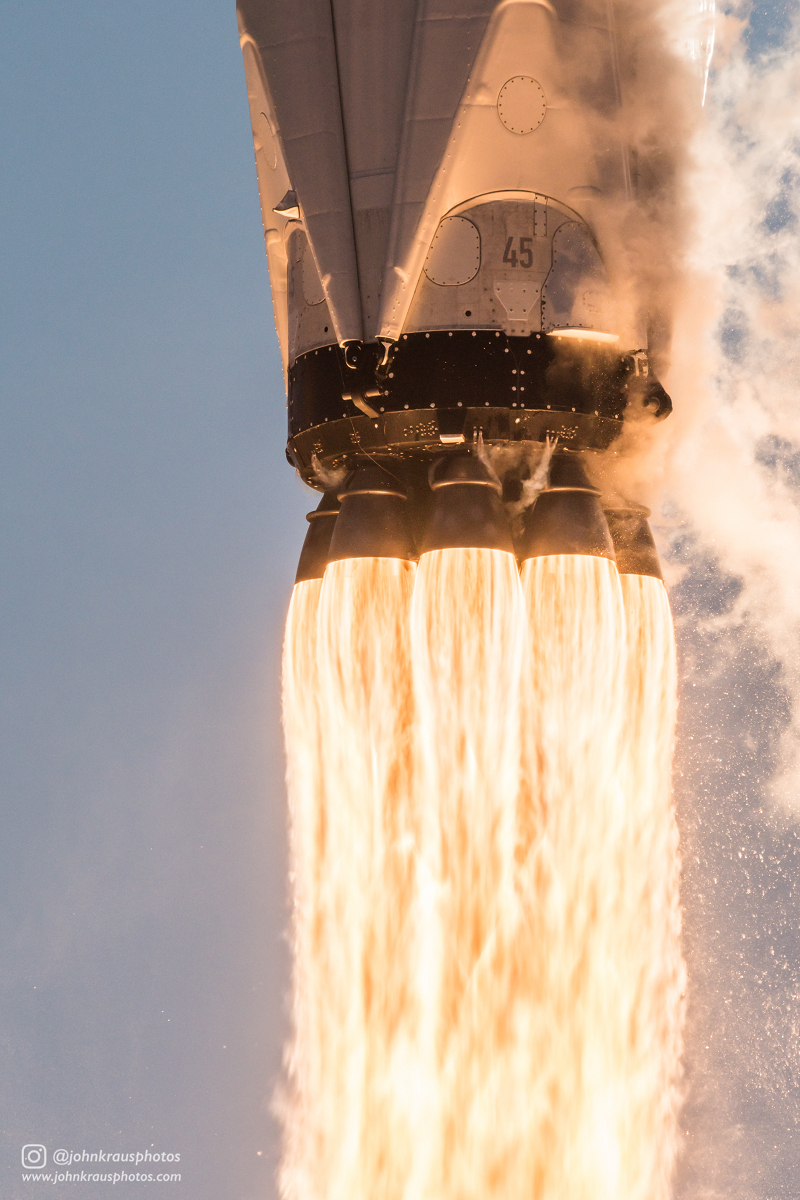
NASA's Transiting Exoplanet Survey Satellite (TESS) began its search for planets orbiting other stars by leaving planet Earth on April 18. The exoplanet hunter rode to orbit on top of a Falcon 9 rocket. The Falcon 9 is so designated for its 9 Merlin first stage engines seen in this sound-activated camera close-up from Space Launch Complex 40 at Cape Canaveral Air Force Station. In the coming weeks, TESS will use a series of thruster burns to boost it into a high-Earth, highly elliptical orbit. A lunar gravity assist maneuver will allow it to reach a previously untried stable orbit with half the orbital period of the Moon and a maximum distance from Earth of about 373,000 kilometers (232,000 miles). From there, TESS will carry out a two year survey to search for planets around the brightest and closest stars in the sky. via NASA https://ift.tt/2vChwDG

Apr 20, 2018

Moon in the Hyades Moon in the Hyades


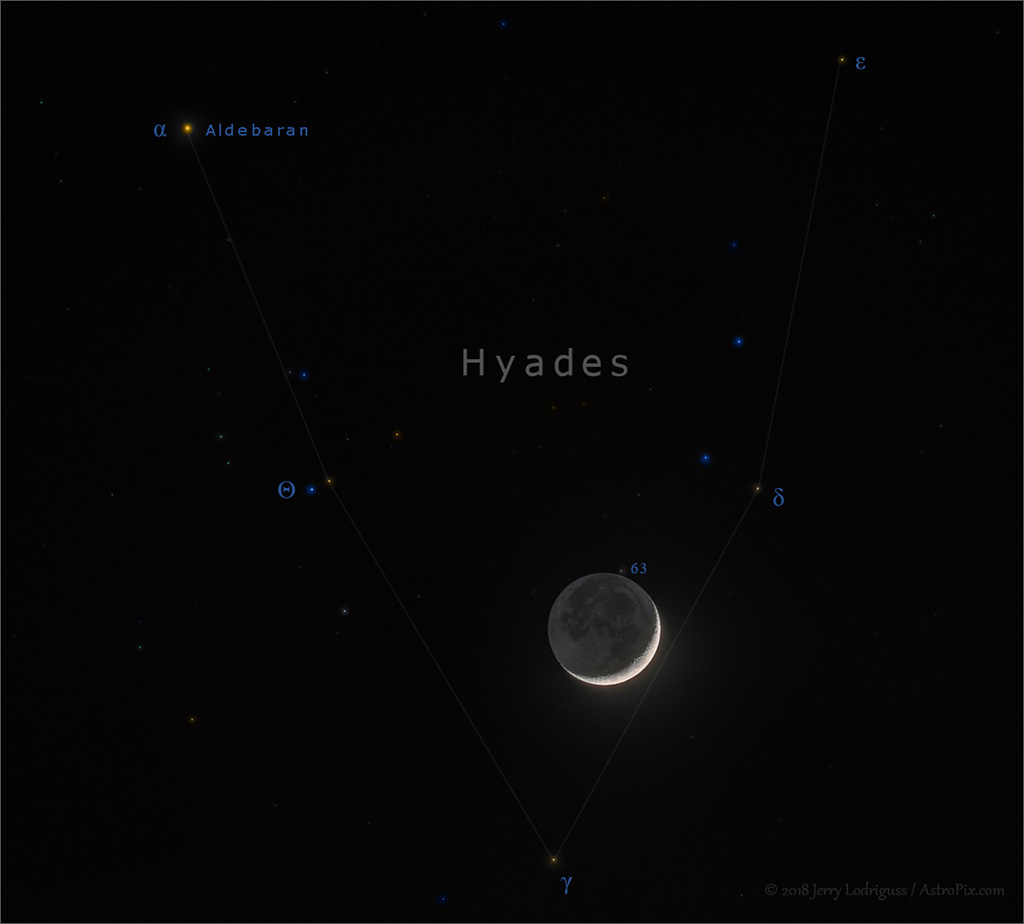
Have you seen the Moon lately? On April 18, its waxing sunlit crescent moved through planet Earth's night across a background of stars in the Hyades. Anchored by bright star Aldebaran, the nearby, V-shaped star cluster and complete lunar orb appear in this telephoto image. The engaging skyview is actually digitally composed from a series of varying exposures. Recorded in 1/60th of a second, the shortest in the series captures the Moon's bright crescent in sharp detail. Longer exposures, ranging up to 15 seconds, capture fainter background stars as well as earthshine, visible to the eye as the earthlit lunar night side. via NASA https://ift.tt/2Hf5SUw

Apr 19, 2018

NGC 7635: The Bubble Nebula NGC 7635: The Bubble Nebula


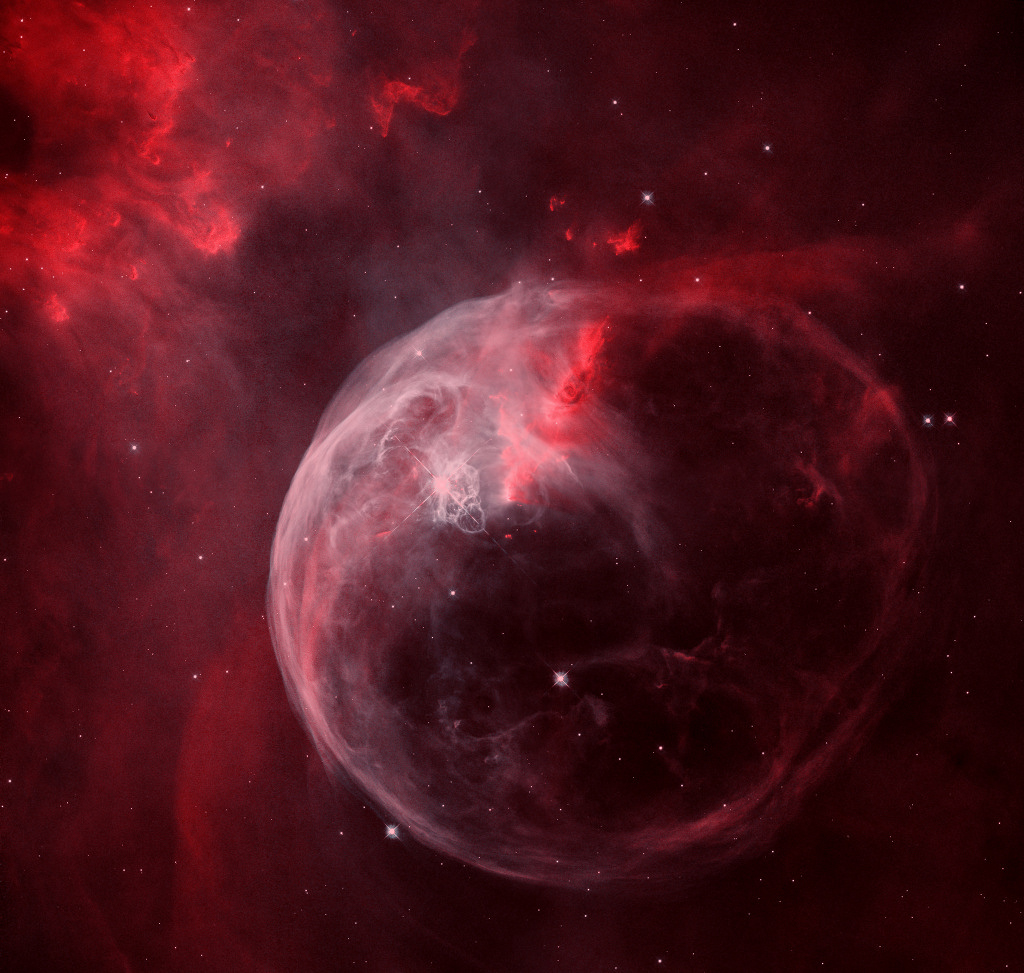
Blown by the wind from a massive star, this interstellar apparition has a surprisingly familiar shape. Cataloged as NGC 7635, it is also known simply as The Bubble Nebula. Although it looks delicate, the 7 light-year diameter bubble offers evidence of violent processes at work. Above and left of the Bubble's center is a hot, O-type star, several hundred thousand times more luminous and some 45 times more massive than the Sun. A fierce stellar wind and intense radiation from that star has blasted out the structure of glowing gas against denser material in a surrounding molecular cloud. The intriguing Bubble Nebula and associated cloud complex lie a mere 7,100 light-years away toward the boastful constellation Cassiopeia. This sharp, tantalizing view of the cosmic bubble is a composite of Hubble Space Telescope image data from 2016, reprocessed to present the nebula's intense narrowband emission in an approximate true color scheme. via NASA https://ift.tt/2HBnKIw

Apr 18, 2018

Milky Way over Deadvlei in Namibia Milky Way over Deadvlei in Namibia


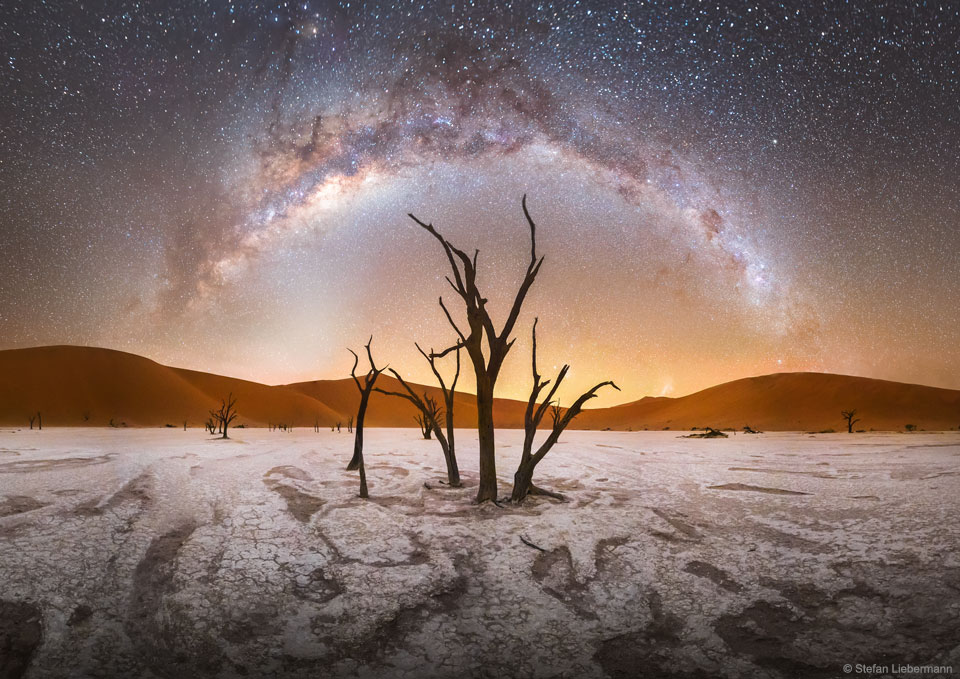
What planet is this? It is the only planet currently known to have trees. The trees in Deadvlei, though, have been dead for over 500 years. Located in Namib-Naukluft Park in Namibia (Earth), saplings grew after rainfall caused a local river to overflow, but died after sand dunes shifted to section off the river. High above and far in the distance, the band of our Milky Way Galaxy forms an arch over a large stalk in this well-timed composite image, taken last month. The soil of white clay appears to glow by reflected starlight. Rising on the left, under the Milky Way's arch, is a band of zodiacal light -- sunlight reflected by dust orbiting in the inner Solar System. On the right, just above one of Earth's larger sand dunes, an astute eye can find the Large Magellanic Cloud, a satellite galaxy of our galaxy. Finding the Small Magellanic Cloud in the featured image, though, is perhaps too hard. via NASA https://ift.tt/2J4DFMA