Pages

Mar 31, 2018

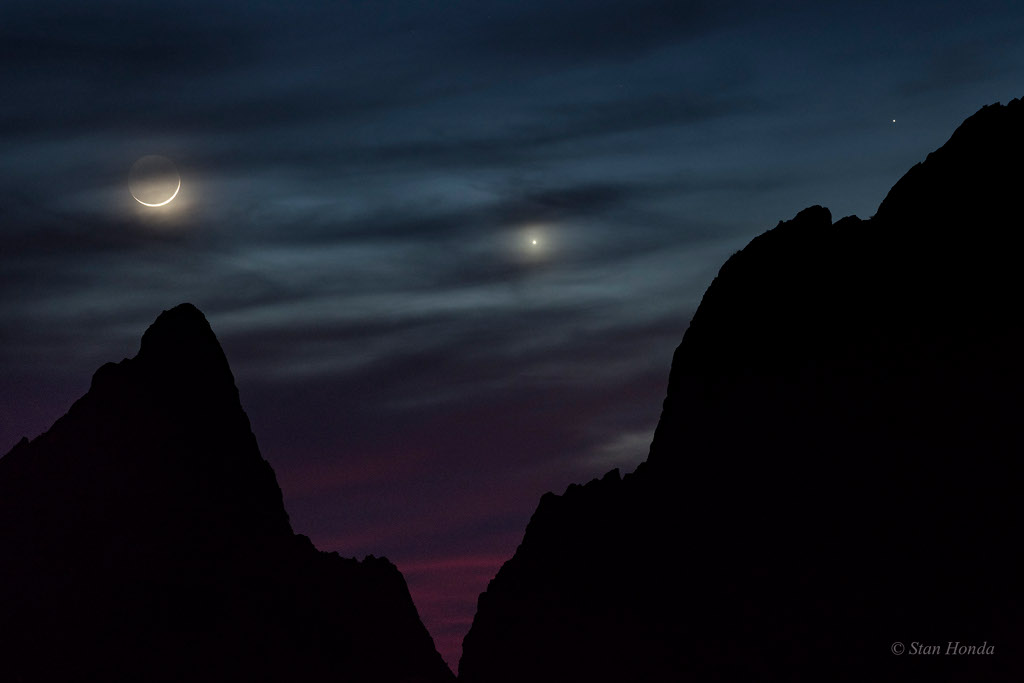
Twilight in a Western Sky Twilight in a Western Sky


A slender crescent Moon and inner planets Venus and Mercury never wander far from the Sun in planet Earth's skies. In the fading evening twilight of March 18, they line up near the western horizon in this atmospheric skyscape. While the celestial scene was enjoyed around the world, this photo captures the trio, with fainter Mercury at the far right, above the crags of Big Bend National Park in southwest Texas. Tonight the Moon will be full though, and rise opposite the Sun. Look for it high in the sky at midnight, near bright star Spica. via NASA https://ift.tt/2uAl3ls

Mar 29, 2018

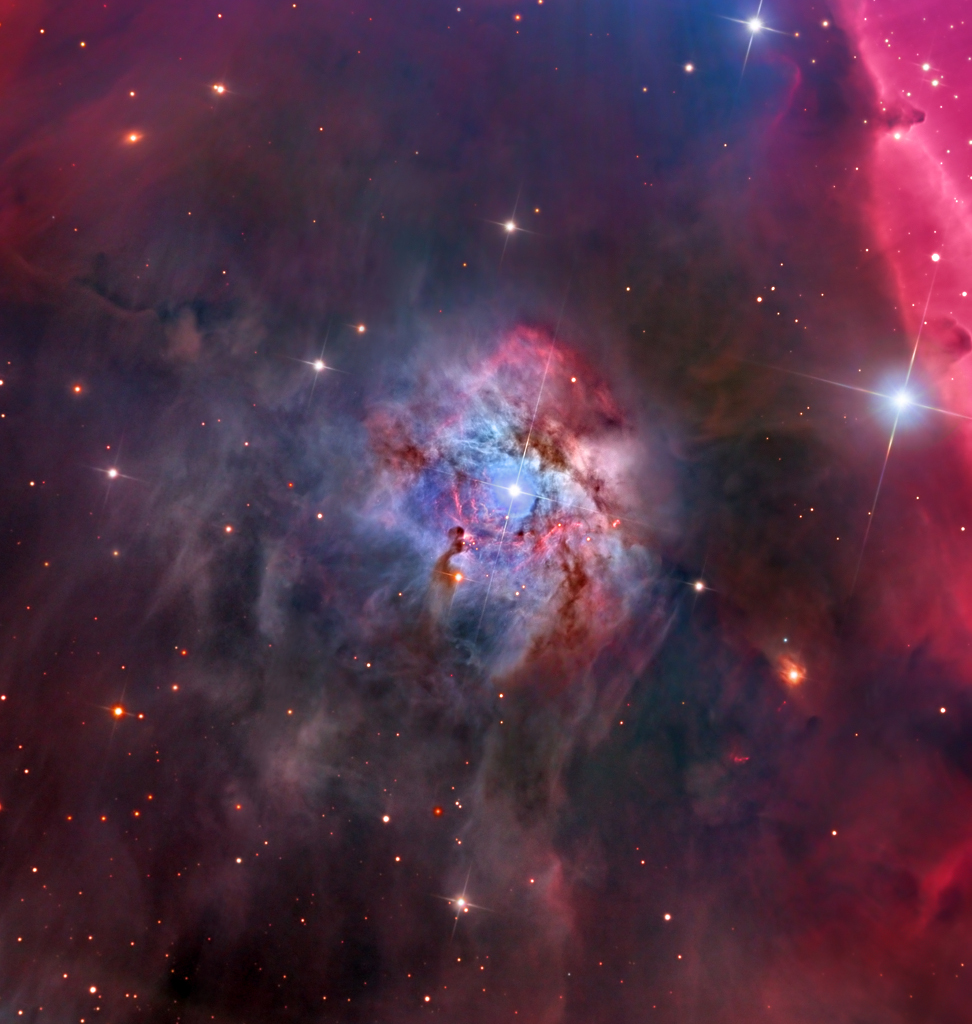
NGC 2023 in the Horsehead s Shadow NGC 2023 in the Horsehead s Shadow


Carved by a bright young star in Orion's dusty molecular clouds, NGC 2023 is often overlooked in favor of the nearby dramatic silhouette of the Horsehead Nebula. In its own right it is seen as a beautiful star forming emission and reflection nebula though, a mere 1500 light-years distant. Surprisingly colorful and complex filaments are detailed in this rare NGC 2023 portrait. Scattered points of emission are also from the region's Herbig-Haro objects, associated with the energetic jets from newborn stars. The sharp telescopic view spans about 10 light-years at the estimated distance of NGC 2023. Off the right edge of the frame lies the more familiar cosmic Horsehead. via NASA https://ift.tt/2GREmZP

Mar 28, 2018

Blue Moon Tree Blue Moon Tree


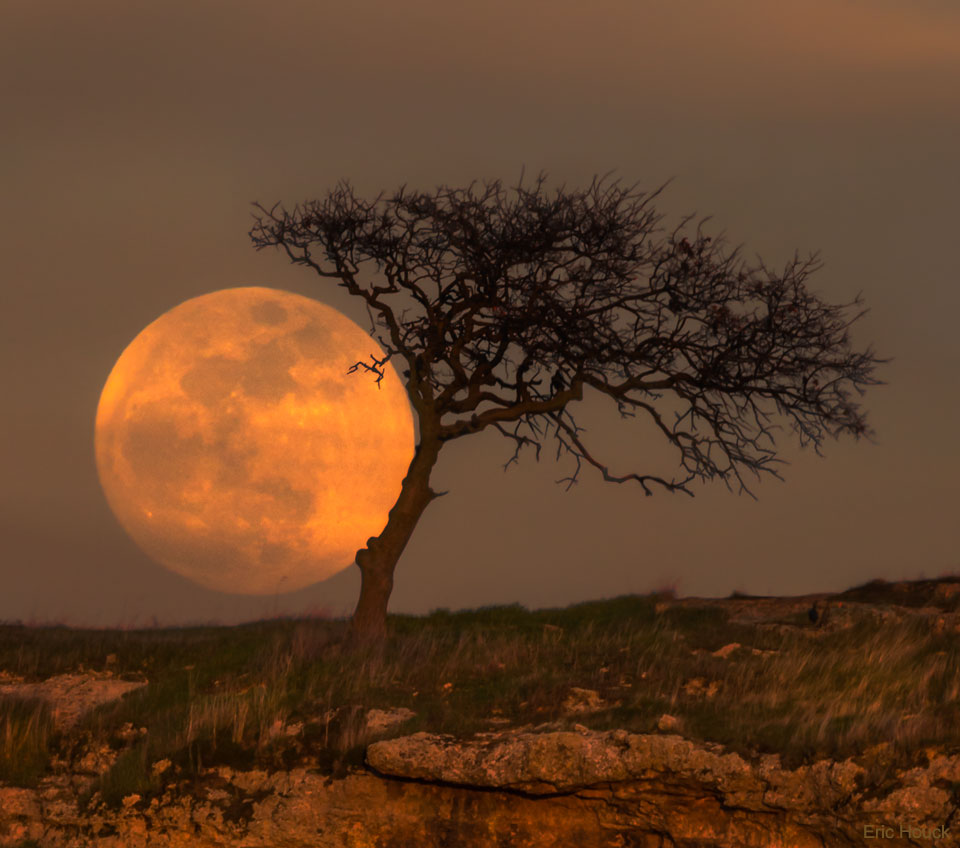
Does an alignment like this occur only once in a blue moon? No, although it was during a blue moon that this single-shot image was taken. During a full moon that happened to be the second of the month -- the situation that defines a blue moon -- the photographer created the juxtaposition in late January by quickly moving around to find just the right spot to get the background Moon superposed behind the arc of a foreground tree. Unfortunately, in this case, there seemed no other way than getting bogged down in mud and resting the camera on a barbed-wire fence. The arc in the oak tree was previously created by hungry cows in Knight's Ferry, California, USA. Quirky Moon-tree juxtapositions like this can be created during any full moon though, given enough planning and time. Another opportunity will arise this weekend, coincidently during another blue moon. Then, the second blue moon in 2018 will occur, meaning that for the second month this year, two full moons will appear during a single month (moon-th). Double blue-moon years are relatively rare, with the last occurring in 1999, and the next in 2037. via NASA https://ift.tt/2GdqjRb

Mar 25, 2018

Announcing Nova Carinae 2018 Announcing Nova Carinae 2018


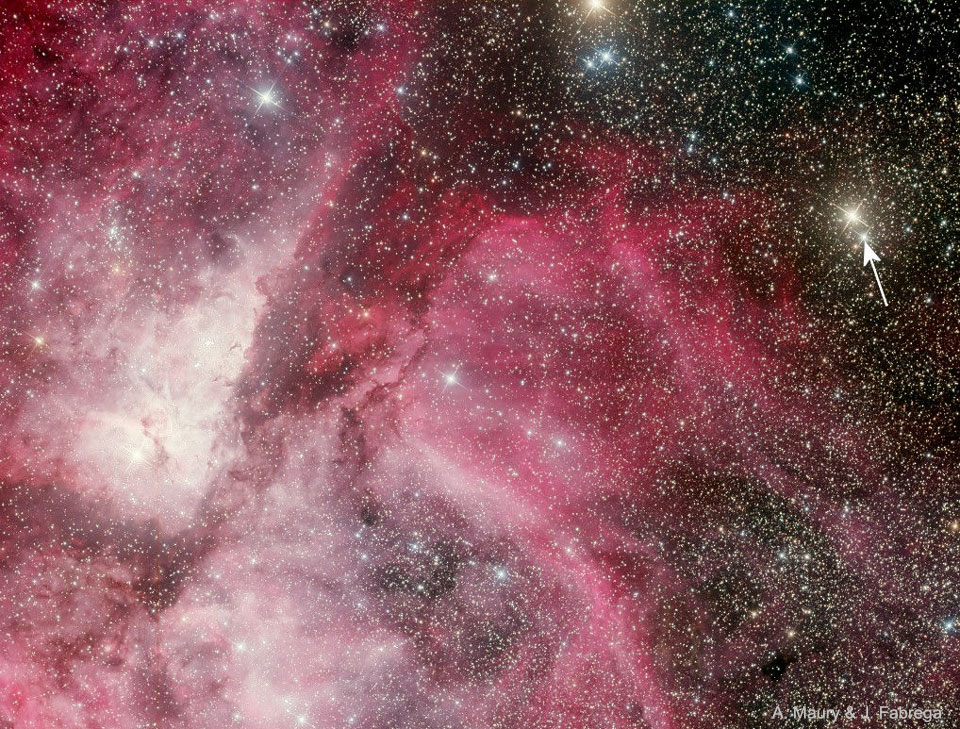
How bright will Nova Carinae 2018 become? The new nova was discovered only last week. Although novas occur frequently throughout the universe, this nova, cataloged as ASASSN-18fv, is so unusually bright in the skies of Earth that it is now easily visible through binoculars in the southern hemisphere. Identified by the arrow, the nova occurs near the direction of the picturesque Carina Nebula. A nova is typically caused by a thermonuclear explosion on the surface of a white dwarf star that is accreting matter from a binary companion, although details of this outburst are currently unknown. Both professional and amateur astronomers will be monitoring this unusual stellar outburst in the coming weeks, looking to see how Nova Carinae 2018 evolves, including whether it becomes bright enough to be visible to the unaided eye. via NASA https://ift.tt/2IO1TM1

Mar 24, 2018

NGC 602 and Beyond NGC 602 and Beyond


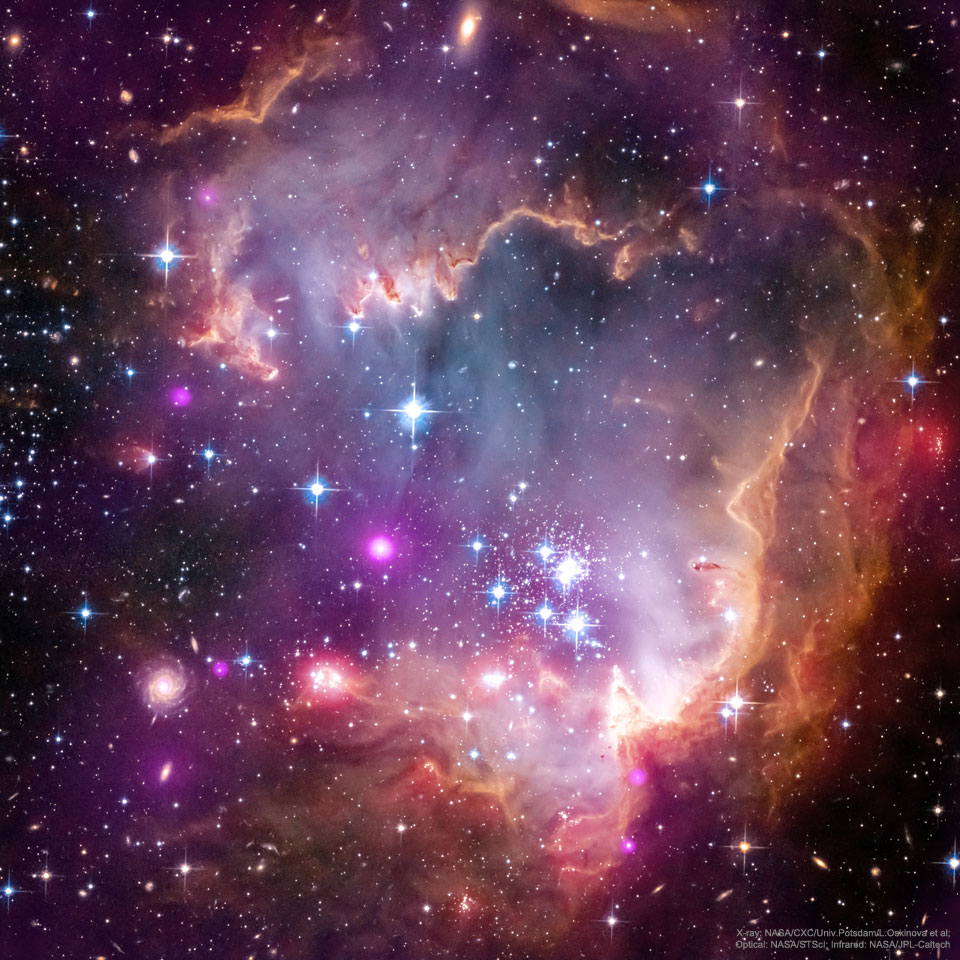
Near the outskirts of the Small Magellanic Cloud, a satellite galaxy some 200 thousand light-years distant, lies 5 million year young star cluster NGC 602. Surrounded by natal gas and dust, NGC 602 is featured in this stunning Hubble image of the region, augmented by images in the X-ray by Chandra, and in the infrared by Spitzer. Fantastic ridges and swept back shapes strongly suggest that energetic radiation and shock waves from NGC 602's massive young stars have eroded the dusty material and triggered a progression of star formation moving away from the cluster's center. At the estimated distance of the Small Magellanic Cloud, the Picture spans about 200 light-years, but a tantalizing assortment of background galaxies are also visible in this sharp multi-colored view. The background galaxies are hundreds of millions of light-years or more beyond NGC 602. via NASA https://ift.tt/2G66Qhr

Mar 22, 2018

NGC 253: Dusty Island Universe NGC 253: Dusty Island Universe


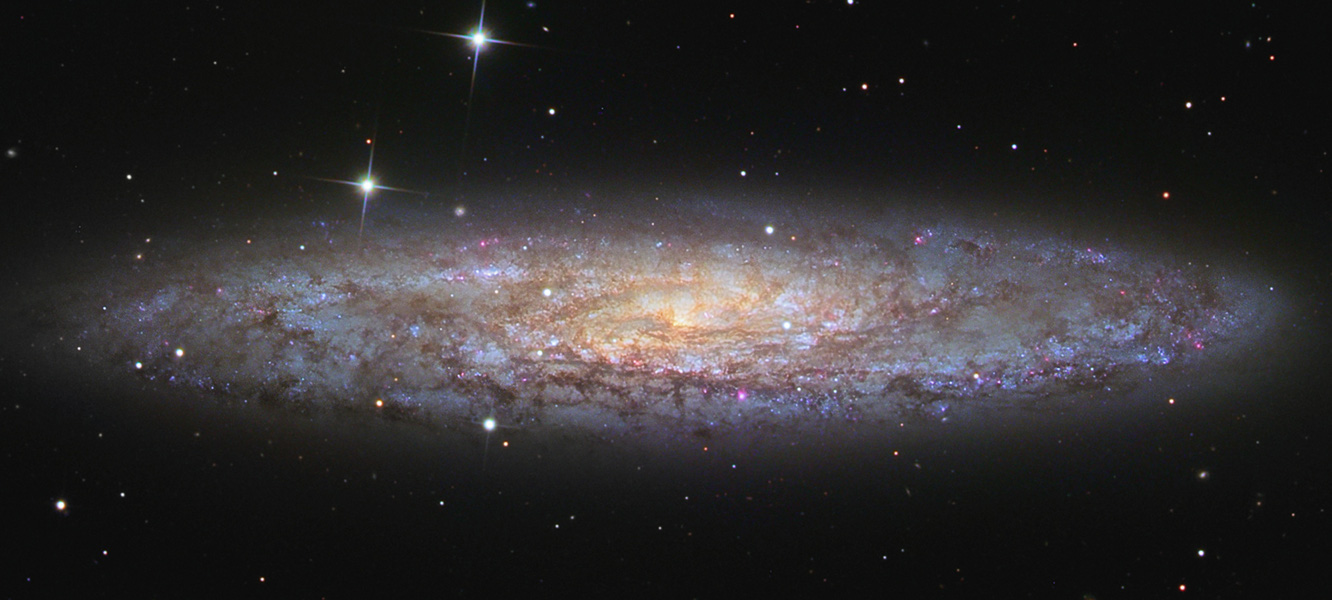
Shiny NGC 253 is one of the brightest spiral galaxies visible, and also one of the dustiest. Some call it the Silver Dollar Galaxy for its appearance in small telescopes, or just the Sculptor Galaxy for its location within the boundaries of the southern constellation Sculptor. Discovered in 1783 by mathematician and astronomer Caroline Herschel, the dusty island universe lies a mere 10 million light-years away. About 70 thousand light-years across, NGC 253 is the largest member of the Sculptor Group of Galaxies, the nearest to our own Local Group of Galaxies. In addition to its spiral dust lanes, tendrils of dust seem to be rising from a galactic disk laced with young star clusters and star forming regions in this sharp color image. The high dust content accompanies frantic star formation, earning NGC 253 the designation of a starburst galaxy. NGC 253 is also known to be a strong source of high-energy x-rays and gamma rays, likely due to massive black holes near the galaxy's center. Take a trip through extragalactic space in this short video flyby of NGC 253. via NASA http://ift.tt/2pvMXch

Mar 21, 2018

Camera Orion Camera Orion


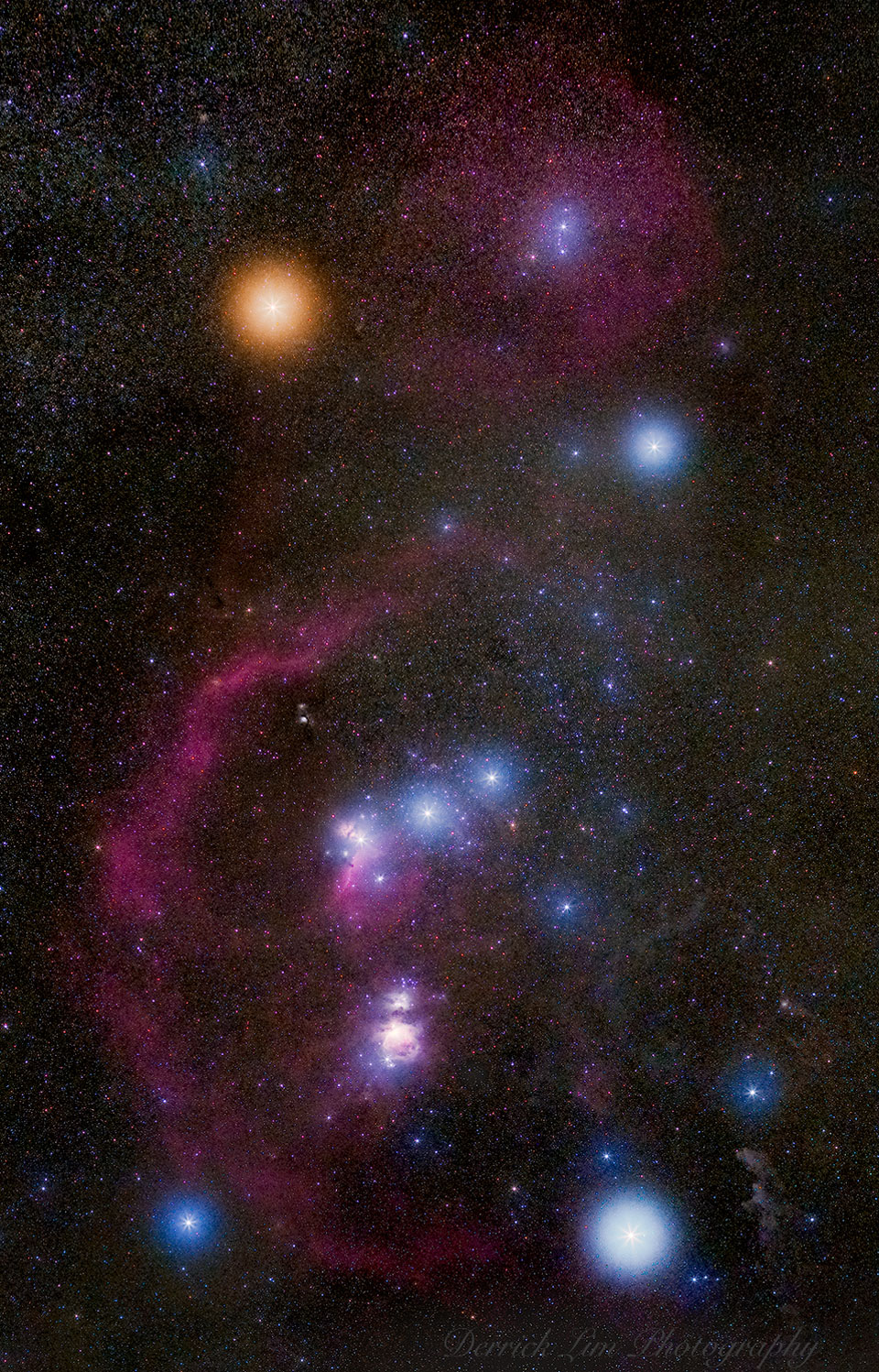
Do you recognize this constellation? Although it is one of the most recognizable star groupings on the sky, Orion's icons don't look quite as colorful to the eye as they do to a camera. In this 20-image digitally-composed mosaic, cool red giant Betelgeuse takes on a strong orange tint as the brightest star at the upper left. Orion's hot blue stars are numerous, with supergiant Rigel balancing Betelgeuse at the lower right, and Bellatrix at the upper right Lined up in Orion's belt are three stars all about 1,500 light-years away, born from the constellation's well-studied interstellar clouds. Below Orion's belt a reddish and fuzzy patch that might also look familiar -- the stellar nursery known as Orion's Nebula. Finally, just barely visible to the unaided eye but quite striking here by camera is Barnard's Loop -- a huge gaseous emission nebula surrounding Orion's Belt and Nebula discovered over 100 years ago by the pioneering Orion photographer E. E. Barnard. via NASA http://ift.tt/2GRtZp2

Mar 19, 2018

The Nebra Sky Disk The Nebra Sky Disk


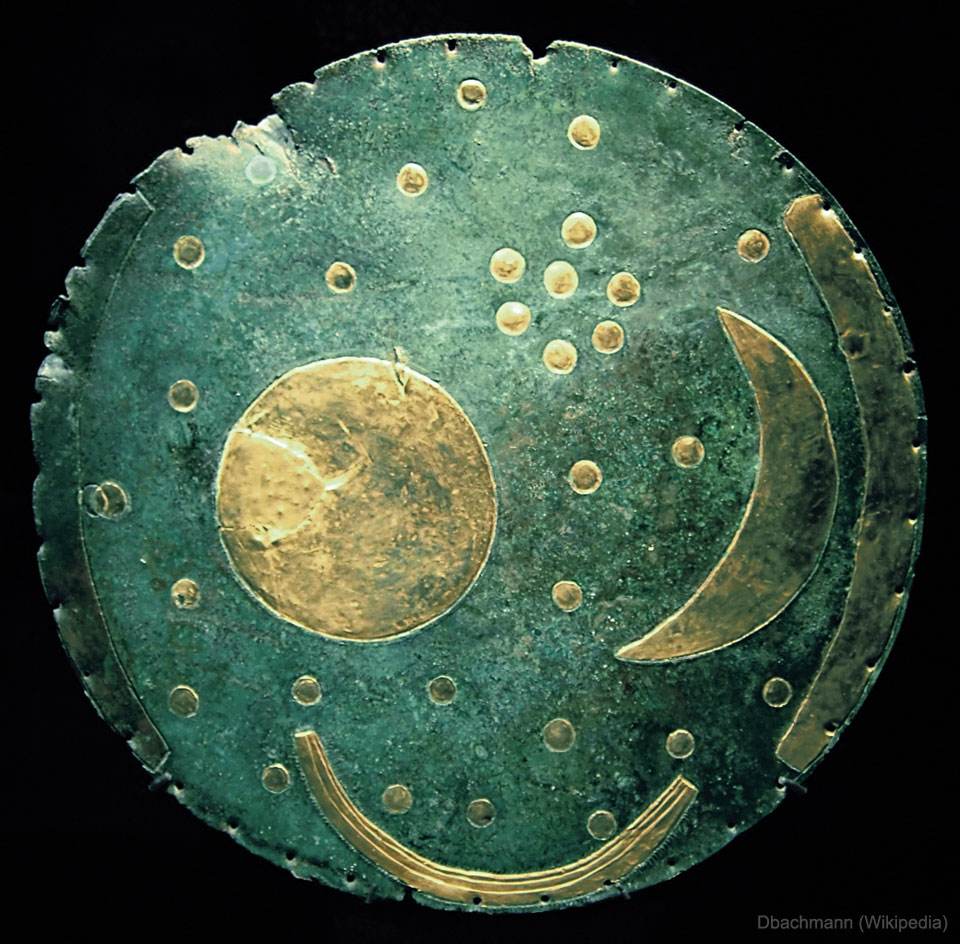
It is considered the oldest known illustration of the night sky. But what, exactly, does it depict, and why was it made? The Nebra sky disk was found with a metal detector in 1999 by treasure hunters near Nebra, Germany, in the midst of several bronze-age weapons. The ancient artifact spans about 30 centimeters and has been associated with the Unetice culture that inhabited part of Europe around 1600 BC. Reconstructed, the dots are thought to represent stars, with the cluster representing the Pleiades, and the large circle and the crescent representing the Sun and Moon. The purpose of the disk remains unknown -- hypotheses including an astronomical clock, a work of art, and a religious symbol. Valued at about $11 million, some believe that the Nebra sky disk is only one of a pair, with the other disk still out there waiting to be discovered. via NASA http://ift.tt/2FJZOCO

Mar 18, 2018

Rotating Moon from LRO Rotating Moon from LRO


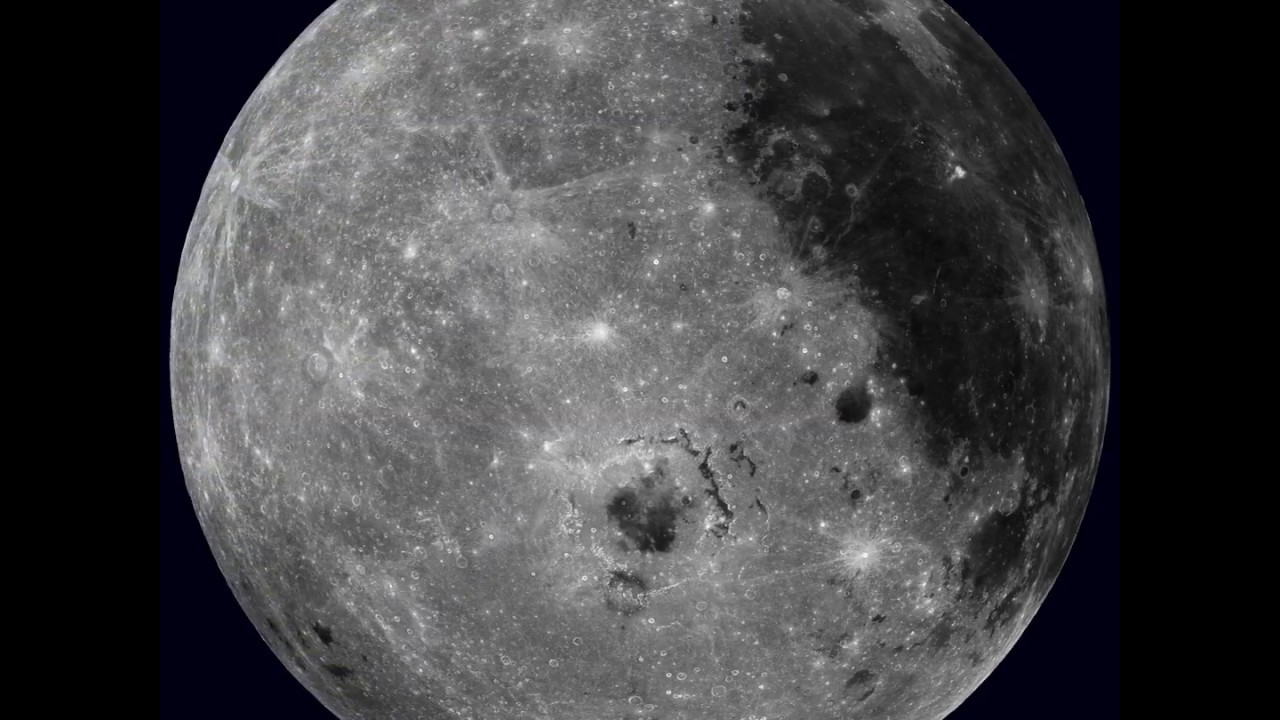
No one, presently, sees the Moon rotate like this. That's because the Earth's moon is tidally locked to the Earth, showing us only one side. Given modern digital technology, however, combined with many detailed images returned by the Lunar Reconnaissance Orbiter (LRO), a high resolution virtual Moon rotation movie has been composed. The above time-lapse video starts with the standard Earth view of the Moon. Quickly, though, Mare Orientale, a large crater with a dark center that is difficult to see from the Earth, rotates into view just below the equator. From an entire lunar month condensed into 24 seconds, the video clearly shows that the Earth side of the Moon contains an abundance of dark lunar maria, while the lunar far side is dominated by bright lunar highlands. Currently, over 20 new missions to the Moon are under active development from four different countries, most of which have expected launch dates either this year or next. via NASA http://ift.tt/2FKI3Di

Mar 17, 2018

The Crab from Space The Crab from Space


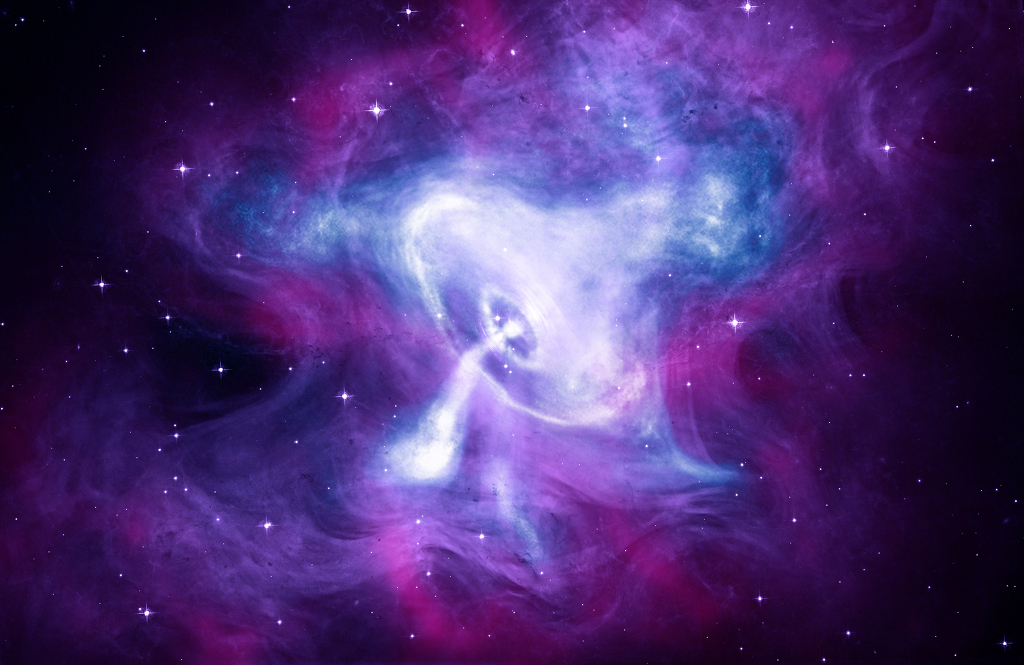
The Crab Nebula is cataloged as M1, the first object on Charles Messier's famous list of things which are not comets. In fact, the Crab is now known to be a supernova remnant, expanding debris from the death explosion of a massive star. This intriguing false-color image combines data from space-based observatories, Chandra, Hubble, and Spitzer, to explore the debris cloud in X-rays (blue-white), optical (purple), and infrared (pink) light. One of the most exotic objects known to modern astronomers, the Crab Pulsar, a neutron star spinning 30 times a second, is the bright spot near picture center. Like a cosmic dynamo, this collapsed remnant of the stellar core powers the Crab's emission across the electromagnetic spectrum. Spanning about 12 light-years, the Crab Nebula is 6,500 light-years away in the constellation Taurus. via NASA http://ift.tt/2FIPDhW