Pages

Oct 31, 2017

Dark Matter in a Simulated Universe Dark Matter in a Simulated Universe


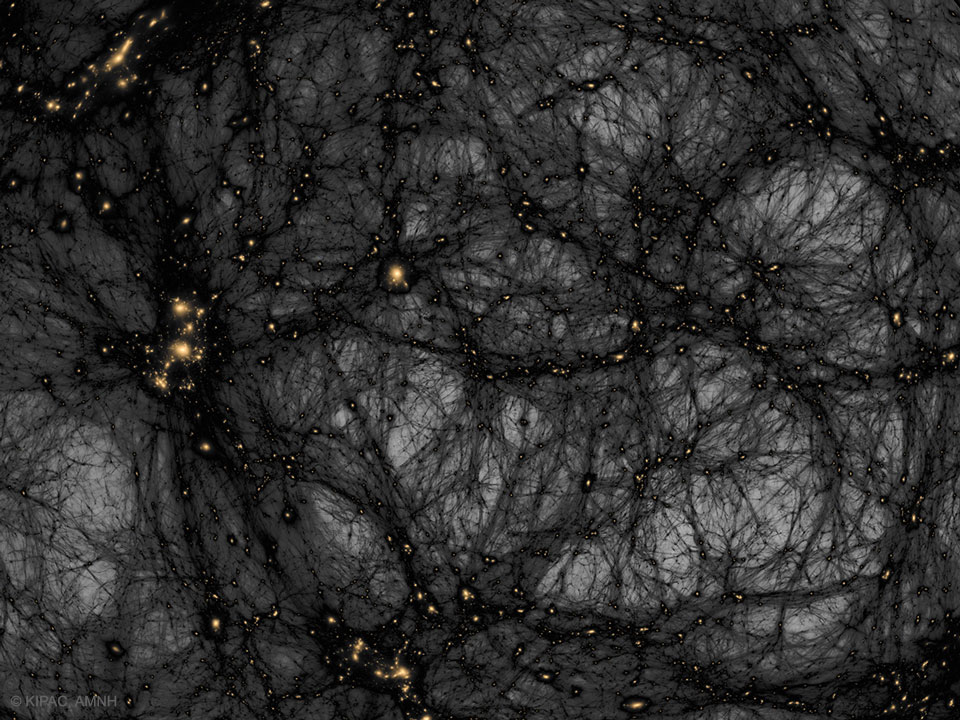
Is our universe haunted? It might look that way on this dark matter map. The gravity of unseen dark matter is the leading explanation for why galaxies rotate so fast, why galaxies orbit clusters so fast, why gravitational lenses so strongly deflect light, and why visible matter is distributed as it is both in the local universe and on the cosmic microwave background. The featured image from the American Museum of Natural History’s Hayden Planetarium Space Show Dark Universe highlights one example of how pervasive dark matter might haunt our universe. In this frame from a detailed computer simulation, complex filaments of dark matter, shown in black, are strewn about the universe like spider webs, while the relatively rare clumps of familiar baryonic matter are colored orange. These simulations are good statistical matches to astronomical observations. In what is perhaps a scarier turn of events, dark matter -- although quite strange and in an unknown form -- is no longer thought to be the strangest source of gravity in the universe. That honor now falls to dark energy, a more uniform source of repulsive gravity that seems to now dominate the expansion of the entire universe. via NASA http://ift.tt/2A0FhDC

Oct 30, 2017

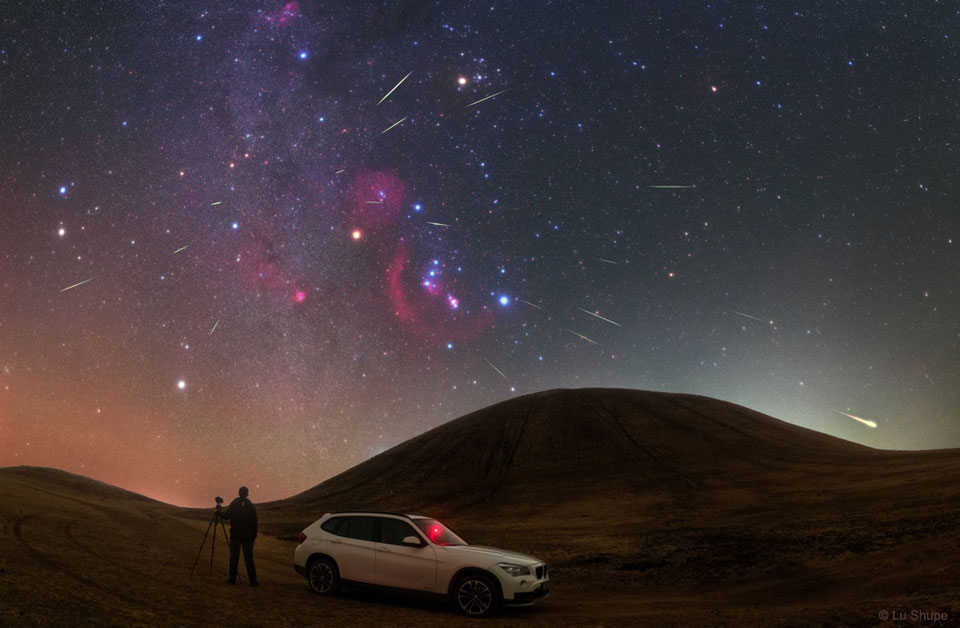
Orionid Meteors from Orion Orionid Meteors from Orion


Meteors have been shooting out from the constellation of Orion. This was expected, as October is the time of year for the Orionids Meteor Shower. Pictured here, over a dozen meteors were caught in successively added exposures last weekend over Wulan Hada volcano in Inner Mongolia, China. The featured image shows multiple meteor streaks that can all be connected to a single small region on the sky called the radiant, here visible just above and to the left of the belt of Orion, The Orionids meteors started as sand sized bits expelled from Comet Halley during one of its trips to the inner Solar System. Comet Halley is actually responsible for two known meteor showers, the other known as the Eta Aquarids and visible every May. Next month, the Leonids Meteor Shower from Comet Tempel-Tuttle should also result in some bright meteor streaks. via NASA http://ift.tt/2lr5sQj

Oct 28, 2017

NGC 6369: The Little Ghost Nebula NGC 6369: The Little Ghost Nebula


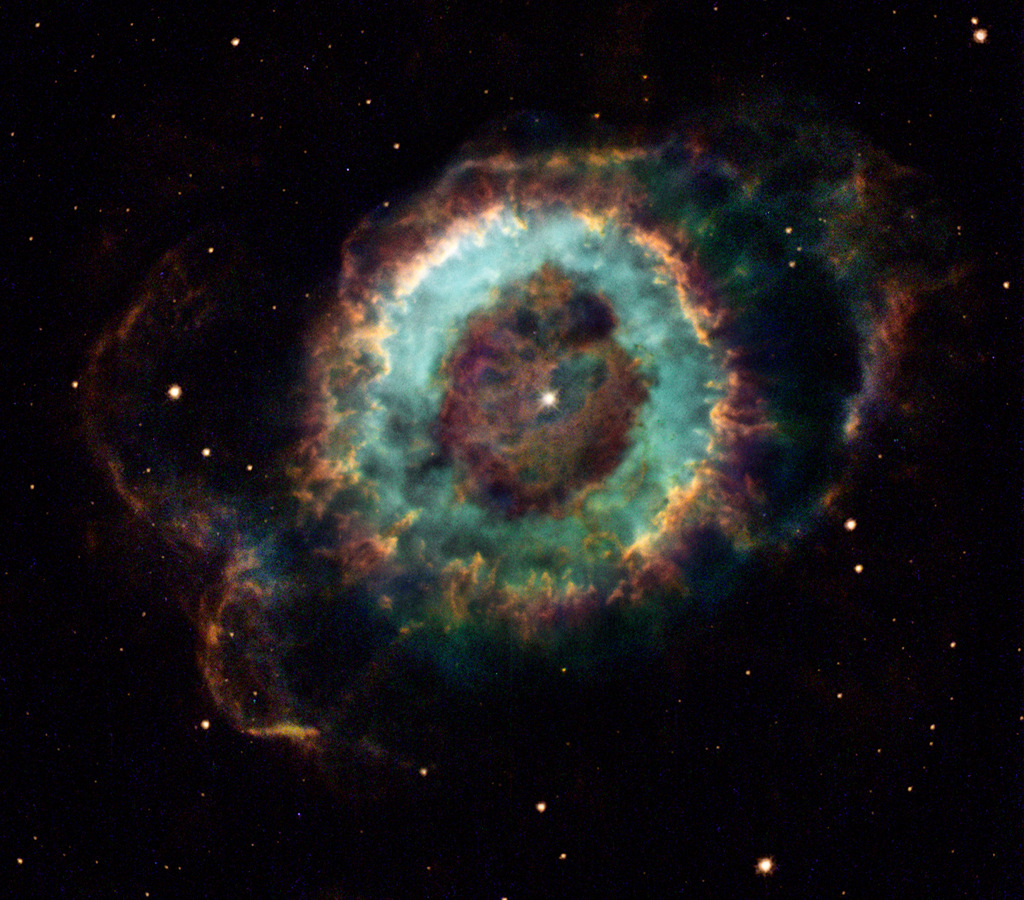
Wraithlike NGC 6369 is a faint apparition in night skies popularly known as the Little Ghost Nebula. It was discovered by 18th century astronomer Sir William Herschel as he used a telescope to explore the medicinal constellation Ophiucus. Herschel historically classified the round and planet-shaped nebula as a Planetary Nebula. But planetary nebulae in general are not at all related to planets. Instead they are gaseous shrouds created at the end of a sun-like star's life, the dying star's outer layers expanding into space while its core shrinks to become a white dwarf. The transformed white dwarf star, seen near the center, radiates strongly at ultraviolet wavelengths and powers the expanding nebula's glow. Surprisingly complex details and structures of NGC 6369 are revealed in this tantalizing image composed from Hubble Space Telescope data. The nebula's main round structure is about a light-year across and the glow from ionized oxygen, hydrogen, and nitrogen atoms are colored blue, green, and red respectively. Over 2,000 light-years away, the Little Ghost Nebula offers a glimpse of the fate of our Sun, which could produce its own planetary nebula about 5 billion years from now. via NASA http://ift.tt/2z9c1x2

Oct 27, 2017

Mirach s Ghost Mirach s Ghost


As far as ghosts go, Mirach's Ghost isn't really that scary. Mirach's Ghost is just a faint, fuzzy galaxy, well known to astronomers, that happens to be seen nearly along the line-of-sight to Mirach, a bright star. Centered in this star field, Mirach is also called Beta Andromedae. About 200 light-years distant, Mirach is a red giant star, cooler than the Sun but much larger and so intrinsically much brighter than our parent star. In most telescopic views, glare and diffraction spikes tend to hide things that lie near Mirach and make the faint, fuzzy galaxy look like a ghostly internal reflection of the almost overwhelming starlight. Still, appearing in this sharp image just above and to the left of Mirach, Mirach's Ghost is cataloged as galaxy NGC 404 and is estimated to be some 10 million light-years away. via NASA http://ift.tt/2i7IzMS

Oct 26, 2017

NGC 7635: Bubble in a Cosmic Sea NGC 7635: Bubble in a Cosmic Sea


Adrift in a cosmic sea of stars and glowing gas the delicate, floating apparition left of center in this widefield view is cataloged as NGC 7635, the Bubble Nebula. A mere 10 light-years wide, the tiny Bubble Nebula was blown by the winds of a massive star. It lies within a larger complex of interstellar gas and dust clouds found about 11,000 light-years distant, straddling the boundary between the parental constellations Cepheus and Cassiopeia. Included in the breathtaking vista is open star cluster M52 (lower left), some 5,000 light-years away. Above and right of the Bubble Nebula is an emission region identified as Sh2-157, also known as the Claw Nebula. Constructed from 47 hours of narrow-band and broad-band exposures, this image spans about 3 degrees on the sky. That corresponds to a width of 500 light-years at the estimated distance of the Bubble Nebula. via NASA http://ift.tt/2i2Uk7E

Oct 24, 2017

Where Your Elements Came From Where Your Elements Came From


The hydrogen in your body, present in every molecule of water, came from the Big Bang. There are no other appreciable sources of hydrogen in the universe. The carbon in your body was made by nuclear fusion in the interior of stars, as was the oxygen. Much of the iron in your body was made during supernovas of stars that occurred long ago and far away. The gold in your jewelry was likely made from neutron stars during collisions that may have been visible as short-duration gamma-ray bursts or gravitational wave events. Elements like phosphorus and copper are present in our bodies in only small amounts but are essential to the functioning of all known life. The featured periodic table is color coded to indicate humanity's best guess as to the nuclear origin of all known elements. The sites of nuclear creation of some elements, such as copper, are not really well known and are continuing topics of observational and computational research. via NASA http://ift.tt/2zIV0GZ

Oct 23, 2017

NGC 4993: The Galactic Home of an Historic Explosion NGC 4993: The Galactic Home of an Historic Explosion


That reddish dot -- it wasn't there before. It's the dot to the upper left of galaxy NGC 4993's center, do you see it? When scanning the large field of possible locations of an optical counterpart to the unprecedented gravitational wave event GW170817 in August, the appearance of this fading dot quickly became of historic importance. It pinpointed GW170817's exact location, thereby enabling humanity's major telescopes to examine the first ever electromagnetic wave counterpart to a gravitational wave event, an event giving strong evidence of being a short gamma-ray burst kilonova, the element-forming explosion that occurs after two neutron stars merge. The featured image of lenticular galaxy NGC 4993 by Hubble shows the fading dot several days after it was discovered. Analyses, continuing, include the physics of the explosion, what heavy elements formed, the similarity of the speeds of gravitational radiation and light, and calibrating a new method for determining the distance scale of our universe. via NASA http://ift.tt/2gXzCWG

Oct 22, 2017

Two Black Holes Dancing in 3C 75 Two Black Holes Dancing in 3C 75


What's happening at the center of active galaxy 3C 75? The two bright sources at the center of this composite x-ray (blue)/ radio (pink) image are co-orbiting supermassive black holes powering the giant radio source 3C 75. Surrounded by multimillion degree x-ray emitting gas, and blasting out jets of relativistic particles the supermassive black holes are separated by 25,000 light-years. At the cores of two merging galaxies in the Abell 400 galaxy cluster they are some 300 million light-years away. Astronomers conclude that these two supermassive black holes are bound together by gravity in a binary system in part because the jets' consistent swept back appearance is most likely due to their common motion as they speed through the hot cluster gas at 1200 kilometers per second. Such spectacular cosmic mergers are thought to be common in crowded galaxy cluster environments in the distant universe. In their final stages the mergers are expected to be intense sources of gravitational waves. via NASA http://ift.tt/2gWCW4t

Oct 21, 2017

Lynds Dark Nebula 183 Lynds Dark Nebula 183


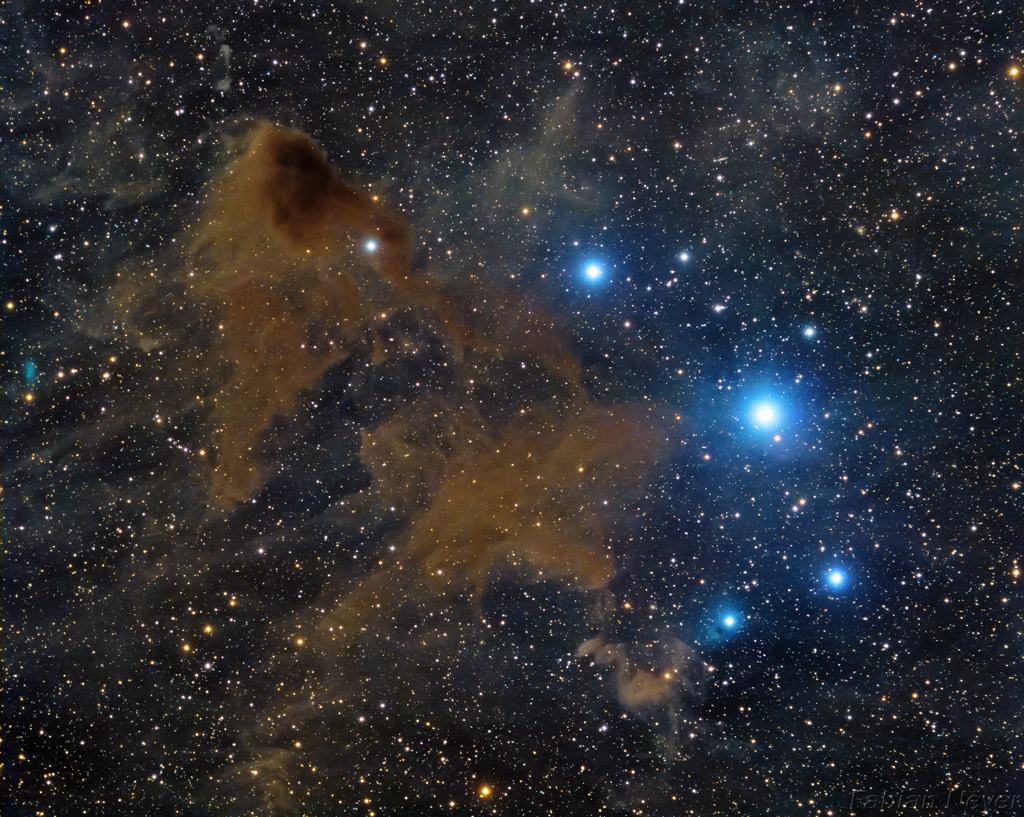
Beverly Lynds Dark Nebula 183 lies a mere 325 light-years away, drifting high above the plane of our Milky Way Galaxy. Obscuring the starlight behind it when viewed at optical wavelengths, the dark, dusty molecular cloud itself seems starless. But far infrared explorations reveal dense clumps within, likely stars in the early stages of formation as enhanced regions of the cloud undergo gravitational collapse. One of the closest molecular clouds, it is seen toward the constellation Serpens Caput. This sharp cosmic cloud portrait spans about half a degree on the sky. That's about 3 light-years at the estimated distance of Lynds Dark Nebula 183. via NASA http://ift.tt/2x9BMbW

Oct 19, 2017

M51: The Whirlpool Galaxy M51: The Whirlpool Galaxy


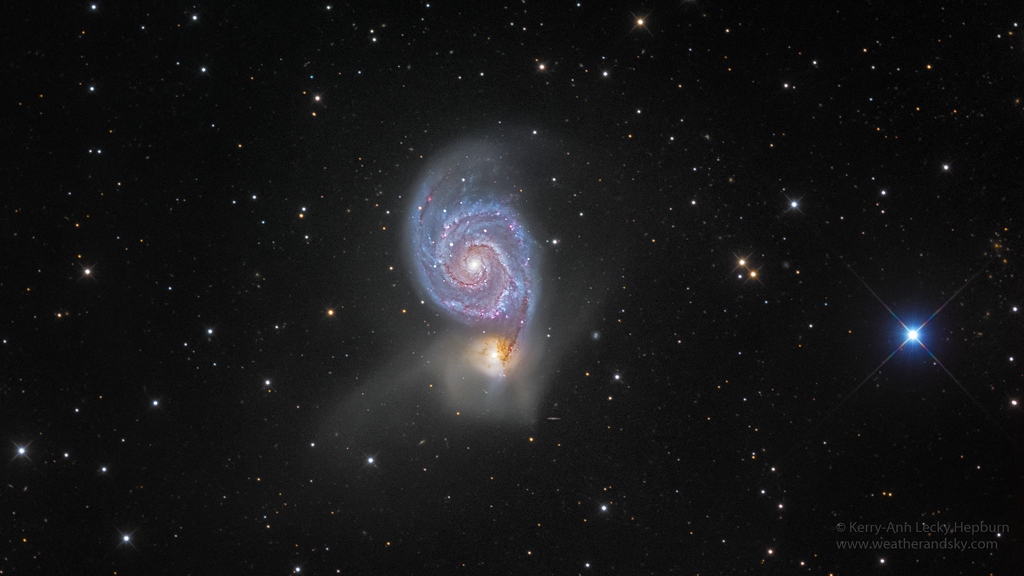
Find the Big Dipper and follow the handle away from the dipper's bowl until you get to the last bright star. Then, just slide your telescope a little south and west and you'll come upon this stunning pair of interacting galaxies, the 51st entry in Charles Messier's famous catalog. Perhaps the original spiral nebula, the large galaxy with well defined spiral structure is also cataloged as NGC 5194. Its spiral arms and dust lanes clearly sweep in front of its companion galaxy (bottom), NGC 5195. The pair are about 31 million light-years distant and officially lie within the angular boundaries of the small constellation Canes Venatici. Though M51 looks faint and fuzzy to the eye, deep images like this one can reveal striking colors and the faint tidal debris around the smaller galaxy via NASA http://ift.tt/2yQWhyI