Pages

Oct 15, 2017

On the Origin of Gold On the Origin of Gold


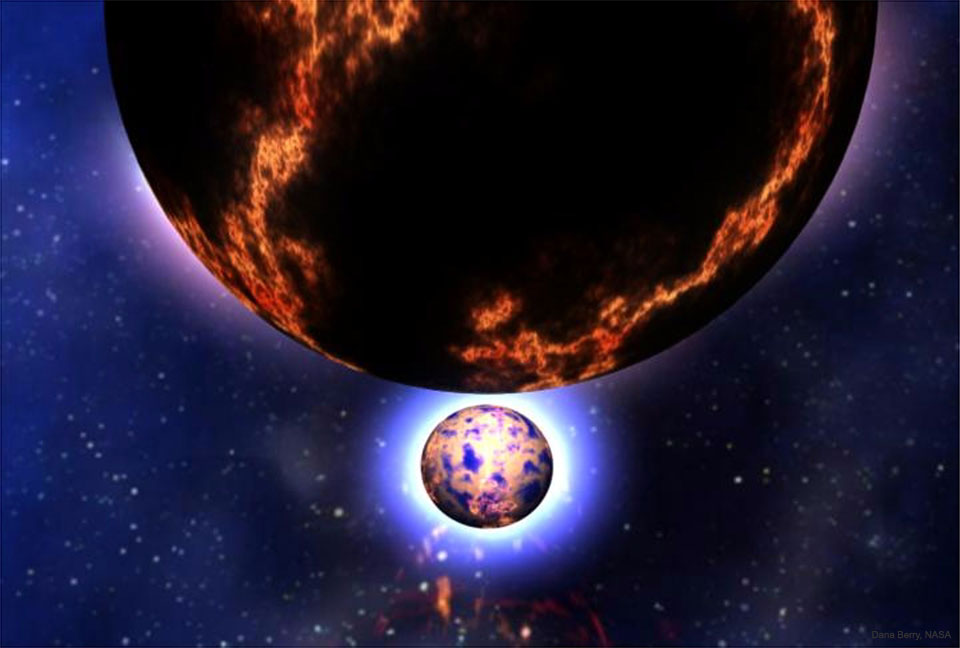
Where did the gold in your jewelry originate? No one is completely sure. The relative average abundance in our Solar System appears higher than can be made in the early universe, in stars, and even in typical supernova explosions. Some astronomers have suggested, and many believe, that neutron-rich heavy elements such as gold might be most easily made in rare neutron-rich explosions such as the collision of neutron stars. Pictured here is an artist's illustration depicting two neutron stars spiraling in toward each other, just before they collide. Since neutron star collisions are also suggested as the origin of short duration gamma-ray bursts, it is possible that you already own a souvenir from one of the most powerful explosions in the universe. via NASA http://ift.tt/2i98Z4L

Oct 14, 2017

All Sky Steve All Sky Steve


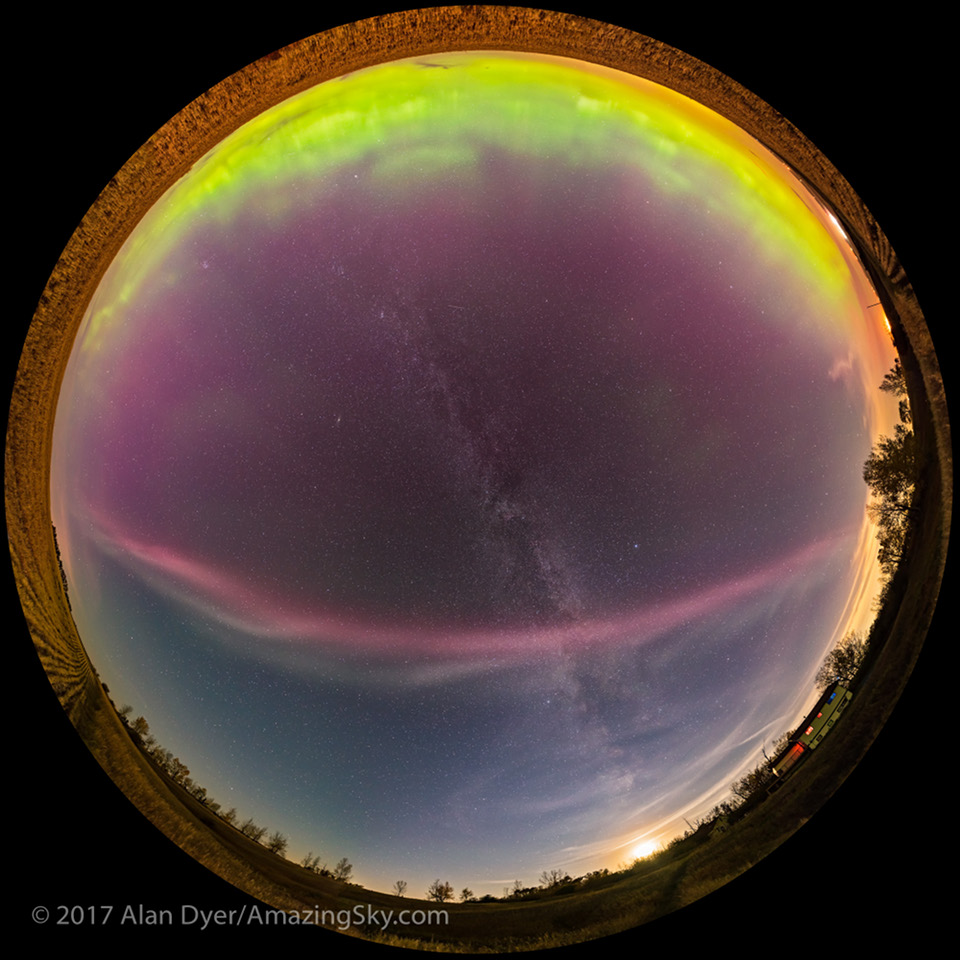
Familiar green and red tinted auroral emission floods the sky along the northern (top) horizon in this fish-eye panorama projection from September 27. On the mild, clear evening the Milky Way tracks through the zenith of a southern Alberta sky and ends where the six-day-old Moon sets in the southwest. The odd, isolated, pink and whitish arc across the south has come to be known as Steve. The name was given to the phenomenon by the Alberta Aurora Chasers Facebook group who had recorded appearances of the aurora-like feature. Sometimes mistakenly identified as a proton aurora or proton arc, the mysterious Steve arcs seem associated with aurorae but appear closer to the equator than the auroral curtains. Widely documented by citizen scientists and recently directly explored by a Swarm mission satellite, Steve arcs have been measured as thermal emission from flowing gas rather than emission excited by energetic electrons. Even though a reverse-engineered acronym that fits the originally friendly name is Sudden Thermal Emission from Velocity Enhancement, his origin is still mysterious. via NASA http://ift.tt/2ykOVlG

Oct 12, 2017

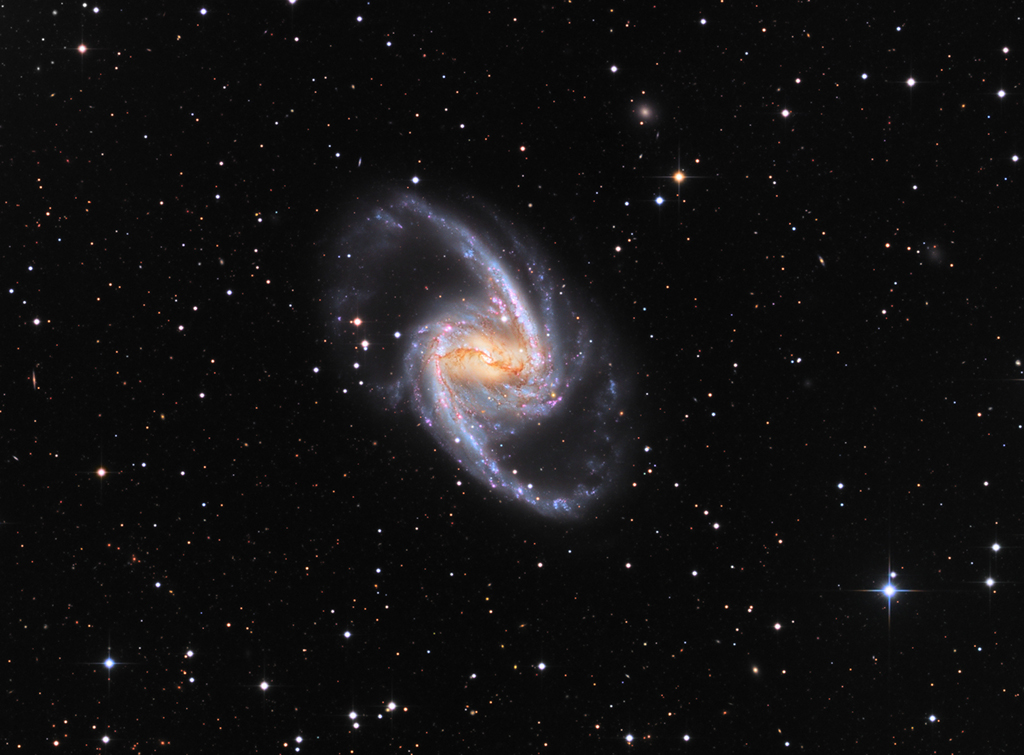
NGC 1365: Majestic Island Universe NGC 1365: Majestic Island Universe


Barred spiral galaxy NGC 1365 is truly a majestic island universe some 200,000 light-years across. Located a mere 60 million light-years away toward the chemical constellation Fornax, NGC 1365 is a dominant member of the well-studied Fornax galaxy cluster. This impressively sharp color image shows intense star forming regions at the ends of the bar and along the spiral arms, and details of dust lanes cutting across the galaxy's bright core. At the core lies a supermassive black hole. Astronomers think NGC 1365's prominent bar plays a crucial role in the galaxy's evolution, drawing gas and dust into a star-forming maelstrom and ultimately feeding material into the central black hole. via NASA http://ift.tt/2g120qf

Oct 11, 2017

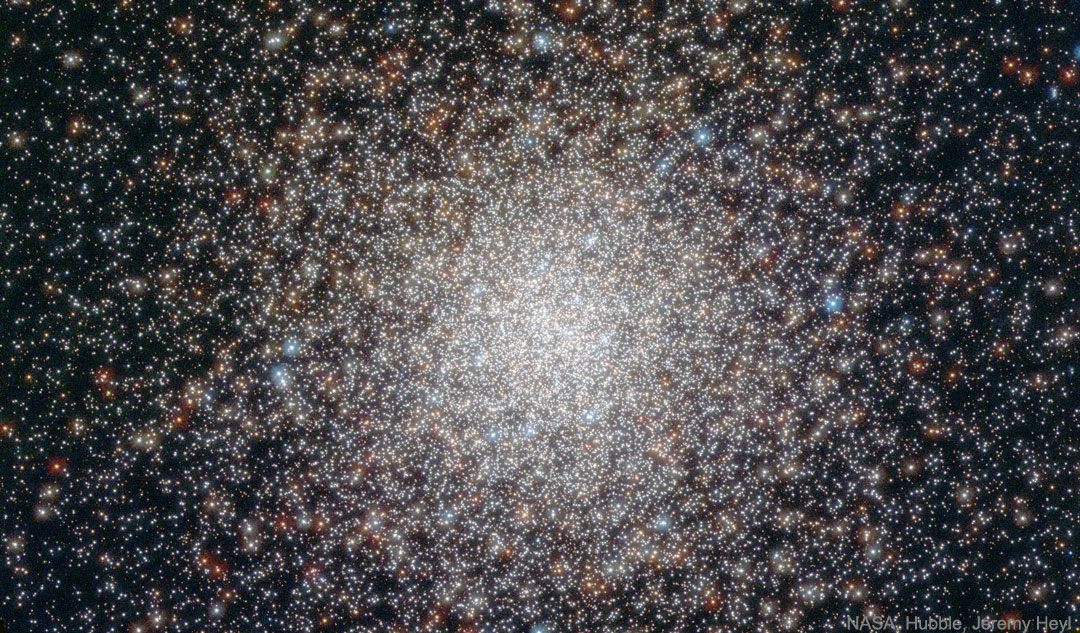
Star Cluster NGC 362 from Hubble Star Cluster NGC 362 from Hubble


If our Sun were near the center of NGC 362, the night sky would glow like a jewel box of bright stars. Hundreds of stars would glow brighter than Sirius, and in many different colors. Although these stars could become part of breathtaking constellations and intricate folklore, it would be difficult for planetary inhabitants there to see -- and hence understand -- the greater universe beyond. NGC 362 is one of only about 170 globular clusters of stars that exist in our Milky Way Galaxy. This star cluster is one of the younger globulars, forming likely well after our Galaxy. NGC 362 can be found with the unaided eye nearly in front of the Small Magellanic Cloud, and angularly close to the second brightest globular cluster known, 47 Tucanae. The featured image was taken with the Hubble Space Telescope to help better understand how massive stars end up near the center of some globular clusters. via NASA http://ift.tt/2zc33My

Oct 9, 2017

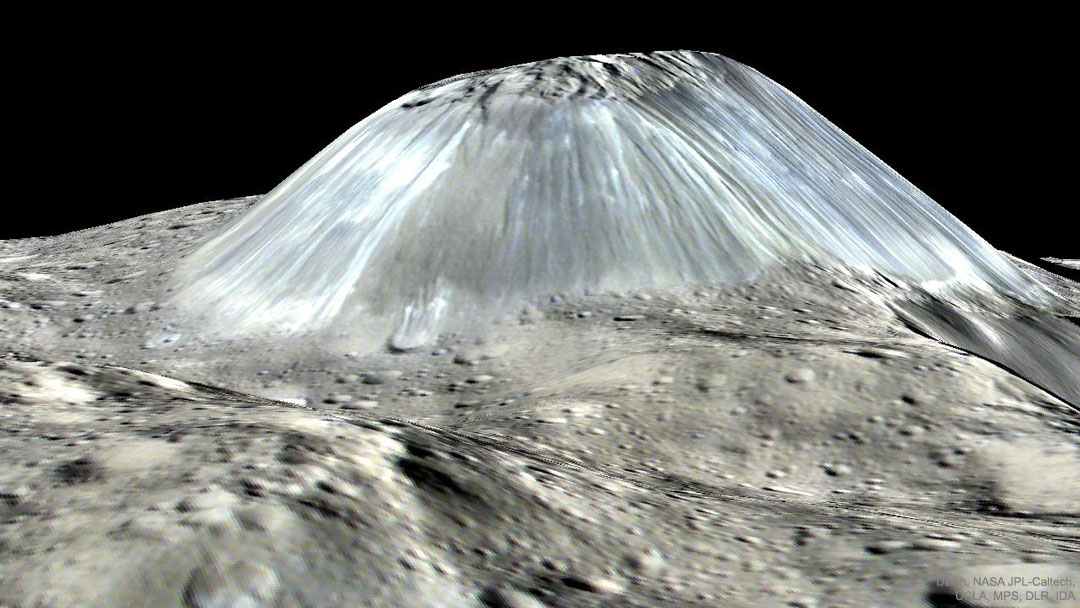
Unusual Mountain Ahuna Mons on Asteroid Ceres Unusual Mountain Ahuna Mons on Asteroid Ceres


What created this unusual mountain? Ahuna Mons is the largest mountain on the largest known asteroid in our Solar System, Ceres, which orbits our Sun in the main asteroid belt between Mars and Jupiter. Ahuna Mons, though, is like nothing that humanity has ever seen before. For one thing, its slopes are garnished not with old craters but young vertical streaks. One hypothesis holds that Ahuna Mons is an ice volcano that formed shortly after a large impact on the opposite side of the dwarf planet loosened up the terrain through focused seismic waves. The bright steaks may be high in reflective salt, and therefore similar to other recently surfaced material such as visible in Ceres' famous bright spots. The featured double-height digital image was constructed from surface maps taken of Ceres last year by the robotic Dawn mission. via NASA http://ift.tt/2y8JHtl

Oct 6, 2017

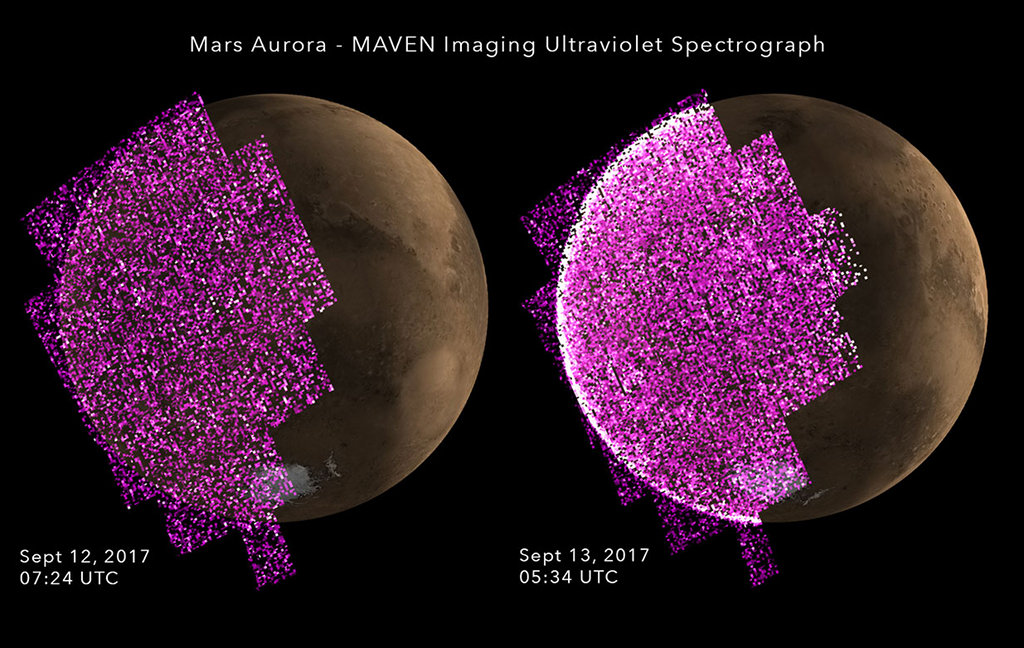
Global Aurora at Mars Global Aurora at Mars


A strong solar event last month triggered intense global aurora at Mars. Before (left) and during (right) the solar storm, these projections show the sudden increase in ultraviolet emission from martian aurora, more than 25 times brighter than auroral emission previously detected by the orbiting MAVEN spacecraft. With a sunlit crescent toward the right, data from MAVEN's ultraviolet imaging spectrograph is projected in purple hues on the night side of Mars globes simulated to match the observation dates and times. On Mars, solar storms can result in planet-wide aurora because, unlike Earth, the Red Planet isn't protected by a strong global magnetic field that can funnel energetic charged particles toward the poles. For all those on the planet's surface during the solar storm, dangerous radiation levels were double any previously measured by the Curiosity rover. MAVEN is studying whether Mars lost its atmosphere due to its lack of a global magnetic field. via NASA http://ift.tt/2fMTEm8

Oct 4, 2017

The Soul Nebula in Infrared from Herschel The Soul Nebula in Infrared from Herschel


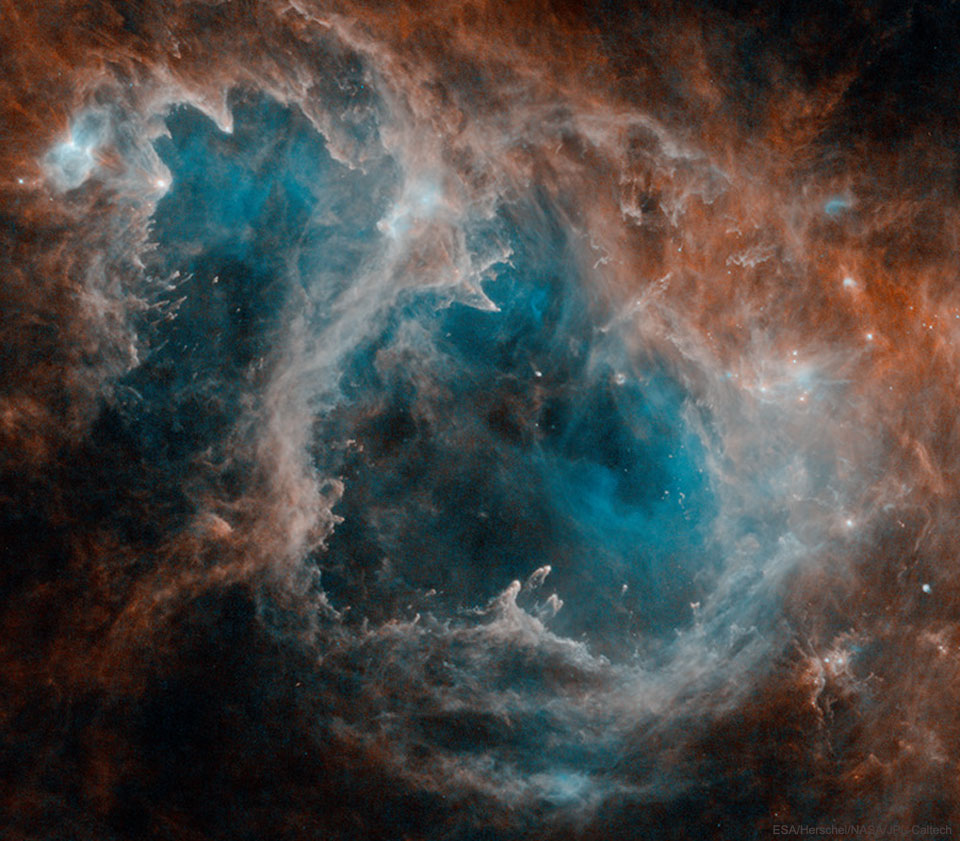
Stars are forming in the Soul of the Queen of Aethopia. More specifically, a large star forming region called the Soul Nebula can be found in the direction of the constellation Cassiopeia, who Greek mythology credits as the vain wife of a King who long ago ruled lands surrounding the upper Nile river. The Soul Nebula houses several open clusters of stars, a large radio source known as W5, and huge evacuated bubbles formed by the winds of young massive stars. Located about 6,500 light years away, the Soul Nebula spans about 100 light years and is usually imaged next to its celestial neighbor the Heart Nebula (IC 1805). The featured image, impressively detailed, was taken last month in several bands of infrared light by the orbiting Herschel Space Observatory. via NASA http://ift.tt/2xMXJBn

Oct 3, 2017

Ice Ring around Nearby Star Fomalhaut Ice Ring around Nearby Star Fomalhaut


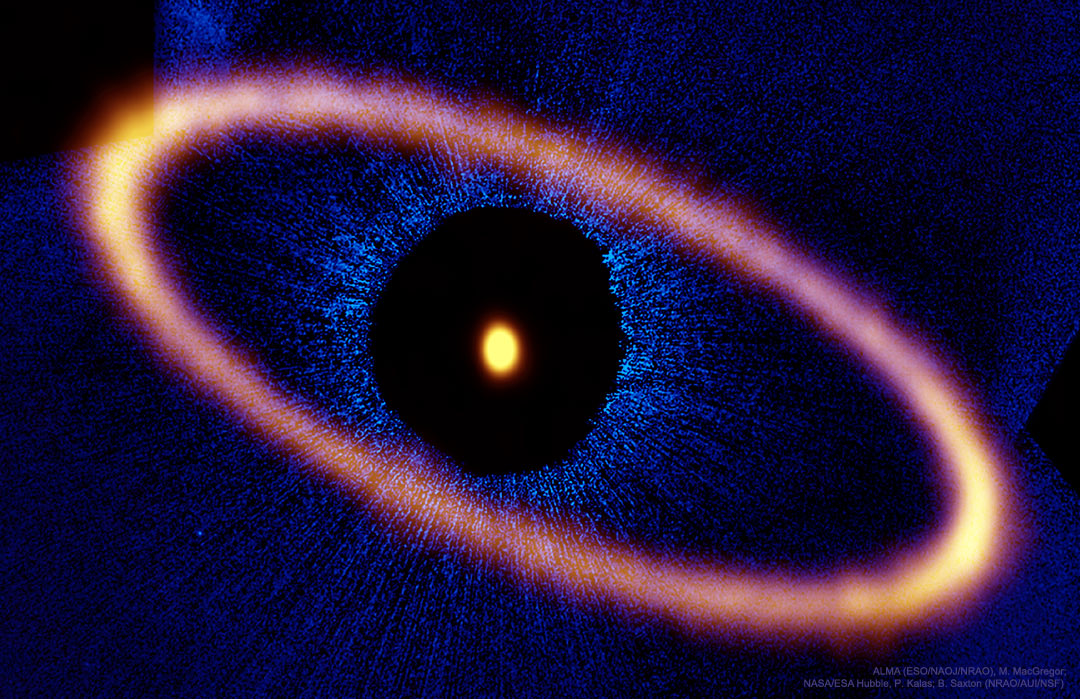
Why is there a large ice ring around Fomalhaut? This interesting star -- easily visible in the night sky -- lies only about 25 light-years away and is known to be orbited by at least one planet, Dagon, as well as several inner dust disks. More intriguing, perhaps, is an outer ring, first discovered about 20 years ago, that has an unusually sharp inner boundary. The featured recent image by the Atacama Large Millimeter Array (ALMA) shows this outer ring with complete and unprecedented detail -- in pink -- superposed on a Hubble image of the Fomalhaut system in blue. A leading theory holds that this ring resulted from numerous violent collisions involving icy comets and planetesimals, the component objects of planets, while the ring boundaries are caused by the gravity of yet unseen planets. If correct, any interior planets in the Fomalhaut system are likely being continually pelted by large meteors and comets -- an onslaught last seen in our own planetary system four billion years ago in an episode called the Late Heavy Bombardment. via NASA http://ift.tt/2kgOZO3

Oct 2, 2017

Two Comets and a Star Cluster Two Comets and a Star Cluster


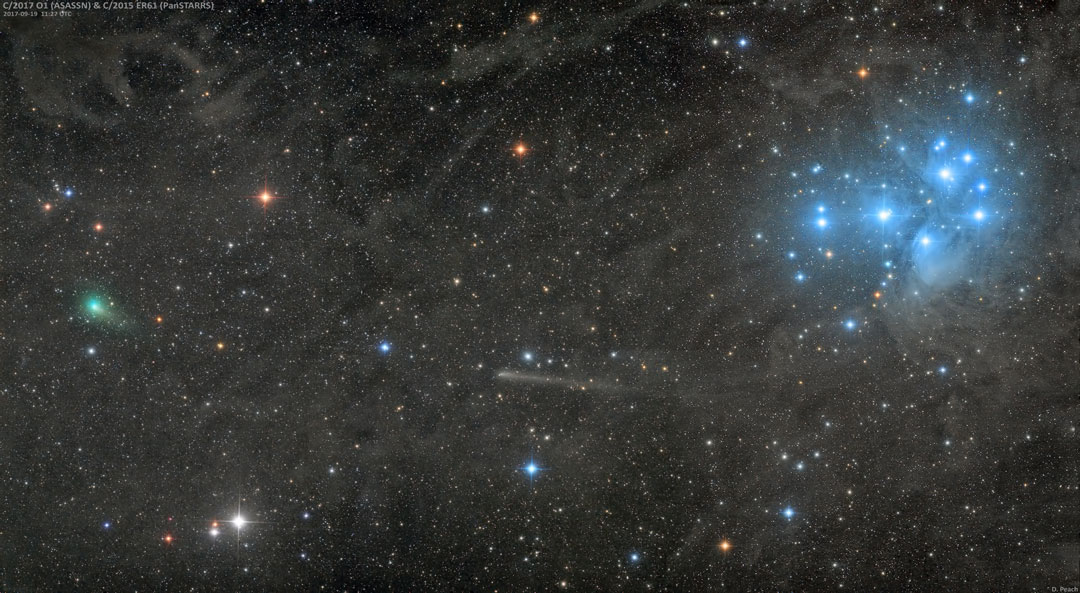
Two unusual spots are on the move near the famous Pleiades star cluster. Shifting only a small amount per night, these spots are actually comets in our nearby Solar System that by chance wandered into the field of the light-years distant stars. On the far left is comet C/2017 O1 ASAS-SN, a multi-kilometer block of evaporating ice sporting a bright coma of surrounding gas dominated by green-glowing carbon. Comet ASAS-SN1 shows a slight tail to its lower right. Near the frame center is comet C/2015 ER61 PanSTARRS, also a giant block of evaporating ice, but sporting a rather long tail to its right. On the upper right is the Pleiades, an open cluster dominated by bright blue stars illuminating nearby reflecting dust. This exposure, taken about two weeks ago, is so deep that the filamentary interstellar dust can be traced across the entire field. The Pleiades is visible to the unaided eye, but it should require binoculars to see the comets. via NASA http://ift.tt/2g1lL1o

Oct 1, 2017

Concept Plane: Supersonic Green Machine Concept Plane: Supersonic Green Machine


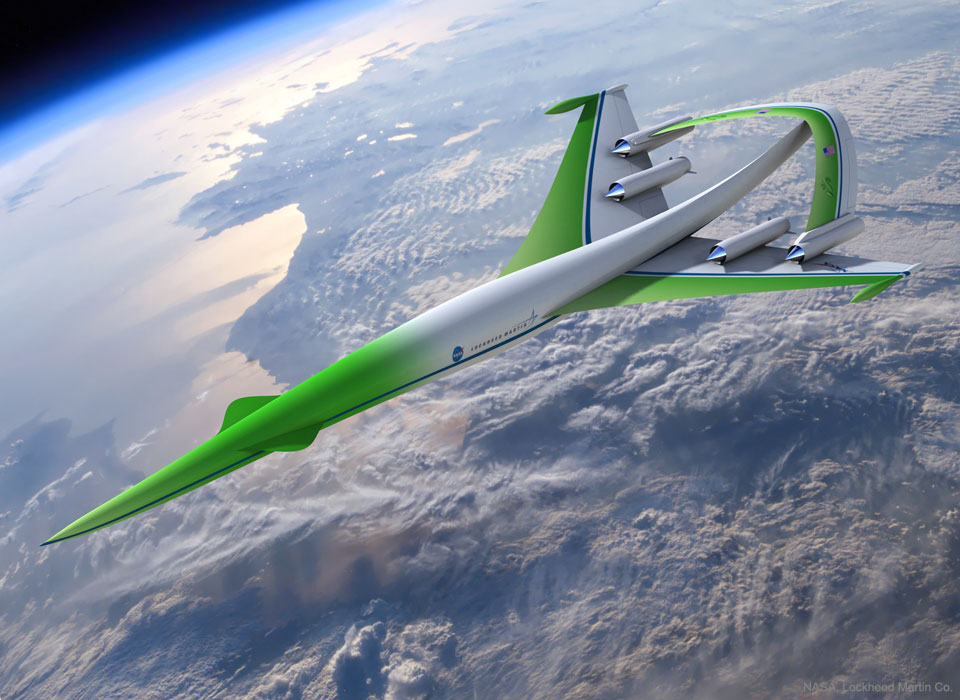
What will passenger airplanes be like in the future? To help brainstorm desirable and workable attributes, NASA sponsors design competitions. Shown here is an artist's depiction of a concept plane that was suggested in 2010. This futuristic plane would be expected to achieve supersonic speeds, possibly surpassing the speeds of the supersonic transport planes that ran commercially in the late twentieth century. In terms of noise reduction, the future aircraft has been drawn featuring an inverted V wing stretched over its engines. The structure is intended to reduce the sound from annoying sonic booms. Additionally, future airplanes would aim to have relatively little impact on our environment, including green limits on pollution and fuel consumption. Aircraft utilizing similar design concepts might well become operational by the 2030s. via NASA http://ift.tt/2x3UJfa