Pages

Mar 11, 2019

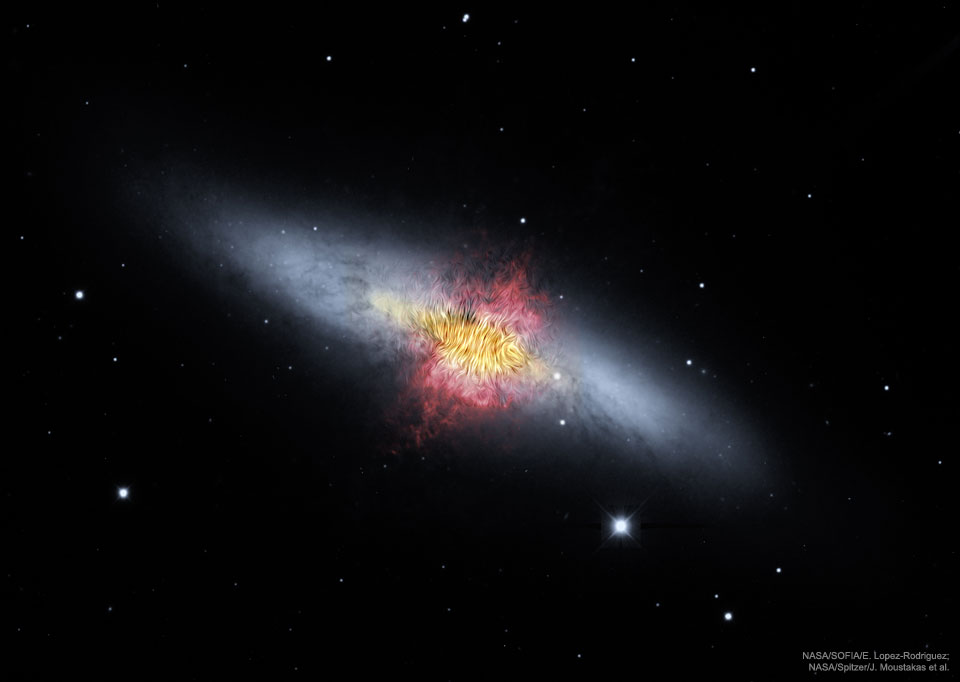
The Central Magnetic Field of the Cigar Galaxy The Central Magnetic Field of the Cigar Galaxy


Are galaxies giant magnets? Yes, but the magnetic fields in galaxies are typically much weaker than on Earth's surface, as well as more complex and harder to measure. Recently, though, the HAWC+ instrument onboard the airborne (747) SOFIA observatory has been successful in detailing distant magnetic fields by observing infrared light polarized by reflection from dust grains. Featured here, HAWC+ observations of the M82, the Cigar galaxy, show that the central magnetic field is perpendicular to the disk and parallel to the strong supergalactic wind. This observation bolsters the hypothesis that M82's central magnetic field helps its wind transport the mass of millions of stars out from the central star-burst region. The featured image shows magnetic field lines superposed on top of an optical light (gray) and hydrogen gas (red) image from Kitt Peak National Observatory, further combined with infrared images (yellow) from SOFIA and the Spitzer Space Telescope. The Cigar Galaxy is about 12 million light years distant and visible with binoculars towards the constellation of the Great Bear. via NASA https://ift.tt/2XJQC6R

Mar 10, 2019

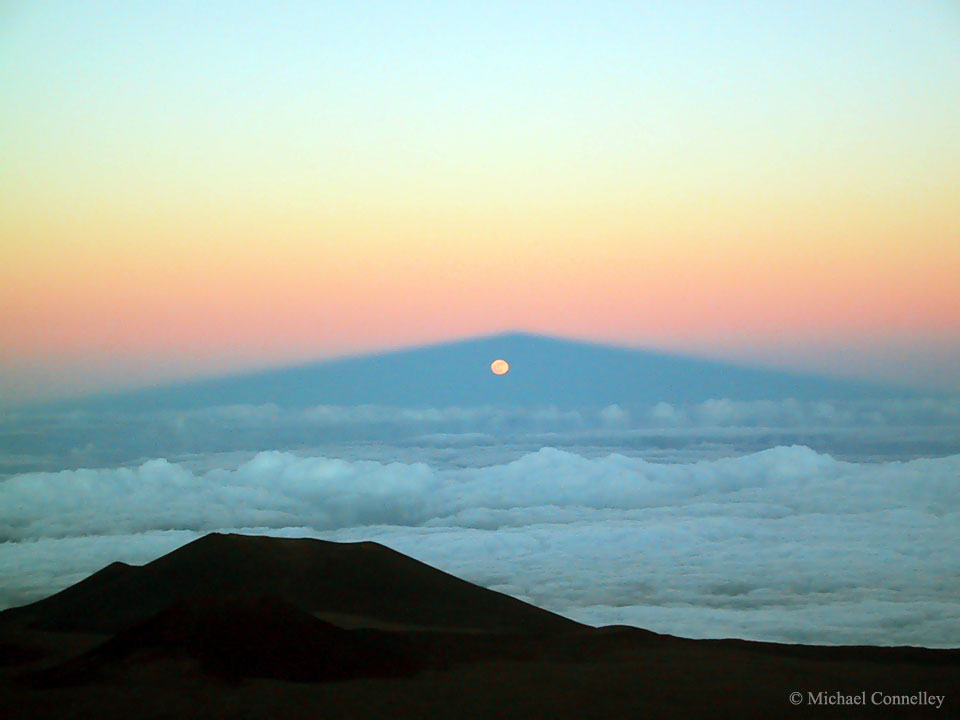
Moonrise Through Mauna Keas Shadow Moonrise Through Mauna Keas Shadow


How can the Moon rise through a mountain? It cannot -- what was photographed here is a moonrise through the shadow of a large volcano. The volcano is Mauna Kea, Hawai'i, USA, a frequent spot for spectacular photographs since it is one of the premier observing locations on planet Earth. The Sun has just set in the opposite direction, behind the camera. Additionally, the Moon has just passed full phase -- were it precisely at full phase it would rise, possibly eclipsed, at the very peak of the shadow. The Moon is actually rising in the triangular shadow cone of the volcano, a corridor of darkness that tapers off in the distance like converging train tracks. The Moon is too large and too far away to be affected by the shadow of the volcano. Refraction of moonlight through the Earth's atmosphere makes the Moon appear slightly oval. Cinder cones from old volcanic eruptions are visible in the foreground. via NASA https://ift.tt/2EYUEkq

Mar 9, 2019

Crescent Enceladus Crescent Enceladus


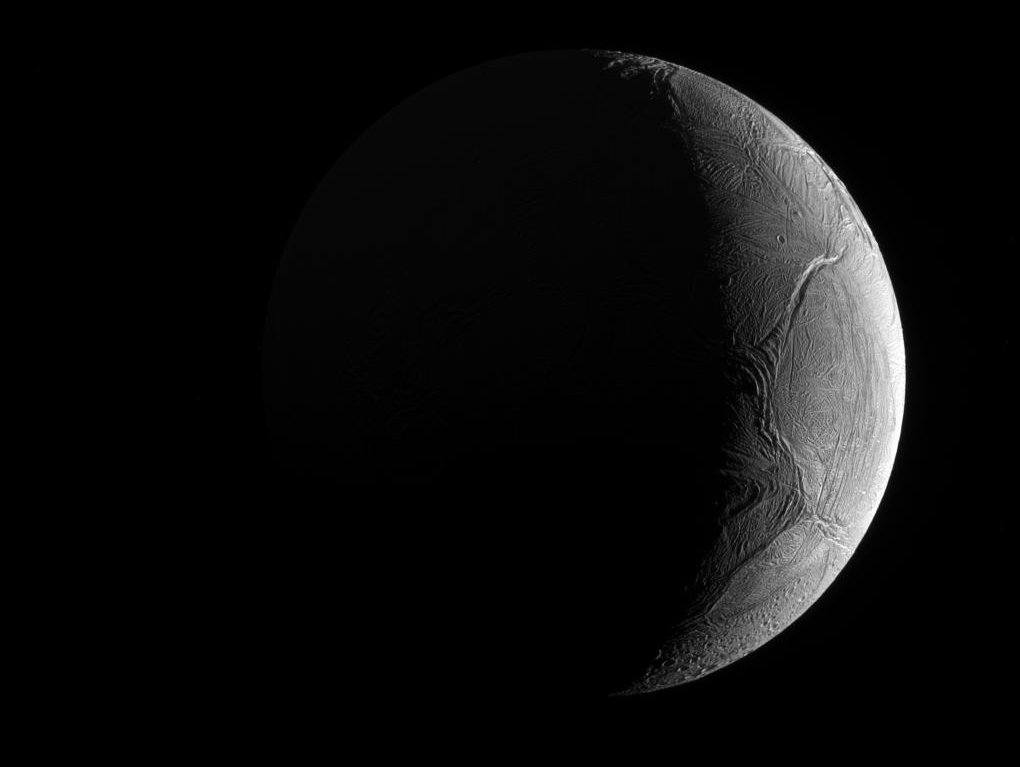
Peering from the shadows, the Saturn-facing hemisphere of tantalizing inner moon Enceladus poses in this Cassini spacecraft image. North is up in the dramatic scene captured during November 2016 as Cassini's camera was pointed in a nearly sunward direction about 130,000 kilometers from the moon's bright crescent. In fact, the distant world reflects over 90 percent of the sunlight it receives, giving its surface about the same reflectivity as fresh snow. A mere 500 kilometers in diameter, Enceladus is a surprisingly active moon. Data collected during Cassini's flybys and years of images have revealed the presence of remarkable south polar geysers and a possible global ocean of liquid water beneath an icy crust. via NASA https://ift.tt/2VO0QBf

Mar 8, 2019

Stardust and Starlight in M78 Stardust and Starlight in M78


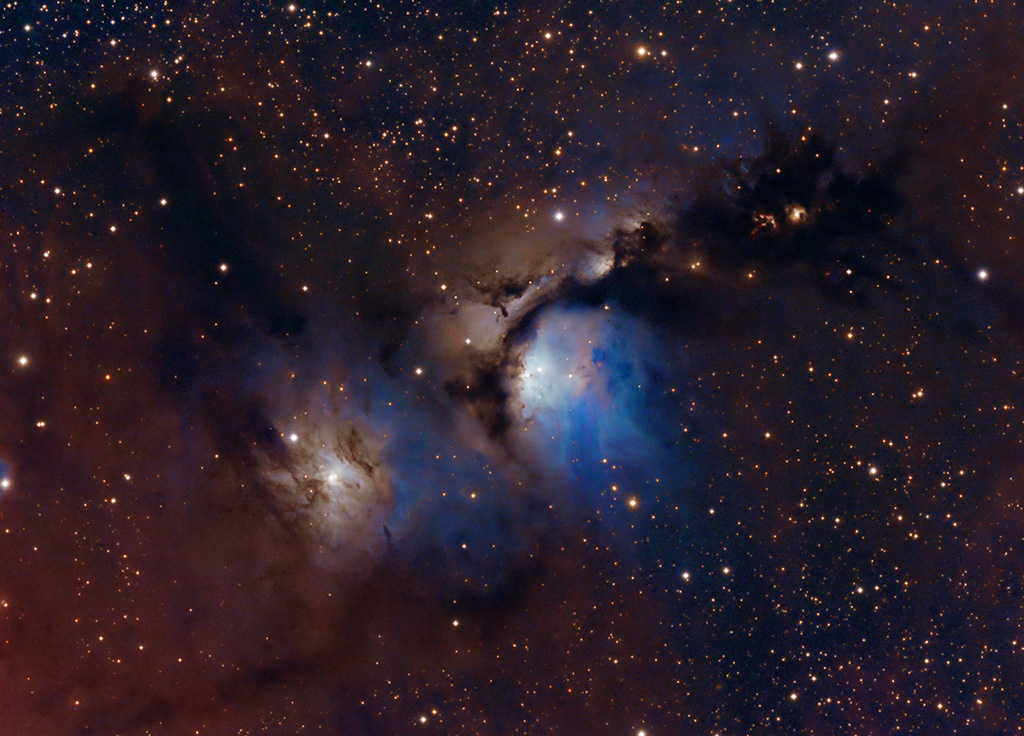
Interstellar dust clouds and bright nebulae abound in the fertile constellation of Orion. One of the brightest, M78, is near the center in this colorful telescopic view, covering an area north of Orion's belt. At a distance of about 1,500 light-years, the bluish nebula itself is about 5 light-years across. Its blue tint is due to dust preferentially reflecting the blue light of hot, young stars in the region. Dark dust lanes and other nebulae can easily be traced through the gorgeous skyscape that includes many Herbig- Haro objects, energetic jets from stars in the process of formation. But missing from this image is McNeil's nebula. A major discovery only recognized in 2004, the enigmatic, variable nebula was found along the dark lane of dust above and right of larger M78. McNeil's nebula is associated with a protostar and seen to be sometimes present and sometimes absent in photos of the well-imaged region. McNeil's nebula faded from view late last year and is still absent in this deep image recorded in February 2019. via NASA https://ift.tt/2IXW96r

Mar 7, 2019

Sharpless 249 and the Jellyfish Nebula Sharpless 249 and the Jellyfish Nebula


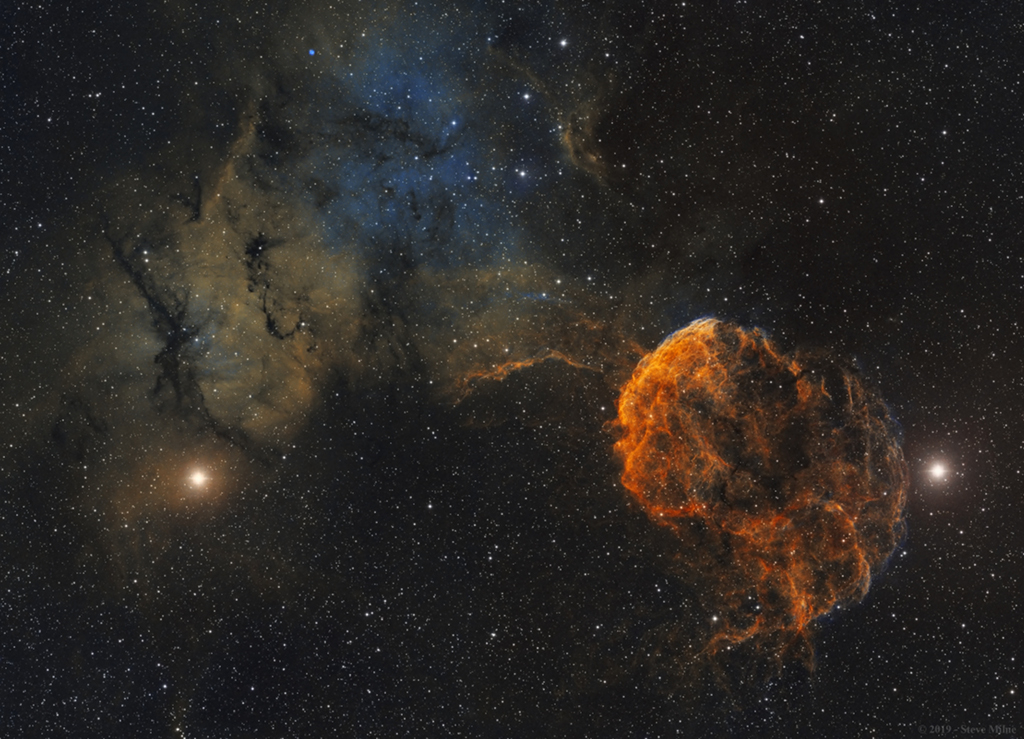
Normally faint and elusive, the Jellyfish Nebula is caught in this alluring telescopic field of view. The entire scene is a two panel mosaic constructed using narrowband image data, with emission from sulfur, hydrogen and oxygen atoms shown in red, green and blue hues. It's anchored right and left by two bright stars, Mu and Eta Geminorum, at the foot of the celestial twin. The Jellyfish Nebula itself is right of center, the brighter arcing ridge of emission with dangling tentacles. In fact, the cosmic jellyfish is part of bubble-shaped supernova remnant IC 443, the expanding debris cloud from a massive star that exploded. Light from the explosion first reached planet Earth over 30,000 years ago. Like its cousin in astrophysical waters the Crab Nebula supernova remnant, the Jellyfish Nebula is known to harbor a neutron star, the remnant of the collapsed stellar core. An emission nebula cataloged as Sharpless 249 fills the field at the upper left. The Jellyfish Nebula is about 5,000 light-years away. At that distance, this image would be about 300 light-years across. via NASA https://apod.nasa.gov/apod/ap190307.html

Mar 6, 2019

A February without Sunpots A February without Sunpots


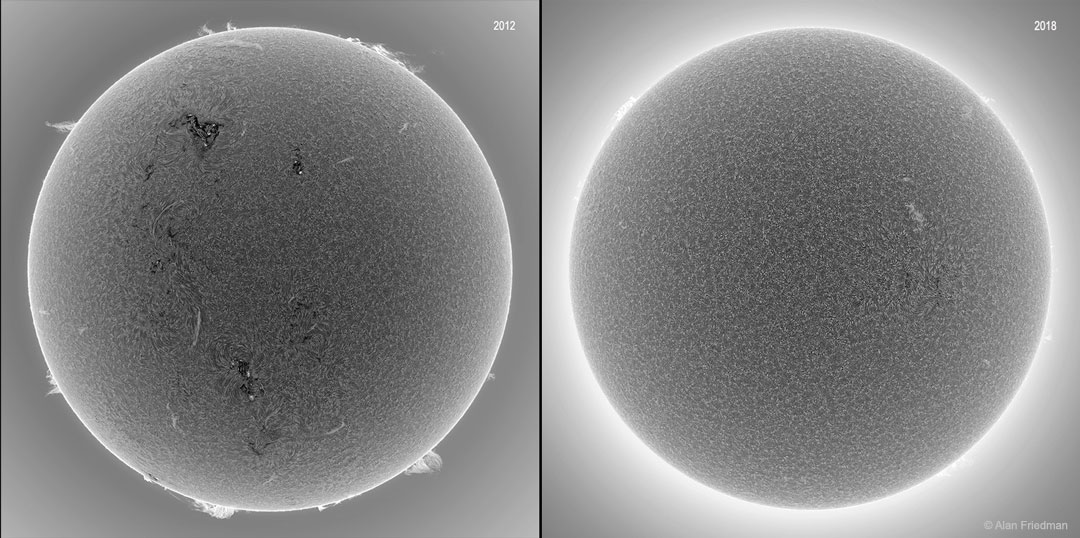
Where have all the sunspots gone? Last month the total number of spots that crossed our Sun was ... zero. Well below of the long term monthly average, the Sun's surface has become as unusually passive this solar minimum just like it did 11 years ago during the last solar minimum. Such passivity is not just a visual spectacle, it correlates with the Sun being slightly dimmer, with holes in the Sun's corona being more stable, and with a reduced intensity in the outflowing solar wind. The reduced wind, in turn, cools and collapses Earth's outer atmosphere (the thermosphere), causing reduced drag on many Earth-orbiting satellites. Pictured in inverted black & white on the left, the Sun's busy surface is shown near solar maximum in 2012, in contrast to the image on the right, which shows the Sun's surface last August, already without spots (for a few days), as solar minimum was setting in. Effects of this unusually static solar minimum are being studied. via NASA https://ift.tt/2NOqUcQ

Mar 5, 2019

X Ray Superbubbles in Galaxy NGC 3079 X Ray Superbubbles in Galaxy NGC 3079


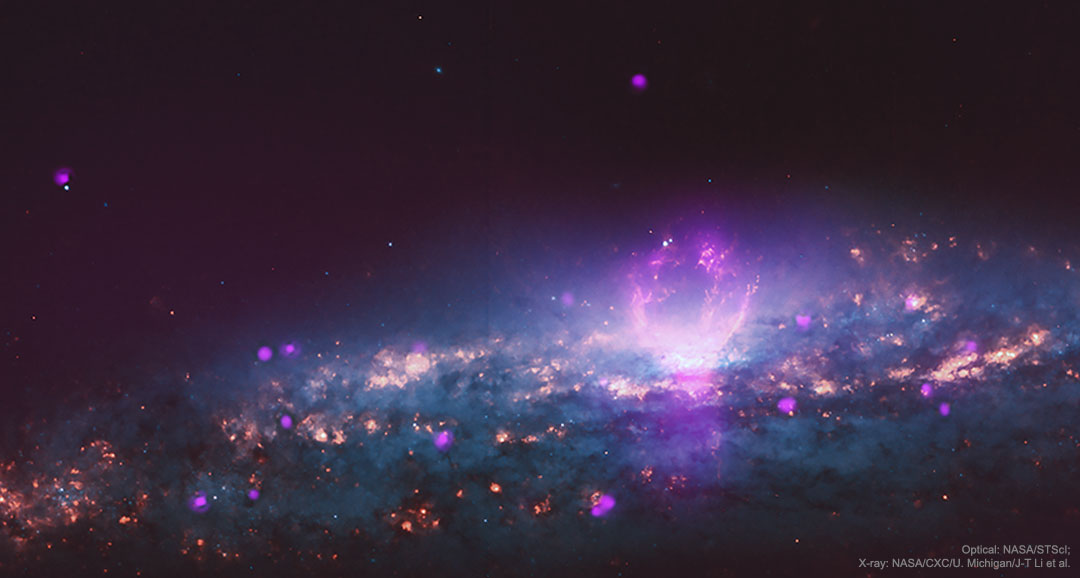
What created these huge galactic superbubbles? Two of these unusual bubbles, each spanning thousands of light-years, were recently discovered near the center of spiral galaxy NGC 3079. The superbubbles, shown in purple on the image right, are so hot they emit X-rays detected by NASA's Earth-orbiting Chandra X-Ray Observatory. Since the bubbles straddle the center of NGC 3079, a leading hypothesis is that they were somehow created by the interaction of the central supermassive black hole with surrounding gas. Alternatively, the superbubbles might have been created primarily by the energetic winds from many young and hot stars near that galaxy's center. The only similar known phenomenon is the gamma-ray emitting Fermi bubbles emanating from the center of our Milky Way Galaxy, discovered 10 years ago in images taken by NASA's Fermi satellite. Research into the nature of the NGC 3079 superbubbles will surely continue, as well as searches for high-energy superbubbles in other galaxies. via NASA https://ift.tt/2IQwmNy

Mar 3, 2019

The Orion Bullets The Orion Bullets


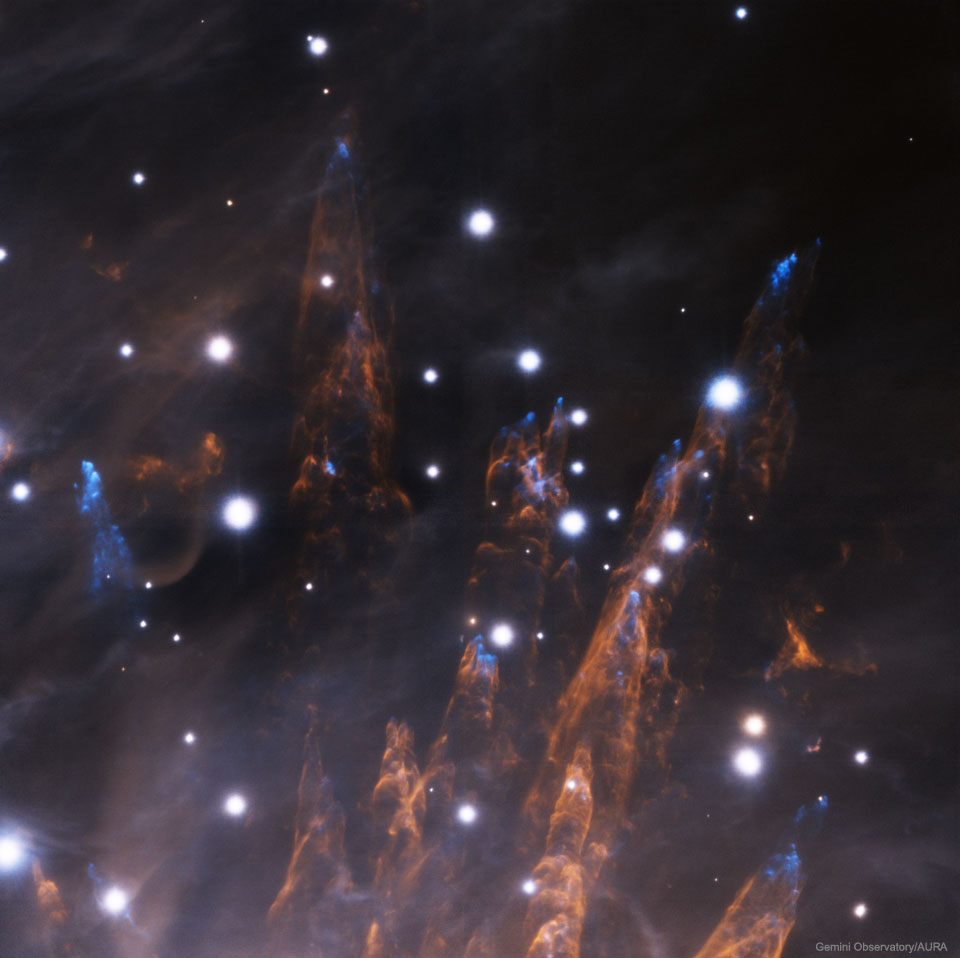
Why are bullets of gas shooting out of the Orion Nebula? Nobody is yet sure. First discovered in 1983, each bullet is actually about the size of our Solar System, and moving at about 400 km/sec from a central source dubbed IRc2. The age of the bullets, which can be found from their speed and distance from IRc2, is very young -- typically less than 1,000 years. As the bullets expand out the top of the Kleinmann-Low section of the Orion Nebula, a small percentage of iron gas causes the tip of each bullet to glow blue, while each bullet leaves a tubular pillar that glows by the light of heated hydrogen gas. The detailed image was created using the 8.1 meter Gemini South telescope in Chile with an adaptive optics system (GeMS). GeMS uses five laser generated guide stars to help compensate for the blurring effects of planet Earth's atmosphere. via NASA https://ift.tt/2VwwqDm

Mar 2, 2019

NGC 6302: The Butterfly Nebula NGC 6302: The Butterfly Nebula


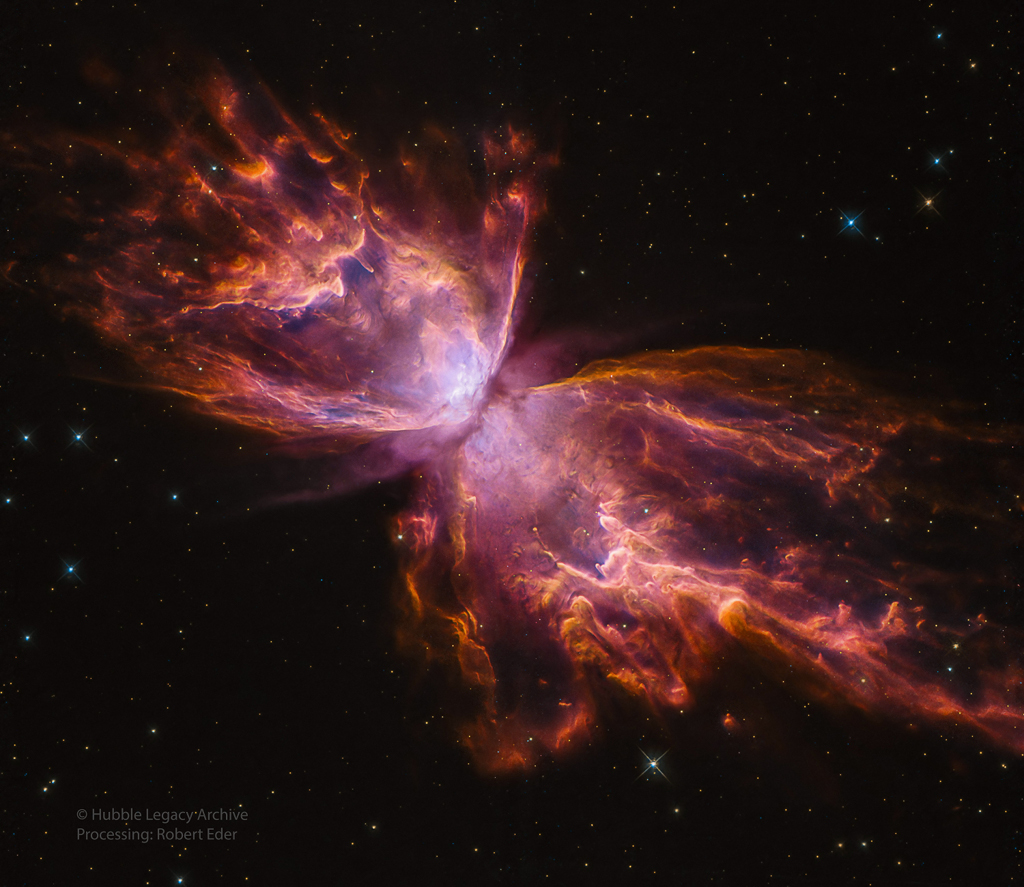
The bright clusters and nebulae of planet Earth's night sky are often named for flowers or insects. Though its wingspan covers over 3 light-years, NGC 6302 is no exception. With an estimated surface temperature of about 250,000 degrees C, the dying central star of this particular planetary nebula has become exceptionally hot, shining brightly in ultraviolet light but hidden from direct view by a dense torus of dust. This sharp close-up was recorded by the Hubble Space Telescope in 2009. The Hubble image data is reprocessed here, showing off the remarkable details of the complex planetary nebula. Cutting across a bright cavity of ionized gas, the dust torus surrounding the central star is near the center of this view, almost edge-on to the line-of-sight. Molecular hydrogen has been detected in the hot star's dusty cosmic shroud. NGC 6302 lies about 4,000 light-years away in the arachnologically correct constellation of the Scorpion (Scorpius). via NASA https://ift.tt/2NK2cdH

Feb 28, 2019

Sharpest Ultima Thule Sharpest Ultima Thule


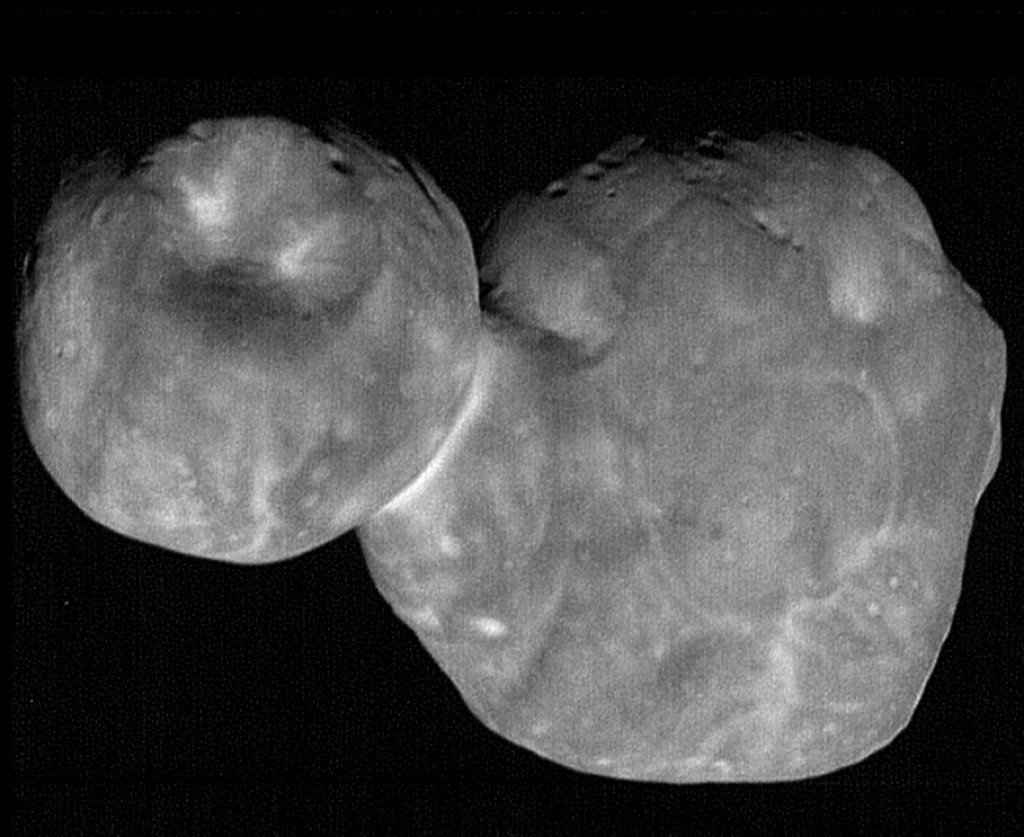
On January 1, New Horizons swooped to within 3,500 kilometers of the Kuiper Belt world known as Ultima Thule. That's about 3 times closer than its July 2015 closest approach to Pluto. The spacecraft's unprecedented feat of navigational precision, supported by data from ground and space-based observing campaigns, was accomplished 6.6 billion kilometers (over 6 light-hours) from planet Earth. Six and a half minutes before closest approach to Ultima Thule it captured the nine frames used in this composite image. The most detailed picture possible of the farthest object ever explored, the image has a resolution of about 33 meters per pixel, revealing intriguing bright surface features and dark shadows near the terminator. A primitive Solar System object, Ultima Thule's two lobes combine to span just 30 kilometers. The larger lobe, referred to as Ultima, is recently understood to be flattened like a fluffy pancake, while the smaller, Thule, has a shape that resembles a dented walnut. via NASA https://ift.tt/2UjlMQ4