Pages

Jan 26, 2018

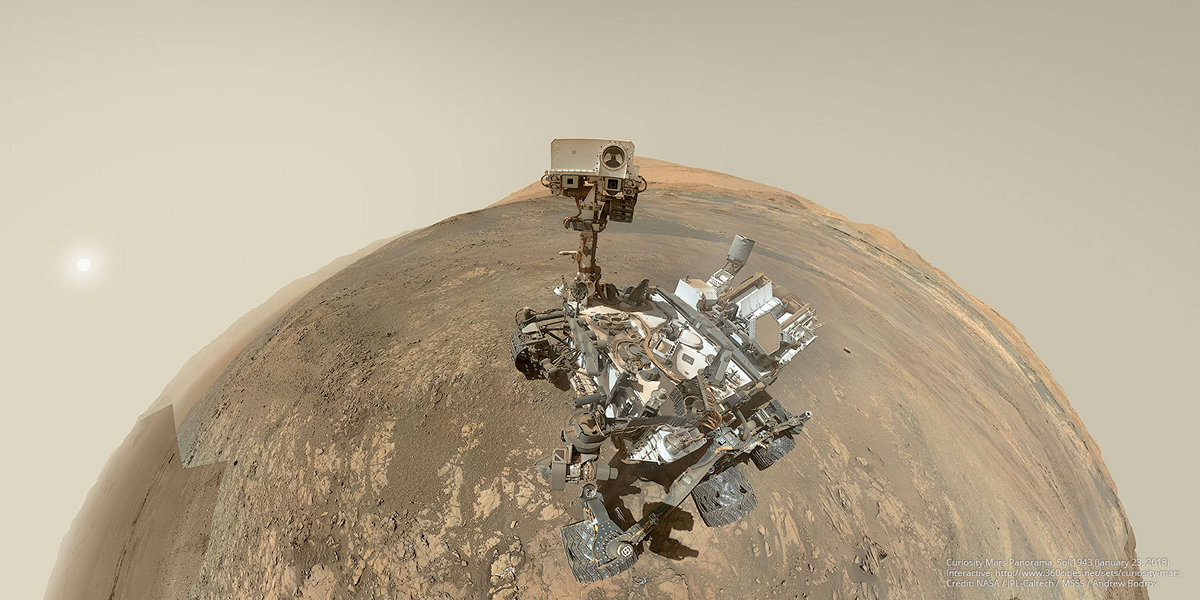
Selfie at Vera Rubin Ridge Selfie at Vera Rubin Ridge


On sol 1943 of its journey of exploration across the surface of Mars, the Curiosity Rover recorded this selfie at the south rim of Vera Rubin Ridge. Of course a sol is a Martian solar day, about 40 minutes longer than an Earth day. Curiosity's sol 1943 corresponds to Earth date January 23, 2018. Also composed as an interactive 360 degree VR, the mosaicked panorama combines 61 exposures taken by the car-sized rover's Mars Hand Lens Imager (MAHLI). Frames containing the imager's arm have been edited out while the extended background used was taken by the rover's Mastcam on sol 1903. At the top of the rover's mast, sitting above the Mastcam, the laser-firing ChemCam housing blocks out the distant peak of Mount Sharp. via NASA http://ift.tt/2EbPy23

Jan 25, 2018

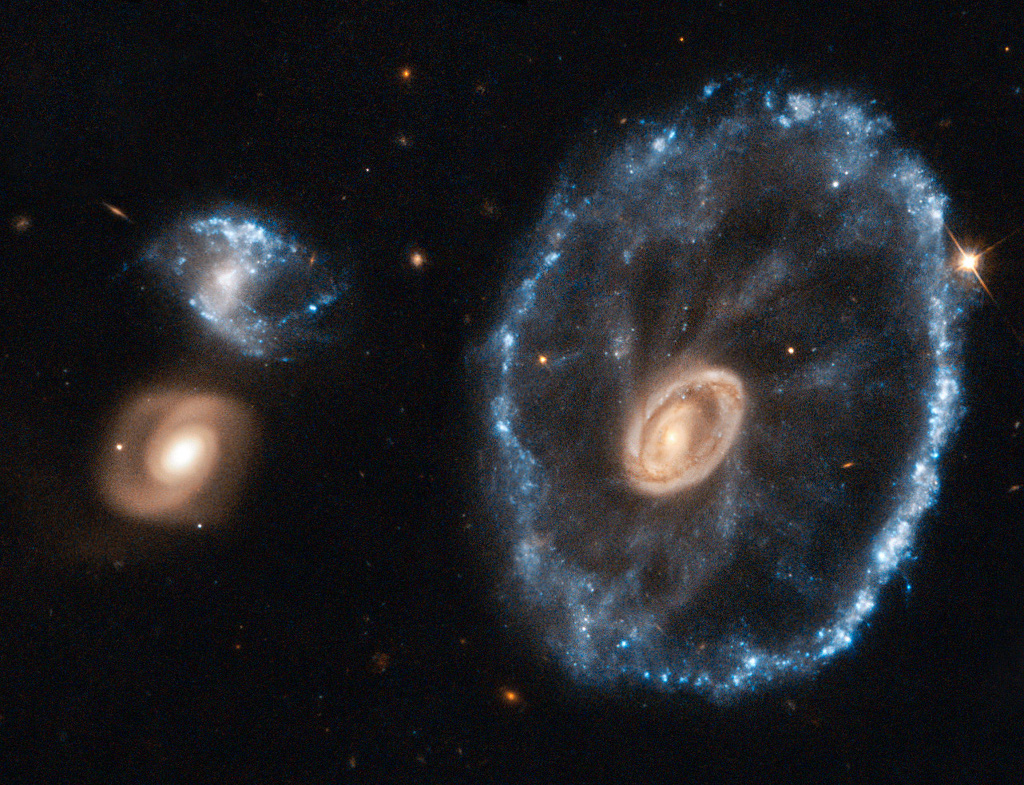
Cartwheel of Fortune Cartwheel of Fortune


By chance, a collision of two galaxies has created a surprisingly recognizable shape on a cosmic scale, The Cartwheel Galaxy. The Cartwheel is part of a group of galaxies about 500 million light years away in the constellation Sculptor. Two smaller galaxies in the group are visible on the right. The Cartwheel Galaxy's rim is an immense ring-like structure 150,000 light years in diameter composed of newly formed, extremely bright, massive stars. When galaxies collide they pass through each other, their individual stars rarely coming into contact. Still, the galaxies' gravitational fields are seriously distorted by the collision. In fact, the ring-like shape is the result of the gravitational disruption caused by a small intruder galaxy passing through a large one, compressing the interstellar gas and dust and causing a a star formation wave to move out from the impact point like a ripple across the surface of a pond. In this case the large galaxy may have originally been a spiral, not unlike our own Milky Way, transformed into the wheel shape by the collision. But ... what happened to the small intruder galaxy? via NASA http://ift.tt/2DB4lGF

Jan 23, 2018

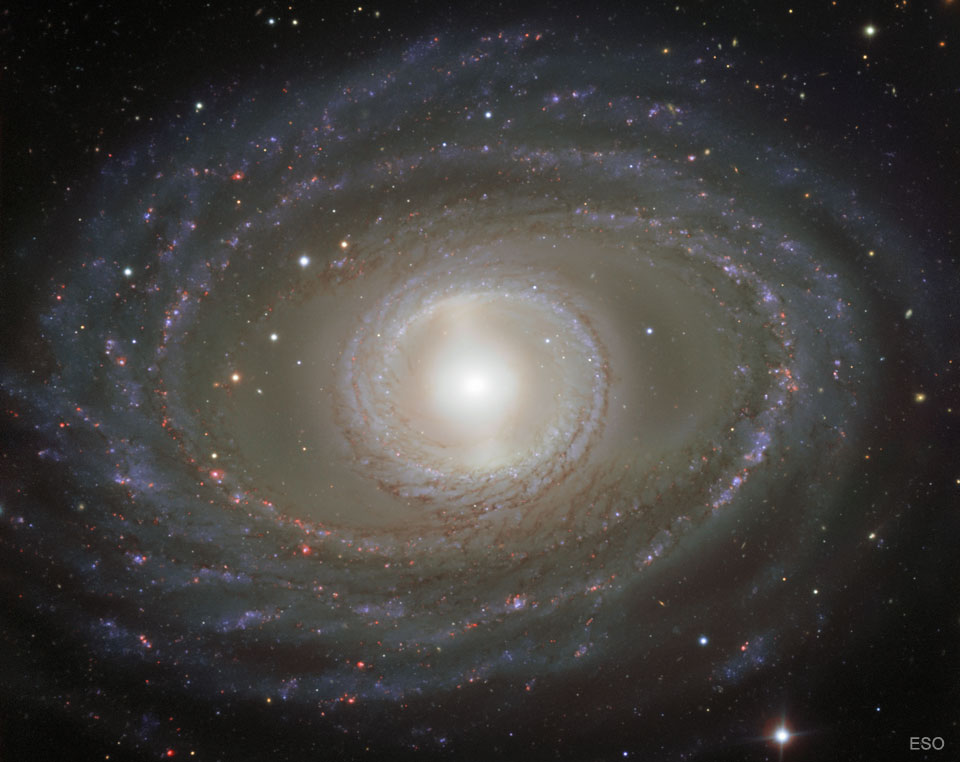
Ribbons and Pearls of Spiral Galaxy NGC 1398 Ribbons and Pearls of Spiral Galaxy NGC 1398


Why do some spiral galaxies have a ring around the center? Spiral galaxy NGC 1398 not only has a ring of pearly stars, gas and dust around its center, but a bar of stars and gas across its center, and spiral arms that appear like ribbons farther out. The featured image was taken with ESO's Very Large Telescope at the Paranal Observatory in Chile and resolves this grand spiral in impressive detail. NGC 1398 lies about 65 million light years distant, meaning the light we see today left this galaxy when dinosaurs were disappearing from the Earth. The photogenic galaxy is visible with a small telescope toward the constellation of the Furnace (Fornax). The ring near the center is likely an expanding density wave of star formation, caused either by a gravitational encounter with another galaxy, or by the galaxy's own gravitational asymmetries. via NASA http://ift.tt/2G3GXiy

Jan 22, 2018

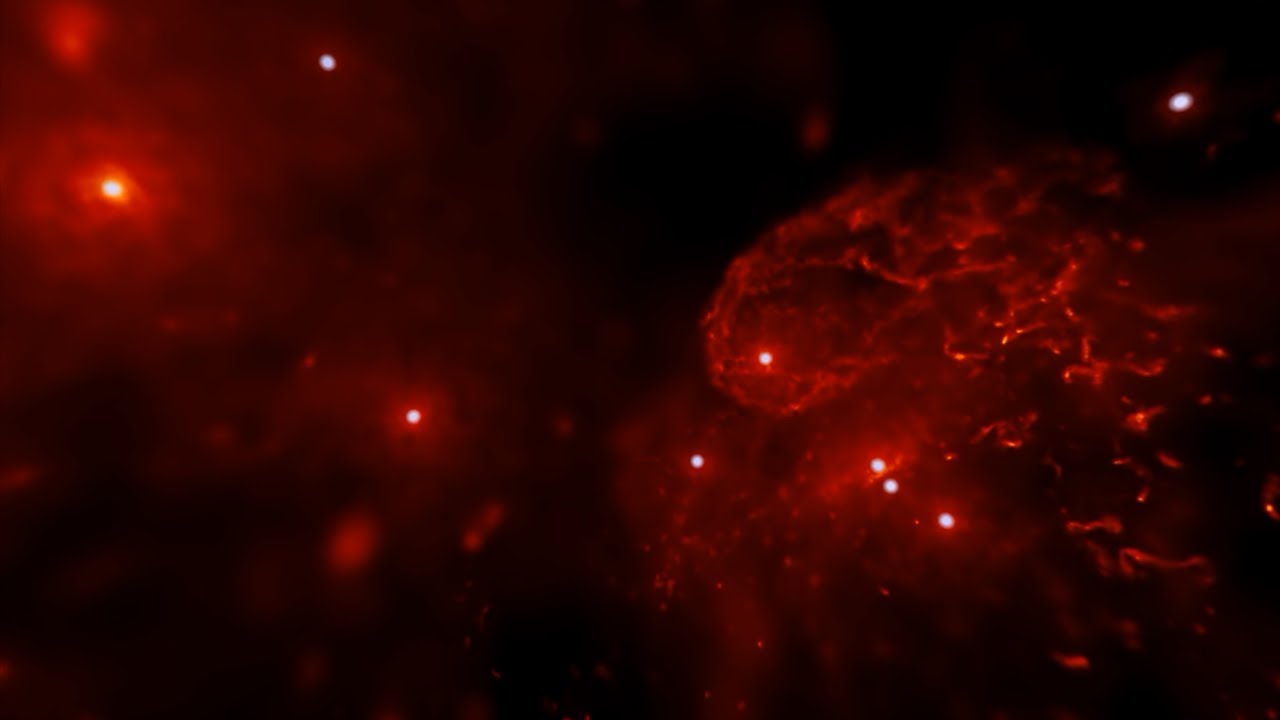
An Immersive Visualization of the Galactic Center An Immersive Visualization of the Galactic Center


What if you could look out from the center of our Galaxy -- what might you see? Two scientifically-determined possibilities are shown in the featured video, an immersive 360-degree view which allows you to look around in every direction. The pictured computer simulation is based on infrared data from ESO's Very Large Telescope in Chile and X-ray data from NASA's orbiting Chandra X-ray Observatory. As the video starts, you quickly approach Sgr A*, the supermassive black hole in the Galactic center. Then looking out, this 500-year time-lapse simulation shows glowing gas and many points of light orbiting all around you. Many of these points are young Wolf-Rayet stars that have visible hot winds blowing out into surrounding nebulas. Clouds approaching close become elongated, while objects approaching too close fall in. Toward the video's end the simulation repeats, but this time with the dynamic region surrounding Sgr A* expelling hot gas that pushes back against approaching material. via NASA http://ift.tt/2BhIheh

Jan 21, 2018

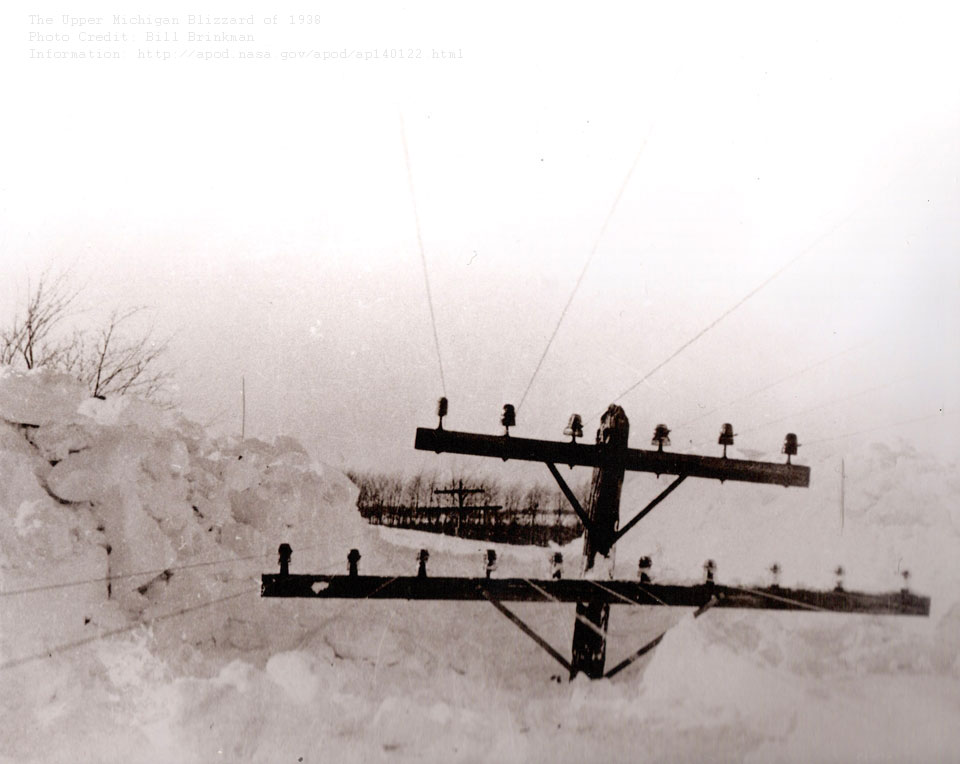
The Upper Michigan Blizzard of 1938 The Upper Michigan Blizzard of 1938


Yes, but can your blizzard do this? In Upper Michigan's Storm of the Century in 1938, some snow drifts reached the level of utility poles. Nearly a meter of new and unexpected snow fell over two days in a storm that started 80 years ago this week. As snow fell and gale-force winds piled snow to surreal heights; many roads became not only impassable but unplowable; people became stranded; cars, school buses and a train became mired; and even a dangerous fire raged. Fortunately only two people were killed, although some students were forced to spend several consecutive days at school. The featured image was taken by a local resident soon after the storm. Although all of this snow eventually melted, repeated snow storms like this help build lasting glaciers in snowy regions of our planet Earth. via NASA http://ift.tt/2rqTSYA

Jan 20, 2018

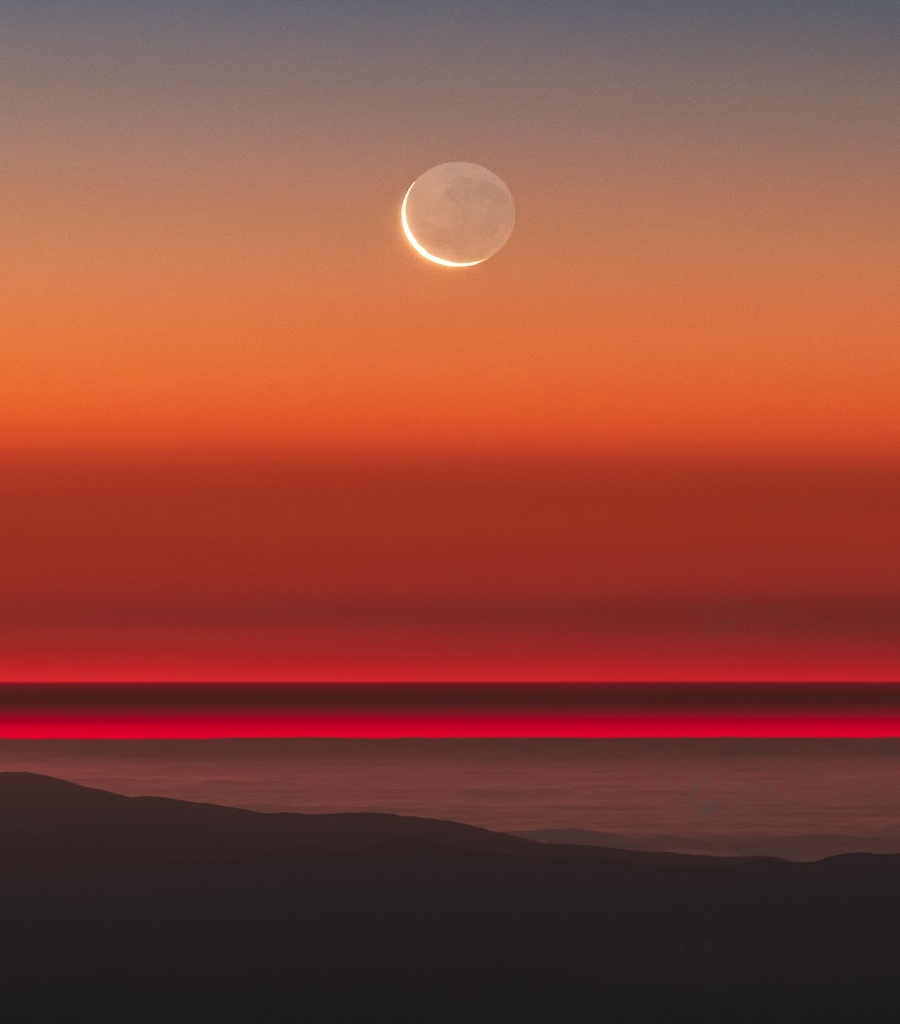
Old Moon in the New Moon s Arms Old Moon in the New Moon s Arms


Also known as the Moon's "ashen glow" or the "Old Moon in the New Moon's arms", earthshine is earthlight reflected from the Moon's night side. This stunning image of earthshine from a young crescent moon was taken from Las Campanas Observatory, Atacama Desert, Chile, planet Earth near moonset on January 18. Dramatic atmospheric inversion layers appear above the Pacific Ocean, colored by the sunset at the planet's western horizon. But the view from the Moon would have been stunning, too. When the Moon appears in Earth's sky as a slender crescent, a dazzlingly bright, nearly full Earth would be seen from the lunar surface. A description of earthshine, in terms of sunlight reflected by Earth's oceans in turn illuminating the Moon's dark surface, was written 500 years ago by Leonardo da Vinci. via NASA http://ift.tt/2FXjHml

Jan 19, 2018

Clouds in the LMC Clouds in the LMC


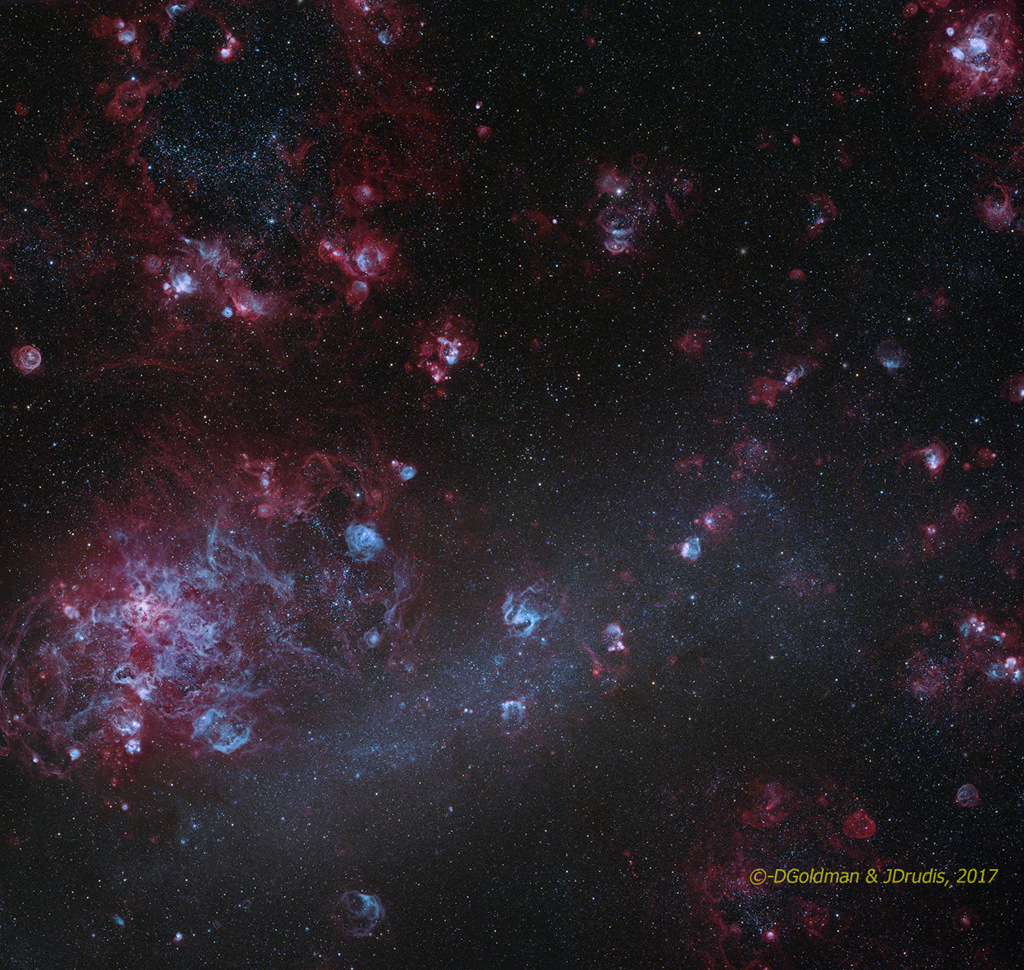
An alluring sight in southern skies, the Large Magellanic Cloud (LMC) is seen in this deep and detailed telescopic mosaic. Recorded with broadband and narrowband filters, the scene spans some 5 degrees or 10 full moons. The narrowband filters are designed to transmit only light emitted by hydrogen, and oxygen atoms. Ionized by energetic starlight, the atoms emit their characteristic light as electrons are recaptured and the atoms transition to a lower energy state. As a result, in this image the LMC seems covered with its own clouds of ionized gas surrounding its massive, young stars. Sculpted by the strong stellar winds and ultraviolet radiation, the glowing clouds, dominated by emission from hydrogen, are known as H II (ionized hydrogen) regions. Itself composed of many overlapping H II regions, the Tarantula Nebula is the large star forming region at the left. The largest satellite of our Milky Way Galaxy, the LMC is about 15,000 light-years across and lies a mere 160,000 light-years away toward the constellation Dorado. via NASA http://ift.tt/2Dm6ENt

Jan 17, 2018

In the Valley of Orion In the Valley of Orion


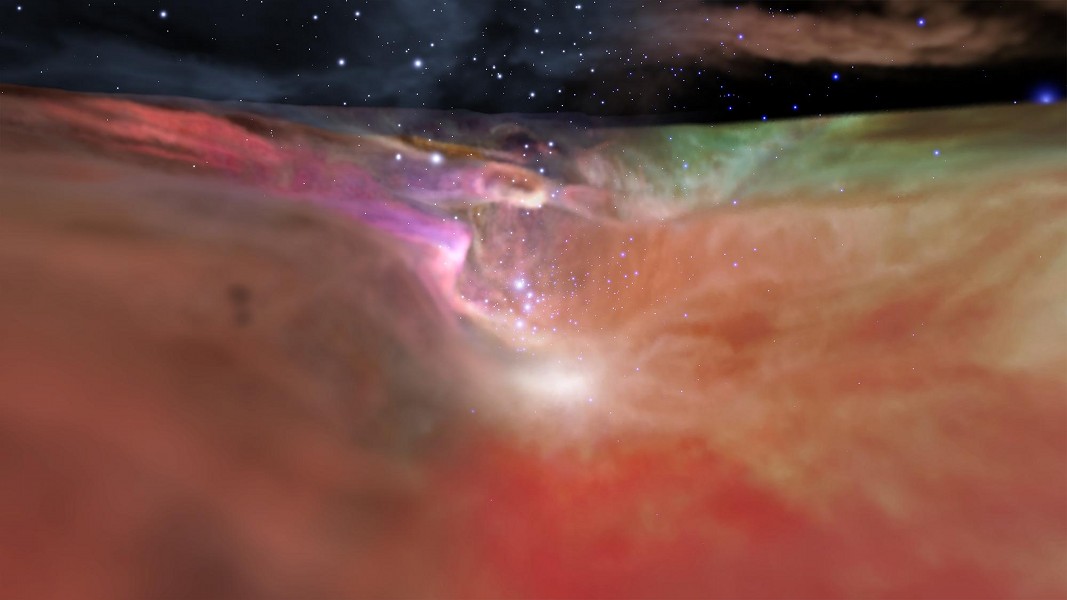
This exciting and unfamiliar view of the Orion Nebula is a visualization based on astronomical data and movie rendering techniques. Up close and personal with a famous stellar nursery normally seen from 1,500 light-years away, the digitally modeled frame transitions from a visible light representation based on Hubble data on the left to infrared data from the Spitzer Space Telescope on the right. The perspective at the center looks along a valley over a light-year wide, in the wall of the region's giant molecular cloud. Orion's valley ends in a cavity carved by the energetic winds and radiation of the massive central stars of the Trapezium star cluster. The single frame is part of a multiwavelength, three-dimensional video that lets the viewer experience an immersive, three minute flight through the Great Nebula of Orion. via NASA http://ift.tt/2B5EHUd

Jan 16, 2018

An Elephant s Trunk in Cepheus An Elephant s Trunk in Cepheus


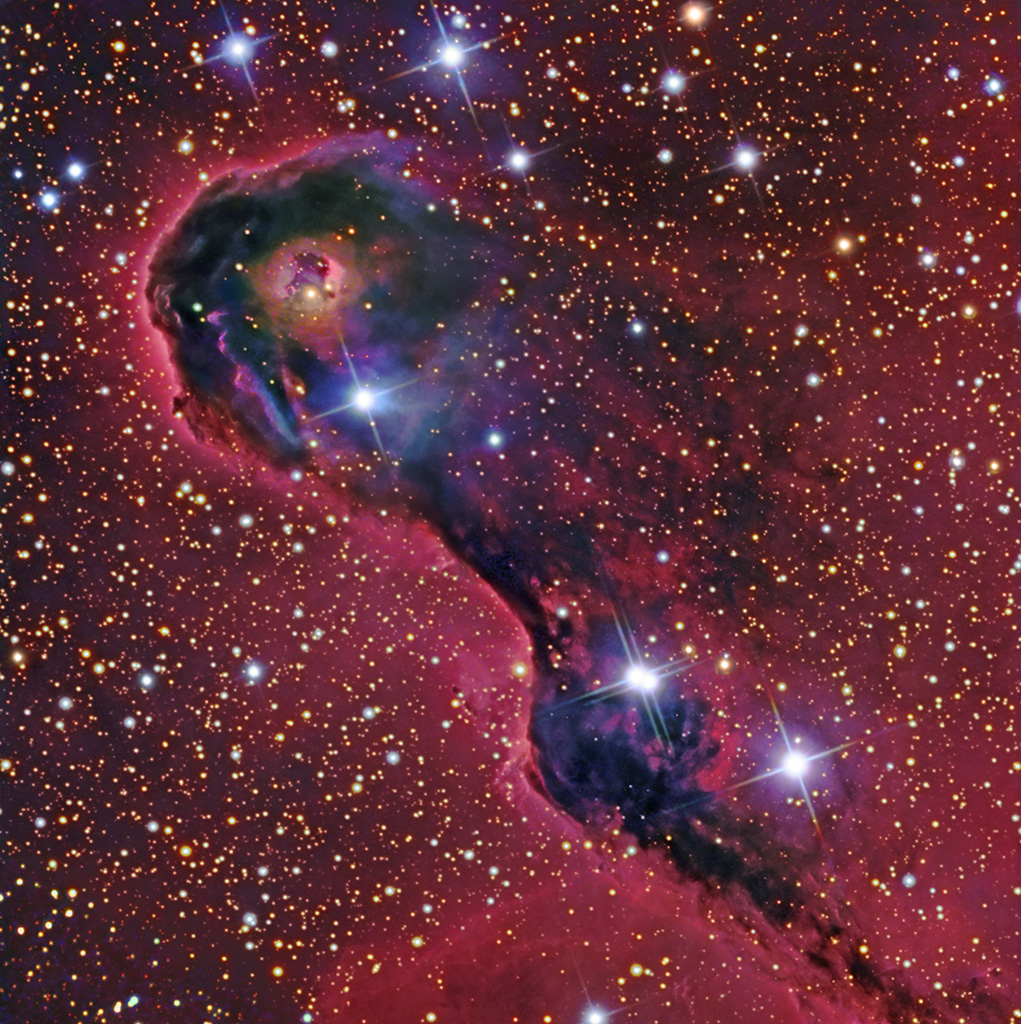
With image data from telescopes large and small, this close-up features the dusty Elephant's Trunk Nebula. It winds through the emission nebula and young star cluster complex IC 1396, in the high and far off constellation of Cepheus. Also known as vdB 142, the cosmic elephant's trunk is over 20 light-years long. The colorful view highlights bright, swept-back ridges that outline the region's pockets of cool interstellar dust and gas. Such embedded, dark, tendril-shaped clouds contain the raw material for star formation and hide protostars within. Nearly 3,000 light-years distant, the relatively faint IC 1396 complex covers a large region on the sky, spanning over 5 degrees. This dramatic scene spans a 1 degree wide field, about the size of 2 Full Moons. via NASA http://ift.tt/2Db580z

Jan 15, 2018

Rigel and the Witch Head Nebula Rigel and the Witch Head Nebula


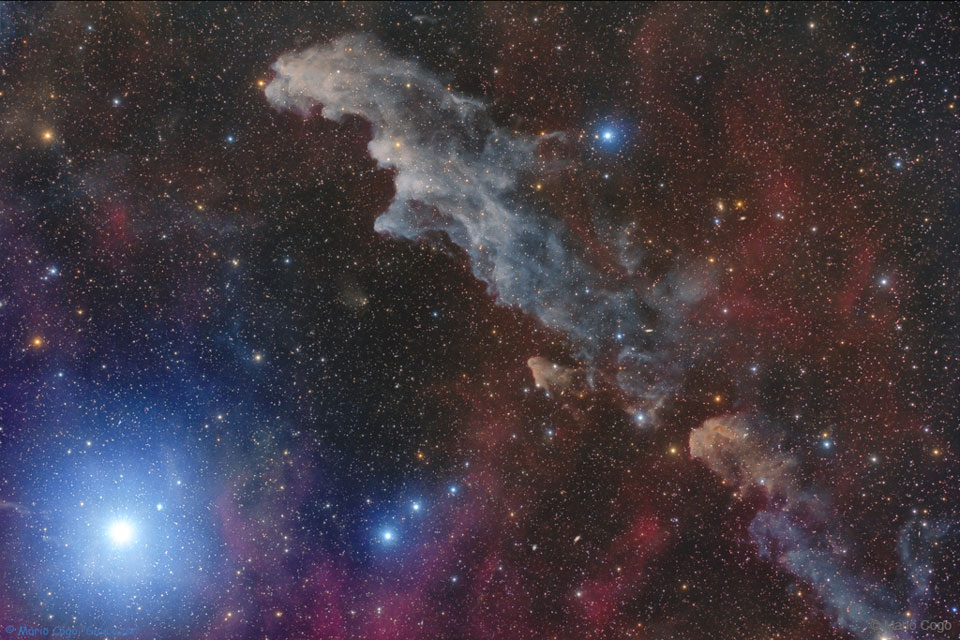
By starlight this eerie visage shines in the dark, a crooked profile evoking its popular name, the Witch Head Nebula. In fact, this entrancing telescopic portrait gives the impression that the witch has fixed her gaze on Orion's bright supergiant star Rigel. More formally known as IC 2118, the Witch Head Nebula spans about 50 light-years and is composed of interstellar dust grains reflecting Rigel's starlight. The blue color of the Witch Head Nebula and of the dust surrounding Rigel is caused not only by Rigel's intense blue starlight but because the dust grains scatter blue light more efficiently than red. The same physical process causes Earth's daytime sky to appear blue, although the scatterers in Earth's atmosphere are molecules of nitrogen and oxygen. Rigel, the Witch Head Nebula, and gas and dust that surrounds them lie about 800 light-years away. via NASA http://ift.tt/2DdfY5t