Pages

Jan 17, 2018

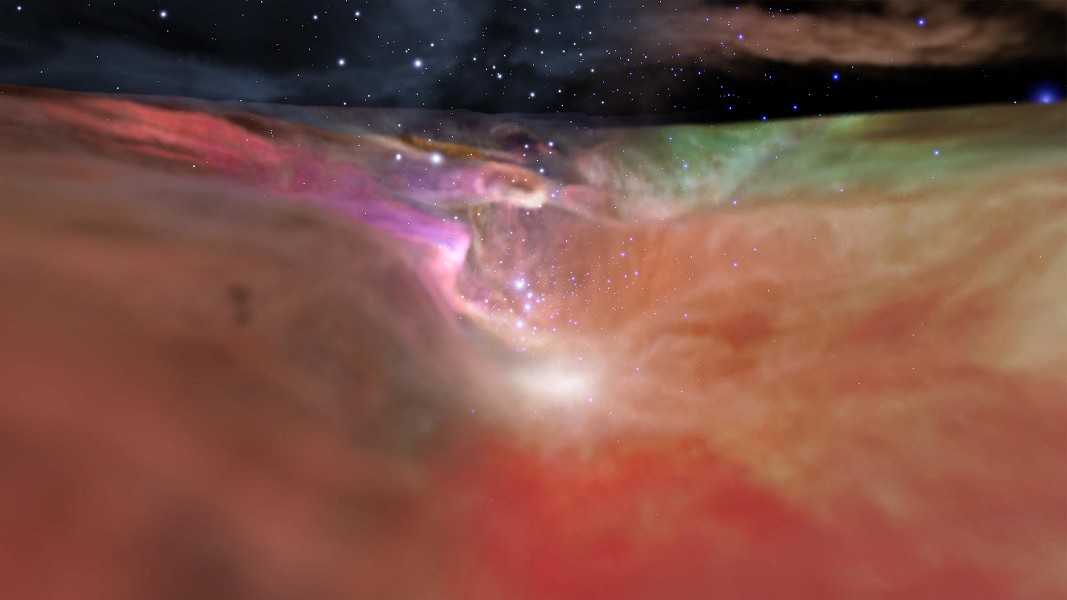
In the Valley of Orion In the Valley of Orion


This exciting and unfamiliar view of the Orion Nebula is a visualization based on astronomical data and movie rendering techniques. Up close and personal with a famous stellar nursery normally seen from 1,500 light-years away, the digitally modeled frame transitions from a visible light representation based on Hubble data on the left to infrared data from the Spitzer Space Telescope on the right. The perspective at the center looks along a valley over a light-year wide, in the wall of the region's giant molecular cloud. Orion's valley ends in a cavity carved by the energetic winds and radiation of the massive central stars of the Trapezium star cluster. The single frame is part of a multiwavelength, three-dimensional video that lets the viewer experience an immersive, three minute flight through the Great Nebula of Orion. via NASA http://ift.tt/2B5EHUd

Jan 16, 2018

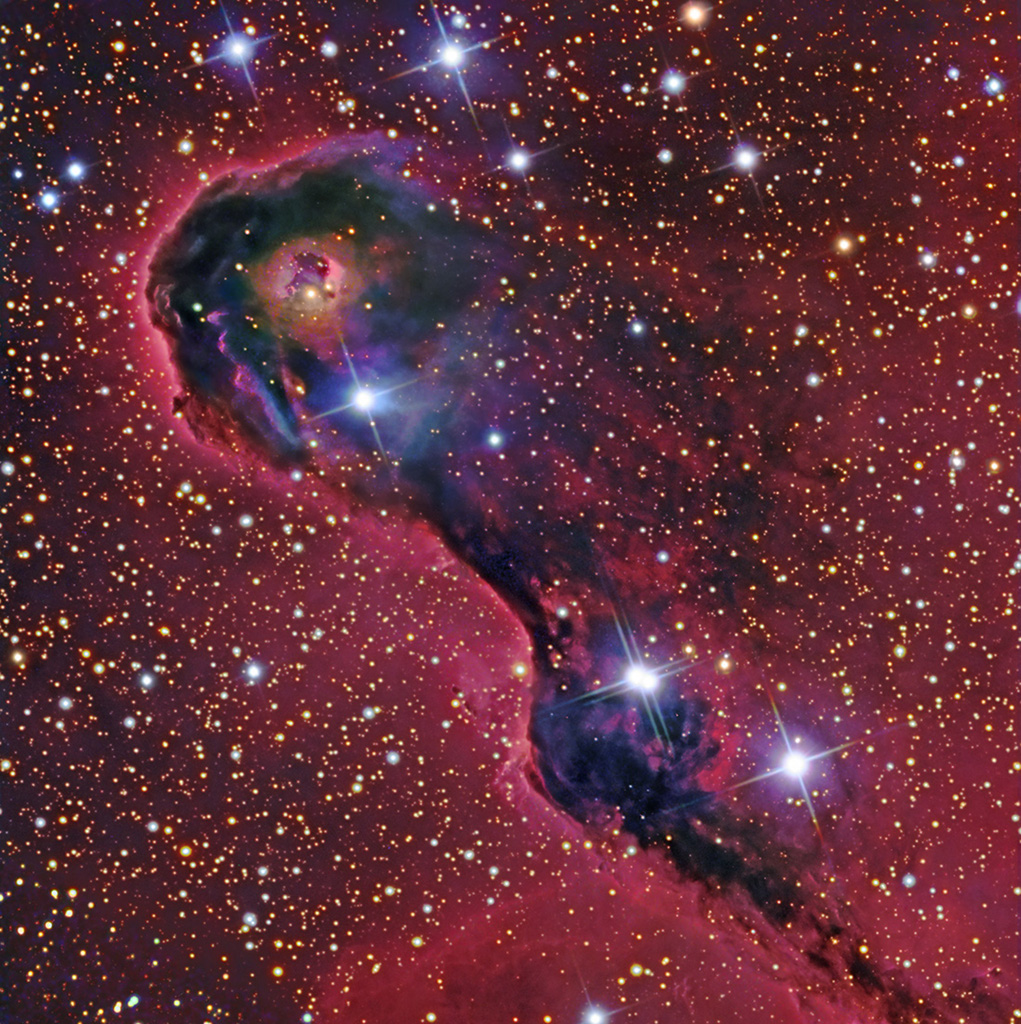
An Elephant s Trunk in Cepheus An Elephant s Trunk in Cepheus


With image data from telescopes large and small, this close-up features the dusty Elephant's Trunk Nebula. It winds through the emission nebula and young star cluster complex IC 1396, in the high and far off constellation of Cepheus. Also known as vdB 142, the cosmic elephant's trunk is over 20 light-years long. The colorful view highlights bright, swept-back ridges that outline the region's pockets of cool interstellar dust and gas. Such embedded, dark, tendril-shaped clouds contain the raw material for star formation and hide protostars within. Nearly 3,000 light-years distant, the relatively faint IC 1396 complex covers a large region on the sky, spanning over 5 degrees. This dramatic scene spans a 1 degree wide field, about the size of 2 Full Moons. via NASA http://ift.tt/2Db580z

Jan 15, 2018

Rigel and the Witch Head Nebula Rigel and the Witch Head Nebula


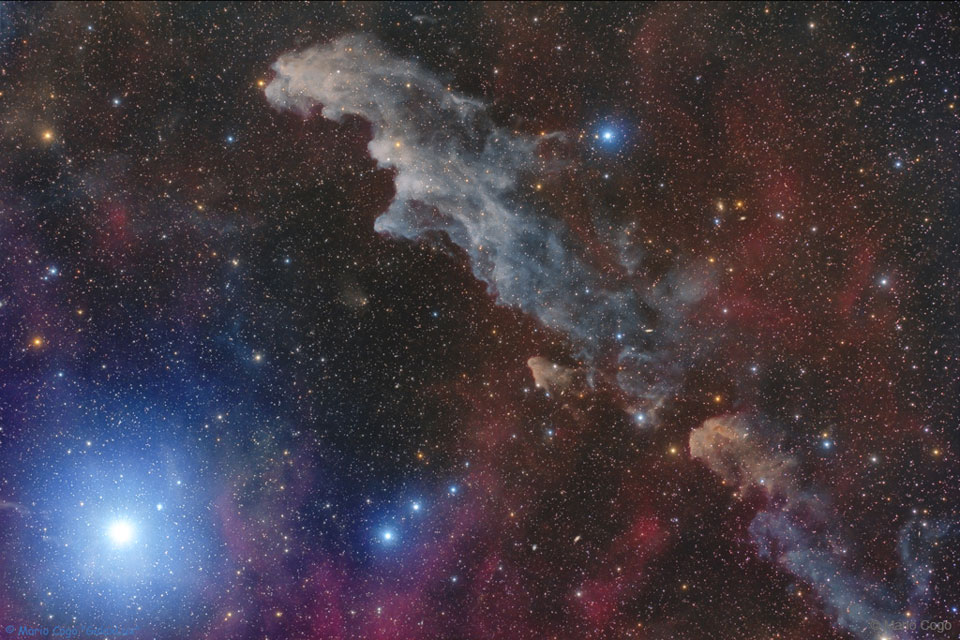
By starlight this eerie visage shines in the dark, a crooked profile evoking its popular name, the Witch Head Nebula. In fact, this entrancing telescopic portrait gives the impression that the witch has fixed her gaze on Orion's bright supergiant star Rigel. More formally known as IC 2118, the Witch Head Nebula spans about 50 light-years and is composed of interstellar dust grains reflecting Rigel's starlight. The blue color of the Witch Head Nebula and of the dust surrounding Rigel is caused not only by Rigel's intense blue starlight but because the dust grains scatter blue light more efficiently than red. The same physical process causes Earth's daytime sky to appear blue, although the scatterers in Earth's atmosphere are molecules of nitrogen and oxygen. Rigel, the Witch Head Nebula, and gas and dust that surrounds them lie about 800 light-years away. via NASA http://ift.tt/2DdfY5t

Jan 14, 2018

Three Galaxies and a Comet Three Galaxies and a Comet


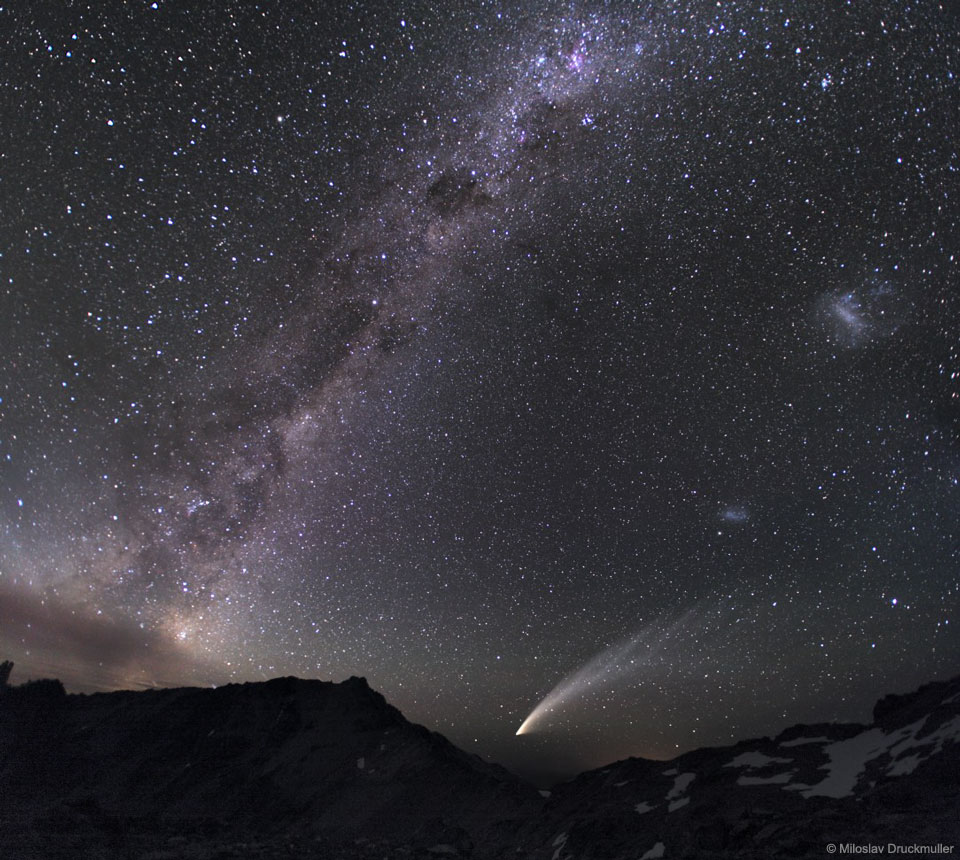
Diffuse starlight and dark nebulae along the southern Milky Way arc over the horizon and sprawl diagonally through this gorgeous nightscape. The breath-taking mosaic spans a wide 100 degrees, with the rugged terrain of the Patagonia, Argentina region in the foreground. Along with the insider's view of our own galaxy, the image features our outside perspective on two irregular satellite galaxies - the Large and Small Magellanic Clouds. The scene also captures the broad tail and bright coma of Comet McNaught, the Great Comet of 2007. via NASA http://ift.tt/2ECYAo1

Jan 12, 2018

Blue Comet PanSTARRS Blue Comet PanSTARRS


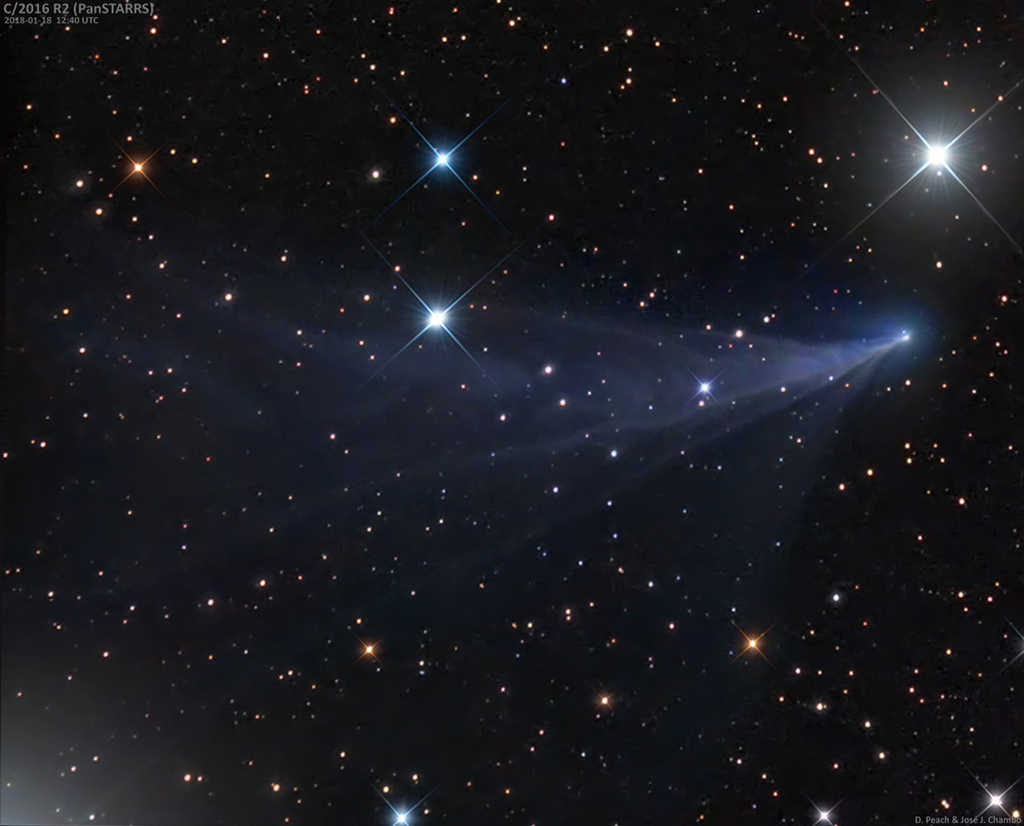
Discovered with the PanSTARRS telescope on September 7, 2016, this Comet PanSTARRS, C/2016 R2, is presently about 24 light minutes (3 AU) from the Sun, sweeping through planet Earth's skies across the background of stars in the constellation Taurus. An inbound visitor from our Solar System's distant Oort Cloud, its beautiful and complex ion tail is a remarkable shade of blue. Still relatively far from the Sun, the comet's already well-developed ion tail is very impressive. Emission from unusually abundant ionized carbon monoxide (CO+) atoms fluorescing in the increasing sunlight is largely responsible for the pretty blue tint. This color image of the blue comet is a combination of data taken from two different telescopes during the night of January 7. Located at the apex of the V-shaped Hyades star cluster in Taurus, bright star Gamma Tauri is responsible for the glow at the bottom left corner of the frame. via NASA http://ift.tt/2qQZf39

Jan 11, 2018

RCW 114: A Dragon s Heart in Ara RCW 114: A Dragon s Heart in Ara


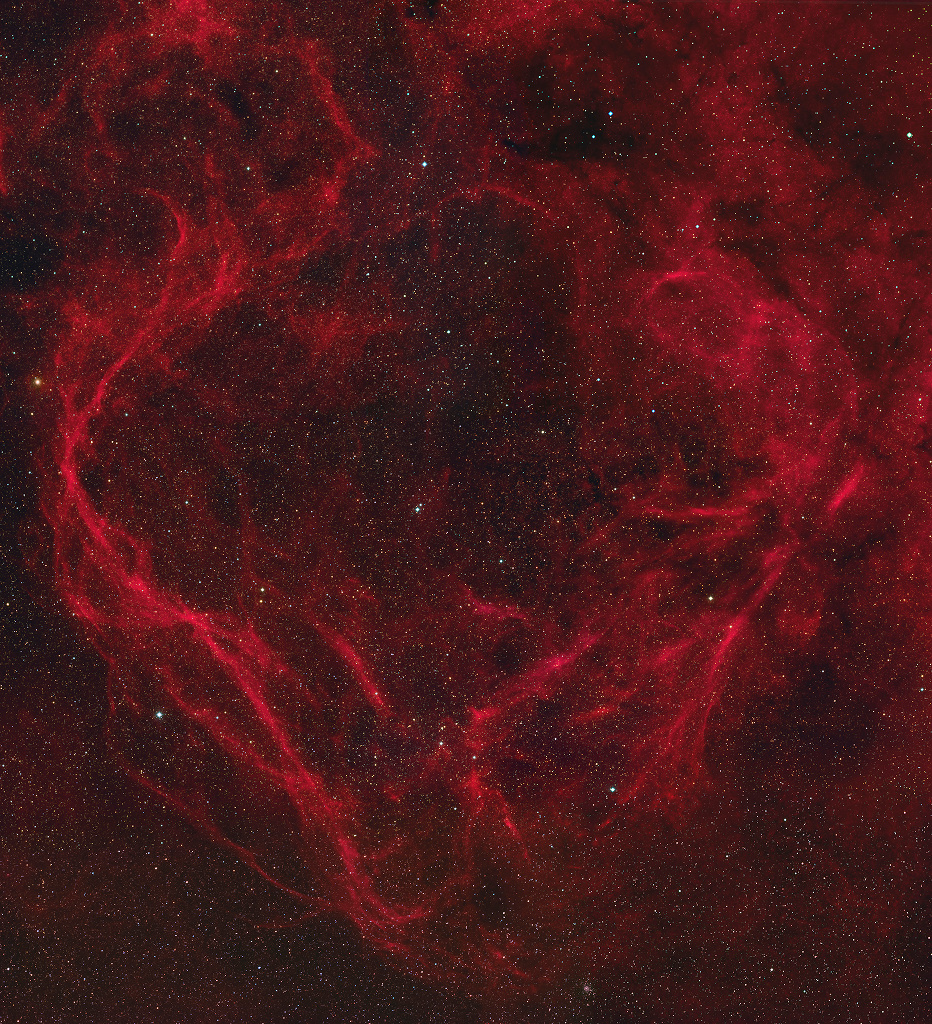
Large and dramatically shaped, this cosmic cloud spans nearly 7 degrees or 14 full moons across planet Earth's sky toward the southern constellation Ara. Difficult to image, the filamentary apparition is cataloged as RCW 114 and traced in this telescopic mosaic by the telltale reddish emission of ionized hydrogen atoms. In fact, RCW 114 has been recognized as a supernova remnant. Its extensive filaments of emission are produced as the still expanding shockwave from the death explosion of a massive star sweeps up the surrounding interstellar medium. Consistent estimates place its distance at over 600 light-years, indicating a diameter of about 100 light-years or so. Light from the supernova explosion that created RCW 114 would have reached Earth around 20,000 years ago. A neutron star or pulsar has recently been identified as the collapsed remains of the stellar core. via NASA http://ift.tt/2mm1tTg

Jan 10, 2018

NGC 2623: Merging Galaxies from Hubble NGC 2623: Merging Galaxies from Hubble


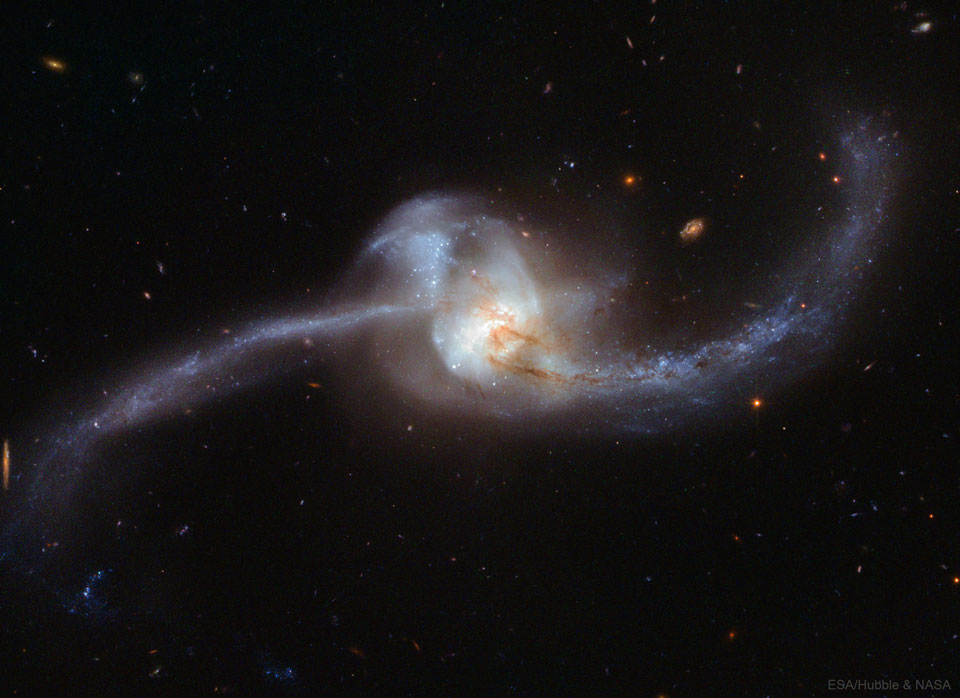
Where do stars form when galaxies collide? To help find out, astronomers imaged the nearby galaxy merger NGC 2623 in high resolution with the Hubble Space Telescope. Analysis of this and other Hubble images as well as images of NGC 2623 in infrared light by the Spitzer Space Telescope, in X-ray light by XMM-Newton, and in ultraviolet light by GALEX, indicate that two originally spiral galaxies appear now to be greatly convolved and that their cores have unified into one active galactic nucleus (AGN). Star formation continues around this core near the featured image center, along the stretched out tidal tails visible on either side, and perhaps surprisingly, in an off-nuclear region on the upper left where clusters of bright blue stars appear. Galaxy collisions can take hundreds of millions of years and take several gravitationally destructive passes. NGC 2623, also known as Arp 243, spans about 50,000 light years and lies about 250 million light years away toward the constellation of the Crab (Cancer). Reconstructing the original galaxies and how galaxy mergers happen is often challenging, sometimes impossible, but generally important to understanding how our universe evolved. via NASA http://ift.tt/2CVMj1y

Jan 8, 2018

Clouds of Andromeda Clouds of Andromeda


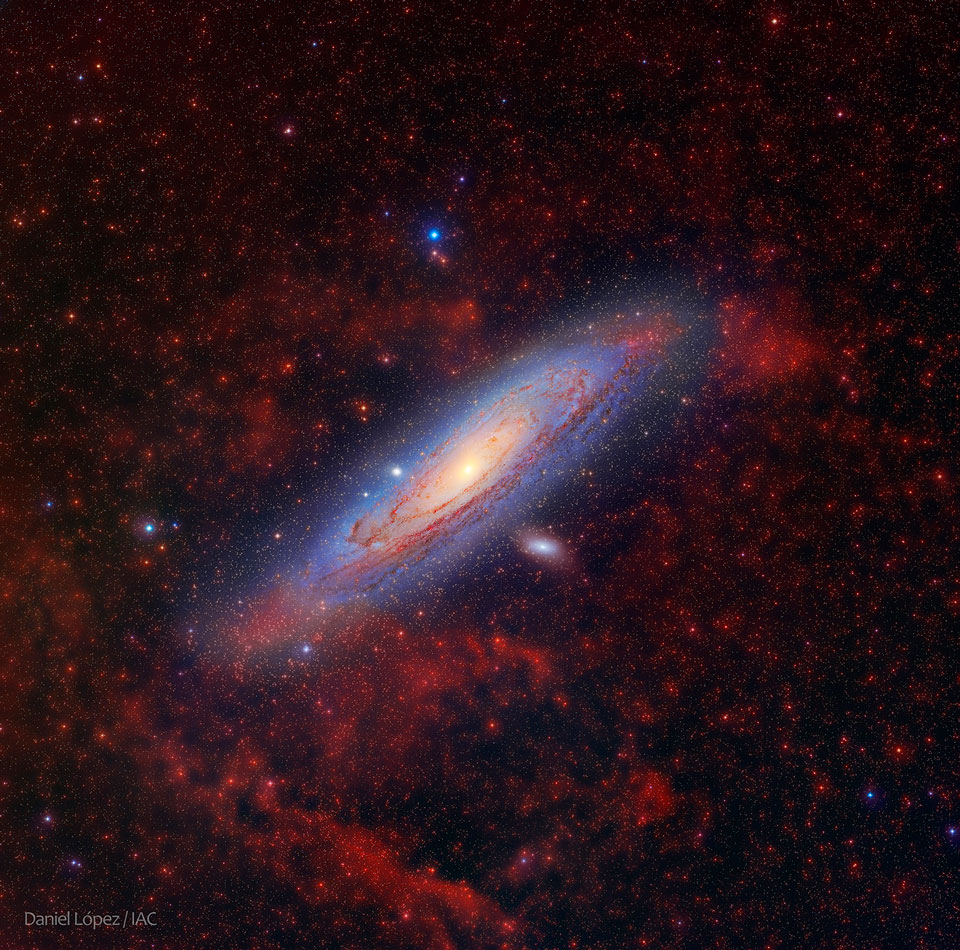
What are those red clouds surrounding the Andromeda galaxy? This galaxy, M31, is often imaged by planet Earth-based astronomers. As the nearest large spiral galaxy, it is a familiar sight with dark dust lanes, bright yellowish core, and spiral arms traced by clouds of bright blue stars. A mosaic of well-exposed broad and narrow-band image data, this colorful portrait of our neighboring island universe offers strikingly unfamiliar features though, faint reddish clouds of glowing ionized hydrogen gas in the same wide field of view. These ionized hydrogen clouds surely lie in the foreground of the scene, well within our Milky Way Galaxy. They are likely associated with the pervasive, dusty interstellar cirrus clouds scattered hundreds of light-years above our own galactic plane. via NASA http://ift.tt/2F6f74J

Jan 7, 2018

A Tether in Space A Tether in Space


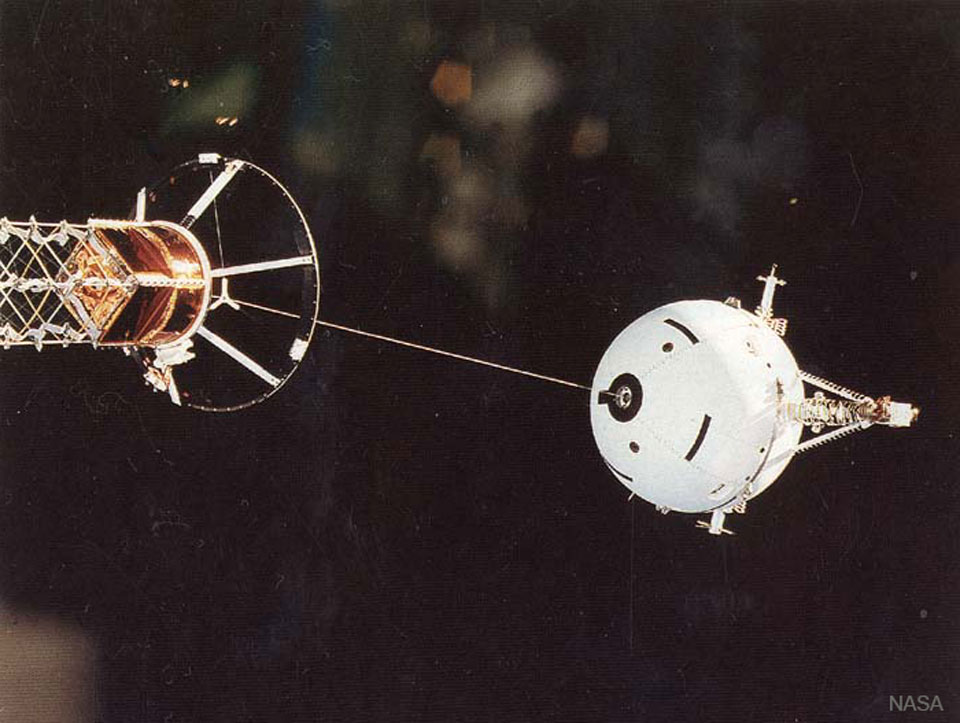
One of the greatest unrequited legends of outer space is the tether. Tethers, long strands of material, hold the promise of stabilizing satellites, generating electricity, and allowing easy transportation. Possibly the most ambitious vision of the space tether is the space elevator popularized by Arthur C. Clarke, where a tether is constructed that connects the ground to geosynchronous orbit. One problem is strength - it is difficult to make a long useful tether that does not snap. Pictured here is the deployment of the Tethered Satellite System 1 (TSS-1) by the space shuttle Altantis in 1992. Like other tested tethers, TSS-1 failed to live up to its promise, although many valuable lessons were learned. via NASA http://ift.tt/2AyU3jX

Jan 6, 2018

Planets on the Wing Planets on the Wing


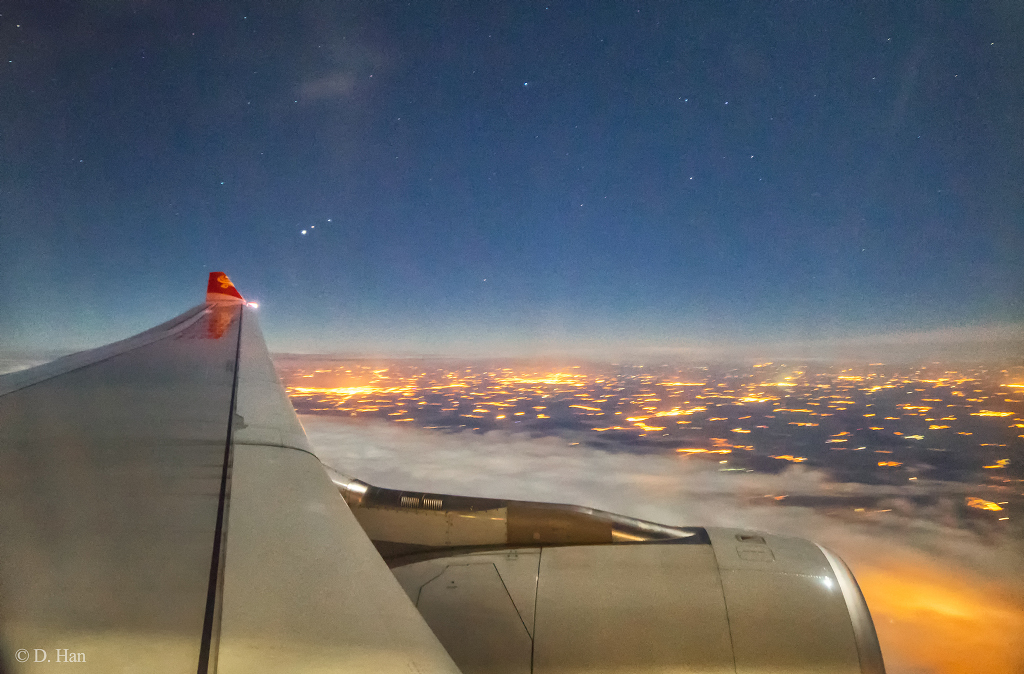
Lately, bright Jupiter and fainter Mars have been easy to spot for early morning skygazers. Before dawn on January 7 the two naked-eye planets will reach a close conjunction near the horizon, only 1/4 degree apart in predawn eastern skies. That apparent separation corresponds to about half the angular diameter of a Full Moon. Just off the wing of a high-flying aircraft in this snapshot from early morning January 5, Jupiter (left) and Mars (middle) are also lined-up with the well-balanced Zubenelgenubi (right), alpha star of the constellation Libra. Below are lights from central Europe near Prague, Czech Republic, planet Earth. via NASA http://ift.tt/2CHJ4KJ