Pages

Jan 14, 2018

Three Galaxies and a Comet Three Galaxies and a Comet


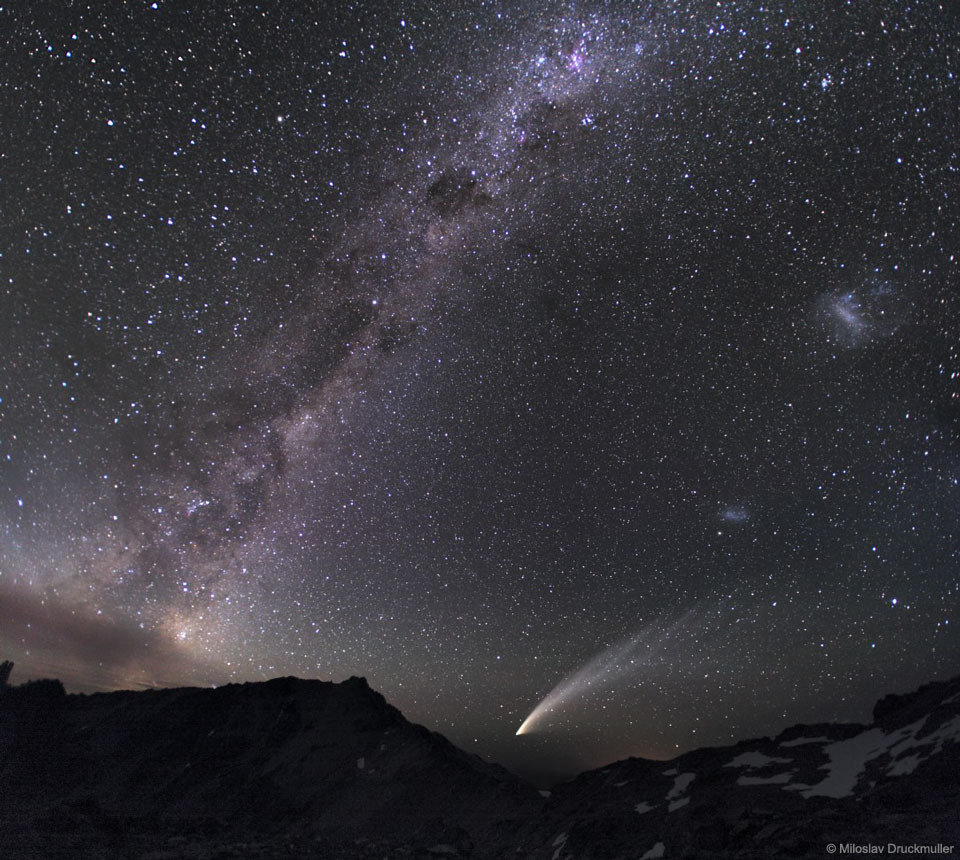
Diffuse starlight and dark nebulae along the southern Milky Way arc over the horizon and sprawl diagonally through this gorgeous nightscape. The breath-taking mosaic spans a wide 100 degrees, with the rugged terrain of the Patagonia, Argentina region in the foreground. Along with the insider's view of our own galaxy, the image features our outside perspective on two irregular satellite galaxies - the Large and Small Magellanic Clouds. The scene also captures the broad tail and bright coma of Comet McNaught, the Great Comet of 2007. via NASA http://ift.tt/2ECYAo1

Jan 12, 2018

Blue Comet PanSTARRS Blue Comet PanSTARRS


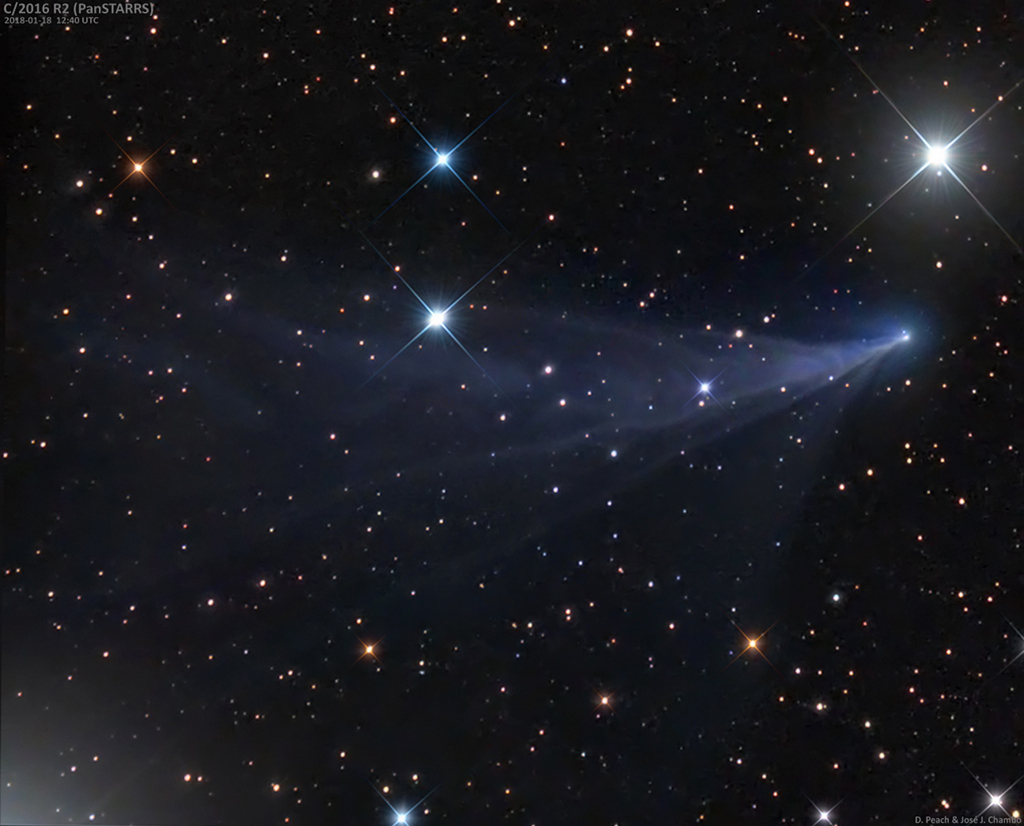
Discovered with the PanSTARRS telescope on September 7, 2016, this Comet PanSTARRS, C/2016 R2, is presently about 24 light minutes (3 AU) from the Sun, sweeping through planet Earth's skies across the background of stars in the constellation Taurus. An inbound visitor from our Solar System's distant Oort Cloud, its beautiful and complex ion tail is a remarkable shade of blue. Still relatively far from the Sun, the comet's already well-developed ion tail is very impressive. Emission from unusually abundant ionized carbon monoxide (CO+) atoms fluorescing in the increasing sunlight is largely responsible for the pretty blue tint. This color image of the blue comet is a combination of data taken from two different telescopes during the night of January 7. Located at the apex of the V-shaped Hyades star cluster in Taurus, bright star Gamma Tauri is responsible for the glow at the bottom left corner of the frame. via NASA http://ift.tt/2qQZf39

Jan 11, 2018

RCW 114: A Dragon s Heart in Ara RCW 114: A Dragon s Heart in Ara


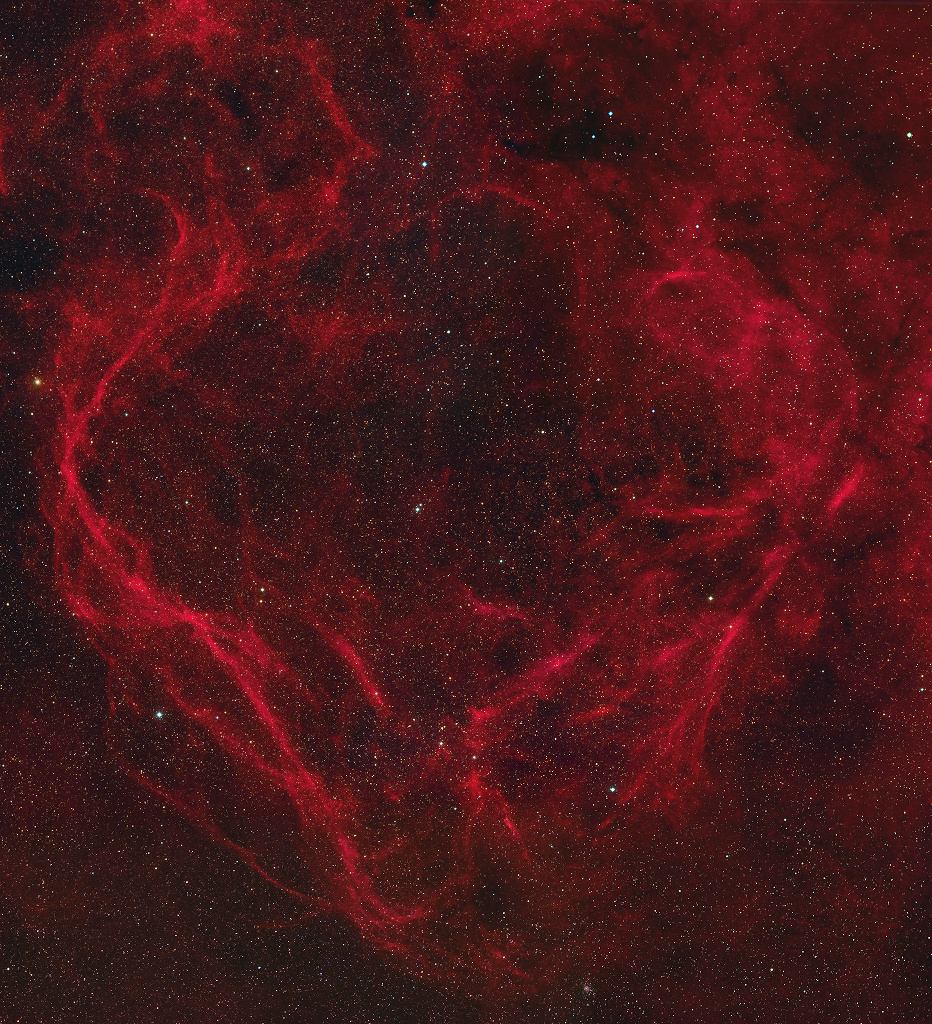
Large and dramatically shaped, this cosmic cloud spans nearly 7 degrees or 14 full moons across planet Earth's sky toward the southern constellation Ara. Difficult to image, the filamentary apparition is cataloged as RCW 114 and traced in this telescopic mosaic by the telltale reddish emission of ionized hydrogen atoms. In fact, RCW 114 has been recognized as a supernova remnant. Its extensive filaments of emission are produced as the still expanding shockwave from the death explosion of a massive star sweeps up the surrounding interstellar medium. Consistent estimates place its distance at over 600 light-years, indicating a diameter of about 100 light-years or so. Light from the supernova explosion that created RCW 114 would have reached Earth around 20,000 years ago. A neutron star or pulsar has recently been identified as the collapsed remains of the stellar core. via NASA http://ift.tt/2mm1tTg

Jan 10, 2018

NGC 2623: Merging Galaxies from Hubble NGC 2623: Merging Galaxies from Hubble


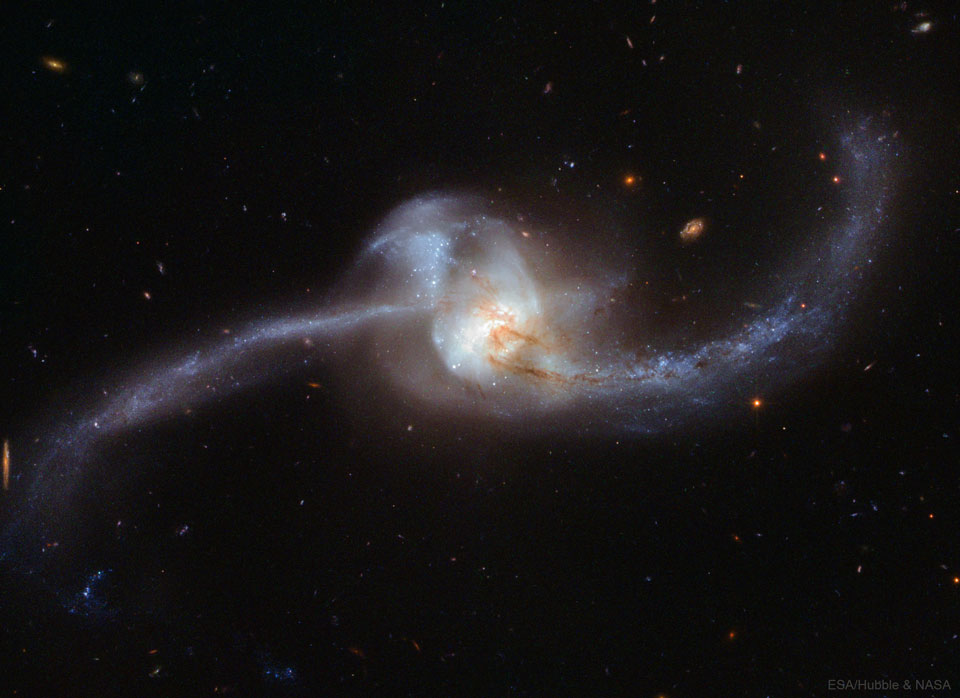
Where do stars form when galaxies collide? To help find out, astronomers imaged the nearby galaxy merger NGC 2623 in high resolution with the Hubble Space Telescope. Analysis of this and other Hubble images as well as images of NGC 2623 in infrared light by the Spitzer Space Telescope, in X-ray light by XMM-Newton, and in ultraviolet light by GALEX, indicate that two originally spiral galaxies appear now to be greatly convolved and that their cores have unified into one active galactic nucleus (AGN). Star formation continues around this core near the featured image center, along the stretched out tidal tails visible on either side, and perhaps surprisingly, in an off-nuclear region on the upper left where clusters of bright blue stars appear. Galaxy collisions can take hundreds of millions of years and take several gravitationally destructive passes. NGC 2623, also known as Arp 243, spans about 50,000 light years and lies about 250 million light years away toward the constellation of the Crab (Cancer). Reconstructing the original galaxies and how galaxy mergers happen is often challenging, sometimes impossible, but generally important to understanding how our universe evolved. via NASA http://ift.tt/2CVMj1y
Jan 8, 2018

Clouds of Andromeda Clouds of Andromeda


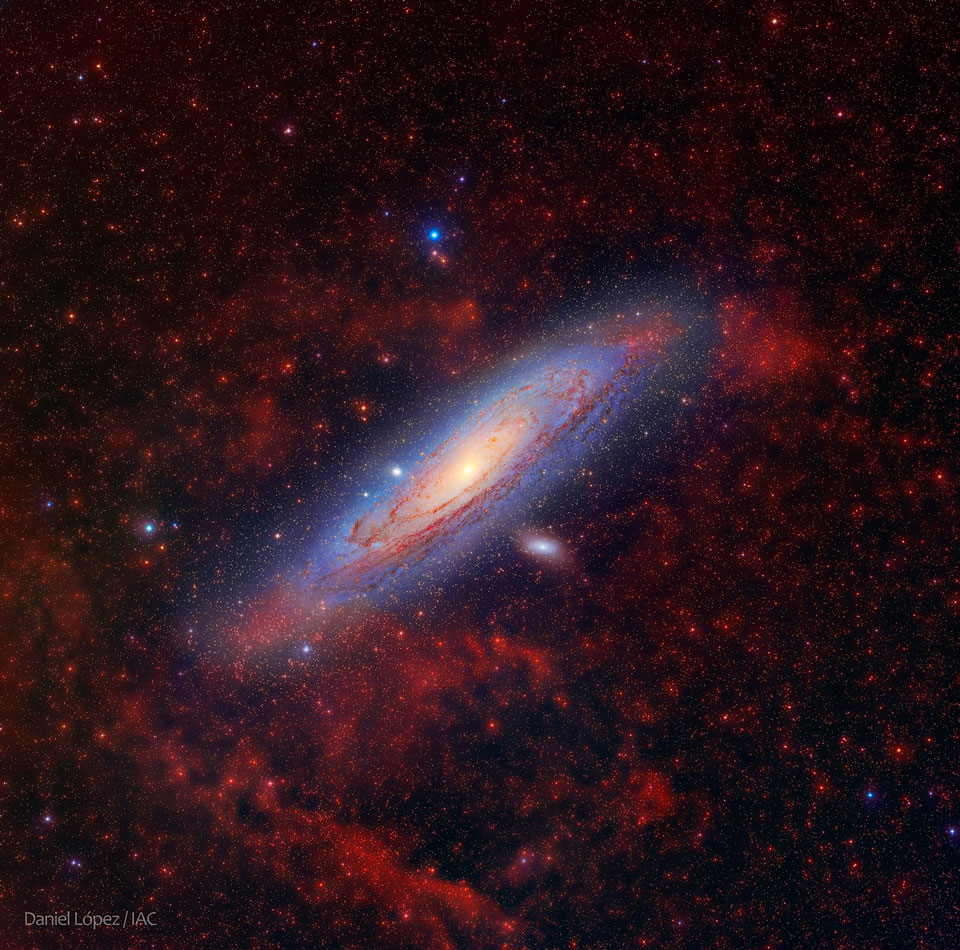
What are those red clouds surrounding the Andromeda galaxy? This galaxy, M31, is often imaged by planet Earth-based astronomers. As the nearest large spiral galaxy, it is a familiar sight with dark dust lanes, bright yellowish core, and spiral arms traced by clouds of bright blue stars. A mosaic of well-exposed broad and narrow-band image data, this colorful portrait of our neighboring island universe offers strikingly unfamiliar features though, faint reddish clouds of glowing ionized hydrogen gas in the same wide field of view. These ionized hydrogen clouds surely lie in the foreground of the scene, well within our Milky Way Galaxy. They are likely associated with the pervasive, dusty interstellar cirrus clouds scattered hundreds of light-years above our own galactic plane. via NASA http://ift.tt/2F6f74J

Jan 7, 2018

A Tether in Space A Tether in Space


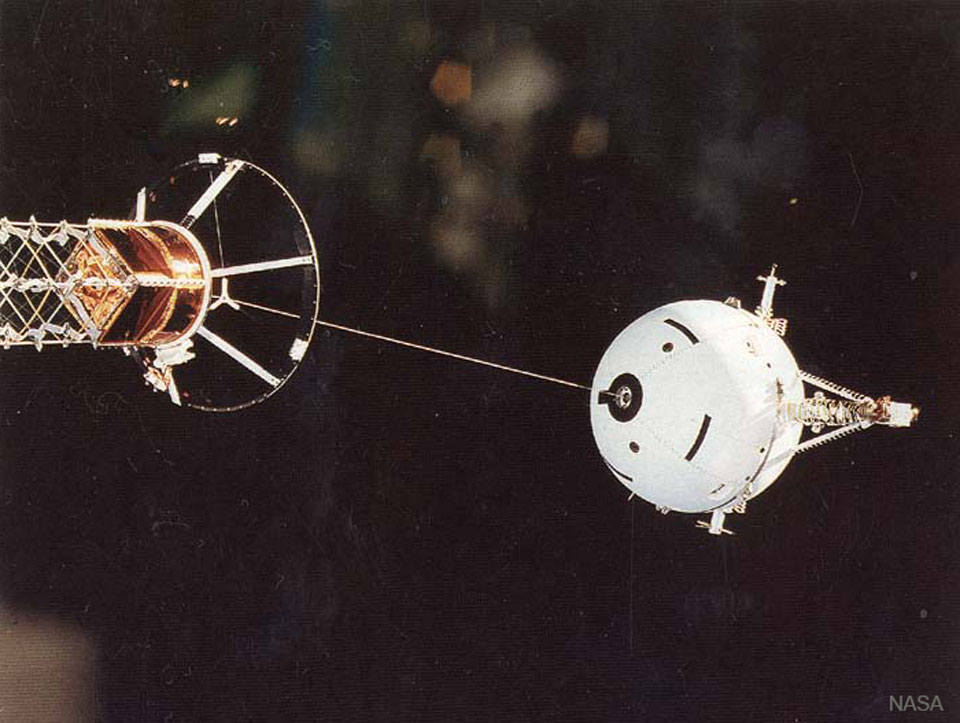
One of the greatest unrequited legends of outer space is the tether. Tethers, long strands of material, hold the promise of stabilizing satellites, generating electricity, and allowing easy transportation. Possibly the most ambitious vision of the space tether is the space elevator popularized by Arthur C. Clarke, where a tether is constructed that connects the ground to geosynchronous orbit. One problem is strength - it is difficult to make a long useful tether that does not snap. Pictured here is the deployment of the Tethered Satellite System 1 (TSS-1) by the space shuttle Altantis in 1992. Like other tested tethers, TSS-1 failed to live up to its promise, although many valuable lessons were learned. via NASA http://ift.tt/2AyU3jX

Jan 6, 2018

Planets on the Wing Planets on the Wing


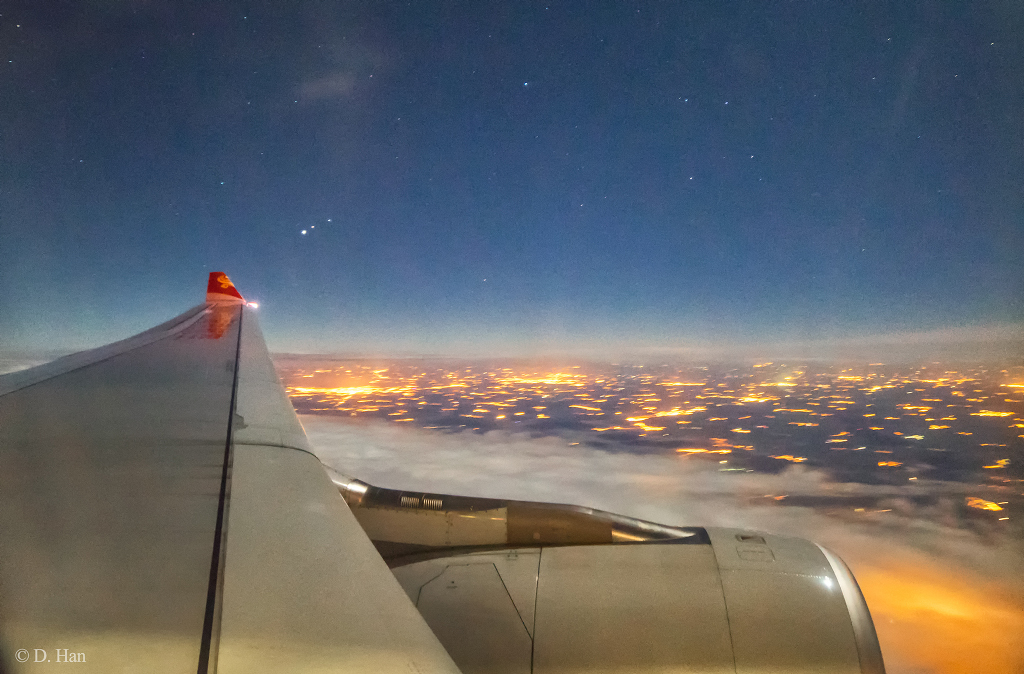
Lately, bright Jupiter and fainter Mars have been easy to spot for early morning skygazers. Before dawn on January 7 the two naked-eye planets will reach a close conjunction near the horizon, only 1/4 degree apart in predawn eastern skies. That apparent separation corresponds to about half the angular diameter of a Full Moon. Just off the wing of a high-flying aircraft in this snapshot from early morning January 5, Jupiter (left) and Mars (middle) are also lined-up with the well-balanced Zubenelgenubi (right), alpha star of the constellation Libra. Below are lights from central Europe near Prague, Czech Republic, planet Earth. via NASA http://ift.tt/2CHJ4KJ

Jan 5, 2018

Carina over Lake Ballard Carina over Lake Ballard


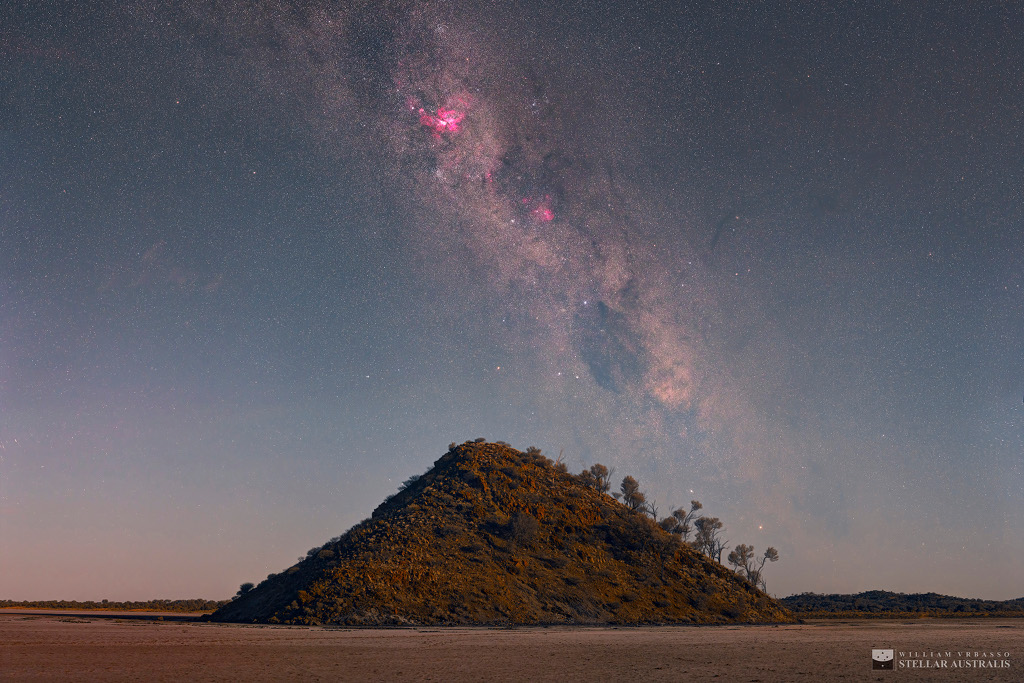
A jewel of the southern sky, the Great Carina Nebula, also known as NGC 3372, is one of our galaxy's largest star forming regions. Easily visible to the unaided eye it stands high above the signature hill of Lake Ballard, ephemeral salt lake of Western Australia, in this serene night skyscape from December 25, 2017. The Milky Way itself stretches beyond the southern horizon. Along the Milky Way, bright stars Alpha and Beta Centauri lie just above the hill's right flank, with the Southern Cross and dark Coalsack Nebula above the hill top. Based on a 22 panel mosaic, the scene was cropped to reveal more closely the beauty of this region of the southern Milky Way. On that short summer night, a star tracking camera mount was used to record the mosaic images of the sky, but turned off to image the foreground in moonlight. via NASA http://ift.tt/2AllL3u

Jan 4, 2018

M1: The Incredible Expanding Crab M1: The Incredible Expanding Crab


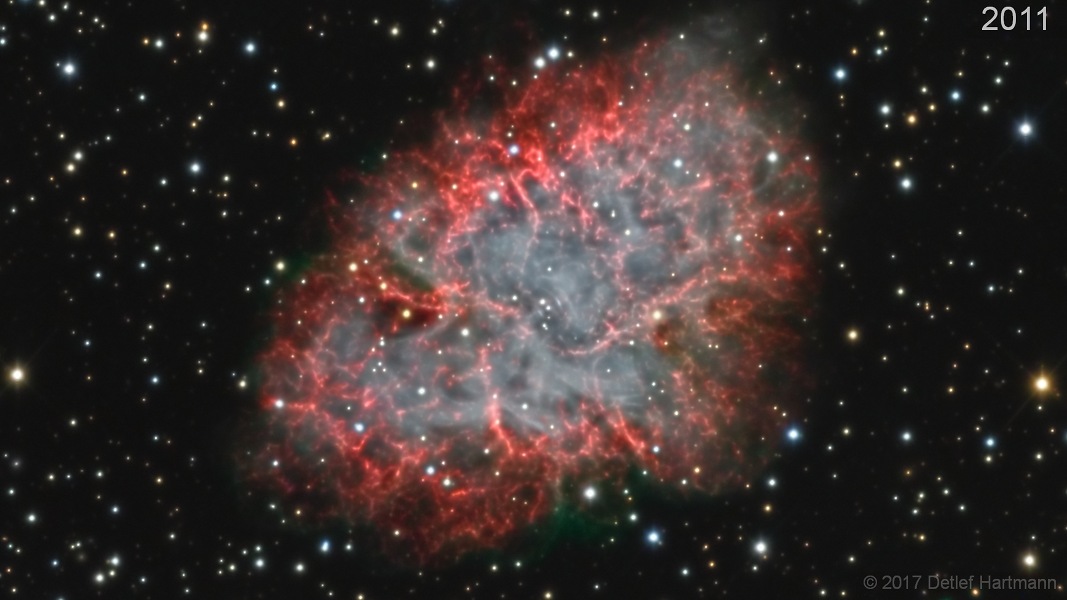
The Crab Nebula is cataloged as M1, the first on Charles Messier's famous list of things which are not comets. In fact, the Crab is now known to be a supernova remnant, an expanding cloud of debris from the explosion of a massive star. The violent birth of the Crab was witnessed by astronomers in the year 1054. Roughly 10 light-years across today, the nebula is still expanding at a rate of over 1,000 kilometers per second. Over the past decade, its expansion has been documented in this stunning time-lapse movie. In each year from 2008 to 2017, an image was produced with the same telescope and camera from a remote observatory in Austria. Combined in the time-lapse movie, the 10 images represent 32 hours of total integration time. The sharp, processed frames even reveal the dynamic energetic emission within the incredible expanding Crab. The Crab Nebula lies about 6,500 light-years away in the constellation Taurus. via NASA http://ift.tt/2lPMoZZ

Jan 2, 2018

Unexpected X Rays from Perseus Galaxy Cluster Unexpected X Rays from Perseus Galaxy Cluster


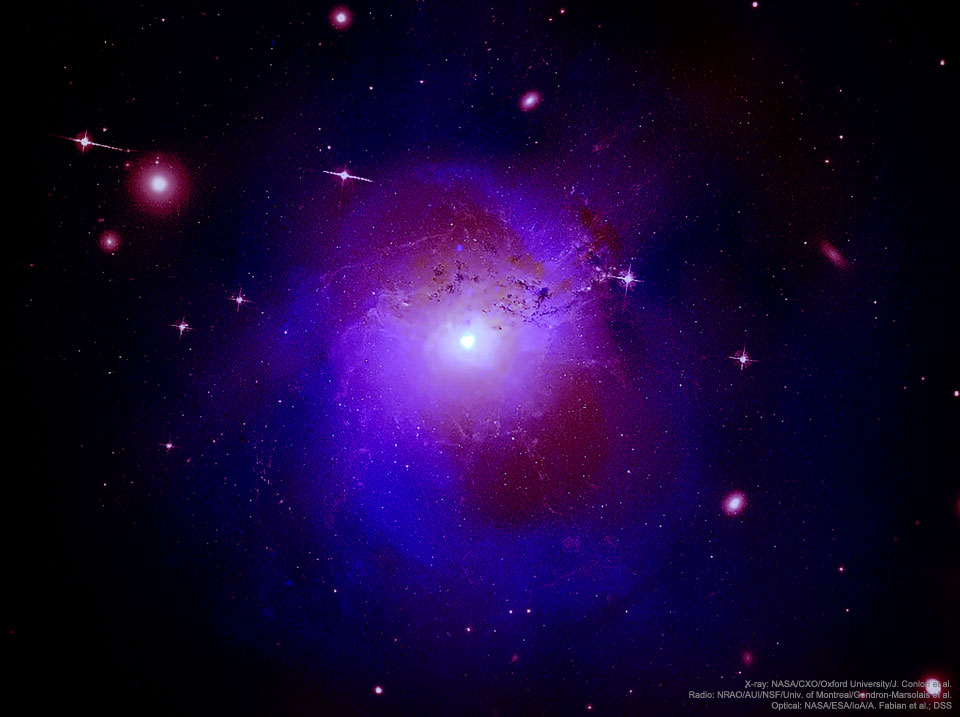
Why does the Perseus galaxy cluster shine so strangely in one specific color of X-rays? No one is sure, but a much-debated hypothesis holds that these X-rays are a clue to the long-sought identity of dark matter. At the center of this mystery is a 3.5 Kilo-electronvolt (KeV) X-ray color that appears to glow excessively only when regions well outside the cluster center are observed, whereas the area directly surrounding a likely central supermassive black hole is actually deficient in 3.5 KeV X-rays. One proposed resolution -- quite controversial -- is that something never seen before might be present: florescent dark matter (FDM). This form of particle dark matter might be able to absorb 3.5 KeV X-radiation. If operating, FDM, after absorption, might later emit these X-rays from all over the cluster, creating an emission line. However, when seen superposed in front of the central region surrounding the black hole, FDM's absorption would be more prominent, creating an absorption line. Pictured, a composite image of the Perseus galaxy cluster shows visible and radio light in red, and X-ray light from the Earth-orbiting Chandra Observatory in blue. via NASA http://ift.tt/2q7I6BP