Pages

Dec 23, 2017

Phaethon s Brood Phaethon s Brood


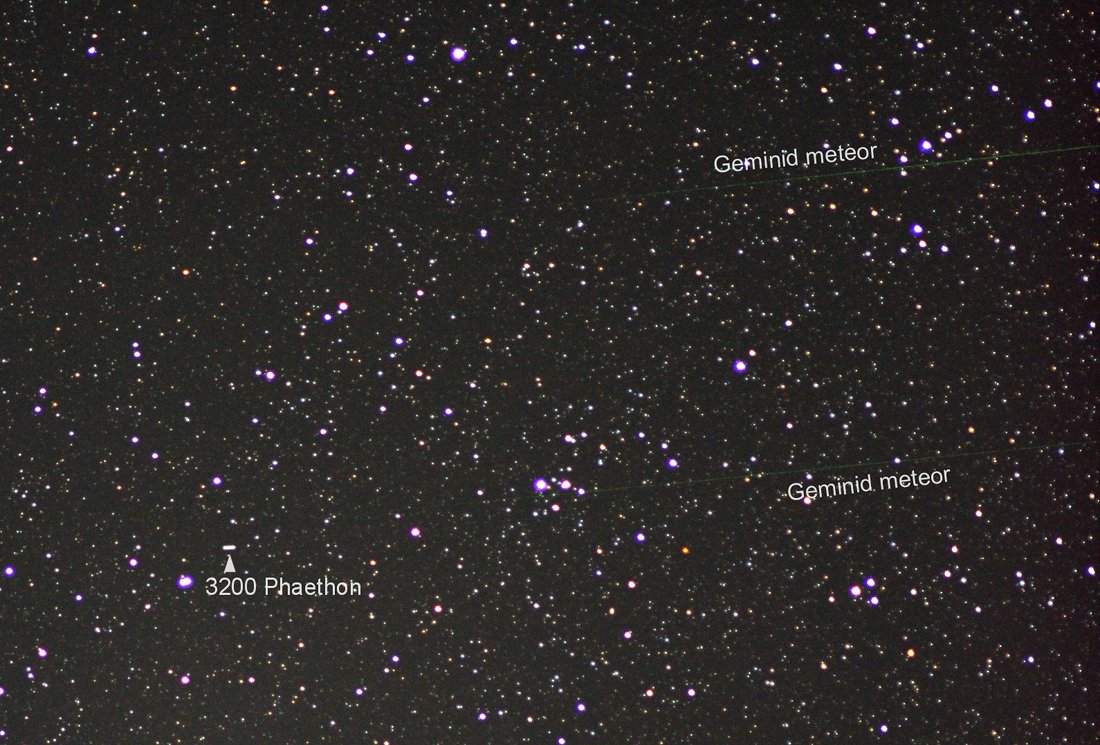
Based on its well-measured orbit, 3200 Phaethon (sounds like FAY-eh-thon) is recognized as the source of the meteroid stream responsible for the annual Geminid meteor shower. Even though most meteor showers' parents are comets, 3200 Phaethon is a known and closely tracked near-Earth asteroid with a 1.4 year orbital period. Rocky and sun-baked, its perihelion or closest approach to the Sun is well within the orbit of innermost planet Mercury. In this telescopic field of view, the asteroid's rapid motion against faint background stars of the heroic constellation Perseus left a short trail during the two minute total exposure time. The parallel streaks of its meteoric children flashed much more quickly across the scene. The family portrait was recorded near the Geminid meteor shower's very active peak on December 13. That was just before 3200 Phaethon's historic December 16 closest approach to planet Earth. via NASA http://ift.tt/2kZD44i

Dec 22, 2017

Gemini s Meteors Gemini s Meteors


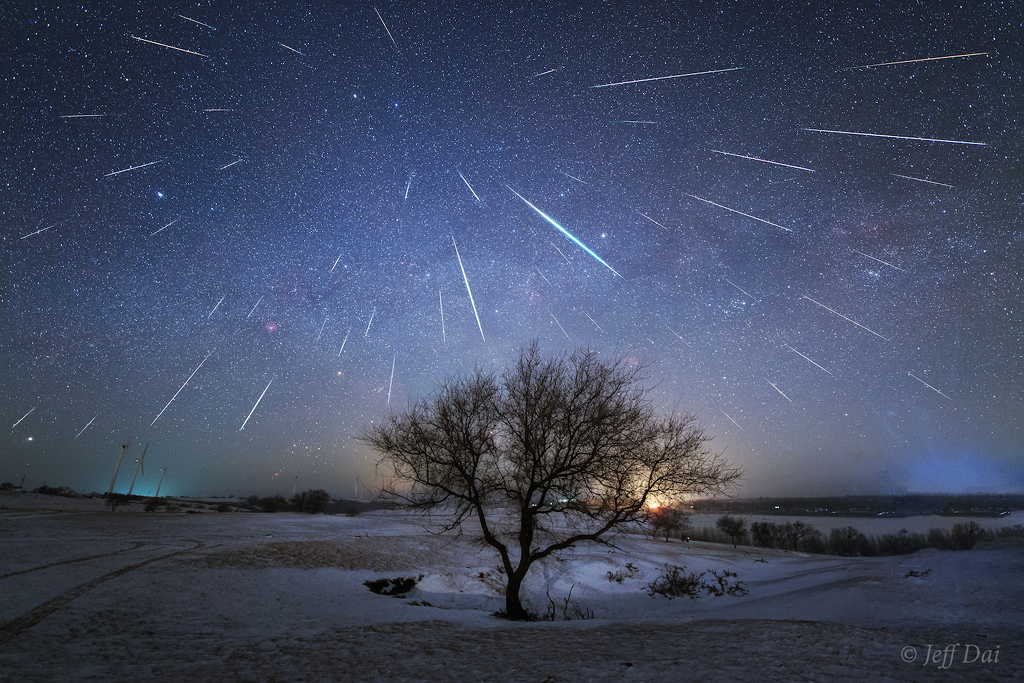
From dark skies above Heilongjiang province in northeastern China, meteors rain down on a wintry landscape in this beautiful composited night scene. The 48 meteors are part of last week's annual Geminid meteor shower. Despite temperatures of -28 degrees C, all were recorded in camera exposures made during the peak hour of the celestial spectacle. They stream away from the shower's radiant high above the horizon near the two bright stars of the zodiacal constellation of the Twins. A very active shower, this year the December 13-14 peak of the Geminids arrived just before the December 16 closest approach of asteroid 3200 Phaethon to planet Earth. Mysterious 3200 Phaethon is the Geminid shower's likely parent body. via NASA http://ift.tt/2BroLAI

Dec 18, 2017

The Kepler 90 Planetary System The Kepler 90 Planetary System


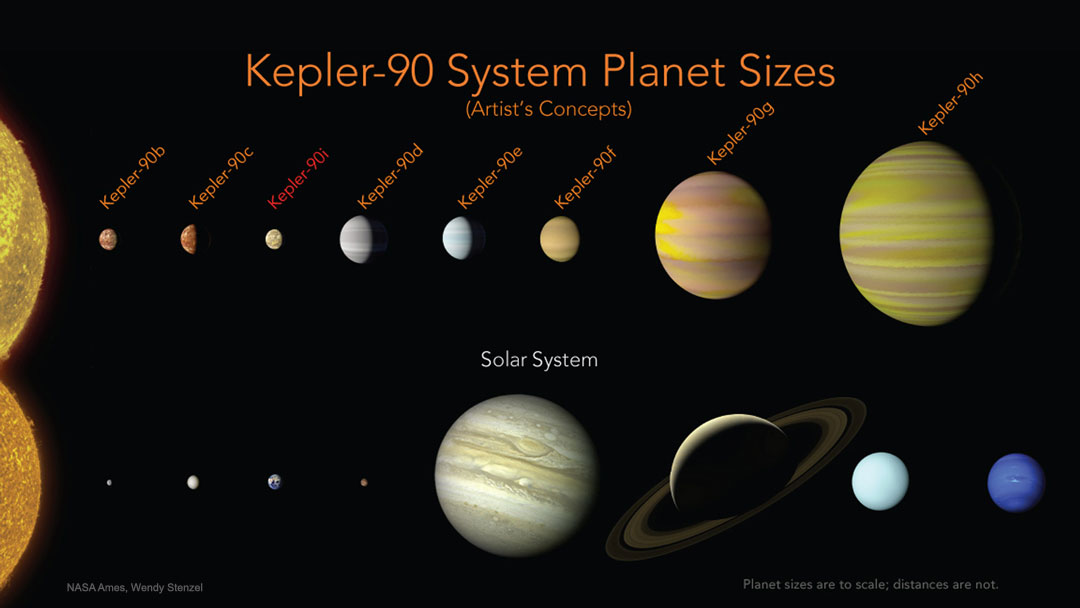
Do other stars have planetary systems like our own? Yes -- one such system is Kepler-90. Cataloged by the orbiting Kepler satellite, an eighth planet has now been discovered giving Kepler-90 the same number of known planets as our Solar System. Similarities between Kepler-90 and our system include a G-type star comparable to our Sun, rocky planets comparable to our Earth, and large planets comparable in size to Jupiter and Saturn. Differences include that all of the known Kepler-90 planets orbit relatively close in -- closer than Earth's orbit around the Sun -- making them possibly too hot to harbor life. However, observations over longer time periods may discover cooler planets further out. Kepler-90 lies about 2,500 light years away, and at magnitude 14 is visible with a medium-sized telescope toward the constellation of the Dragon (Draco). Exoplanet-finding missions planned for launch in the next decade include TESS, JWST, WFIRST, and PLATO. via NASA http://ift.tt/2k5QcFB

Dec 17, 2017

The Einstein Cross Gravitational Lens The Einstein Cross Gravitational Lens


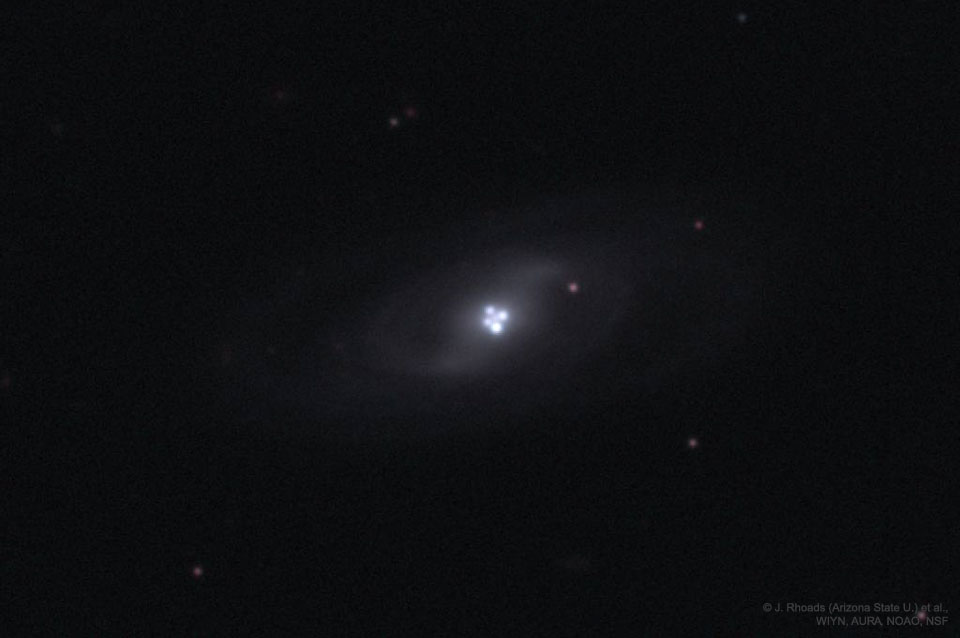
Most galaxies have a single nucleus -- does this galaxy have four? The strange answer leads astronomers to conclude that the nucleus of the surrounding galaxy is not even visible in this image. The central cloverleaf is rather light emitted from a background quasar. The gravitational field of the visible foreground galaxy breaks light from this distant quasar into four distinct images. The quasar must be properly aligned behind the center of a massive galaxy for a mirage like this to be evident. The general effect is known as gravitational lensing, and this specific case is known as the Einstein Cross. Stranger still, the images of the Einstein Cross vary in relative brightness, enhanced occasionally by the additional gravitational microlensing effect of specific stars in the foreground galaxy. via NASA http://ift.tt/2j8dLNf

Dec 9, 2017

Stardust in Aries Stardust in Aries


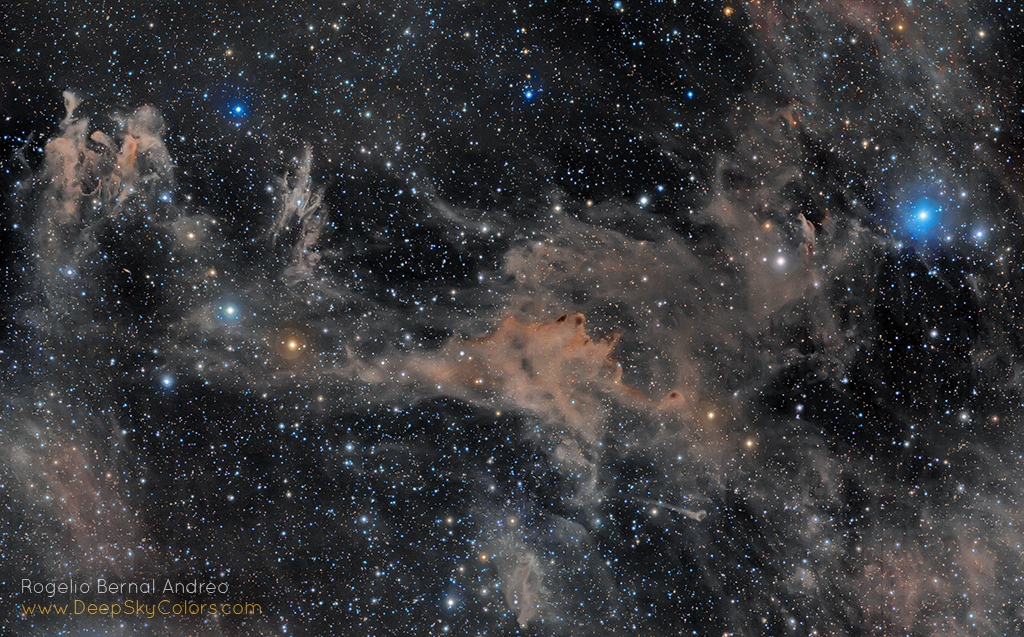
This composition in stardust covers over 8 degrees on the northern sky. The mosaicked field of view is west of the familiar Pleiades star cluster, toward the zodiacal constellation Aries and the plane of our Milky Way Galaxy. At right in the deep skyscape is bluish Epsilon Arietis, a star visible to the naked-eye and about 330 light-years away. Reflecting starlight in the region, dusty nebulae LBN762, LBN753, and LBN743 sprawl left to right across the field, but are likely some 1,000 light-years away. At that estimated distance, the cosmic canvas is over 140 light-years across. Near the edge of a large molecular cloud, their dark interiors can hide newly formed stars and young stellar objects or protostars from prying optical telescopes. Collapsing due to self-gravity, the protostars form around dense cores embedded in the molecular cloud. via NASA http://ift.tt/2A1Zfx4

Dec 8, 2017

Alpine Superga Moonset Alpine Superga Moonset


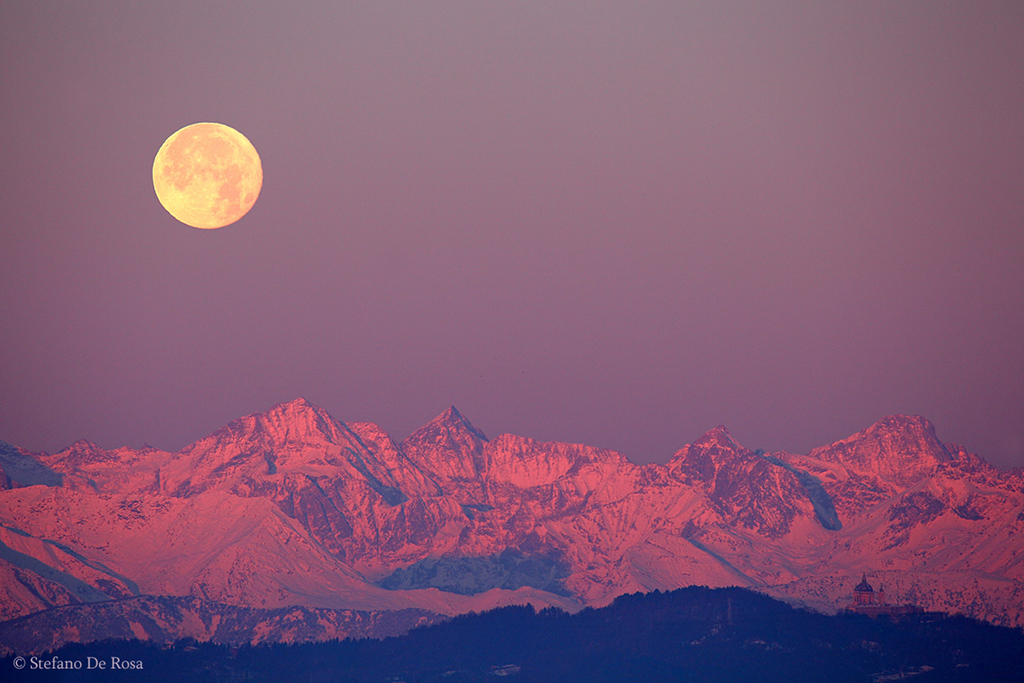
December's Full Moon phase occurred near perigee, the closest point in its orbit around our fair planet. Big and bright, the fully illuminated lunar disk sets over rugged mountains in this early morningscape from Turin, Italy. Captured just before sunrise on the opposite horizon, scattered sunlight near the edge of Earth's shadow provides the beautiful reddish glow of the alpine peaks. Hills in the foreground are still in shadow. But the scattered sunlight just illuminates the dome and towers of Turin's historic Basilica of Superga on a hilltop near the lower right in the telephoto frame. via NASA http://ift.tt/2BGwGG3

Dec 7, 2017

All the Eclipses of 2017 All the Eclipses of 2017


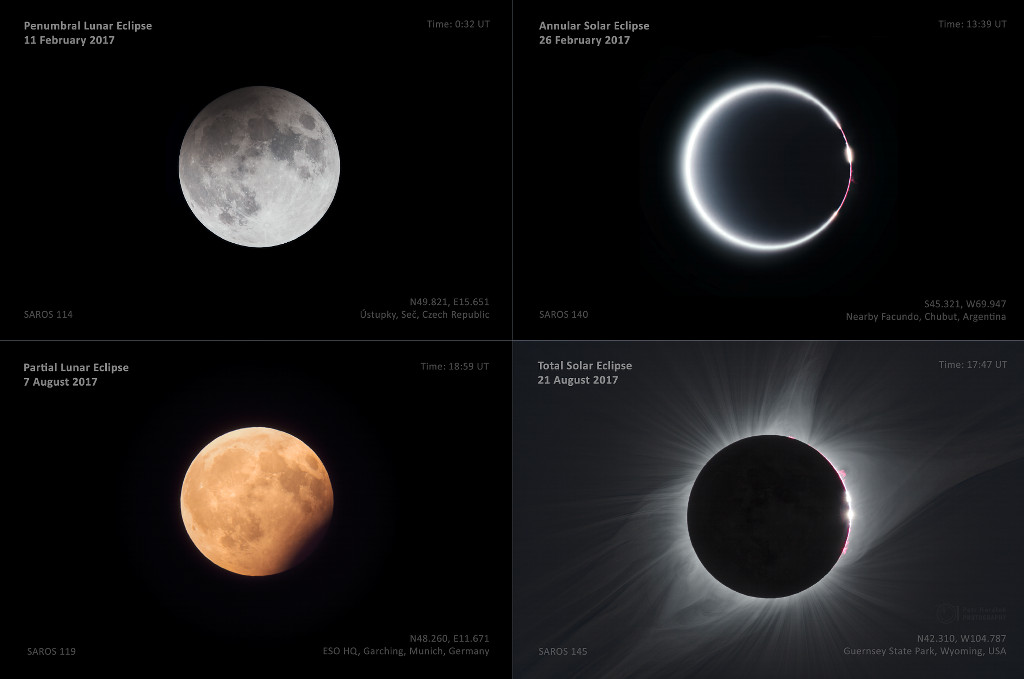
As seen from planet Earth, all the lunar and solar eclipses of 2017 are represented at the same scale in these four panels. The year's celestial shadow play was followed through four different countries by one adventurous eclipse chaser. To kick off the eclipse season, at top left February's Full Moon was captured from the Czech Republic. Its subtle shading, a penumbral lunar eclipse, is due to Earth's lighter outer shadow. Later that month the New Moon at top right was surrounded by a ring of fire, recorded on film from Argentina near the midpoint of striking annular solar eclipse. The August eclipse pairing below finds the Earth's dark umbral shadow in a partial eclipse from Germany at left, and the vibrant solar corona surrounding a totally eclipsed Sun from the western USA. If you're keeping score, the Saros numbers (eclipse cycles) for all the 2017 eclipses are at bottom left in each panel. via NASA http://ift.tt/2AAbJ0j

Dec 5, 2017

A Horizon with Blue and Red A Horizon with Blue and Red


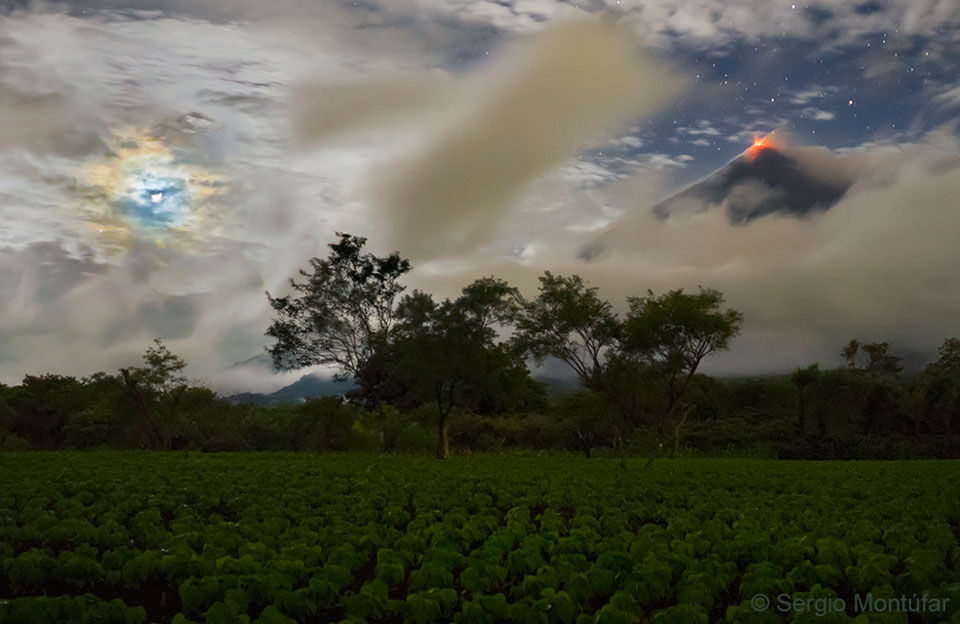
What's happening on the horizon? The horizon itself, past a spinach field in Guatemala, shows not only trees but a large volcano: the Volcán de Fuego (Volcano of Fire). The red glow at the top of the volcano is hot lava. But your eye may also be drawn to the blue circle above the horizon on the left. This circle surrounds the Moon and, together with other colors, is called a corona. A corona is caused by diffraction of light -- here moonlight -- by small water droplets in the Earth's intervening atmosphere. A break in the clouds on the right shows stars and even the planet Saturn far beyond the volcano. Although Volcán de Fuego frequently undergoes low-level activity, the astrophotographer considered himself lucky to capture the scene just during an explosive eruption in late September. via NASA http://ift.tt/2klfuTd

Dec 2, 2017

Messier Craters in Stereo Messier Craters in Stereo


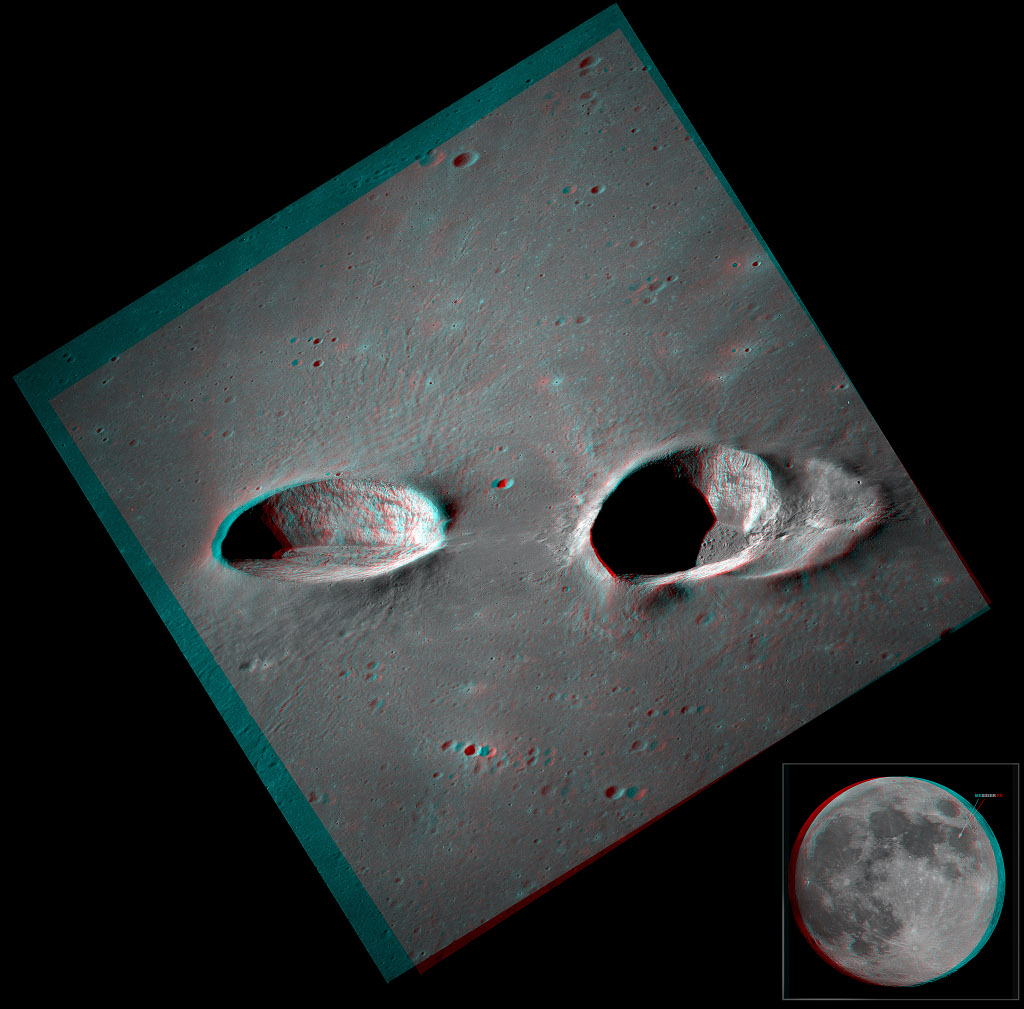
Many bright nebulae and star clusters in planet Earth's sky are associated with the name of astronomer Charles Messier, from his famous 18th century catalog. His name is also given to these two large and remarkable craters on the Moon. Standouts in the dark, smooth lunar Sea of Fertility or Mare Fecunditatis, Messier (left) and Messier A have dimensions of 15 by 8 and 16 by 11 kilometers respectively. Their elongated shapes are explained by a left-to-right moving, extremely shallow-angle trajectory followed by an impactor that gouged out the craters. The shallow impact also resulted in two bright rays of material extending along the surface to the right, beyond the picture. Intended to be viewed with red/blue glasses (red for the left eye), this striking stereo picture of the crater pair was recently created from high resolution scans of two images (AS11-42-6304, AS11-42-6305) taken during the Apollo 11 mission to the moon. via NASA http://ift.tt/2jBSk78

Dec 1, 2017

North America and the Pelican North America and the Pelican


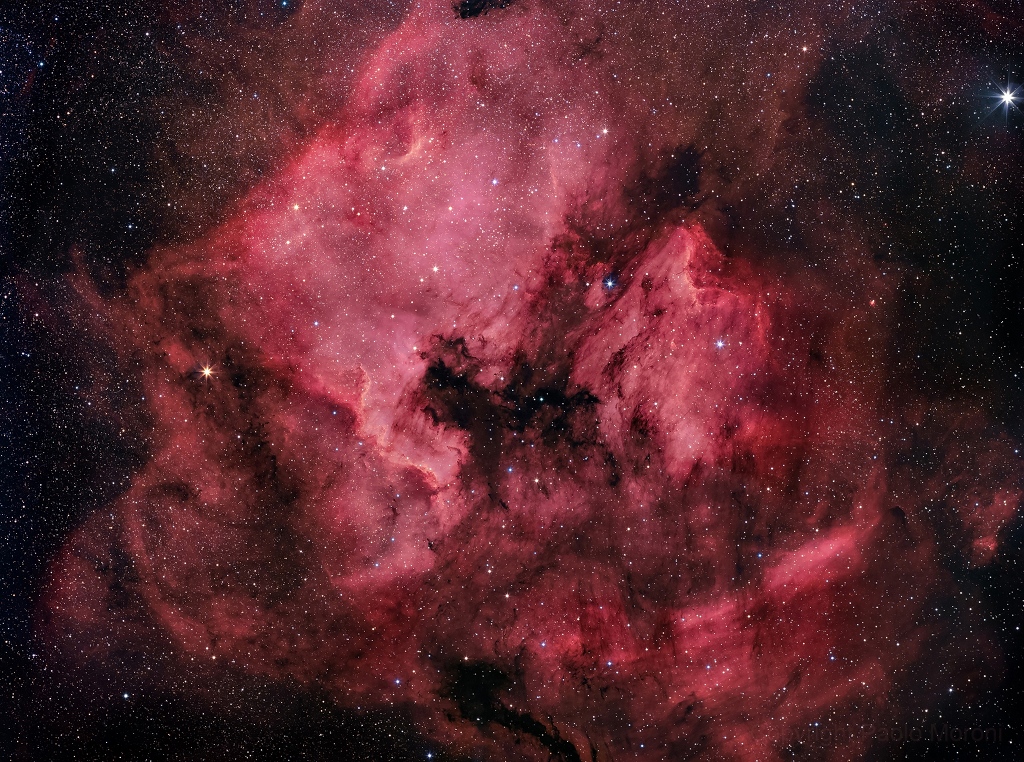
Fans of our fair planet might recognize the outlines of these cosmic clouds. On the left, bright emission outlined by dark, obscuring dust lanes seems to trace a continental shape, lending the popular name North America Nebula to the emission region cataloged as NGC 7000. To the right, just off the North America Nebula's east coast, is IC 5070, whose profile suggests the Pelican Nebula. The two bright nebulae are about 1,500 light-years away, part of the same large and complex star forming region, almost as nearby as the better-known Orion Nebula. At that distance, the 6 degree wide field of view would span 150 light-years. This careful cosmic portrait uses narrow band images to highlight the bright ionization fronts and the characteristic red glow from atomic hydrogen gas. These nebulae can be seen with binoculars from a dark location. Look northeast of bright star Deneb in the constellation of Cygnus the Swan. via NASA http://ift.tt/2jysEbh