Pages

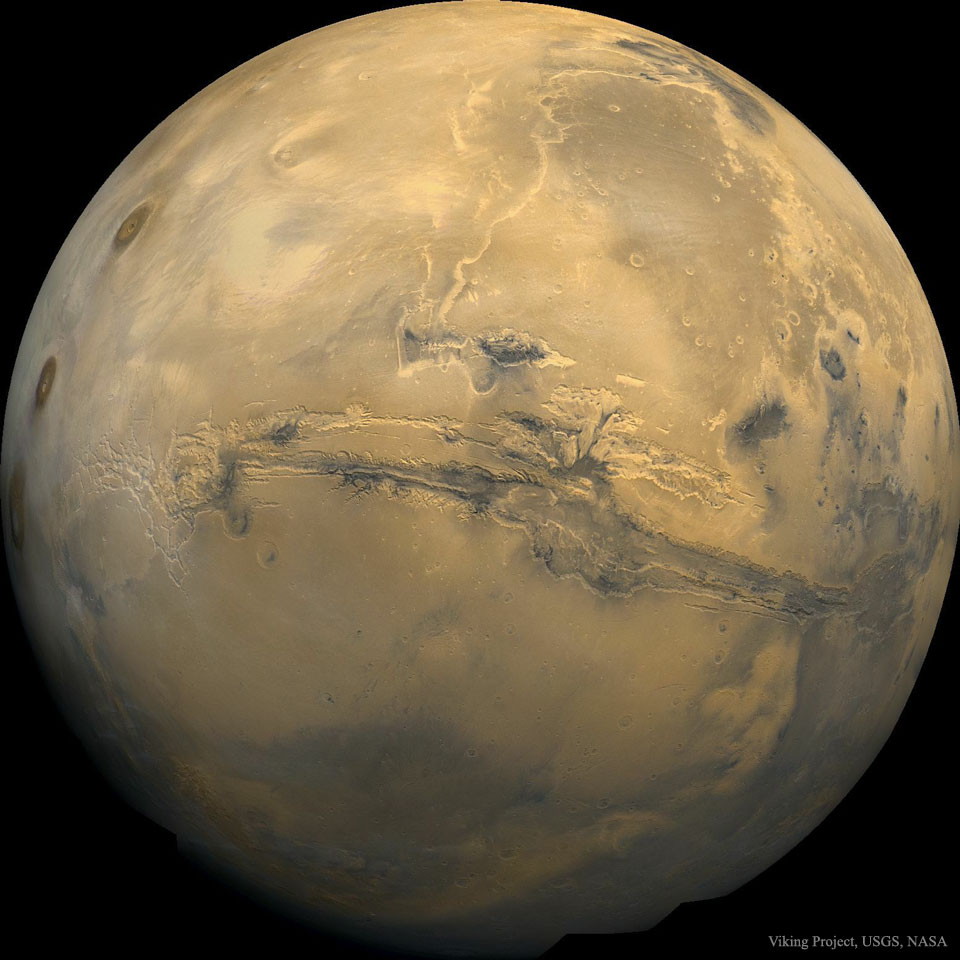
Valles Marineris: The Grand Canyon of Mars Valles Marineris: The Grand Canyon of Mars


Mars will look good in Earth's skies over the next few days -- but not this good. To get a view this amazing, a spacecraft had to actually visit the red planet. Running across the image center, though, is one the largest canyons in the Solar System. Named Valles Marineris, the grand valley extends over 3,000 kilometers long, spans as much as 600 kilometers across, and delves as much as 8 kilometers deep. By comparison, the Earth's Grand Canyon in Arizona, USA is 800 kilometers long, 30 kilometers across, and 1.8 kilometers deep. The origin of the Valles Marineris remains unknown, although a leading hypothesis holds that it started as a crack billions of years ago as the planet cooled. Several geologic processes have been identified in the canyon. The featured mosaic was created from over 100 images of Mars taken by Viking Orbiters in the 1970s. Tomorrow, Mars and Earth will pass the closest in 11 years, resulting in the red planet being quite noticeable toward the southeast after sunset. via NASA http://ift.tt/24eIt5s

Cat s Eye Wide and Deep Cat s Eye Wide and Deep


The Cat's Eye Nebula (NGC 6543) is one of the best known planetary nebulae in the sky. Its more familiar outlines are seen in the brighter central region of the nebula in this impressive wide-angle view. But the composite image combines many short and long exposures to also reveal an extremely faint outer halo. At an estimated distance of 3,000 light-years, the faint outer halo is over 5 light-years across. Planetary nebulae have long been appreciated as a final phase in the life of a sun-like star. More recently, some planetary nebulae are found to have halos like this one, likely formed of material shrugged off during earlier episodes in the star's evolution. While the planetary nebula phase is thought to last for around 10,000 years, astronomers estimate the age of the outer filamentary portions of this halo to be 50,000 to 90,000 years. Visible on the left, some 50 million light-years beyond the watchful planetary nebula, lies spiral galaxy NGC 6552. via NASA http://ift.tt/1XXfRhn

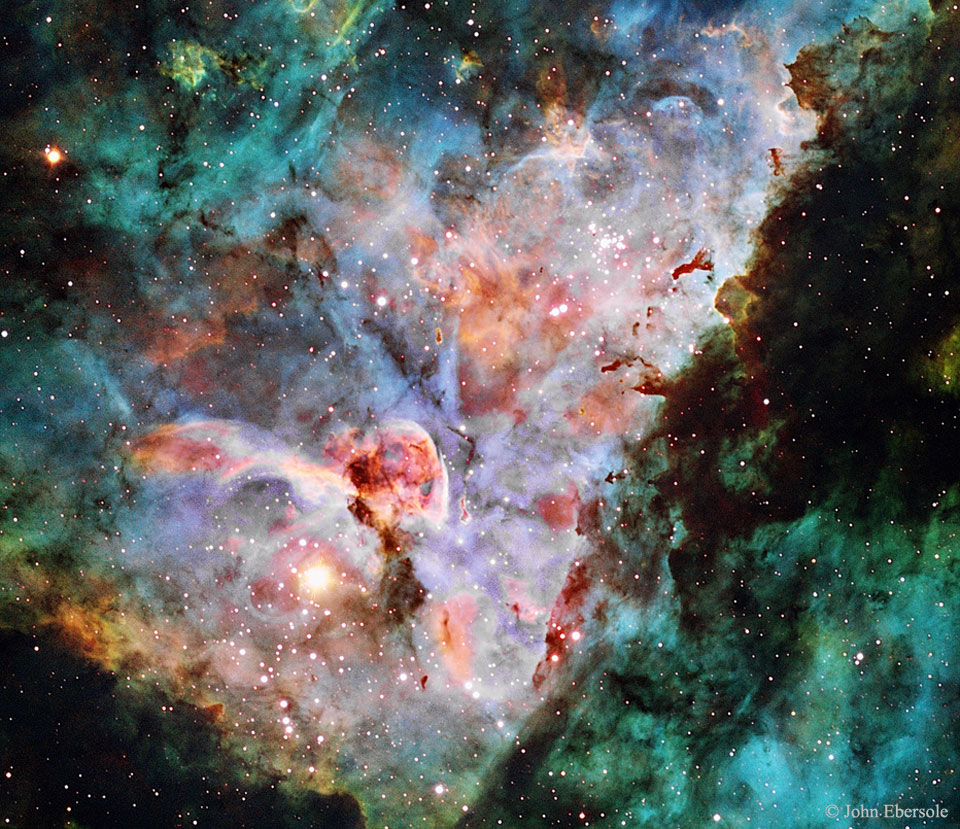
The Great Carina Nebula The Great Carina Nebula


A jewel of the southern sky, the Great Carina Nebula, also known as NGC 3372, spans over 300 light-years, one of our galaxy's largest star forming regions. Like the smaller, more northerly Great Orion Nebula, the Carina Nebula is easily visible to the unaided eye, though at a distance of 7,500 light-years it is some 5 times farther away. This gorgeous telescopic close-up reveals remarkable details of the region's central glowing filaments of interstellar gas and obscuring cosmic dust clouds. The field of view is over 50 light-years across. The Carina Nebula is home to young, extremely massive stars, including the stars of open cluster Trumpler 14 (below and right of center) and the still enigmatic variable Eta Carinae, a star with well over 100 times the mass of the Sun. Eta Carinae is the brightest star, seen here just above the dusty Keyhole Nebula (NGC 3324). While Eta Carinae itself maybe on the verge of a supernova explosion, X-ray images indicate that the Great Carina Nebula has been a veritable supernova factory. via NASA http://ift.tt/1ORra3a

IC 5067 in the Pelican Nebula IC 5067 in the Pelican Nebula


The prominent ridge of emission featured in this sharp, colorful skyscape is cataloged as IC 5067. Part of a larger emission nebula with a distinctive shape, popularly called The Pelican Nebula, the ridge spans about 10 light-years following the curve of the cosmic pelican's head and neck. This false-color view also translates the pervasive glow of narrow emission lines from atoms in the nebula to a color palette made popular in Hubble Space Telescope images of star forming regions. Fantastic, dark shapes inhabiting the 1/2 degree wide field are clouds of cool gas and dust sculpted by the winds and radiation from hot, massive stars. Close-ups of some of the sculpted clouds show clear signs of newly forming stars. The Pelican Nebula, itself cataloged as IC 5070, is about 2,000 light-years away. To find it, look northeast of bright star Deneb in the high flying constellation Cygnus. via NASA http://ift.tt/1qLt7rO

NGC 5078 and Friends NGC 5078 and Friends


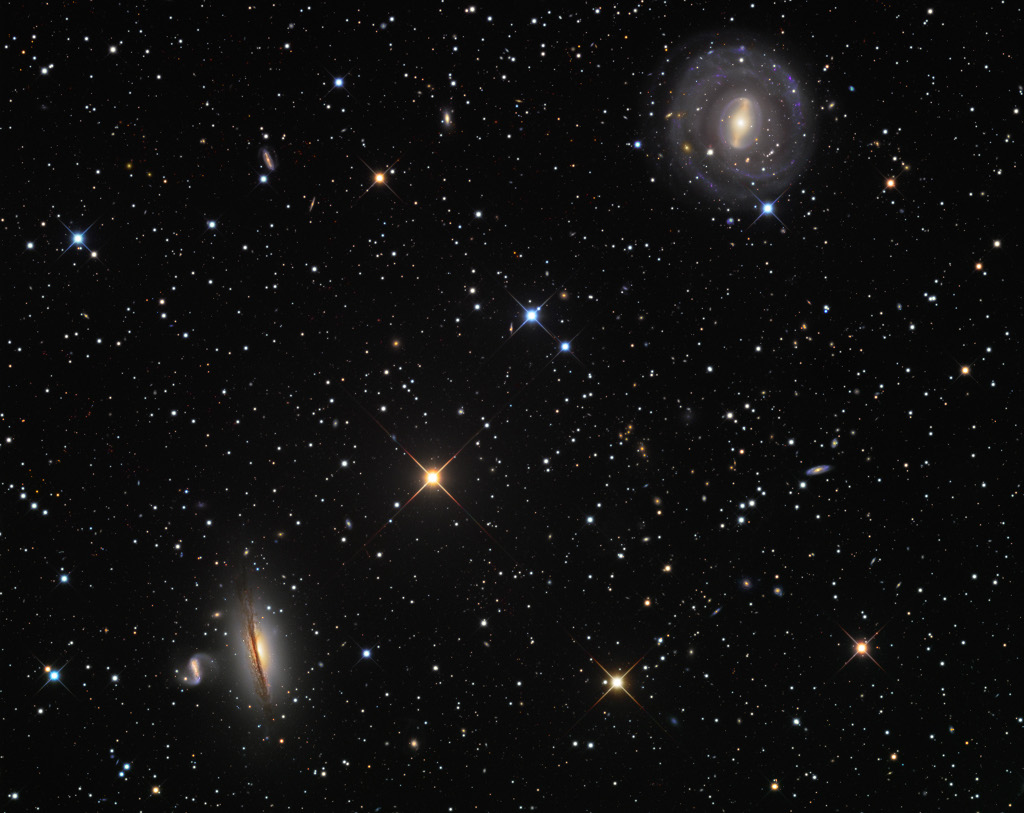
This sharp telescopic field of view holds two bright galaxies. Barred spiral NGC 5101 (top right) and nearly edge-on system NGC 5078 are separated on the sky by about 0.5 degrees or about the apparent width of a full moon. Found within the boundaries of the serpentine constellation Hydra, both are estimated to be around 90 million light-years away and similar in size to our own large Milky Way galaxy. In fact, if they both lie at the same distance their projected separation would be only 800,000 light-years or so. That's easily less than half the distance between the Milky Way and the Andromeda Galaxy. NGC 5078 is interacting with a smaller companion galaxy, cataloged as IC 879, seen just left of the larger galaxy's bright core. Even more distant background galaxies are scattered around the colorful field. Some are even visible right through the face-on disk of NGC 5101. But the prominent spiky stars are in the foreground, well within our own Milky Way. via NASA http://ift.tt/1WOiTos

Milky Way Over the Spanish Peaks Milky Way Over the Spanish Peaks


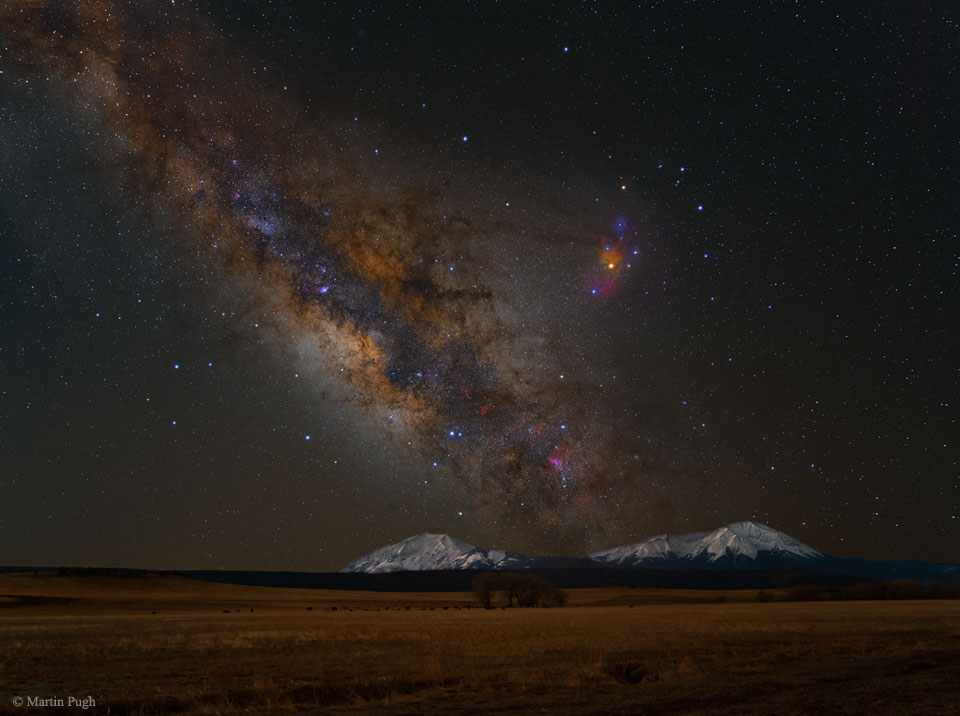
That's not lightning, and it did not strike between those mountains. The diagonal band is actually the central band of our Milky Way Galaxy, while the twin peaks are actually called the Spanish Peaks -- but located in Colorado, USA. Although each Spanish peak is composed of a slightly different type of rock, both are approximately 25 million years old. This serene yet spirited image composite was meticulously created by merging a series of images all taken from the same location on one night and early last month. In the first series of exposures, the background sky was built up, with great detail being revealed in the Milky Way dust lanes as well as the large colorful region surrounding the star Rho Ophiuchus just right of center. One sky image, though, was taken using a fogging filter so that brighter stars would appear more spread out and so more prominent. As a bonus, the planets Mars and Saturn are placed right above peaks and make an orange triangle with the bright star Antares. Later that night, after the moonrise, the Moon itself naturally illuminated the snow covered mountain tops. via NASA http://ift.tt/1TwOTI0

Inside a Daya Bay Antineutrino Detector Inside a Daya Bay Antineutrino Detector


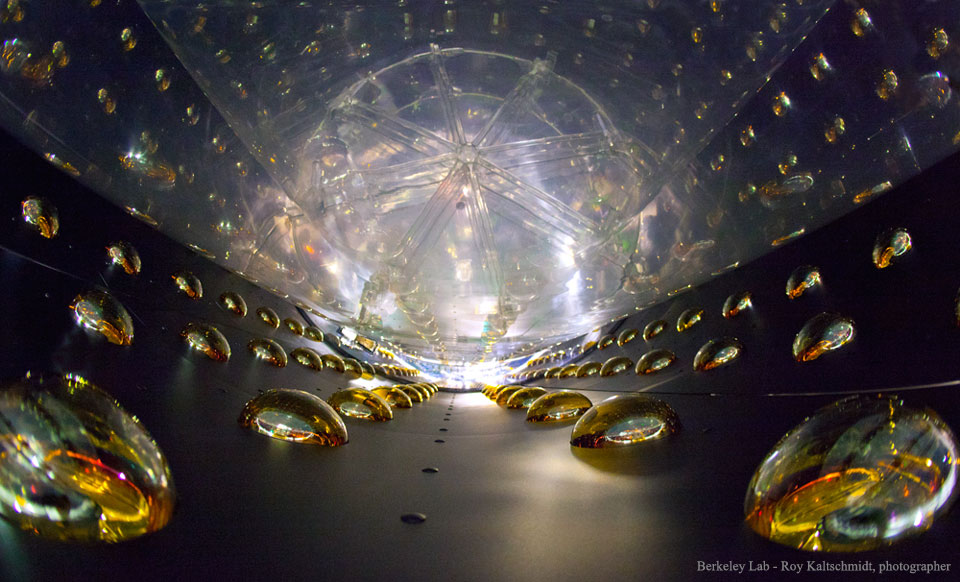
Why is there more matter than antimatter in the Universe? To better understand this facet of basic physics, energy departments in China and the USA led in the creation of the Daya Bay Reactor Neutrino Experiment. Located under thick rock about 50 kilometers northeast of Hong Kong, China, eight Daya Bay detectors monitor antineutrinos emitted by six nearby nuclear reactors. Featured here, a camera looks along one of the Daya Bay detectors, imaging photon sensors that pick up faint light emitted by antineutrinos interacting with fluids in the detector. Early results indicate an unexpectedly high rate of one type of antineutrino changing into another, a rate which, if confirmed, could imply the existence of a previously undetected type of neutrino as well as impact humanity's comprehension of fundamental particle reactions that occurred within the first few seconds of the Big Bang. via NASA http://ift.tt/25bsp6Q

LL Orionis: When Cosmic Winds Collide LL Orionis: When Cosmic Winds Collide


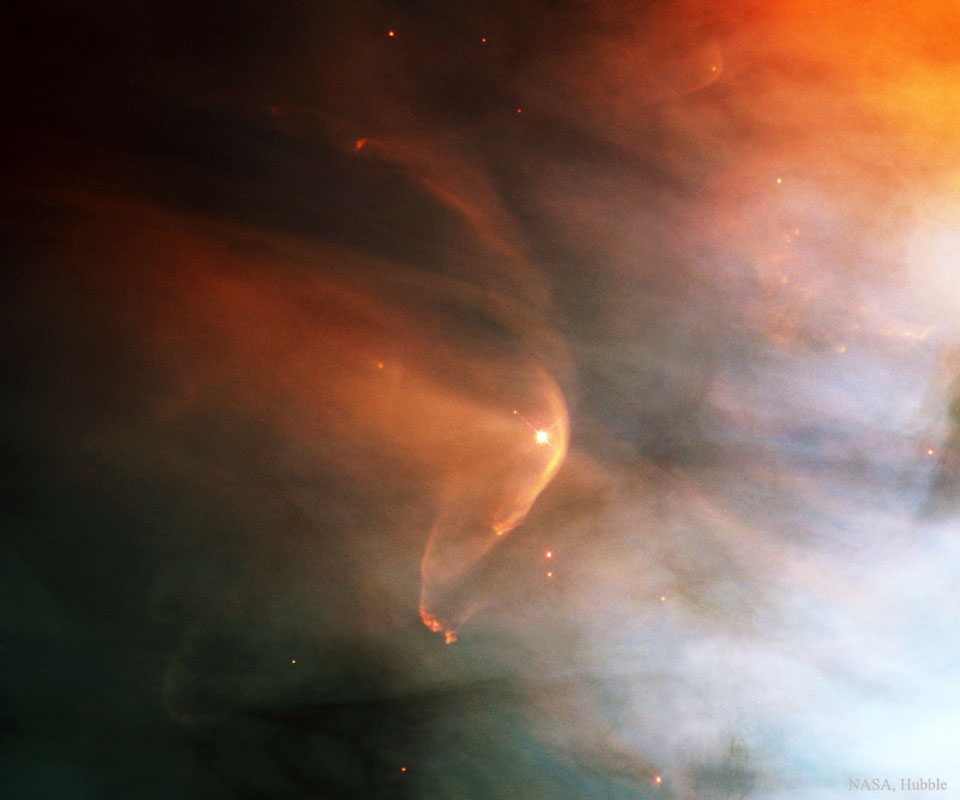
What created this great arc in space? This arcing, graceful structure is actually a bow shock about half a light-year across, created as the wind from young star LL Orionis collides with the Orion Nebula flow. Adrift in Orion's stellar nursery and still in its formative years, variable star LL Orionis produces a wind more energetic than the wind from our own middle-aged sun. As the fast stellar wind runs into slow moving gas a shock front is formed, analogous to the bow wave of a boat moving through water or a plane traveling at supersonic speed. The slower gas is flowing away from the Orion Nebula's hot central star cluster, the Trapezium, located off the lower right hand edge of the picture. In three dimensions, LL Ori's wrap-around shock front is shaped like a bowl that appears brightest when viewed along the "bottom" edge. The complex stellar nursery in Orion shows a myriad of similar fluid shapes associated with star formation, including the bow shock surrounding a faint star at the upper right. Part of a mosaic covering the Great Nebula in Orion, this composite color image was recorded in 1995 by the Hubble Space Telescope. via NASA http://ift.tt/25g4UwZ

Milky Way and Planets Near Opposition Milky Way and Planets Near Opposition


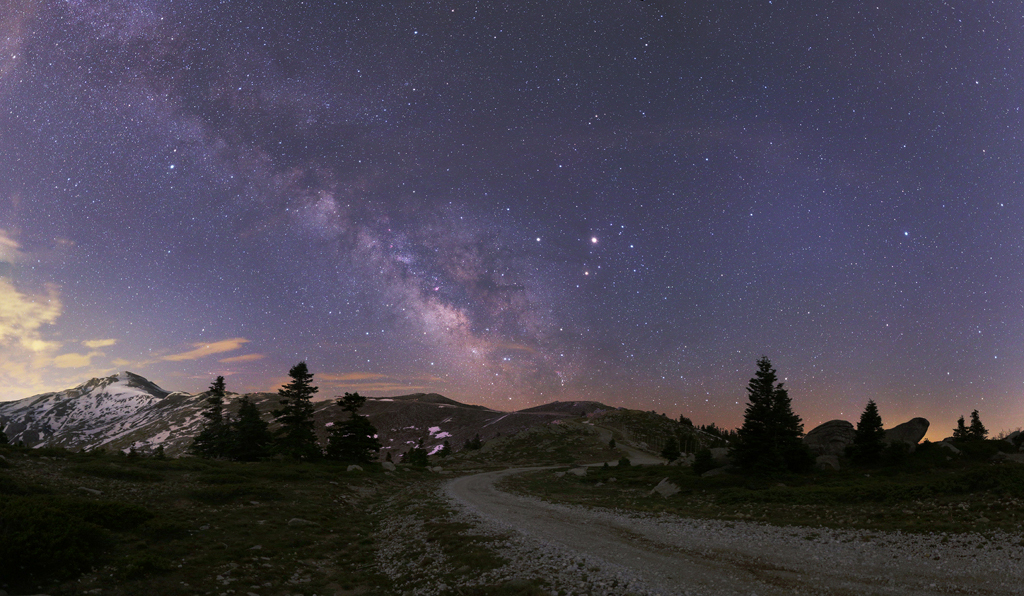
In this early May night skyscape, a mountain road near Bursa, Turkey seems to lead toward bright planets Mars and Saturn and the center of our Milky Way Galaxy, a direction nearly opposite the Sun in planet Earth's sky. The brightest celestial beacon on the scene, Mars, reaches its opposition tonight and Saturn in early June. Both will remain nearly opposite the Sun, up all night and close to Earth for the coming weeks, so the time is right for good telescopic viewing. Mars and Saturn form the tight celestial triangle with red giant star Antares just right of the Milky Way's central bulge. But tonight the Moon is also at opposition. Easy to see near bright Mars and Saturn, the Full Moon's light will wash out the central Milky Way's fainter starlight though, even in dark mountain skies. via NASA http://ift.tt/257Pojj

3D Mercury Transit 3D Mercury Transit


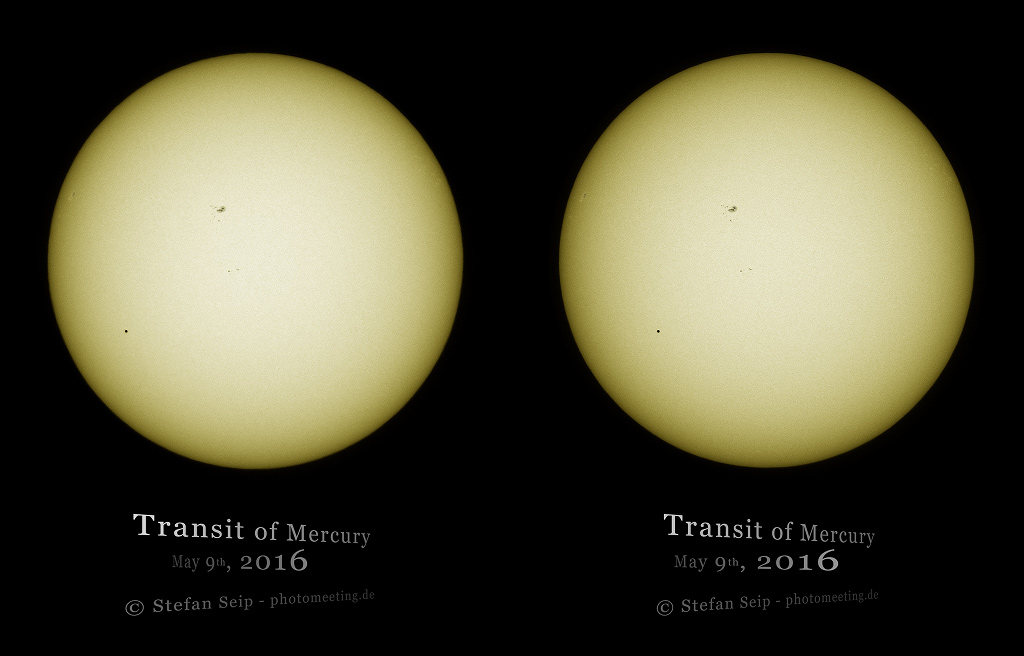
On May 9, innermost planet Mercury crossed IN FRONT of the Sun. Though pictures project the event in only two dimensions, a remarkable three dimensional perspective on the transit is possible by free viewing this stereo pair. The images were made 23 minutes apart and rotated so that Mercury's position shifts horizontally between the two. As a result, Mercury's orbital motion produced an exaggerated parallax simulating binocular vision. Between the two exposures, the appropriately named planet's speedy 47.4 kilometer per second orbital velocity actually carried it over 65,000 kilometers. Taken first, the left image is intended for the right eye, so a cross-eyed view is needed to see Mercury's tiny silhouette suspended in the foreground. Try it. Merging the text below the images helps. via NASA http://ift.tt/20eTfaS

The Surface of Europa The Surface of Europa


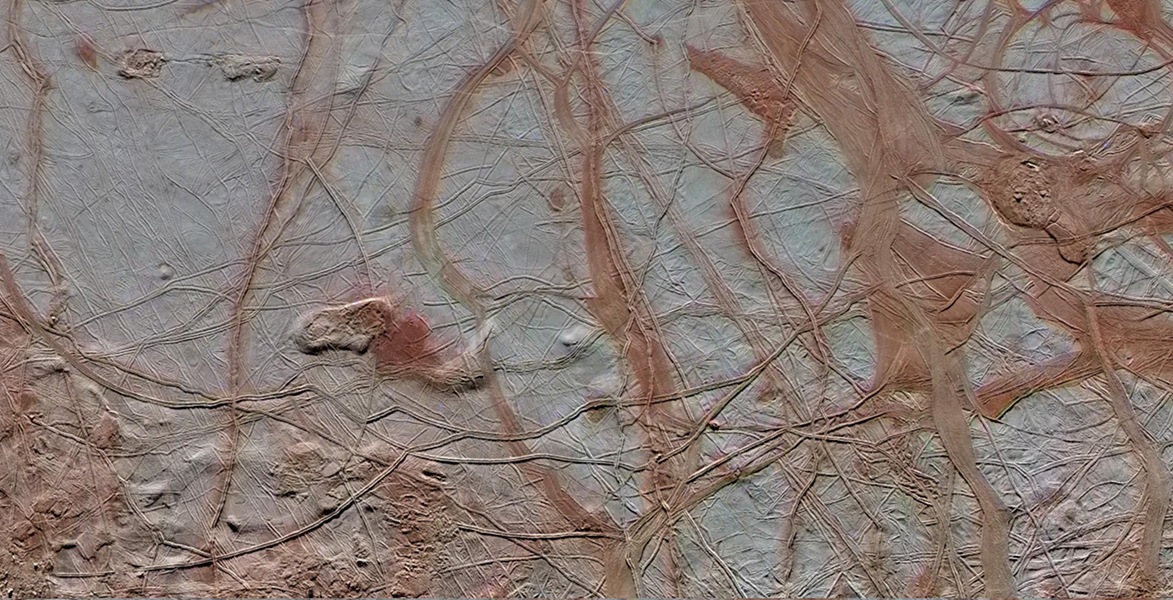
An enhanced-color view, this image covers a 350 by 750 kilometer swath across the surface of Jupiter's tantalizing moon Europa. The close-up combines high-resolution image data with lower resolution color data from observations made in 1998 by the Galileo spacecraft. Smooth ice plains, long fractures, and jumbled blocks of chaos terrain are thought to hide a deep ocean of salty liquid water beneath. Though the ice-covered alien ocean world is outside the Solar System's habitable zone, new studies show the potential chemistry driving its oxygen and hydrogen production, a key indicator of the energy available for life, could produce amounts comparable in scale to planet Earth. Hydrogen would be generated by chemical reactions of the salty water in contact with the rocky ocean floor. Oxygen and other compounds that react with hydrogen would come from Europa's surface. There water ice molecules would be split apart by the intense flux of high-energy radiation from Jupiter and cycled into the Europan ocean from above. via NASA http://ift.tt/1U1G3kW

Halo from Atacama Halo from Atacama


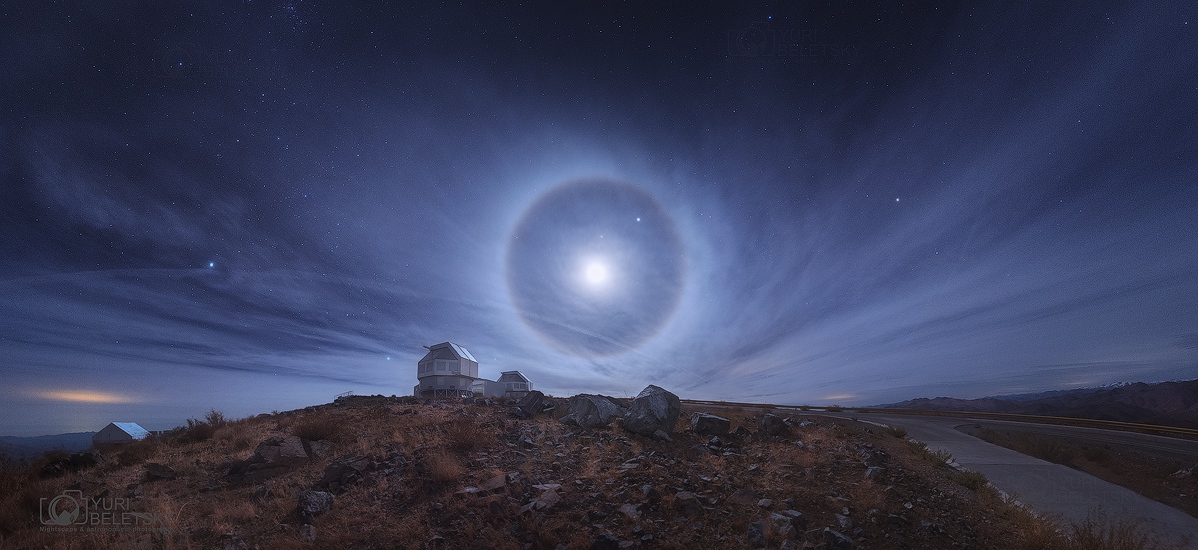
Influenced by the strong Pacific El Nino, cloudy skies have more often come to Chile's high Atacama Desert this season, despite its reputation as an astronomer's paradise. Located in one of the driest, darkest places on planet Earth, domes of the region's twin 6.5 meter Magellan telescopes of Carnegie Las Campanas Observatory were closed on May 13. Still, a first quarter Moon and bright stars shine through in this panoramic night skyscape, the lunar disk surrounded by a beautiful, bright halo. The angular radius of the halo is 22 degrees. Not determined by the brightness or phase of the Moon itself, the angle is set by the hexagonal geometry of atmospheric ice crystals that reflect and refract the moonlight. On that night, the brilliant star just inside the halo's radius was really planet Jupiter. The brightest star flanking the halo to the far left is Canopus, with Arcturus on the halo's right. via NASA http://ift.tt/1YBQOP5

The Orion Nebula in Visible and Infrared The Orion Nebula in Visible and Infrared


The Great Nebula in Orion is a colorful place. Visible to the unaided eye, it appears as a small fuzzy patch in the constellation of Orion. Long exposure, multi-wavelength images like this, however, show the Orion Nebula to be a busy neighborhood of young stars, hot gas, and dark dust. This digital composite features not only three colors of visible light but four colors of infrared light taken by NASA's orbiting Spitzer Space Telescope as well. The power behind much of the Orion Nebula (M42) is the Trapezium - four of the brightest stars in the nebula. Many of the filamentary structures visible are actually shock waves - fronts where fast moving material encounters slow moving gas. The Orion Nebula spans about 40 light years and is located about 1500 light years away in the same spiral arm of our Galaxy as the Sun. via NASA http://ift.tt/201tJWu

Clouds of the Carina Nebula Clouds of the Carina Nebula


What forms lurk in the mists of the Carina Nebula? The dark ominous figures are actually molecular clouds, knots of molecular gas and dust so thick they have become opaque. In comparison, however, these clouds are typically much less dense than Earth's atmosphere. Featured here is a detailed image of the core of the Carina Nebula, a part where both dark and colorful clouds of gas and dust are particularly prominent. The image was captured last month from Siding Spring Observatory in Australia. Although the nebula is predominantly composed of hydrogen gas -- here colored green, the image was assigned colors so that light emitted by trace amounts of sulfur and oxygen appear red and blue, respectively. The entire Carina Nebula, cataloged as NGC 3372, spans over 300 light years and lies about 7,500 light-years away in the constellation of Carina. Eta Carinae, the most energetic star in the nebula, was one of the brightest stars in the sky in the 1830s, but then faded dramatically. via NASA http://ift.tt/1ThxMNQ

Milky Way Over Quiver Tree Forest Milky Way Over Quiver Tree Forest


In front of a famous background of stars and galaxies lies some of Earth's more unusual trees. Known as quiver trees, they are actually succulent aloe plants that can grow to tree-like proportions. The quiver tree name is derived from the historical usefulness of their hollowed branches as dart holders. Occurring primarily in southern Africa, the trees pictured in the above 16-exposure composite are in Quiver Tree Forest located in southern Namibia. Some of the tallest quiver trees in the park are estimated to be about 300 years old. Behind the trees is light from the small town of Keetmanshoop, Namibia. Far in the distance, arching across the background, is the majestic central band of our Milky Way Galaxy. Even further in the distance, visible on the image left, are the Large and Small Magellanic Clouds, smaller satellite galaxies of the Milky Way that are prominent in the skies of Earth's southern hemisphere. via NASA http://ift.tt/22aLpAJ

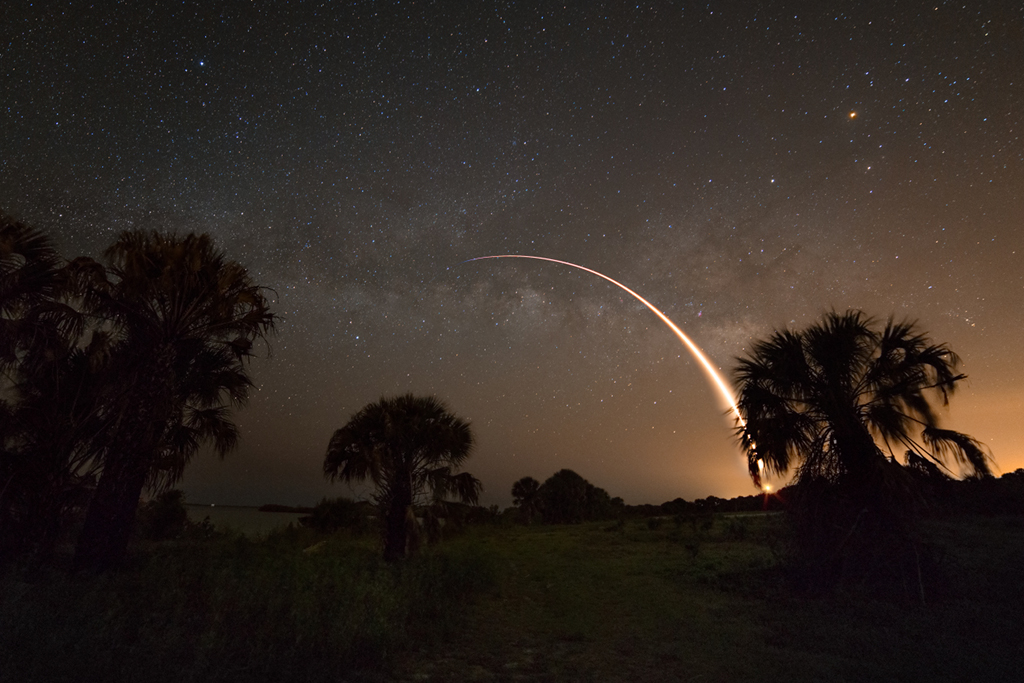
Falcon 9 and Milky Way Falcon 9 and Milky Way


On May 6, the after midnight launch of a SpaceX Falcon 9 rocket lit up dark skies over Merritt Island, planet Earth. Its second stage bound for Earth orbit, the rocket's arc seems to be on course for the center of the Milky Way in this pleasing composite image looking toward the southeast. Two consecutive exposures made with camera fixed to a tripod were combined to follow rocket and home galaxy. A 3 minute long exposure at low sensitivity allowed the rocket's first stage burn to trace the bright orange arc and a 30 second exposure at high sensitivity captured the stars and the faint Milky Way. Bright orange Mars dominates the starry sky at the upper right. A few minutes later, booster engines were restarted and the Falcon 9's first stage headed for a landing on the autonomous spaceport drone ship Of Course I Still Love You, patiently waiting in the Atlantic 400 miles east of the Cape Canaveral launch site. via NASA http://ift.tt/27mf1yT

ISS and Mercury Too ISS and Mercury Too


Transits of Mercury are relatively rare. Monday's leisurely 7.5 hour long event was only the 2nd of 14 Mercury transits in the 21st century. If you're willing to travel, transits of the International Space Station can be more frequent though, and much quicker. This sharp video frame composite was taken from a well-chosen location in Philadelphia, USA. It follows the space station, moving from upper right to lower left, as it crossed the Sun's disk in 0.6 seconds. Mercury too is included as the small, round, almost stationary silhouette just below center. In apparent size, the International Space Station looms larger from low Earth orbit, about 450 kilometers from Philadelphia. Mercury was about 84 million kilometers away. (Editor's note: The stunning video includes another double transit, Mercury and a Pilatus PC12 aircraft. Even quicker than the ISS to cross the Sun, the aircraft was about 1 kilometer away.) via NASA http://ift.tt/1rJM3bK

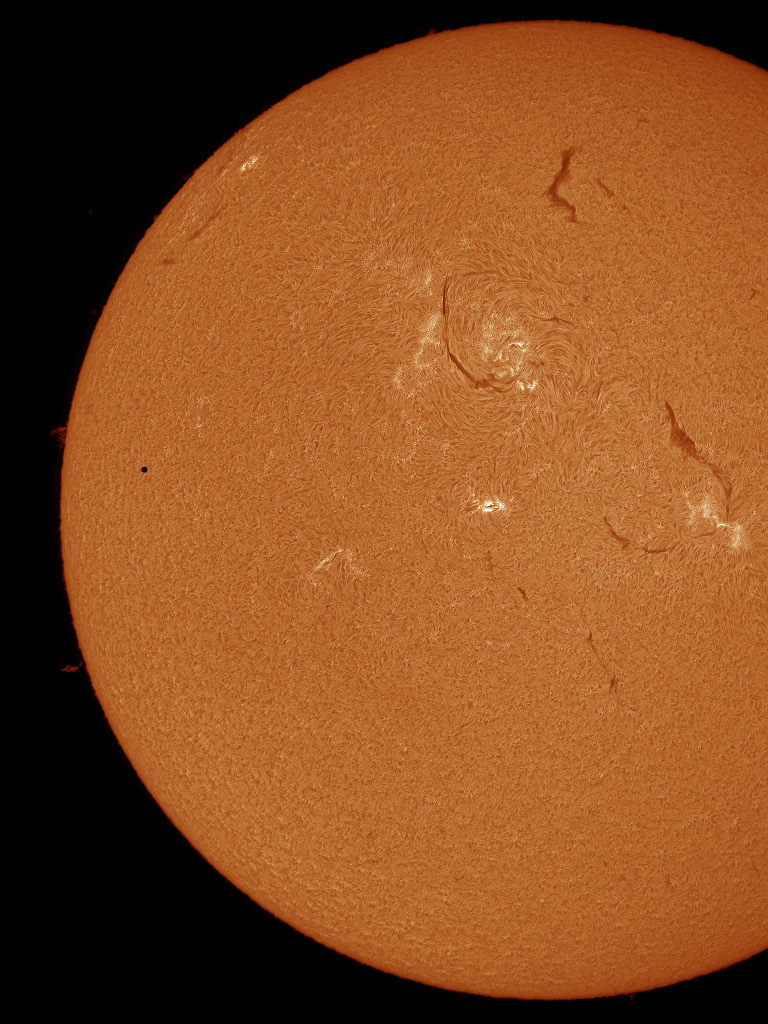
A Transit of Mercury A Transit of Mercury


On May 9, the diminutive disk of Mercury spent about seven and a half hours crossing in front of the Sun as viewed from the general vicinity of Earth. It was the second of 14 transits of the Solar System's innermost planet in the 21st century. Captured from Fulham, London, England, planet Earth the tiny silhouette shares the enormous solar disk with prominences, filaments, and active regions in this sharp image. But Mercury's round disk (left of center) appears to be the only dark spot, despite the planet-sized sunspots scattered across the Sun. Made with an H-alpha filter that narrowly transmits the red light from hydrogen atoms, the image emphasizes the chromosphere, stretching above the photosphere or normally visible solar surface. In H-alpha pictures of the chromosphere, normally dark sunspot regions are dominated by bright splotches called plages. via NASA http://ift.tt/1TcE1Bd