Pages

Fermi's Gamma-ray Moon Fermi's Gamma-ray Moon


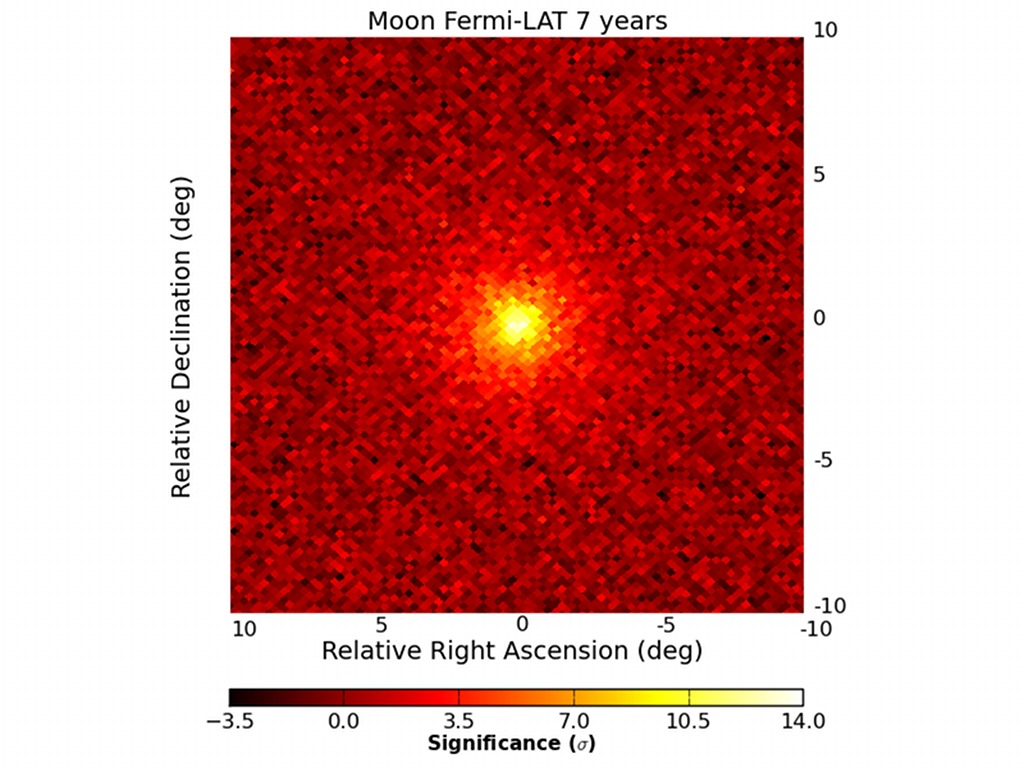
If you could only see gamma-rays, photons with up to a billion or more times the energy of visible light, the Moon would be brighter than the Sun! That startling notion underlies this novel image of the Moon, based on data collected by the Fermi Gamma-ray Space Telescope's Large Area Telescope (LAT) instrument during its first seven years of operation (2008-2015). Fermi's gamma-ray vision doesn't distinguish details on the lunar surface, but a gamma-ray glow consistent with the Moon's size and position is clearly found at the center of the false color map. The brightest pixels correspond to the most significant detections of lunar gamma-rays. Why is the gamma-ray Moon so bright? High-energy charged particles streaming through the Solar System known as cosmic rays constantly bombard the lunar surface, unprotected by a magnetic field, generating the gamma-ray glow. Because the cosmic rays come from all sides, the gamma-ray Moon is always full and does not go through phases. The first gamma-ray image of the Moon was captured by the EGRET instrument onboard the Compton Gamma-ray Observatory, launched 25 years ago. via NASA http://ift.tt/1NFCW5y

A Dust Angel Nebula A Dust Angel Nebula


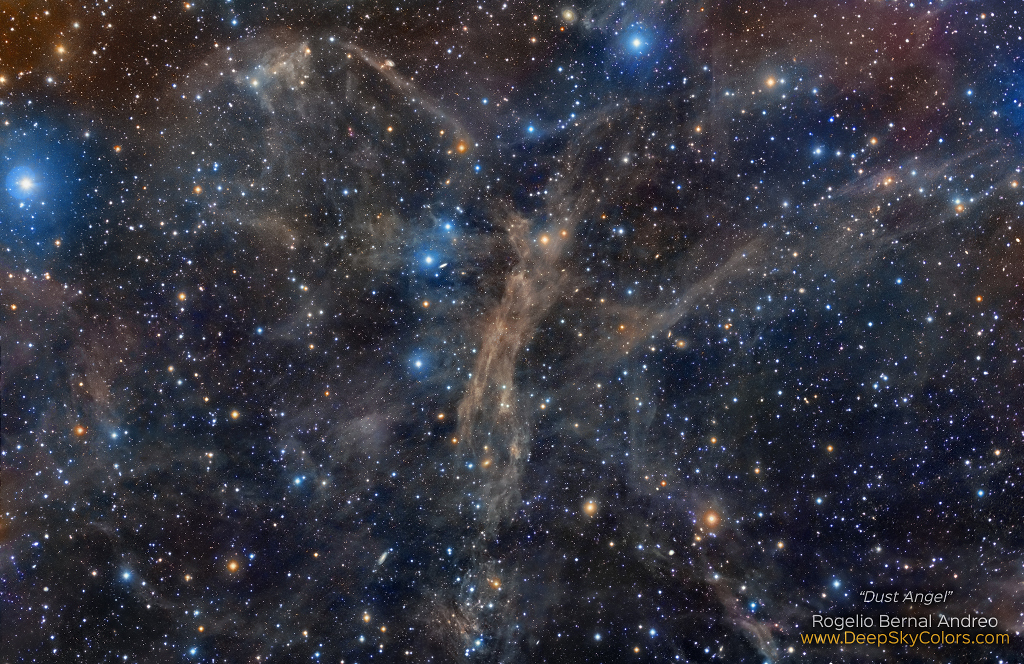
The combined light of stars along the Milky Way are reflected by these cosmic dust clouds that soar some 300 light-years or so above the plane of our galaxy. Dubbed the Angel Nebula, the faint apparition is part of an expansive complex of dim and relatively unexplored, diffuse molecular clouds. Commonly found at high galactic latitudes, the dusty galactic cirrus can be traced over large regions toward the North and South Galactic poles. Along with the refection of starlight, studies indicate the dust clouds produce a faint reddish luminescence, as interstellar dust grains convert invisible ultraviolet radiation to visible red light. Also capturing nearby Milky Way stars and an array of distant background galaxies, the deep, wide-field 3x5 degree image spans about 10 Full Moons across planet Earth's sky toward the constellation Ursa Major. via NASA http://ift.tt/1QCgbtZ

Omega Centauri: The Brightest Globular Star Cluster Omega Centauri: The Brightest Globular Star Cluster


This huge ball of stars predates our Sun. Long before humankind evolved, before dinosaurs roamed, and even before our Earth existed, ancient globs of stars condensed and orbited a young Milky Way Galaxy. Of the 200 or so globular clusters that survive today, Omega Centauri is the largest, containing over ten million stars. Omega Centauri is also the brightest globular cluster, at apparent visual magnitude 3.9 it is visible to southern observers with the unaided eye. Cataloged as NGC 5139, Omega Centauri is about 18,000 light-years away and 150 light-years in diameter. Unlike many other globular clusters, the stars in Omega Centauri show several different ages and trace chemical abundances, indicating that the globular star cluster has a complex history over its 12 billion year age. via NASA http://ift.tt/1WpI4MP

NGC 6872: A Stretched Spiral Galaxy NGC 6872: A Stretched Spiral Galaxy


What makes this spiral galaxy so long? Measuring over 700,000 light years across from top to bottom, NGC 6872, also known as the Condor galaxy, is one of the most elongated barred spiral galaxies known. The galaxy's protracted shape likely results from its continuing collision with the smaller galaxy IC 4970, visible just above center. Of particular interest is NGC 6872's spiral arm on the upper left, as pictured here, which exhibits an unusually high amount of blue star forming regions. The light we see today left these colliding giants before the days of the dinosaurs, about 300 million years ago. NGC 6872 is visible with a small telescope toward the constellation of the Peacock (Pavo). via NASA http://ift.tt/1reZNLn

Simeis 147: Supernova Remnant Simeis 147: Supernova Remnant


It's easy to get lost following the intricate strands of the Spaghetti Nebula. A supernova remnant cataloged as Simeis 147 and Sh2-240, the glowing gas filaments cover nearly 3 degrees -- 6 full moons -- on the sky. That's about 150 light-years at the stellar debris cloud's estimated distance of 3,000 light-years. This sharp composite includes image data taken through a narrow-band filter to highlight emission from hydrogen atoms tracing the shocked, glowing gas. The supernova remnant has an estimated age of about 40,000 years, meaning light from the massive stellar explosion first reached Earth about 40,000 years ago. But the expanding remnant is not the only aftermath. The cosmic catastrophe also left behind a spinning neutron star or pulsar, all that remains of the original star's core. via NASA http://ift.tt/1rcmIXv

M16: Pillars of Star Creation M16: Pillars of Star Creation


Newborn stars are forming in the Eagle Nebula. This image, taken with the Hubble Space Telescope in 1995, shows evaporating gaseous globules (EGGs) emerging from pillars of molecular hydrogen gas and dust. The giant pillars are light years in length and are so dense that interior gas contracts gravitationally to form stars. At each pillars' end, the intense radiation of bright young stars causes low density material to boil away, leaving stellar nurseries of dense EGGs exposed. The Eagle Nebula, associated with the open star cluster M16, lies about 7000 light years away. The pillars of creation were imaged again in 2007 by the orbiting Spitzer Space Telescope in infrared light, leading to the conjecture that the pillars may already have been destroyed by a local supernova, but light from that event has yet to reach the Earth. via NASA http://ift.tt/1WPb4Ow

Milky Way in Moonlight Milky Way in Moonlight


A waning crescent moon, early morning twilight, and Al Hamra's city lights on the horizon can't hide the central Milky Way in this skyscape from planet Earth. Captured in a single exposure, the dreamlike scene looks southward across the region's grand canyon from Jabal Shams (Sun Mountain), near the highest peak in Oman, on the Arabian Peninsula. Mist, moonlight, and shadows still play along the steep canyon walls. Dark rifts along the luminous band of the Milky Way are the galaxy's cosmic dust clouds. Typically hundreds of light-years distant, they obscure starlight along the galactic plane, viewed edge-on from the Solar System's perspective. via NASA http://ift.tt/1SDb1W1

NGC 7635: The Bubble Nebula NGC 7635: The Bubble Nebula


Blown by the wind from a massive star, this interstellar apparition has a surprisingly familiar shape. Cataloged as NGC 7635, it is also known simply as The Bubble Nebula. Although it looks delicate, the 7 light-year diameter bubble offers evidence of violent processes at work. Above and left of the Bubble's center is a hot, O-type star, several hundred thousand times more luminous and around 45 times more massive than the Sun. A fierce stellar wind and intense radiation from that star has blasted out the structure of glowing gas against denser material in a surrounding molecular cloud. The intriguing Bubble Nebula and associated cloud complex lie a mere 7,100 light-years away toward the boastful constellation Cassiopeia. This sharp, tantalizing view of the cosmic bubble is a composite of Hubble Space Telescope image data from 2016, released to celebrate the 26th anniversary of Hubble's launch. via NASA http://ift.tt/1WK50qB

The Comet the Owl and the Galaxy The Comet the Owl and the Galaxy


Comet C/2014 S2 (PanSTARRS) poses for a Messier moment in this telescopic snapshot from April 18. In fact it shares the 1.5 degree wide field-of-view with two well-known entries in the 18th century comet-hunting astronomer's famous catalog. Outward bound and sweeping through northern skies just below the Big Dipper, the fading visitor to the inner Solar System was about 18 light-minutes from our fair planet. Dusty, edge-on spiral galaxy Messier 108 (upper right) is more like 45 million light-years away. A planetary nebula with an aging but intensely hot central star, the owlish Messier 97 is only about 12 thousand light-years distant though, still well within our own Milky Way galaxy. Astronomers expect the orbit of this comet PanSTARRS to return it to the inner Solar System around the year 4226. via NASA http://ift.tt/1pkHliR

Galaxy Einstein Ring Galaxy Einstein Ring


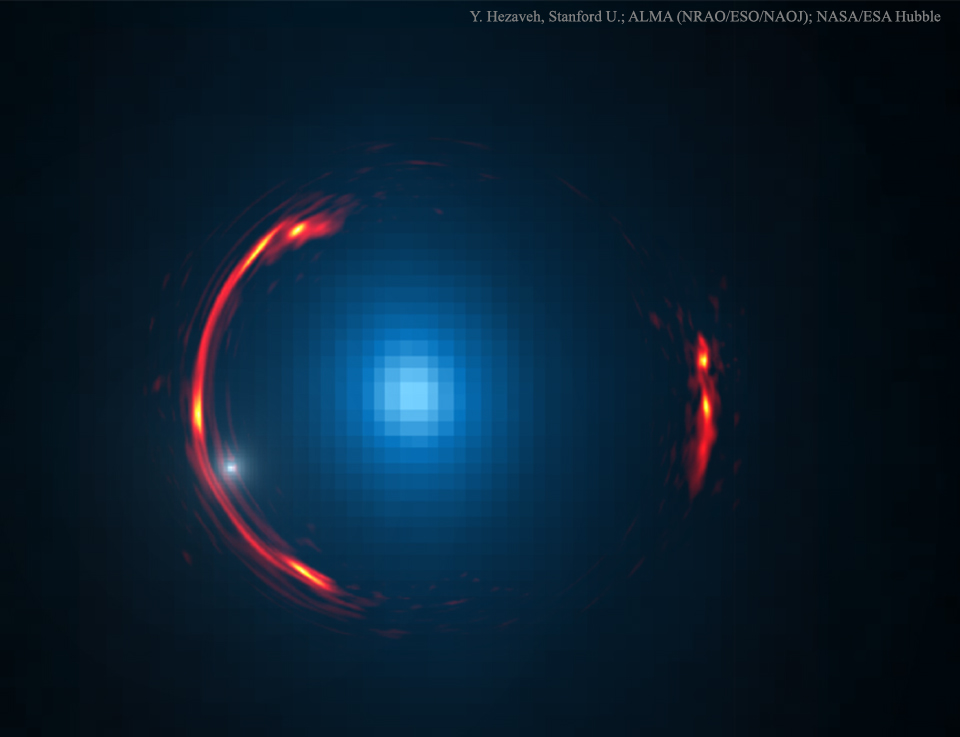
Can one galaxy hide behind another? Not in the case of SDP.81. Here the foreground galaxy, shown in blue in an image taken by the Hubble Space Telescope, acts like a huge gravitational lens, pulling light from a background galaxy, shown in red in an image taken in radio waves by the Atacama Large Millimeter Array (ALMA), around it, keeping it visible. The alignment is so precise that the distant galaxy is distorted into part of a ring around the foreground galaxy, a formation known as an Einstein ring. Detailed analysis of the gravitational lens distortions indicate that a small dark satellite galaxy participates in the deflections, bolstering indication that many satellite galaxies are quite dim and dominated by dark matter. That small galaxy is depicted by a small white dot on the left. Although spanning only a few arcseconds, the featured Einstein ring is really tens of thousands of light years across. via NASA http://ift.tt/1S9NY2Z

Asperatus Clouds Over New Zealand Asperatus Clouds Over New Zealand


What kind of clouds are these? Although their cause is presently unknown, such unusual atmospheric structures, as menacing as they might seem, do not appear to be harbingers of meteorological doom. Known informally as Undulatus asperatus clouds, they can be stunning in appearance, unusual in occurrence, are relatively unstudied, and have even been suggested as a new type of cloud. Whereas most low cloud decks are flat bottomed, asperatus clouds appear to have significant vertical structure underneath. Speculation therefore holds that asperatus clouds might be related to lenticular clouds that form near mountains, or mammatus clouds associated with thunderstorms, or perhaps a foehn wind -- a type of dry downward wind that flows off mountains. Such a wind called the Canterbury arch streams toward the east coast of New Zealand's South Island. The featured image, taken above Hanmer Springs in Canterbury, New Zealand, in 2005, shows great detail partly because sunlight illuminates the undulating clouds from the side. via NASA http://ift.tt/1STbQ7v

Heliopause Electrostatic Rapid Transit System Heliopause Electrostatic Rapid Transit System


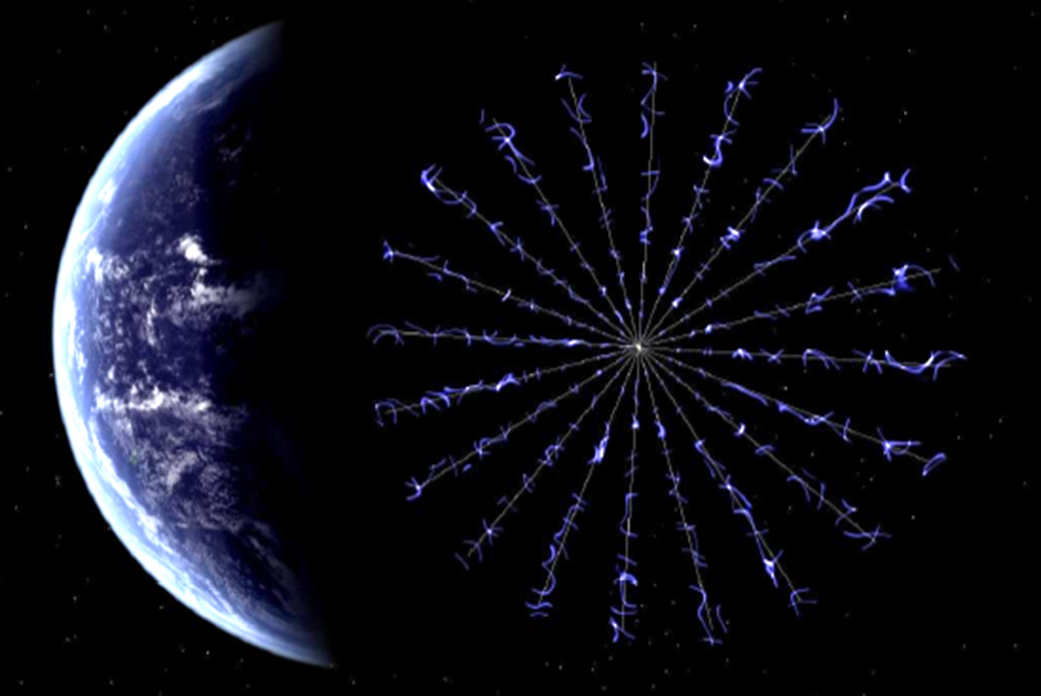
Want to take a fast trip to the edge of the Solar System? Consider a ride on a Heliopause Electrostatic Rapid Transit System (HERTS). The concept is currently being tested and it might take only 10 to 15 years to make the trip of over 100 Astronomical Units (15 billion kilometers). That's fast compared to the 35 years it took Voyager 1, presently humanity's most distant spacecraft, to approach the heliopause or outer boundary of the influence of the solar wind. HERTS would use an advanced electric solar sail that works by extending multiple, 20 kilometer or so long, 1 millimeter thin, positively charged wires from a rotating spacecraft. The electrostatic force generated repels fast moving solar wind protons to create thrust. Compared to a reflective solar light sail, another propellantless deep space propulsion system, the electric solar wind sail could continue to accelerate at greater distances from the Sun, still developing thrust as it cruised toward the outer planets. via NASA http://ift.tt/1QdRu6U

Mercury and Crescent Moon Set Mercury and Crescent Moon Set


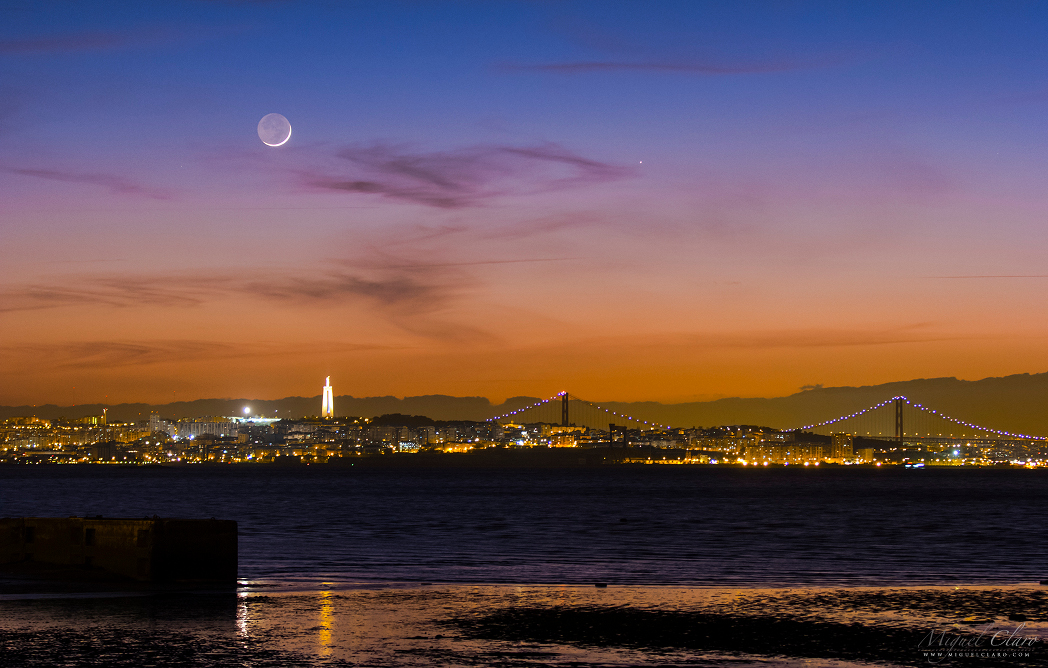
Innermost planet Mercury and a thin crescent Moon are never found far from the Sun in planet Earth's skies. Taken near dusk on April 8, this colorful evening skyscape shows them both setting toward the western horizon just after the Sun. The broad Tagus River and city lights of Lisbon, Portugal run through the foreground under the serene twilight sky. Near perigee or closest approach to Earth, the Moon's bright, slender crescent represents about 3 percent of the lunar disk in sunlight. Of course as seen from the Moon, a nearly full Earth would light up the lunar night, and that strong perigee earthshine makes the rest of the lunar disk visible in this scene. Bright Mercury stays well above the western horizon at sunset for northern skywatchers in the coming days. The fleeting planet reaches maximum elongation, or angular distance from the Sun, on April 18. But Mercury will swing back toward the Sun and actually cross the solar disk on May 9, the first transit of Mercury since November 8, 2006. via NASA http://ift.tt/1SPzS3h

Full Venus and Crescent Moon Rise Full Venus and Crescent Moon Rise


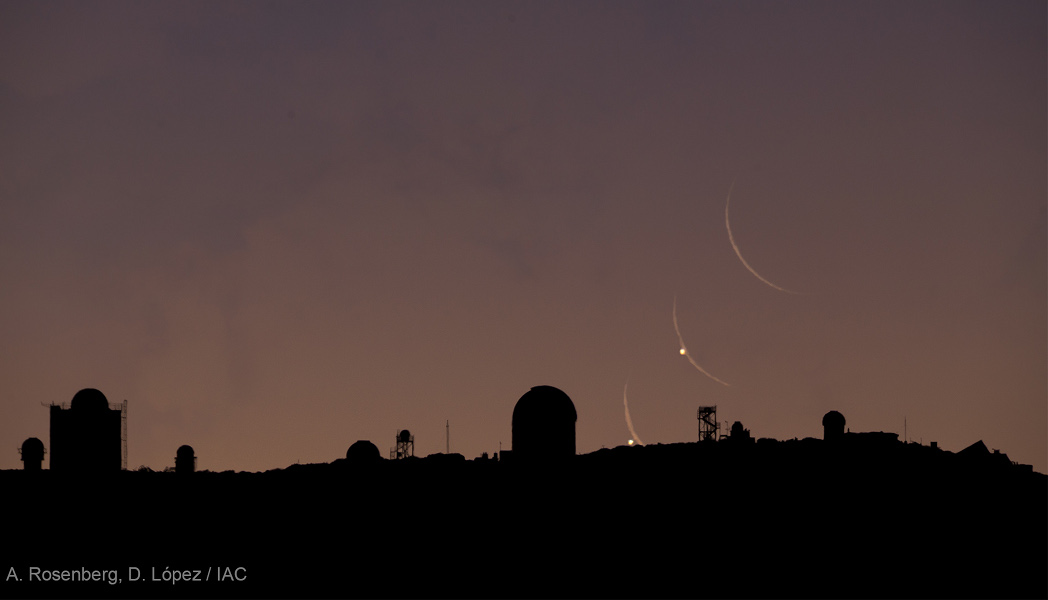
Inner planet Venus and a thin crescent Moon are never found far from the Sun in planet Earth's skies. Taken near dawn on April 6, this timelapse composite shows them both rising just before the Sun. The mountaintop Teide Observatory domes on the fortunate island of Tenerife appear in silhouette against the twilight. In fact, the series of telephoto exposures follows the occultation of Venus by the Moon in three frames. Far from Earth in its orbit and in a nearly full phase, Venus was 96 percent illuminated. Near perigee or closest approach to Earth, the Moon's slender crescent represents about 2 percent of the lunar disk in sunlight. Seen in the first two exposures, the brilliant morning star only vanishes in the third as it winks out behind the bright lunar limb. Five minutes of the dramatic occultation at dawn is compressed into 15 seconds in this timelapse video (vimeo). via NASA http://ift.tt/1Q9tq54

Orion in Red and Blue Orion in Red and Blue


When did Orion become so flashy? This colorful rendition of part of the constellation of Orion comes from red light emitted by hydrogen and sulfur (SII), and blue-green light emitted by oxygen (OIII). Hues on the featured image were then digitally reassigned to be indicative of their elemental origins -- but also striking to the human eye. The breathtaking composite was painstakingly composed from hundreds of images which took nearly 200 hours to collect. Pictured, Barnard's Loop, across the image bottom, appears to cradle interstellar constructs including the intricate Orion Nebula seen just right of center. The Flame Nebula can also be quickly located, but it takes a careful eye to identify the slight indentation of the dark Horsehead Nebula. As to Orion's flashiness -- a leading explanation for the origin of Barnard's Loop is a supernova blast that occurred about two million years ago. via NASA http://ift.tt/1qoEpma

Combined Solar Eclipse Corona from Earth and Space Combined Solar Eclipse Corona from Earth and Space


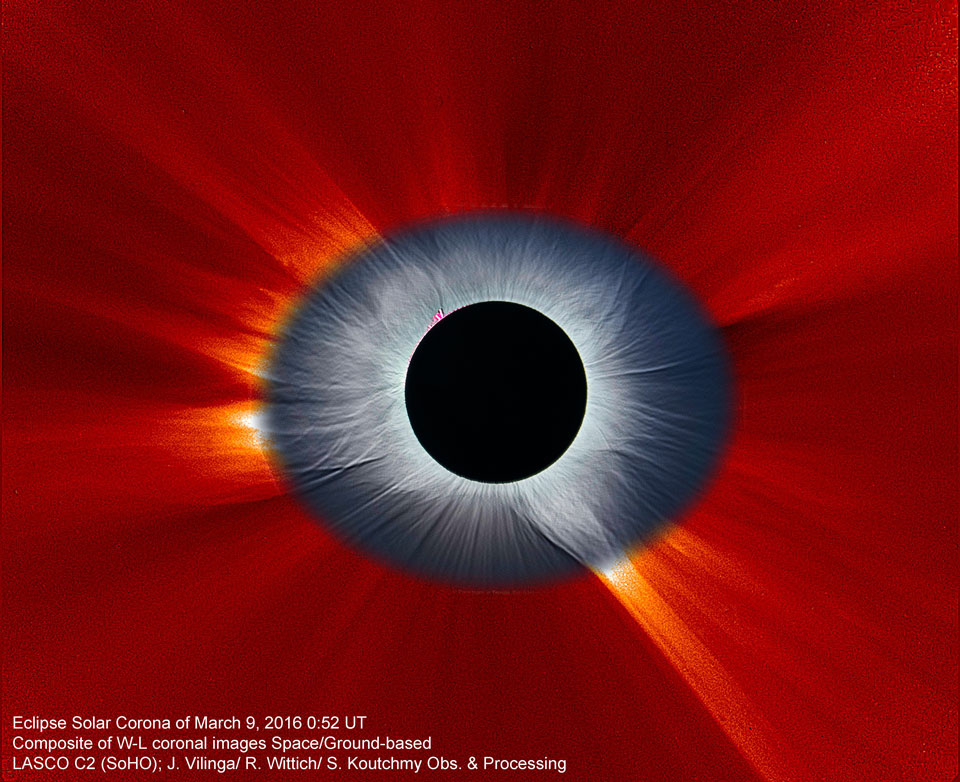
Sometimes, a total eclipse is a good time to eye the Sun. Taking advantage of an unusual juxtaposition of Earth, Moon and Sun, the featured image depicts the total solar eclipse that occurred last month as it appeared -- nearly simultaneously -- from both Earth and space. The innermost image shows the total eclipse from the ground, with the central pupil created by the bright Sun covered by a comparatively dark Moon. Surrounding the blocked solar disk is the tenuous corona of Sun imaged in white light, easily visible from the ground only during an eclipse. Normally, this corona is hard to track far from the Sun, but the featured montage matches it to false-colored observations of the Sun from NASA and ESA's space-based, Sun-orbiting, Solar and Heliospheric Observatory (SOHO). Observations like this allow the study of the constantly changing magnetic activity both near and far from the Sun, the same activity that ultimately drives Earth's auroras. via NASA http://ift.tt/1N6evht

The Comet and the Star Cluster The Comet and the Star Cluster


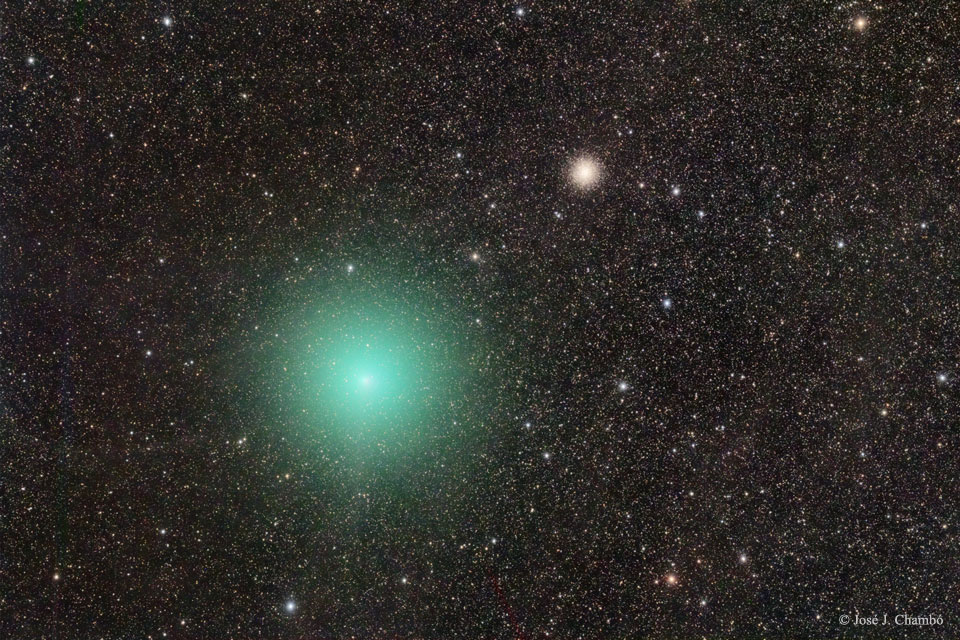
Comet Linear has become unexpectedly bright. The comet, discovered in 2000, underwent a 100-fold outburst just a week before it passed a mere 14 lunar distances from Earth late last month. The comet was captured here last week at about magnitude 6 -- just bright enough to be seen by the unaided eye -- passing in front of the distant globular star cluster M14. Comet 252/P LINEAR is one of a rare group of comets that vacillate between the Earth and Jupiter every 5 years. How the comet will evolve from here is unknown, but hopes run high that it will remain a good object for binoculars in northern skies for the next week or two. via NASA http://ift.tt/1TMdBrU