Pages

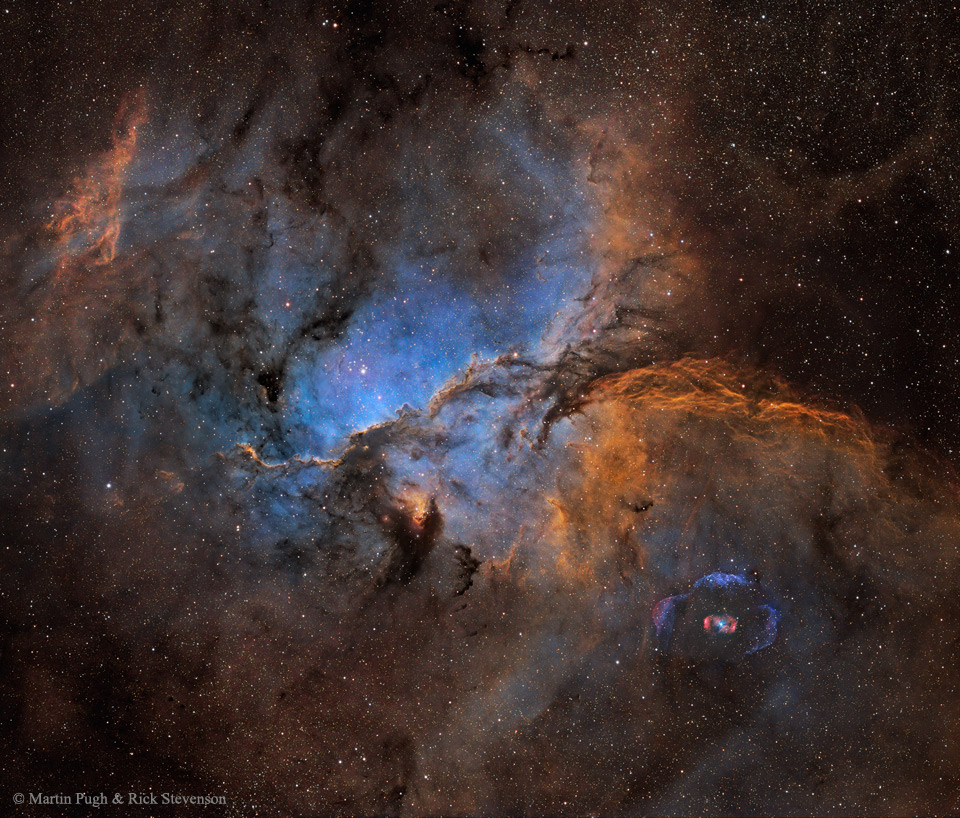
NGC 6188 and NGC 6164 NGC 6188 and NGC 6164


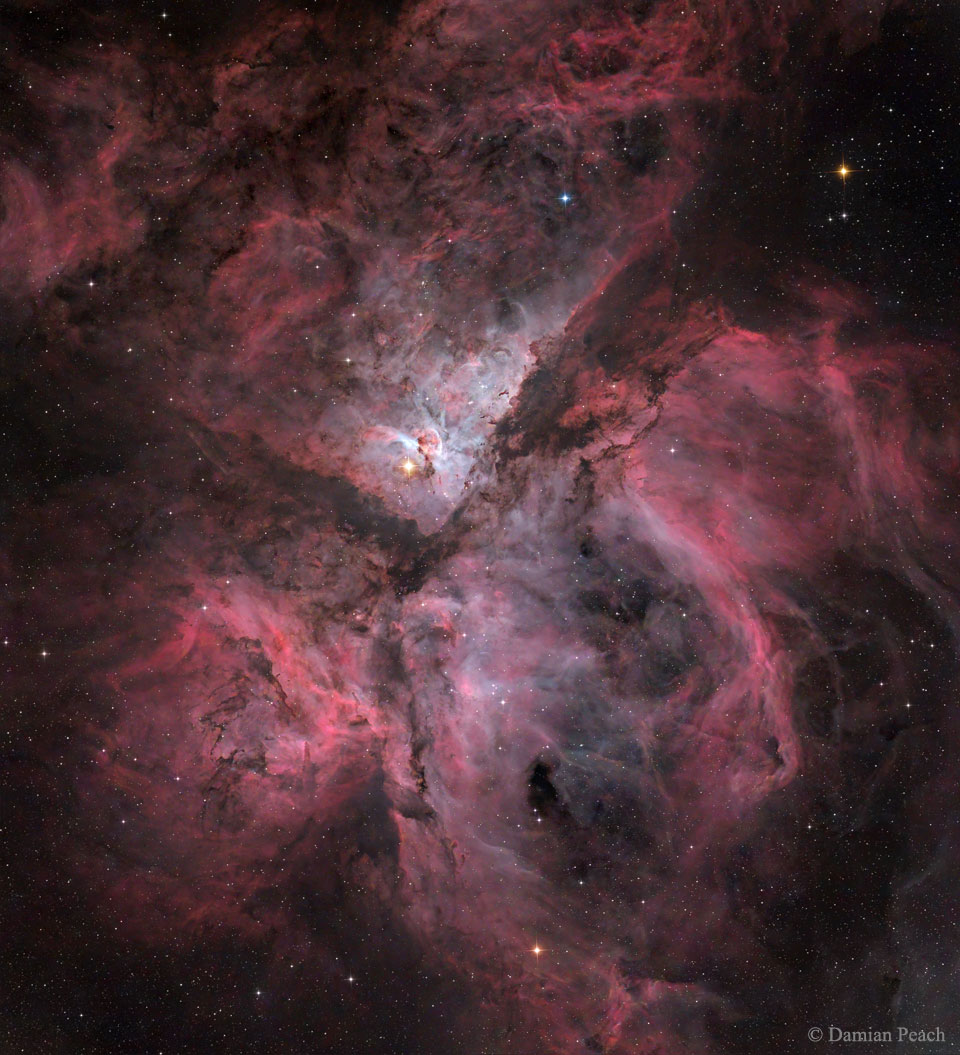
Fantastic shapes lurk in clouds of glowing gas in the giant star forming region NGC 6188. The emission nebula is found about 4,000 light years away near the edge of a large molecular cloud unseen at visible wavelengths, in the southern constellation Ara. Massive, young stars of the embedded Ara OB1 association were formed in that region only a few million years ago, sculpting the dark shapes and powering the nebular glow with stellar winds and intense ultraviolet radiation. The recent star formation itself was likely triggered by winds and supernova explosions, from previous generations of massive stars, that swept up and compressed the molecular gas. Joining NGC 6188 on this cosmic canvas, visible toward the lower right, is rare emission nebula NGC 6164, also created by one of the region's massive O-type stars. Similar in appearance to many planetary nebulae, NGC 6164's striking, symmetric gaseous shroud and faint halo surround its bright central star near the bottom edge. The impressively wide field of view spans over 3 degrees (six full Moons), corresponding to over 200 light years at the estimated distance of NGC 6188. Three image sets have been included in the featured composite. via NASA http://ift.tt/1RKuBcc

Orions Belt and Sword over Teides Peak Orions Belt and Sword over Teides Peak


The southern part of Orion, the famous constellation and mythical hunter, appears quite picturesque posing here over a famous volcano. Located in the Canary Islands off the northwest coast of Africa, the snow-peaked Teide is one of the largest volcanoes on Earth. Lights from a group planning to summit Teide before dawn are visible below the volcano's peak. In this composite of exposures taken from the same location one night last month, the three iconic belt stars of Orion are seen just above the peak, while the famous Orion Nebula and the rest of Orion's sword are visible beyond the volcano's left slope. Also visible in the long duration sky image are the Horsehead Nebula, seen as a dark indentation on the red emission nebula to the belt's left, and the Flame Nebula, evident just above and to the right of the Horsehead. via NASA http://ift.tt/1LTXjvg

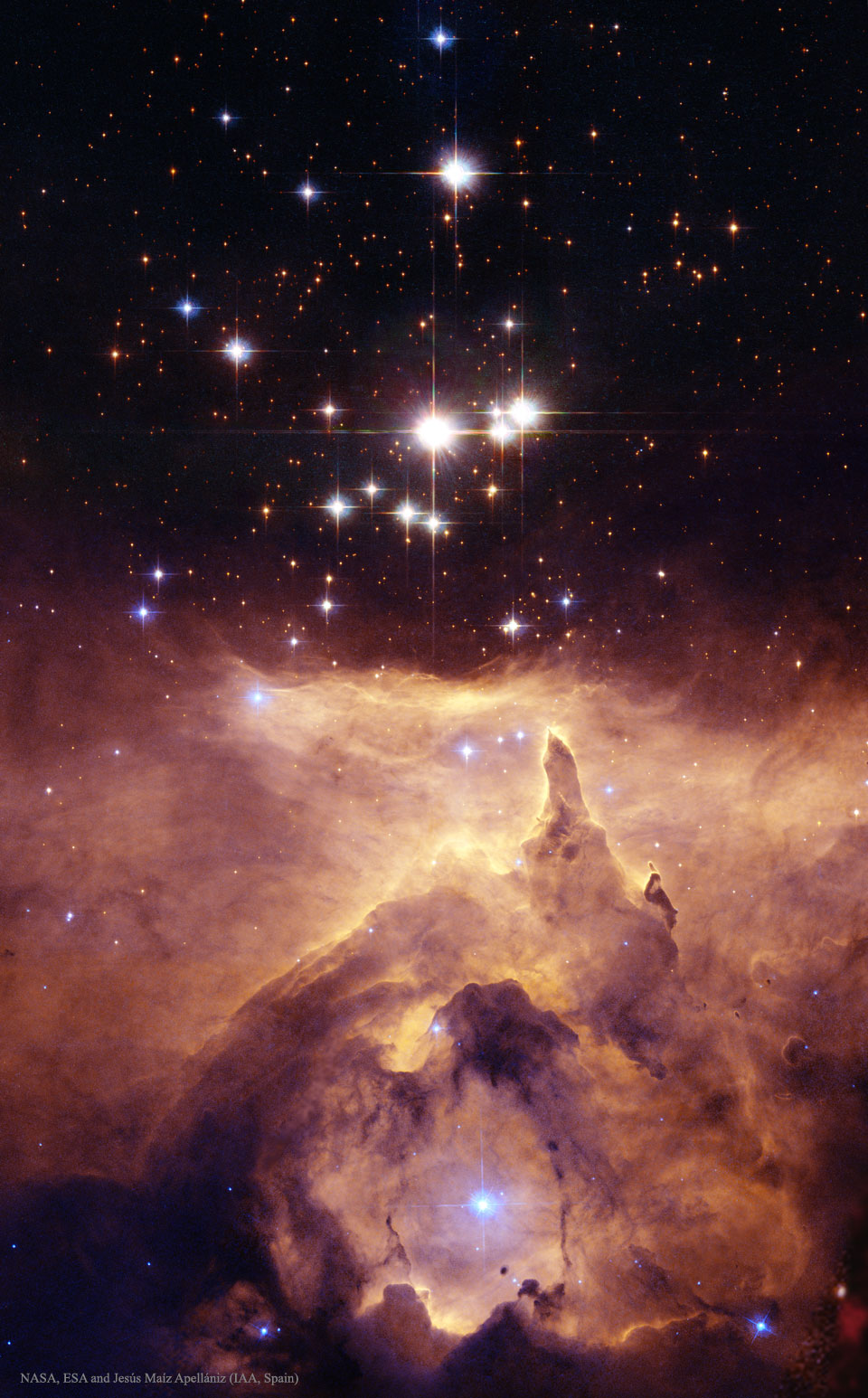
NGC 6357: Cathedral to Massive Stars NGC 6357: Cathedral to Massive Stars


How massive can a normal star be? Estimates made from distance, brightness and standard solar models had given one star in the open cluster Pismis 24 over 200 times the mass of our Sun, making it one of the most massive stars known. This star is the brightest object located just above the gas front in the featured image. Close inspection of images taken with the Hubble Space Telescope, however, have shown that Pismis 24-1 derives its brilliant luminosity not from a single star but from three at least. Component stars would still remain near 100 solar masses, making them among the more massive stars currently on record. Toward the bottom of the image, stars are still forming in the associated emission nebula NGC 6357. Appearing perhaps like a Gothic cathedral, energetic stars near the center appear to be breaking out and illuminating a spectacular cocoon. via NASA http://ift.tt/22ENYyP

Sostice to Equinox Cubed Sostice to Equinox Cubed


This 3 month long exposure packed the days from December 22, 2015 through March 20 into a box. Dubbed a solargraph, the unconventional, unfolded picture was recorded with a pinhole camera made from a cube-shaped container, its sides lined with photographic paper. Fixed to a single spot for the entire exposure, the simple camera recorded the Sun's path through Hungarian skies. Each day a glowing trail was burned into the photosensitive paper. From short and low, to long and high, the trails follow the progression from winter solstice to spring equinox. Of course, dark gaps in the daily sun trails are caused by cloud cover. Sunny days produce the more continuous bright tracks. via NASA http://ift.tt/1XUvcwF

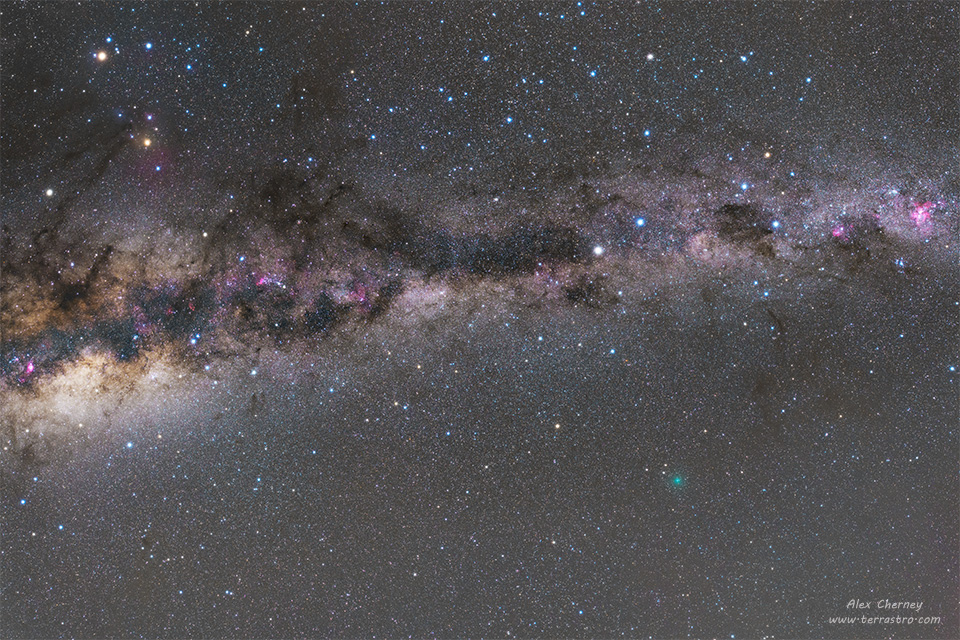
Close Comet and the Milky Way Close Comet and the Milky Way


Comet 252P/Linear's lovely greenish coma is easy to spot in this expansive southern skyscape. Visible to the naked eye from the dark site near Flinders, Victoria, Australia, the comet appears tailless. Still, its surprisingly bright coma spans about 1 degree, posed here below the nebulae, stars, and dark rifts of the Milky Way. The five panels used in the wide-field mosaic were captured after moonset and before morning twilight on March 21. That was less than 24 hours from the comet's closest approach, a mere 5.3 million kilometers from our fair planet. Sweeping quickly across the sky because it is so close to Earth, the comet should be spotted in the coming days by northern hemisphere comet watchers. In predawn but moonlit skies it will move through Sagittarius and Scorpius seen toward the southern horizon. That's near the triangle formed by bright, yellowish, Mars, Saturn, and Antares at the upper left of this frame. via NASA http://ift.tt/1MGkwf2

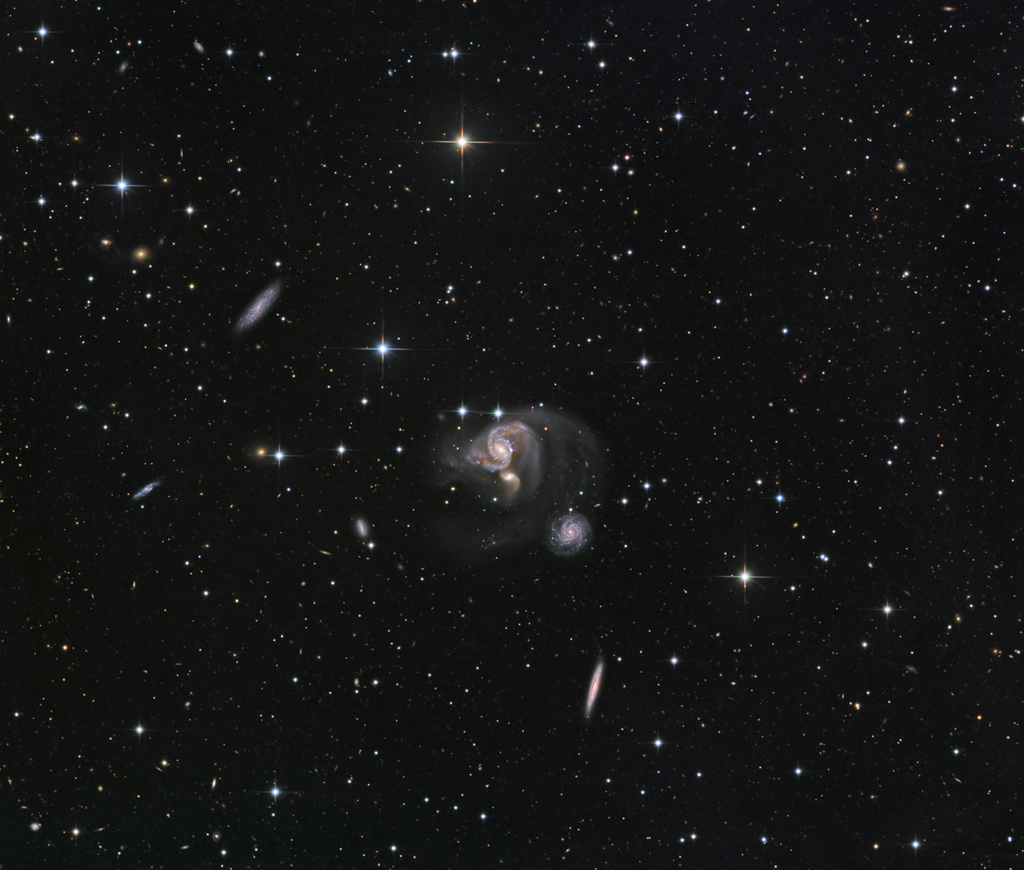
Hickson 91 in Piscis Austrinus Hickson 91 in Piscis Austrinus


Scanning the skies for galaxies, Canadian astronomer Paul Hickson and colleagues identified some 100 compact groups of galaxies, now appropriately called Hickson Compact Groups (HCGs). This sharp telescopic image captures one such galaxy group, HCG 91, in beautiful detail. The group's three colorful spiral galaxies at the center of the field of view are locked in a gravitational tug of war, their interactions producing faint but visible tidal tails over 100,000 light-years long. Their close encounters trigger furious star formation. On a cosmic timescale the result will be a merger into a large single galaxy, a process now understood to be a normal part of the evolution of galaxies, including our own Milky Way. HCG 91 lies about 320 million light-years away in the constellation Piscis Austrinus. But the impressively deep image also catches evidence of fainter tidal tails and galaxy interactions close to 2 billion light-years distant. via NASA http://ift.tt/1T7z7XN

The Great Nebula in Carina The Great Nebula in Carina


In one of the brightest parts of Milky Way lies a nebula where some of the oddest things occur. NGC 3372, known as the Great Nebula in Carina, is home to massive stars and changing nebulas. The Keyhole Nebula (NGC 3324), the bright structure just above the image center, houses several of these massive stars and has itself changed its appearance. The entire Carina Nebula spans over 300 light years and lies about 7,500 light-years away in the constellation of Carina. Eta Carinae, the most energetic star in the nebula, was one of the brightest stars in the sky in the 1830s, but then faded dramatically. Eta Carinae is the brightest star near the image center, just left of the Keyhole Nebula. While Eta Carinae itself maybe on the verge of a supernova explosion, X-ray images indicate that much of the Great Carina Nebula has been a veritable supernova factory. via NASA http://ift.tt/25mesUK

Rainbow Airglow over the Azores Rainbow Airglow over the Azores


Why would the sky glow like a giant repeating rainbow? Airglow. Now air glows all of the time, but it is usually hard to see. A disturbance however -- like an approaching storm -- may cause noticeable rippling in the Earth's atmosphere. These gravity waves are oscillations in air analogous to those created when a rock is thrown in calm water. The long-duration exposure nearly along the vertical walls of airglow likely made the undulating structure particularly visible. OK, but where do the colors originate? The deep red glow likely originates from OH molecules about 87-kilometers high, excited by ultraviolet light from the Sun. The orange and green airglow is likely caused by sodium and oxygen atoms slightly higher up. The featured image was captured during a climb up Mount Pico in the Azores of Portugal. Ground lights originate from the island of Faial in the Atlantic Ocean. A spectacular sky is visible through this banded airglow, with the central band of our Milky Way Galaxy running up the image center, and M31, the Andromeda Galaxy, visible near the top left. via NASA http://ift.tt/1SfcRc5

Alaskan Moondogs Alaskan Moondogs


What's happened to the sky? Moonlight illuminates a snowy scene in this night land and skyscape made on 2013 January from Lower Miller Creek, Alaska, USA. Overexposed near the mountainous western horizon is the first quarter Moon itself, surrounded by an icy halo and flanked left and right by moondogs. Sometimes called mock moons, a more scientific name for the luminous apparitions is paraselenae (plural). Analogous to a sundog or parhelion, a paraselene is produced by moonlight refracted through thin, hexagonal, plate-shaped ice crystals. As determined by the crystal geometry, paraselenae are seen at an angle of 22 degrees or more from the Moon. Compared to the bright lunar disk, paraselenae are faint and easier to spot when the Moon is low. via NASA http://ift.tt/1ScNZ4F

A Picturesque Equinox Sunset A Picturesque Equinox Sunset


What's that at the end of the road? The Sun. Many towns have roads that run east - west, and on two days each year, the Sun rises and sets right down the middle. Today is one of those days: an equinox. Not only is today a day of equal night ("aequus"-"nox") and day time, but also a day when the sun rises precisely to the east and sets due west. Featured here is a picturesque road in northwest Illinois, USA that runs approximately east -west. The image was taken one year ago today, during the March Equinox of 2015, and shows the Sun down the road at sunset. In many cultures, this March equinox is taken to be the first day of a season, typically spring in Earth's northern hemisphere, and autumn in the south. Does your favorite street run east - west? Tonight at sunset, with a quick glance, you can actually find out. via NASA http://ift.tt/1ZghOnV

3D Ahuna Mons 3D Ahuna Mons


Get out your red/blue glasses and gaze across Ceres at mysterious mountain Ahuna Mons. Shown in a 3D anaglyph perspective view, the mosaicked image data was captured in December of 2015, taken from the Dawn spacecraft's low-altitude mapping orbit about 385 kilometers above the surface of the dwarf planet. A remarkable dome-shaped feature on Ceres, with steep, smooth sides Ahuna Mons is about 20 kilometers (12 miles) in diameter at its base, rising on average 4 kilometers to a flattened summit. Similar in size to mountains found on planet Earth, no other Cerean surface feature is so tall and well-defined. It is not known what process shaped the lonely Ahuna Mons, or if the bright material streaking its steepest side is the same material responsible for Ceres' famous bright spots. via NASA http://ift.tt/1Mtn6oM

The W in Cassiopeia The W in Cassiopeia


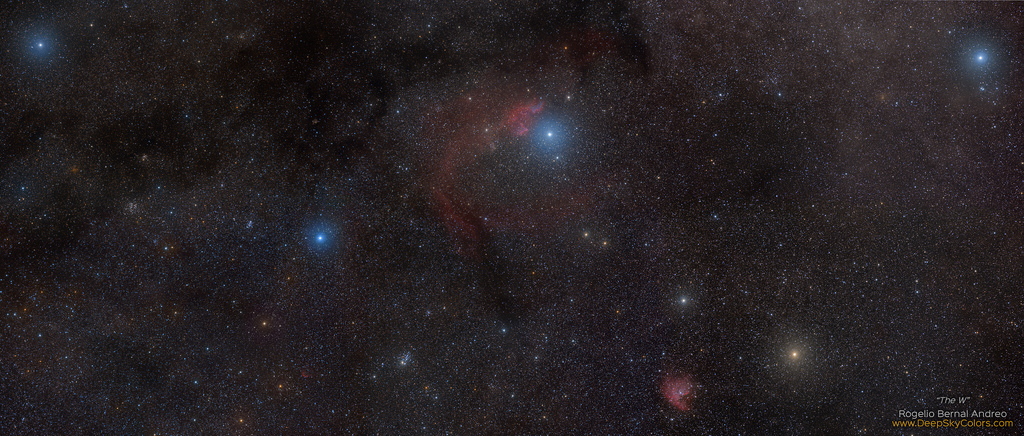
A familiar, zigzag, W pattern in northern constellation Cassiopeia is traced by five bright stars in this colorful and broad mosaic. Stretching about 15 degrees across rich starfields, the celestial scene includes dark clouds, bright nebulae, and star clusters along the Milky Way. In yellow-orange hues Cassiopeia's alpha star Shedar is a standout though. The yellowish giant star is cooler than the Sun, over 40 times the solar diameter, and so luminous it shines brightly in Earth's night from 230 light-years away. A massive, rapidly rotating star at the center of the W, bright Gamma Cas is about 550 light-years distant. Bluish Gamma Cas is much hotter than the Sun. Its intense, invisible ultraviolet radiation ionizes hydrogen atoms in nearby interstellar clouds to produce visible red H-alpha emission as the atoms recombine with electrons. Of course, night skygazers in the Alpha Centauri star system would also see the recognizable outline traced by Cassiopeia's bright stars. But from their perspective a mere 4.3 light-years away they would see our Sun as a sixth bright star in Cassiopeia, extending the zigzag pattern just beyond the left edge of this frame. via NASA http://ift.tt/1VjfPz3

Close Comet and Large Magellanic Cloud Close Comet and Large Magellanic Cloud


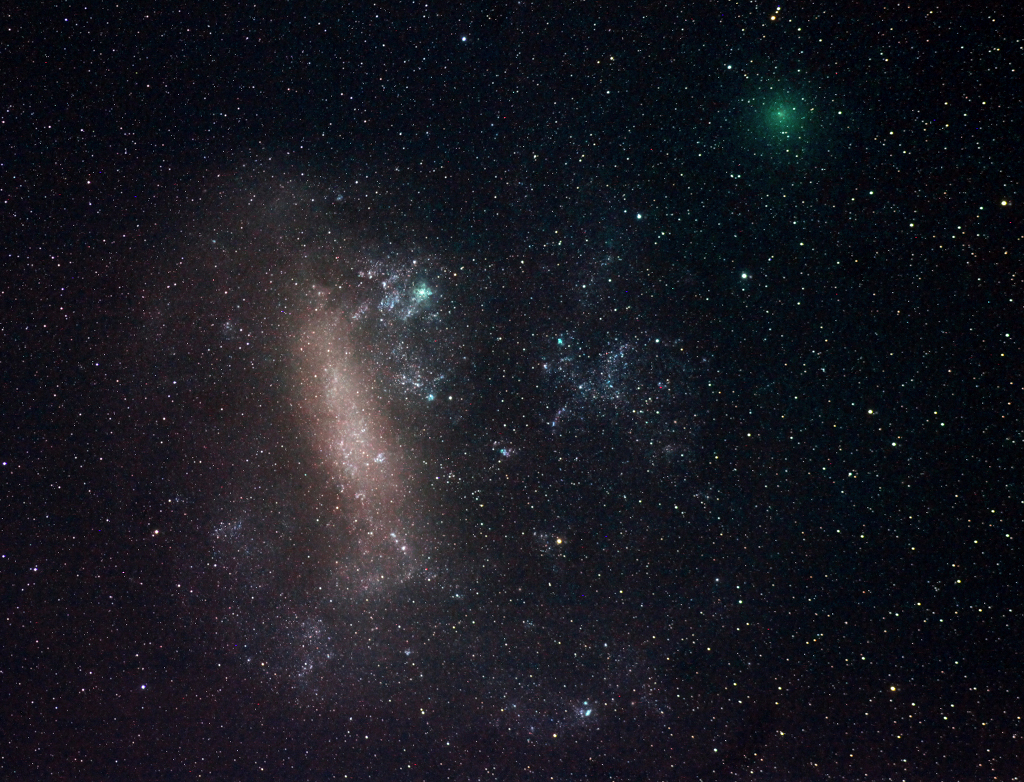
Sporting a surprisingly bright, lovely green coma Comet 252P/Linear poses next to the Large Magellanic Cloud in this southern skyscape. The stack of telephoto exposures was captured on March 16 from Penwortham, South Australia. Recognized as a Jupiter family periodic comet, 252P/Linear will come close to our fair planet on March 21, passing a mere 5.3 million kilometers away. That's about 14 times the Earth-Moon distance. In fact, it is one of two comets that will make remarkably close approaches in the next few days as a much fainter Comet Pan-STARRS (P/2016 BA14) comes within 3.5 million kilometers (9 times the Earth-Moon distance) on March 22. The two have extremely similar orbits, suggesting they may have originally been part of the same comet. Sweeping quickly across the sky because of their proximity to Earth, both comets will soon move into northern skies. via NASA http://ift.tt/1WsRHZf

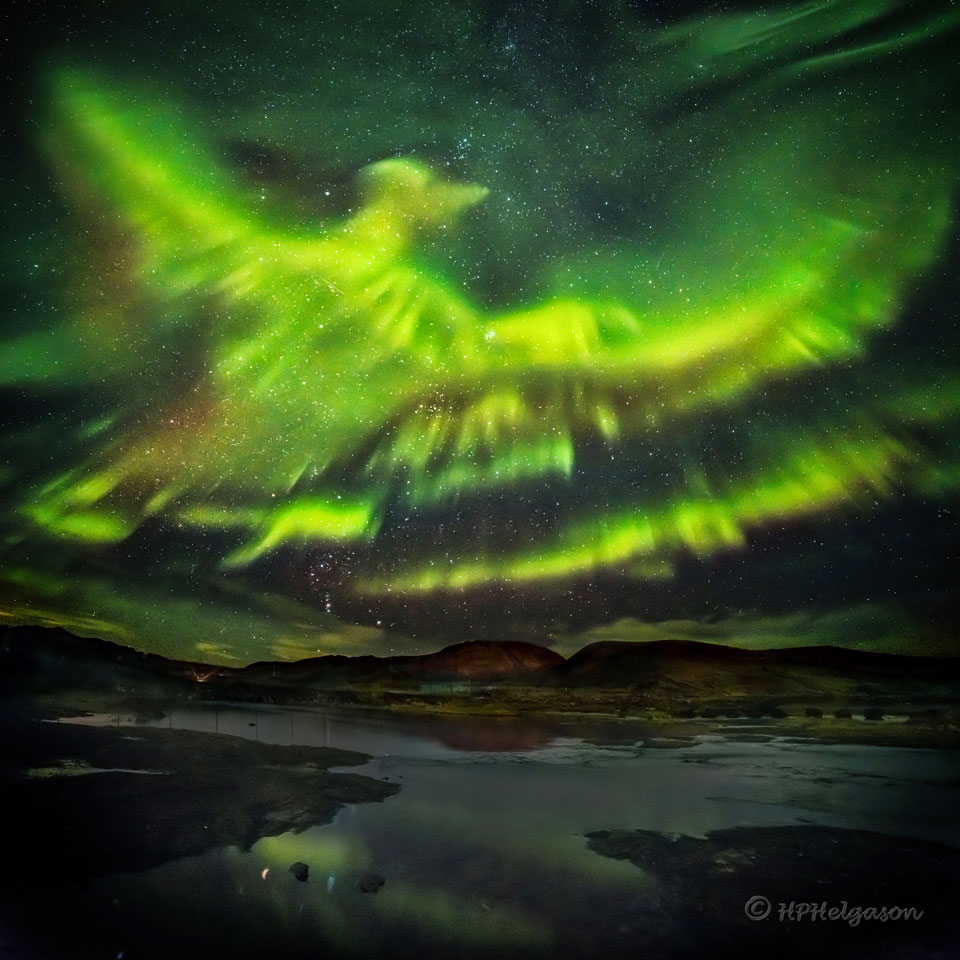
A Phoenix Aurora over Iceland A Phoenix Aurora over Iceland


All of the other aurora watchers had gone home. By 3:30 am in Iceland, on a quiet night last September, much of that night's auroras had died down. Suddenly though, a new burst of particles streamed down from space, lighting up the Earth's atmosphere once again. This time, unexpectedly, pareidoliacally, they created an amazing shape reminiscent of a giant phoenix. With camera equipment at the ready, two quick sky images were taken, followed immediately by a third of the land. The mountain in the background is Helgafell, while the small foreground river is called Kaldรก, both located about 30 kilometers north of Iceland's capital Reykjavik. Seasoned skywatchers will note that just above the mountain, toward the left, is the constellation of Orion, while the Pleiades star cluster is also visible just above the frame center. The new aurora lasted only a minute and would be gone forever -- possibly dismissed as an embellished aberration -- were it not captured in the featured, digitally-composed, image mosaic. via NASA http://ift.tt/254533W

Dark Nebulas across Taurus Dark Nebulas across Taurus


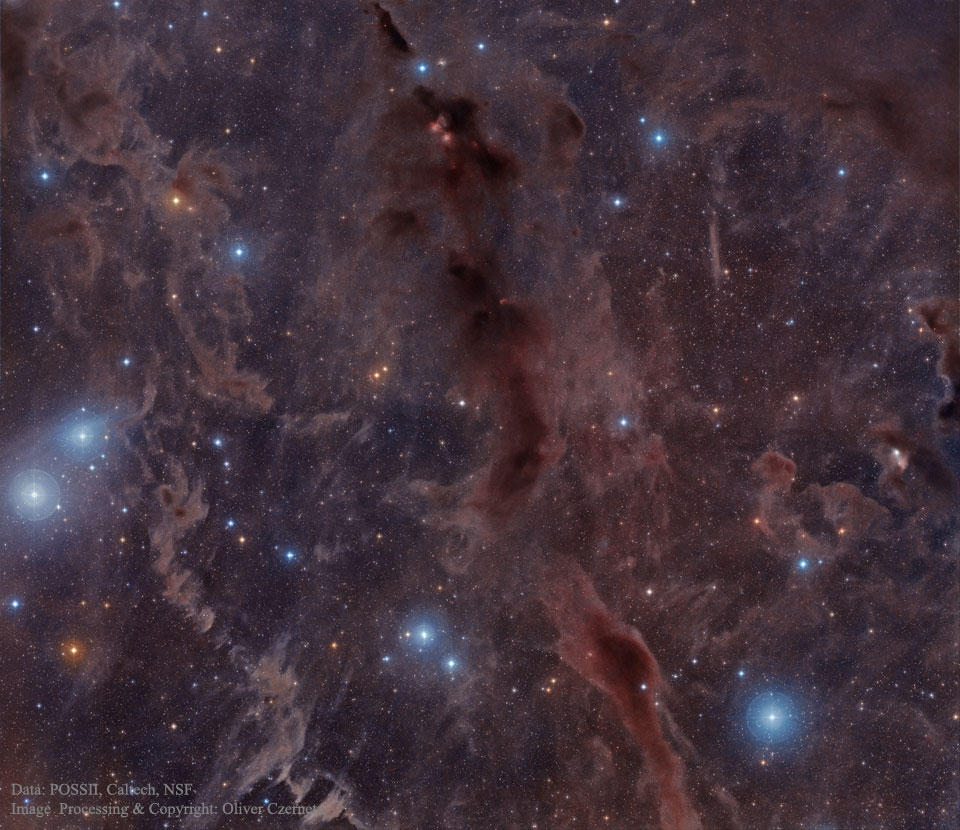
Sometimes even the dark dust of interstellar space has a serene beauty. One such place occurs toward the constellation of Taurus. The filaments featured here can be found on the sky between the Pleiades star cluster and the California Nebula. This dust is not known not for its bright glow but for its absorption and opaqueness. Several bright stars are visible with their blue light seen reflecting off the brown dust. Other stars appear unusually red as their light barely peaks through a column of dark dust, with red the color that remains after the blue is scattered away. Yet other stars are behind dust pillars so thick they are not visible here. Although appearing serene, the scene is actually an ongoing loop of tumult and rebirth. This is because massive enough knots of gas and dust will gravitationally collapse to form new stars -- stars that both create new dust in their atmospheres and destroy old dust with their energetic light and winds. via NASA http://ift.tt/1XpZlDN

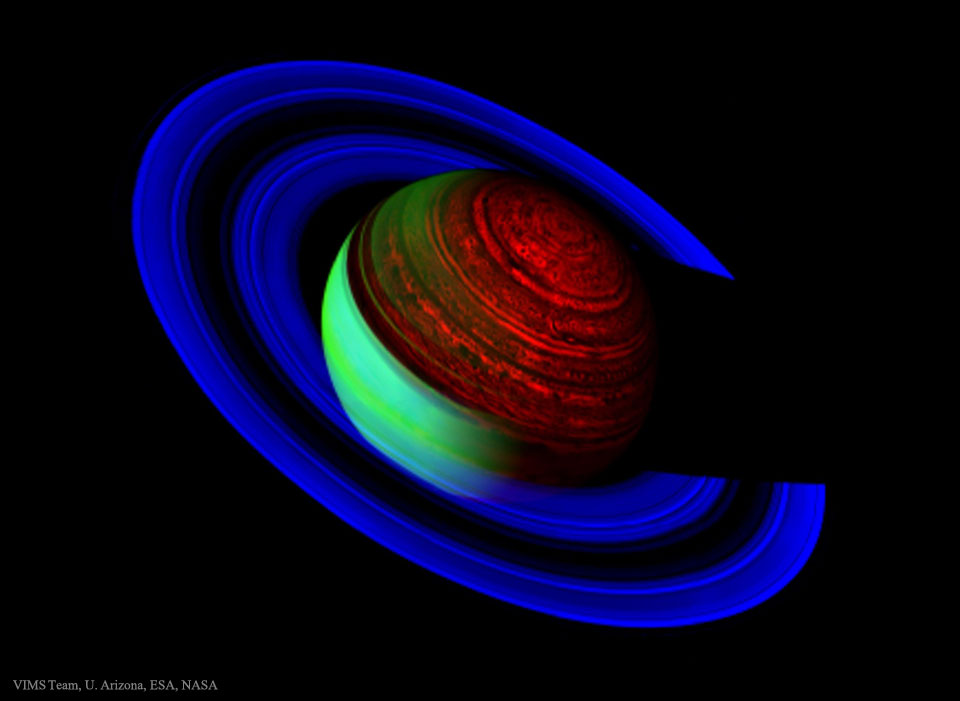
Neon Saturn Neon Saturn


If seen in the right light, Saturn glows like a neon sign. Although Saturn has comparatively little of the element neon, a composite image false-colored in three bands of infrared light highlights features of the giant ringed planet like a glowing sign. At the most blue band of the infrared light featured, false-colored blue in the above image, Saturn itself appears dark but Saturn's thin rings brightly reflect light from our Sun. Conversely, Saturn's B ring is so thick that little reflected light makes it through, creating a dark band between Saturn's A and C rings. At the most red band of the infrared, false-colored red above, Saturn emits a surprisingly detailed thermal glow, indicating planet-wide bands, huge hurricane-like storms, and a strange hexagon-shaped cloud system around the North Pole. In the middle infrared band, false-colored green, the sunlit side of Saturn's atmosphere reflects brightly. The above image was obtained in 2007 by the robotic Cassini spacecraft orbiting about 1.6 million kilometers out from Saturn. via NASA http://ift.tt/1pgRg9s