Pages

A Five Planet Dawn A Five Planet Dawn


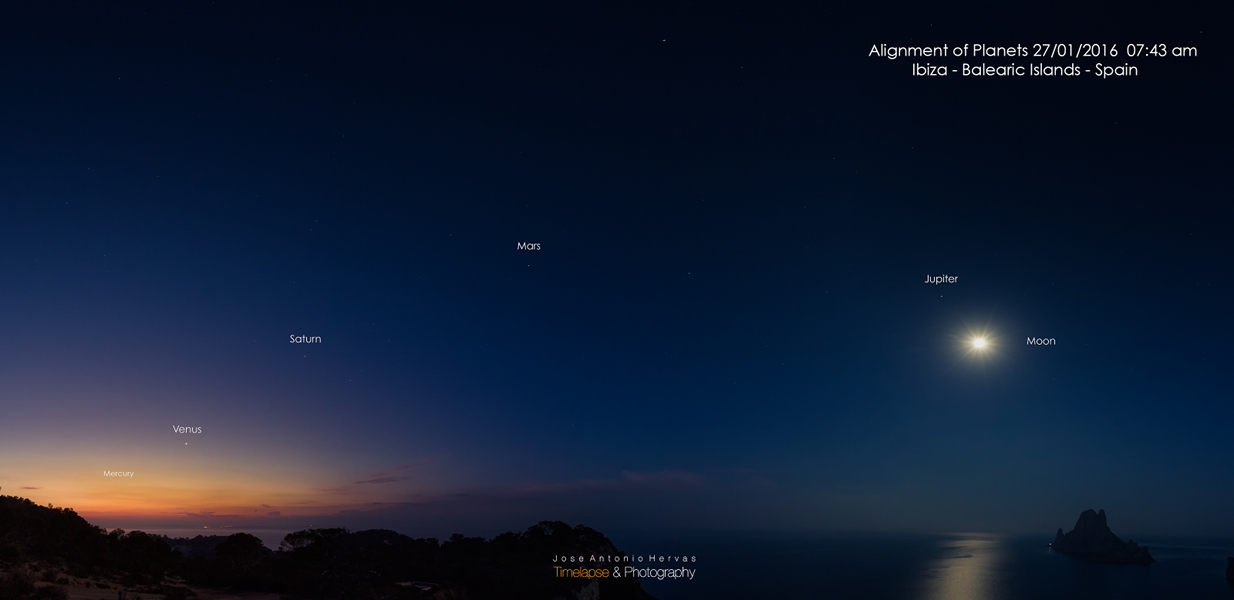
As January closes and in the coming days of February, early morning risers can spot the five naked-eye planets before dawn. Though some might claim to see six planets, in this seaside panoramic view all five celestial wanderers were found above the horizon along with a bright waning gibbous Moon on January 27. Nearly aligned along the plane of the ecliptic, but not along a line with the Sun, the five planets are spread well over 100 degrees across the sky. Just arriving on the predawn scene, fleeting Mercury stands above the southeastern horizon in the golden light of the approaching sunrise. via NASA http://ift.tt/1Vxf42Y

Hidden Galaxy IC 342 Hidden Galaxy IC 342


Similar in size to large, bright spiral galaxies in our neighborhood, IC 342 is a mere 10 million light-years distant in the long-necked, northern constellation Camelopardalis. A sprawling island universe, IC 342 would otherwise be a prominent galaxy in our night sky, but it is hidden from clear view and only glimpsed through the veil of stars, gas and dust clouds along the plane of our own Milky Way galaxy. Even though IC 342's light is dimmed by intervening cosmic clouds, this deep telescopic image traces the galaxy's obscuring dust, blue star clusters, and glowing pink star forming regions along spiral arms that wind far from the galaxy's core. IC 342 may have undergone a recent burst of star formation activity and is close enough to have gravitationally influenced the evolution of the local group of galaxies and the Milky Way. via NASA http://ift.tt/1nCJE0C

Elliptical M60, Spiral NGC 4647 Elliptical M60, Spiral NGC 4647


Giant elliptical galaxy M60 and spiral galaxy NGC 4647 do look like an odd couple in this sharp cosmic portrait from the Hubble Space Telescope. But they are found in a region of space where galaxies tend to gather, on the eastern side of the nearby Virgo Galaxy Cluster. About 54 million light-years distant, bright M60's simpler egg-like shape is created by its randomly swarming older stars, while NGC 4647's young blue stars, gas and dust are organized into winding arms rotating in a flattened disk. Spiral NGC 4647 is estimated to be more distant than M60, some 63 million light-years away. Also known as Arp 116, the pair of galaxies may be on the verge of a significant gravitational encounter, though. M60 (aka NGC 4649) is about 120,000 light-years across. The smaller NGC 4647 spans around 90,000 light-years, about the size of our own Milky Way. via NASA http://ift.tt/1ZVsRBG

An Airglow Fan from Lake to Sky An Airglow Fan from Lake to Sky


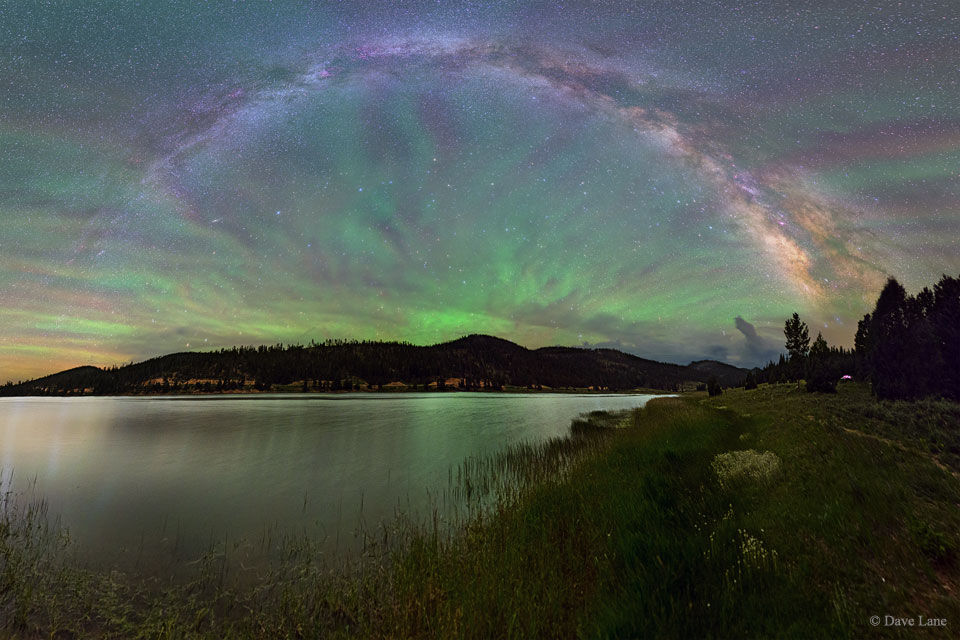
Why would the sky look like a giant fan? Airglow. The featured intermittent green glow appeared to rise from a lake through the arch of our Milky Way Galaxy, as captured last summer next to Bryce Canyon in Utah, USA. The unusual pattern was created by atmospheric gravity waves, ripples of alternating air pressure that can grow with height as the air thins, in this case about 90 kilometers up. Unlike auroras powered by collisions with energetic charged particles and seen at high latitudes, airglow is due to chemiluminescence, the production of light in a chemical reaction. More typically seen near the horizon, airglow keeps the night sky from ever being completely dark. via NASA http://ift.tt/1lRVIJA

A Candidate for the Biggest Boom Yet Seen A Candidate for the Biggest Boom Yet Seen


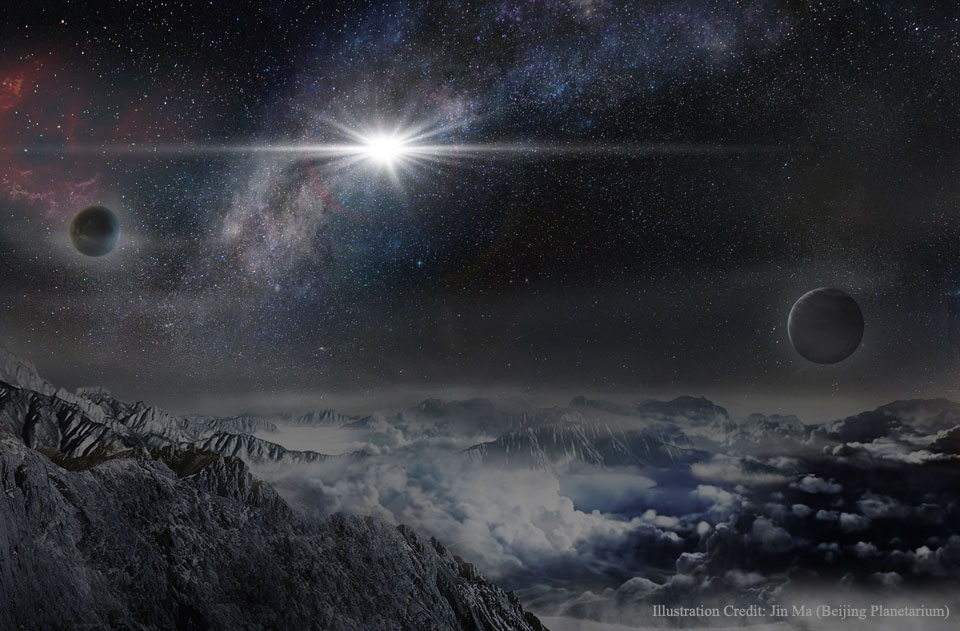
It is a candidate for the brightest and most powerful explosion ever seen -- what is it? The flaring spot of light was found by the All Sky Automated Survey for Supernovae (ASASSN) in June of last year and labelled ASASSN-15lh. Located about three billion light years distant, the source appears tremendously bright for anything so far away: roughly 200 times brighter than an average supernova, and temporarily 20 times brighter than all of the stars in our Milky Way Galaxy combined. Were light emitted by ASASSN-15lh at this rate in all directions at once, it would be the most powerful explosion yet recorded. No known stellar object was thought to create an explosion this powerful, although pushing the theoretical limits for the spin-down of highly-magnetized neutron star -- a magnetar -- gets close. Assuming the flare fades as expected later this year, astronomers are planning to use telescopes including Hubble to zoom in on the region to gain more clues. The above-featured artist's illustration depicts a hypothetical night sky of a planet located across the host galaxy from the outburst. via NASA http://ift.tt/1QyMpv7

Where Your Elements Came From Where Your Elements Came From


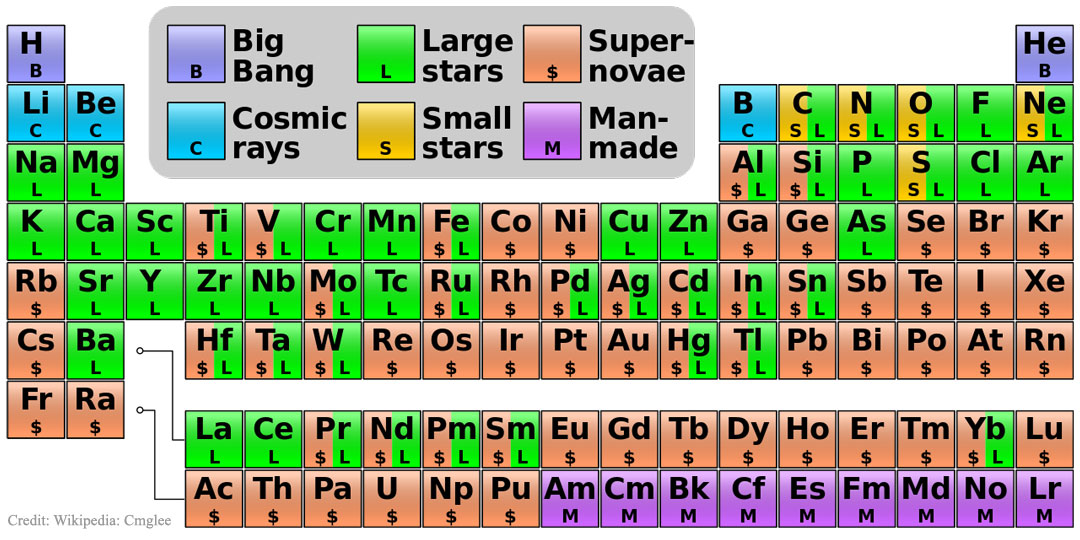
The hydrogen in your body, present in every molecule of water, came from the Big Bang. There are no other appreciable sources of hydrogen in the universe. The carbon in your body was made by nuclear fusion in the interior of stars, as was the oxygen. Much of the iron in your body was made during supernovas of stars that occurred long ago and far away. The gold in your jewelry was likely made from neutron stars during collisions that may have been visible as short-duration gamma-ray bursts. Elements like phosphorus and copper are present in our bodies in only small amounts but are essential to the functioning of all known life. The featured periodic table is color coded to indicate humanity's best guess as to the nuclear origin of all known elements. The sites of nuclear creation of some elements, such as copper, are not really well known and are continuing topics of observational and computational research. via NASA http://ift.tt/1nJFrIo

Star Cluster R136 Bursts Out Star Cluster R136 Bursts Out


In the center of star-forming region 30 Doradus lies a huge cluster containing some of the largest, hottest, and most massive stars known. These stars, known collectively as star cluster R136, were captured in the featured image in visible light by the Wide Field Camera 3 in 2009 peering through the Hubble Space Telescope. Gas and dust clouds in 30 Doradus, also known as the Tarantula Nebula, have been sculpted into elongated shapes by powerful winds and ultraviolet radiation from these hot cluster stars. The 30 Doradus Nebula lies within a neighboring galaxy known as the Large Magellanic Cloud and is located a mere 170,000 light-years away. via NASA http://ift.tt/1Qmpbqa

Big Dipper, Deep Sky Big Dipper, Deep Sky


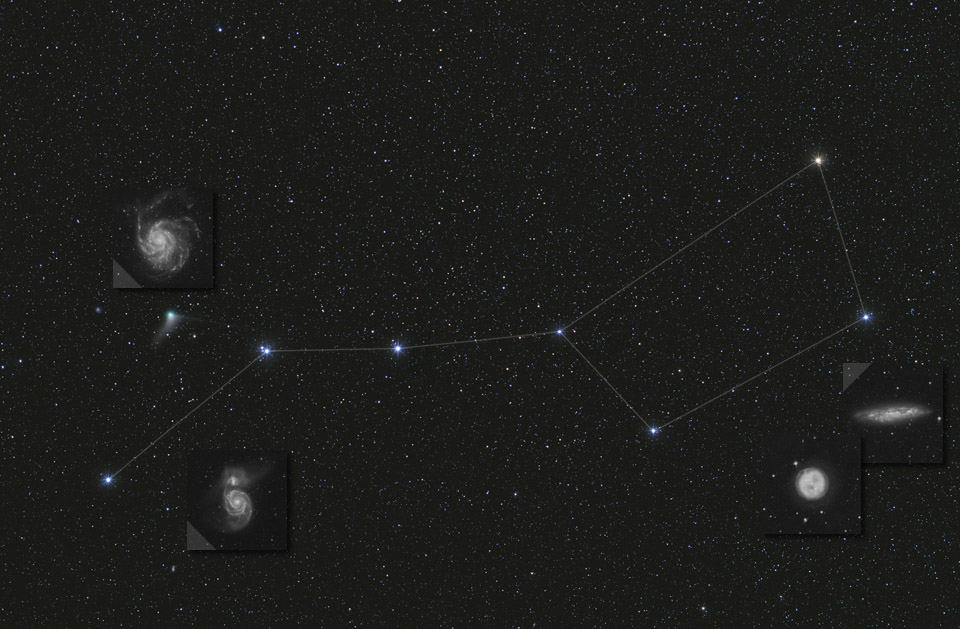
The Big Dipper is an easy to recognize, well-known asterism in northern skies, though many see the Plough or Wagon. Famous bright nebulae of the north can also be found along its familiar lines, highlighted in this carefully composed scene with telescopic insets framed in the wider-field skyview. All from Messier's catalog, M101 and M51 are cosmic pinwheel and whirlpool on the left, spiral galaxies far beyond the Milky Way. To the right, M108, a distant edge-on spiral galaxy is seen close to our galaxy's own owl-faced planetary nebula M97. Taken on January 16, the wider-field view seems to include an extra star along the Dipper's handle, though. That's Comet Catalina (C/2013 US10) now sweeping through northern nights. via NASA http://ift.tt/1TfGb3O

International Space Station Transits Saturn International Space Station Transits Saturn


From low Earth orbit to the outer Solar System, this remarkable video frame composite follows the International Space Station's transit of Saturn. On January 15, the well-timed capture from a site near Dulmen, Germany required telescope and camera to be positioned along the predicted transit centerline, a path only 40 meters wide. That put the camera about 1,140 kilometers away from the space station during the transit and 1,600,000,000 kilometers away from Saturn. A video rate of 42 frames per second follows the orbital outpost moving quickly from lower right to upper left. The transit itself lasted about 0.02 seconds, with one frame showing the station directly in front of the ringed gas giant. Of course, you could also try to capture the International Space Station as it transits Jupiter. via NASA http://ift.tt/1RYJH3C

The View Toward M101 The View Toward M101


Sweeping through northern skies, Comet Catalina (C/2013 US10) made its closest approach on January 17, passing about 6 light-minutes from our fair planet. Dust and ion tails clearly separated in this Earth-based view, the comet is also posed for a Messier moment, near the line-of-sight to M101, grand spiral galaxy in Ursa Major. A cosmic pinwheel at the lower left, M101 is nearly twice the size of our own Milky Way galaxy, but some 270 thousand light-centuries away. Both galaxy and comet are relatively bright, easy targets for binocular-equipped skygazers. But Comet Catalina is now outbound from the inner Solar System and will slowly fade in coming months. This telescopic two panel mosaic spans about 5 degrees (10 Full Moons) on the sky. via NASA http://ift.tt/1Jksn6d

Stars and Globules in the Running Chicken Nebula Stars and Globules in the Running Chicken Nebula


The eggs from this gigantic chicken may form into stars. The featured emission nebula, shown in scientifically assigned colors, is cataloged as IC 2944 but known as the Running Chicken Nebula for the shape of its greater appearance. Seen toward the top of the image are small, dark molecular clouds rich in obscuring cosmic dust. Called Thackeray's Globules for their discoverer, these "eggs" are potential sites for the gravitational condensation of new stars, although their fates are uncertain as they are also being rapidly eroded away by the intense radiation from nearby young stars. Together with patchy glowing gas and complex regions of reflecting dust, these massive and energetic stars form the open cluster Collinder 249. This gorgeous skyscape spans about 60 light-years at the nebula's estimated 6,000 light-year distance. via NASA http://ift.tt/1JY6edP

A Dark Sand Dune on Mars A Dark Sand Dune on Mars


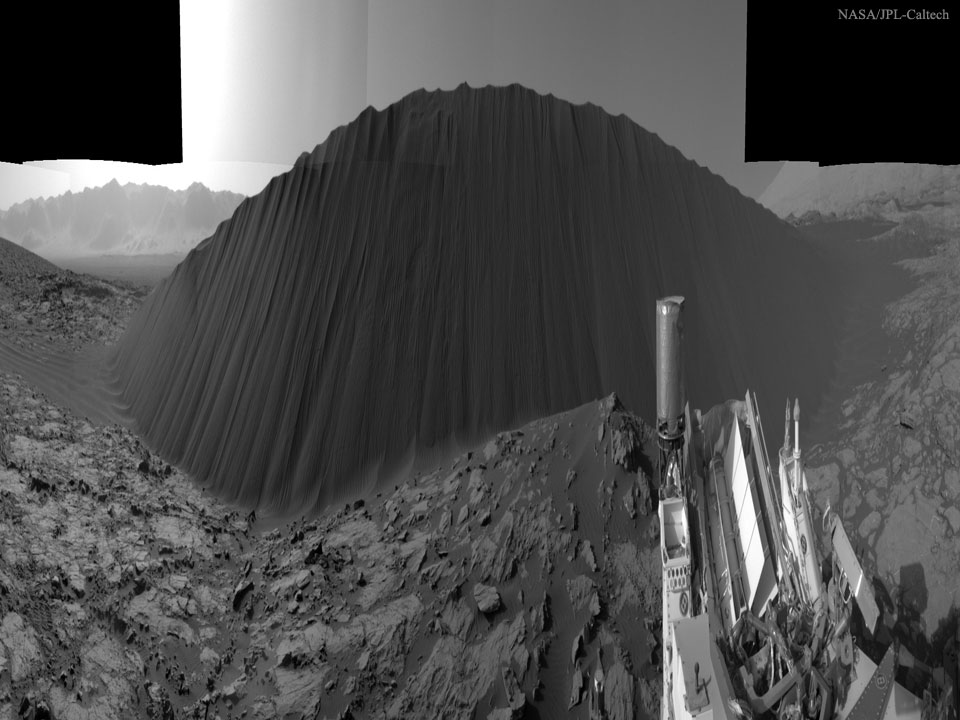
What is that dark sand dune doing on Mars? NASA's robotic rover Curiosity has been studying it to find out, making this the first-ever up-close investigation of an active sand dune on another world. Named Namib Dune, the dark sand mound stands about 4 meters tall and, along with the other Bagnold Dunes, is located on the northwestern flank of Mount Sharp. The featured image was taken last month and horizontally compressed here for comprehensibility. Wind is causing the dune to advance about one meter a year across the light bedrock underneath, and wind-blown sand is visible on the left. Part of the Curiosity rover itself is visible on the lower right. Just in the past few days, Curiosity scooped up some of the dark sand for a detailed analysis. After further exploration of the Bagnold Dunes, Curiosity is scheduled to continue its trek up the 5-kilometer tall Mount Sharp, the central peak in the large crater where the car-sized rover landed. via NASA http://ift.tt/1StRLce

Proxima Centauri: The Closest Star Proxima Centauri: The Closest Star


Does the closest star to our Sun have planets? No one is sure -- but you can now follow frequent updates of a new search that is taking place during the first few months of this year. The closest star, Proxima Centauri, is the nearest member of the Alpha Centauri star system. Light takes only 4.24 years to reach us from Proxima Centauri. This small red star, captured in the center of the featured image by the Hubble Space Telescope, is so faint that it was only discovered in 1915 and is only visible through a telescope. Telescope-created X-shaped diffraction spikes surround Proxima Centauri, while several stars further out in our Milky Way Galaxy are visible in the background. The brightest star in the Alpha Centauri system is quite similar to our Sun, has been known as long as recorded history, and is the third brightest star in the night sky. The Alpha Centauri system is primarily visible from Earth's Southern Hemisphere. Starting last week, the European Southern Observatory's Pale Red Dot project began investigating slight changes in Proxima Centauri to see if they result from a planet -- possibly an Earth-sized planet. Although unlikely, were a modern civilization found living on a planet orbiting Proxima Centauri, its proximity makes it a reasonable possibility that humanity could communicate with them. via NASA http://ift.tt/1Os1Ken

The Galactic Center in Infrared The Galactic Center in Infrared


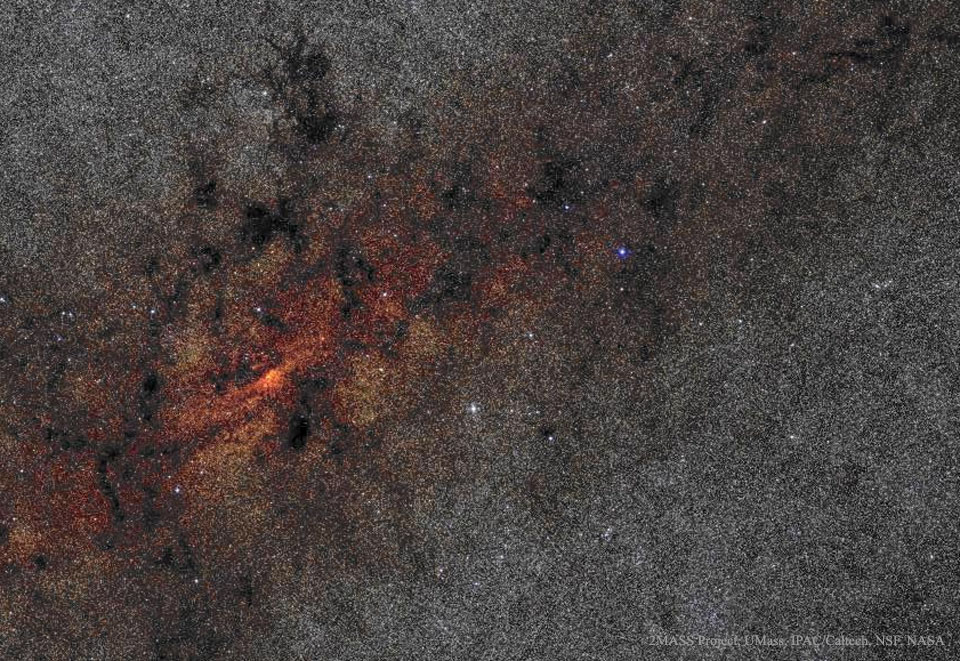
The center of our Galaxy is a busy place. In visible light, much of the Galactic Center is obscured by opaque dust. In infrared light, however, dust glows more and obscures less, allowing nearly one million stars to be recorded in the featured photograph. The Galactic Center itself appears on the left and is located about 30,000 light years away towards the constellation of the Archer (Sagittarius). The Galactic Plane of our Milky Way Galaxy, the plane in which the Sun orbits, is identifiable by the dark diagonal dust lane. The absorbing dust grains are created in the atmospheres of cool red-giant stars and grow in molecular clouds. The region directly surrounding the Galactic Center glows brightly in radio and high-energy radiation, and is thought to house a large black hole. via NASA http://ift.tt/1JasUY4

The View Toward M106 The View Toward M106


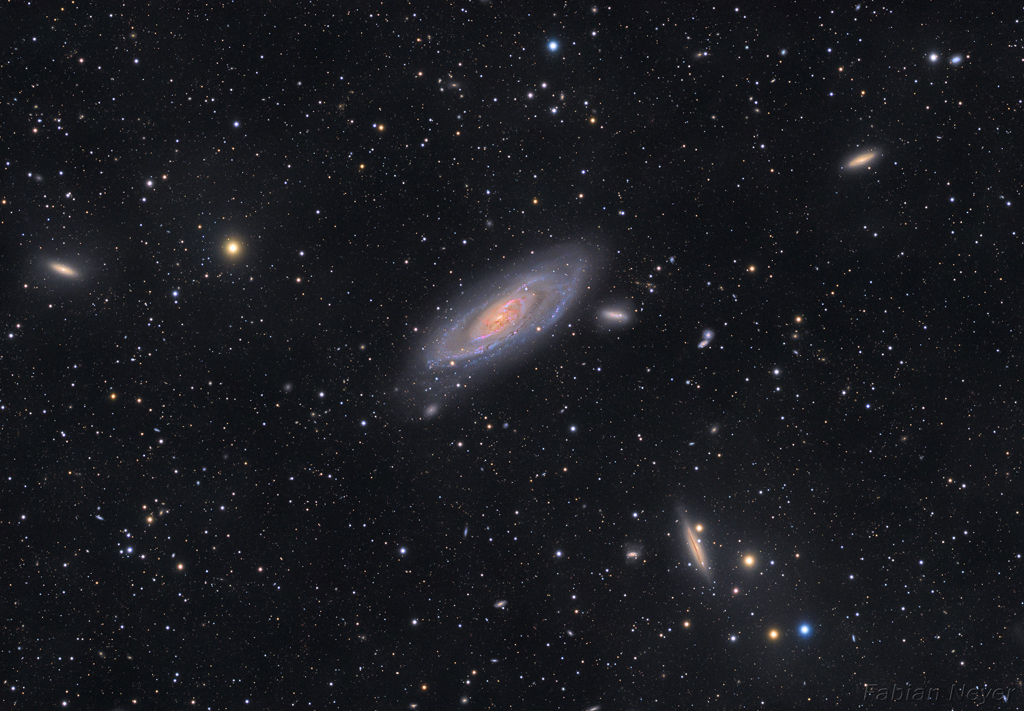
A big, bright, beautiful spiral, Messier 106 is at the center of this galaxy filled cosmic vista. The two degree wide telescopic field of view looks toward the well-trained constellation Canes Venatici, near the handle of the Big Dipper. Also known as NGC 4258, M106 is about 80,000 light-years across and 23.5 million light-years away, the largest member of the Canes II galaxy group. For a far away galaxy, the distance to M106 is well-known in part because it can be directly measured by tracking this galaxy's remarkable maser, or microwave laser emission. Very rare but naturally occuring, the maser emission is produced by water molecules in molecular clouds orbiting its active galactic nucleus. Another prominent spiral galaxy on the scene, viewed nearly edge-on, is NGC 4217 below and right of M106. The distance to NGC 4217 is much less well-known, estimated to be about 60 million light-years. via NASA http://ift.tt/1RVS4ex

Wright Mons in Color Wright Mons in Color


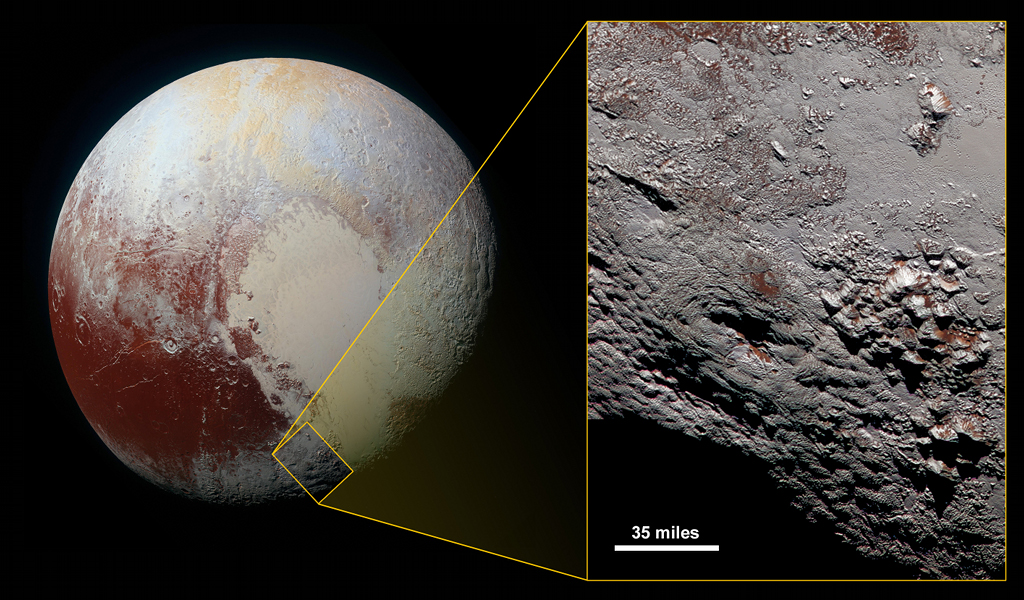
Informally named Wright Mons, a broad mountain about 150 kilometers across and 4 kilometers high with a wide, deep summit depression is featured in this inset image captured during the New Horizons flyby of Pluto in July 2015. Of course, broad mountains with summit craters are found elsewhere in the Solar System, like the large shield volcano Mauna Loa on planet Earth or giant Olympus Mons on Mars. New Horizons scientists note the striking similarity of Pluto's Wright Mons, and nearby Piccard Mons, to large shield volcanoes suggests the two could be giant cryovolcanoes that once erupted molten ice from the interior of the cold, distant world. In fact, found on a frozen dwarf planet Wright Mons could be the largest volcano in the outer Solar System. Since only one impact crater has been identified on its slopes, Wright Mons may well have been active late in Pluto's history. This highest resolution color image also reveals red material sparsely scattered around the region. via NASA http://ift.tt/1OTcyDI

Infrared Portrait of the Large Magellanic Cloud Infrared Portrait of the Large Magellanic Cloud


Cosmic dust clouds ripple across this infrared portrait of our Milky Way's satellite galaxy, the Large Magellanic Cloud. In fact, the remarkable composite image from the Herschel Space Observatory and the Spitzer Space Telescope show that dust clouds fill this neighboring dwarf galaxy, much like dust along the plane of the Milky Way itself. The dust temperatures tend to trace star forming activity. Spitzer data in blue hues indicate warm dust heated by young stars. Herschel's instruments contributed the image data shown in red and green, revealing dust emission from cooler and intermediate regions where star formation is just beginning or has stopped. Dominated by dust emission, the Large Magellanic Cloud's infrared appearance is different from views in optical images. But this galaxy's well-known Tarantula Nebula still stands out, easily seen here as the brightest region to the left of center. A mere 160,000 light-years distant, the Large Cloud of Magellan is about 30,000 light-years across. via NASA http://ift.tt/1SQ3gtN

Reflections on the 1970s Reflections on the 1970s


The 1970s are sometimes ignored by astronomers, like this beautiful grouping of reflection nebulae in Orion - NGC 1977, NGC 1975, and NGC 1973 - usually overlooked in favor of the substantial glow from the nearby stellar nursery better known as the Orion Nebula. Found along Orion's sword just north of the bright Orion Nebula complex, these reflection nebulae are also associated with Orion's giant molecular cloud about 1,500 light-years away, but are dominated by the characteristic blue color of interstellar dust reflecting light from hot young stars. In this sharp color image a portion of the Orion Nebula appears along the bottom border with the cluster of reflection nebulae at picture center. NGC 1977 stretches across the field just below center, separated from NGC 1973 (above right) and NGC 1975 (above left) by dark regions laced with faint red emission from hydrogen atoms. Taken together, the dark regions suggest to many the shape of a running man. via NASA http://ift.tt/1Q54iRX

The California Nebula The California Nebula


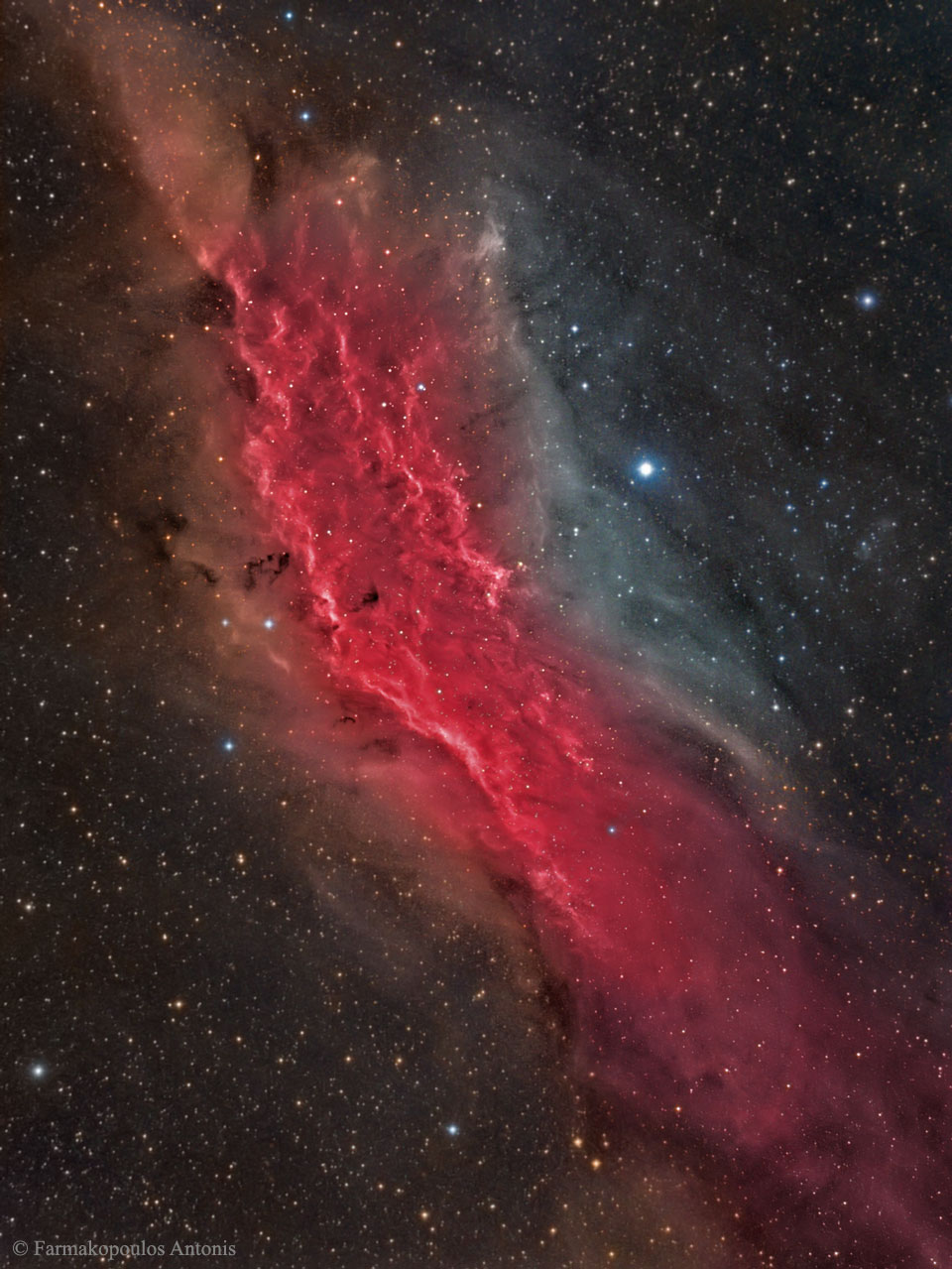
What's California doing in space? Drifting through the Orion Arm of the spiral Milky Way Galaxy, this cosmic cloud by chance echoes the outline of California on the west coast of the United States. Our own Sun also lies within the Milky Way's Orion Arm, only about 1,500 light-years from the California Nebula. Also known as NGC 1499, the classic emission nebula is around 100 light-years long. On the featured image, the most prominent glow of the California Nebula is the red light characteristic of hydrogen atoms recombining with long lost electrons, stripped away (ionized) by energetic starlight. The star most likely providing the energetic starlight that ionizes much of the nebular gas is the bright, hot, bluish Xi Persei just to the right of the nebula. A regular target for astrophotographers, the California Nebula can be spotted with a wide-field telescope under a dark sky toward the constellation of Perseus, not far from the Pleiades. via NASA http://ift.tt/1OfMqBf