Pages

Dark Sand Cascades on Mars Dark Sand Cascades on Mars


They might look like trees on Mars, but they're not. Groups of dark brown streaks have been photographed by the Mars Reconnaissance Orbiter on melting pinkish sand dunes covered with light frost. The above image was taken in 2008 April near the North Pole of Mars. At that time, dark sand on the interior of Martian sand dunes became more and more visible as the spring Sun melted the lighter carbon dioxide ice. When occurring near the top of a dune, dark sand may cascade down the dune leaving dark surface streaks -- streaks that might appear at first to be trees standing in front of the lighter regions, but cast no shadows. Objects about 25 centimeters across are resolved on this image spanning about one kilometer. Close ups of some parts of this image show billowing plumes indicating that the sand slides were occurring even while the image was being taken. via NASA http://ift.tt/1Oo0Vot

Rosetta and Comet Outbound Rosetta and Comet Outbound


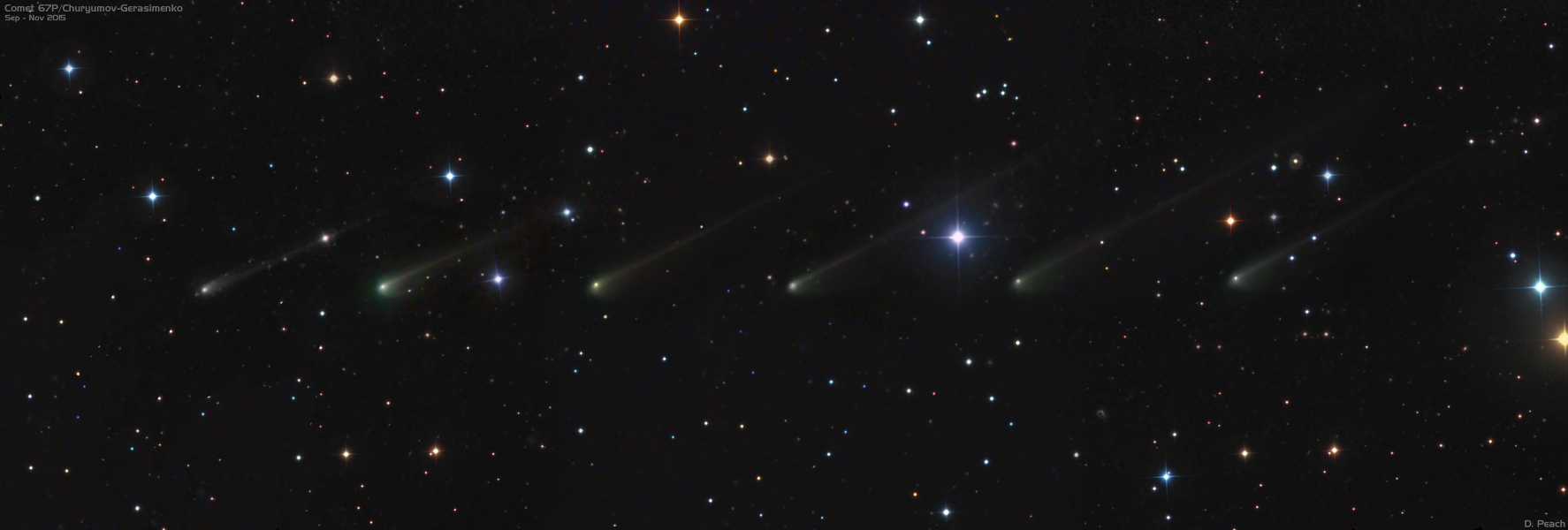
Not a bright comet, 67P/Churyumov-Gerasimenko now sweeps slowly through planet Earth's predawn skies near the line-up of planets along the ecliptic. Still, this composite of telescopic images follows the comet's progress as it moves away from the Sun beyond the orbit of Mars, from late September (left) through late November (far right). Its faint but extensive coma and tails are viewed against the colorful background of stars near the eastern edge of the constellation Leo. A year ago, before its perihelion passage, the comet was less active, though. Then the Rosetta mission's lander Philae made it's historic landing, touching down on the surface of the comet's nucleus. via NASA http://ift.tt/1kYXBok

Gravity's Grin Gravity's Grin


Albert Einstein's general theory of relativity, published 100 years ago this month, predicted the phenomenon of gravitational lensing. And that's what gives these distant galaxies such a whimsical appearance, seen through the looking glass of X-ray and optical image data from the Chandra and Hubble space telescopes. Nicknamed the Cheshire Cat galaxy group, the group's two large elliptical galaxies are suggestively framed by arcs. The arcs are optical images of distant background galaxies lensed by the foreground group's total distribution of gravitational mass dominated by dark matter. In fact the two large elliptical "eye" galaxies represent the brightest members of their own galaxy groups which are merging. Their relative collisional speed of nearly 1,350 kilometers/second heats gas to millions of degrees producing the X-ray glow shown in purple hues. Curiouser about galaxy group mergers? The Cheshire Cat group grins in the constellation Ursa Major, some 4.6 billion light-years away. via NASA http://ift.tt/1HskNFu

Planets of the Morning Planets of the Morning


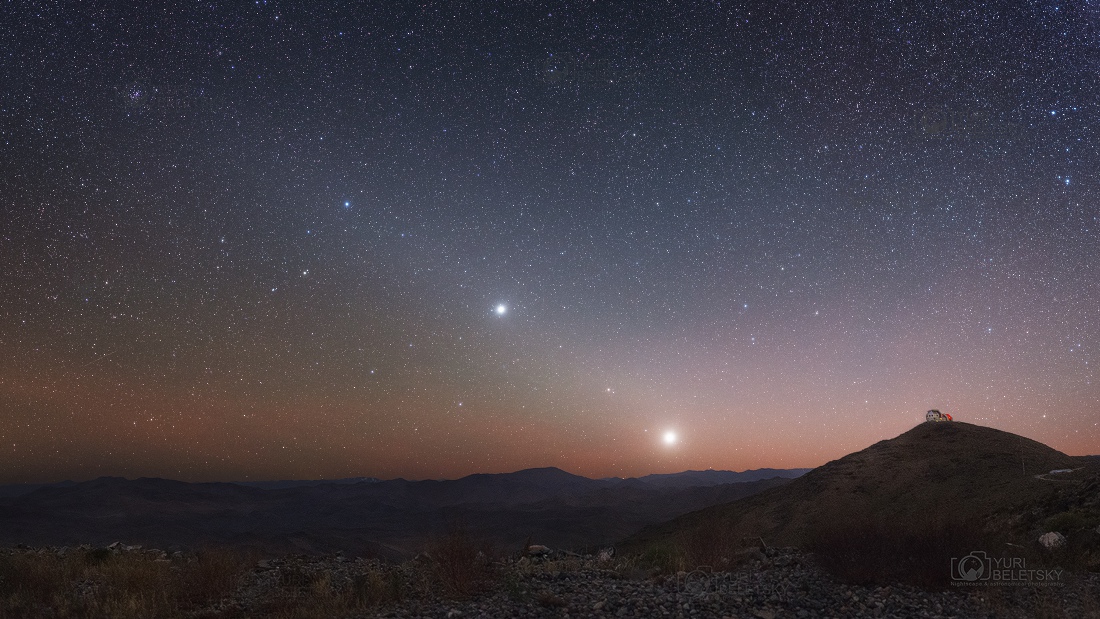
Planet Earth's horizon stretches across this recent Solar System group portrait, seen from the southern hemisphere's Las Campanas Observatory. Taken before dawn it traces the ecliptic with a line-up familiar to November's early morning risers. Toward the east are bright planets Venus, Mars, and Jupiter as well as Regulus, alpha star of the constellation Leo. Of course the planets are immersed in the faint glow of zodiacal light, visible from the dark site rising at an angle from the horizon. Sometimes known as the false dawn, it's no accident the zodiacal light and planets both lie along the ecliptic. Formed in the flattened protoplanetary disk, the Solar System's planet's all orbit near the ecliptic plane, while dust near the plane scatters sunlight, the source of the faint zodiacal glow. via NASA http://ift.tt/1NvB8f9

Unusual Pits Discovered on Pluto Unusual Pits Discovered on Pluto


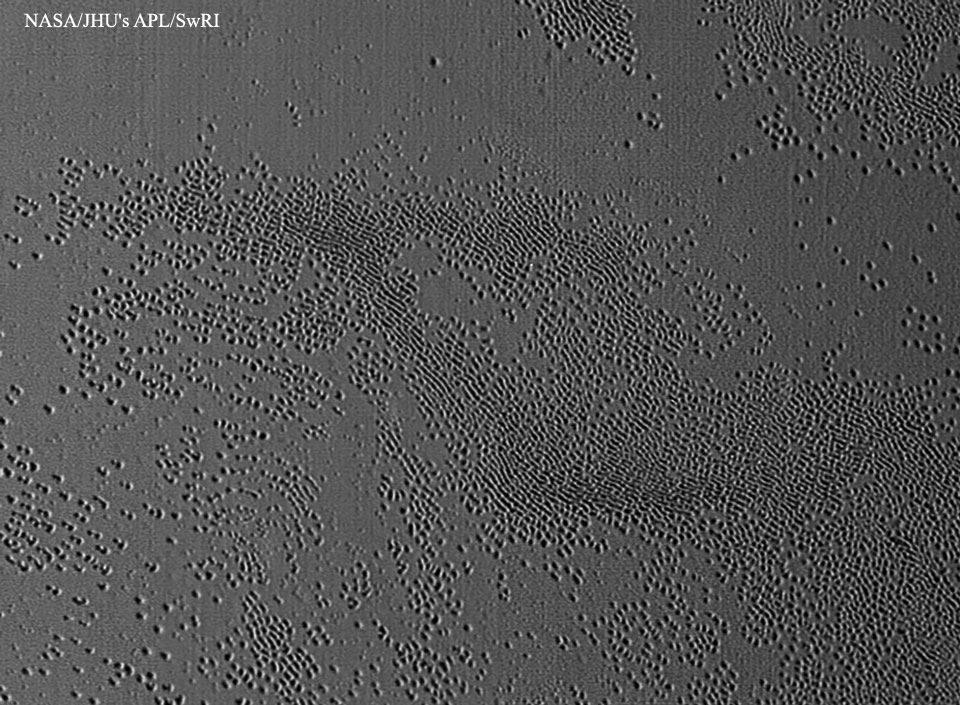
Why are there unusual pits on Pluto? The indentations were discovered during the New Horizons spacecraft's flyby of the dwarf planet in July. The largest pits span a kilometer across and dip tens of meters into a lake of frozen nitrogen, a lake that sprawls across Sputnik Planum, part of the famous light-colored heart-shaped region named Tombaugh Regio. Although most pits in the Solar System are created by impact craters, these depressions look different -- many are similarly sized, densely packed, and aligned. Rather, it is thought that something has caused these specific areas of ice to sublimate and evaporate away. In fact, the lack of overlying impact craters indicates these pits formed relatively recently. Even though the robotic New Horizons is now off to a new destination, it continues to beam back to Earth new images and data from its dramatic encounter with Pluto. via NASA http://ift.tt/1QHXIRV

Aurora over Clouds Aurora over Clouds


Auroras usually occur high above the clouds. The auroral glow is created when fast-moving particles ejected from the Sun impact the Earth's magnetosphere, from which charged particles spiral along the Earth's magnetic field to strike atoms and molecules high in the Earth's atmosphere. An oxygen atom, for example, will glow in the green light commonly emitted by an aurora after being energized by such a collision. The lowest part of an aurora will typically occur at 100 kilometers up, while most clouds usually exist only below about 10 kilometers. The relative heights of clouds and auroras are shown clearly in the featured picture from Dyrholaey, Iceland. There, a determined astrophotographer withstood high winds and initially overcast skies in an attempt to capture aurora over a picturesque lighthouse, only to take, by chance, the featured picture along the way. via NASA http://ift.tt/1IdvuGN

A 212 Hour Exposure of Orion A 212 Hour Exposure of Orion


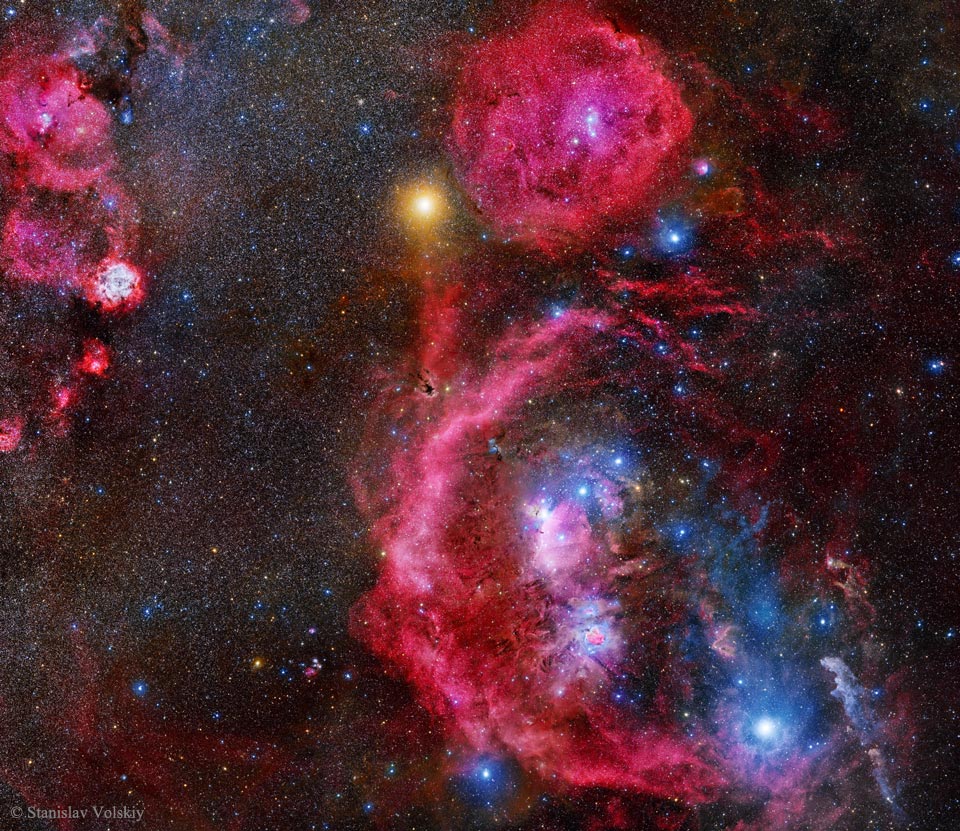
The constellation of Orion is much more than three stars in a row. It is a direction in space that is rich with impressive nebulas. To better appreciate this well-known swath of sky, an extremely long exposure was taken over many clear nights in 2013 and 2014. After 212 hours of camera time and an additional year of processing, the featured 1400-exposure collage spanning over 40 times the angular diameter of the Moon emerged. Of the many interesting details that have become visible, one that particularly draws the eye is Barnard's Loop, the bright red circular filament arcing down from the middle. The Rosette Nebula is not the giant red nebula near the top of the image -- that is a larger but lesser known nebula known as Lambda Orionis. The Rosette Nebula is visible, though: it is the red and white nebula on the upper left. The bright orange star just above the frame center is Betelgeuse, while the bright blue star on the lower right is Rigel. Other famous nebulas visible include the Witch Head Nebula, the Flame Nebula, the Fox Fur Nebula, and, if you know just where to look, the comparatively small Horsehead Nebula. About those famous three stars that cross the belt of Orion the Hunter -- in this busy frame they can be hard to locate, but a discerning eye will find them just below and to the right of the image center. via NASA http://ift.tt/1YplPWR

Phobos: Doomed Moon of Mars Phobos: Doomed Moon of Mars


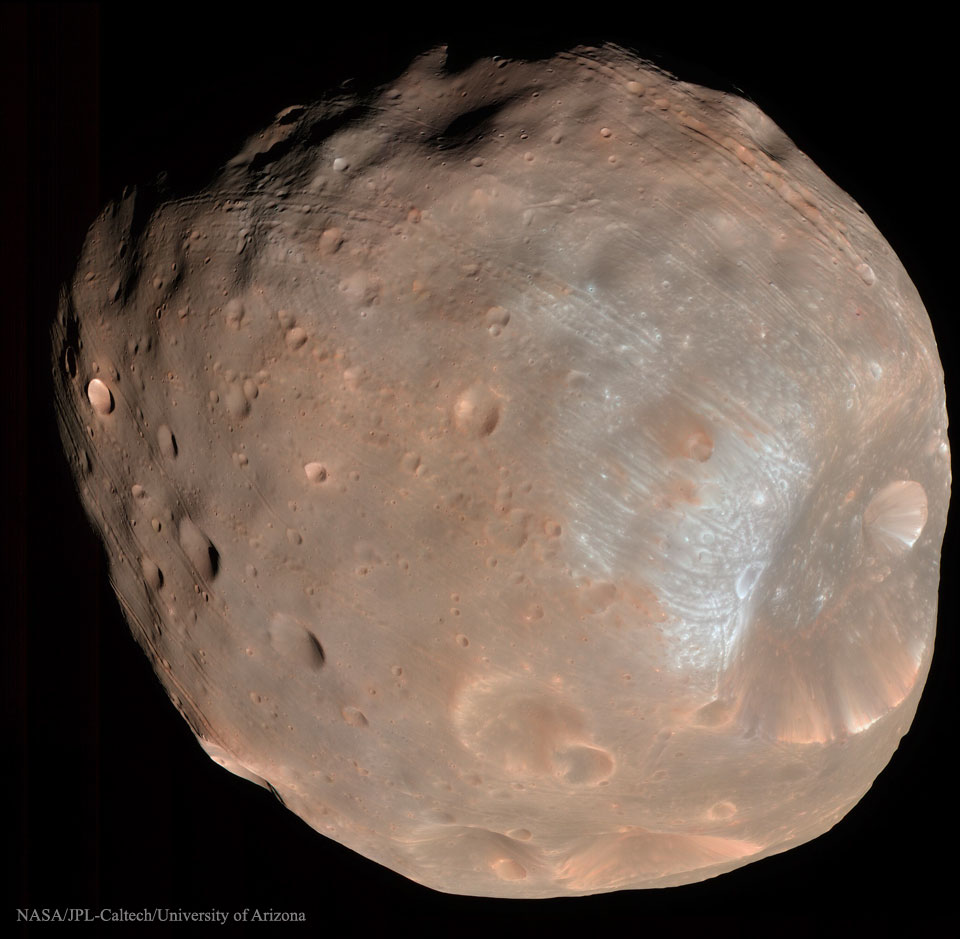
This moon is doomed. Mars, the red planet named for the Roman god of war, has two tiny moons, Phobos and Deimos, whose names are derived from the Greek for Fear and Panic. These martian moons may well be captured asteroids originating in the main asteroid belt between Mars and Jupiter or perhaps from even more distant reaches of the Solar System. The larger moon, Phobos, is indeed seen to be a cratered, asteroid-like object in this stunning color image from the robotic Mars Reconnaissance Orbiter, recorded at a resolution of about seven meters per pixel. But Phobos orbits so close to Mars - about 5,800 kilometers above the surface compared to 400,000 kilometers for our Moon - that gravitational tidal forces are dragging it down. A recent analysis of the long grooves indicates that they may result from global stretching caused by tides -- the differing force of Mars' gravity on different sides of Phobos. These grooves may then be an early phase in the disintegration of Phobos into a ring of debris around Mars. via NASA http://ift.tt/1XiNczv

Recycling NGC 5291 Recycling NGC 5291


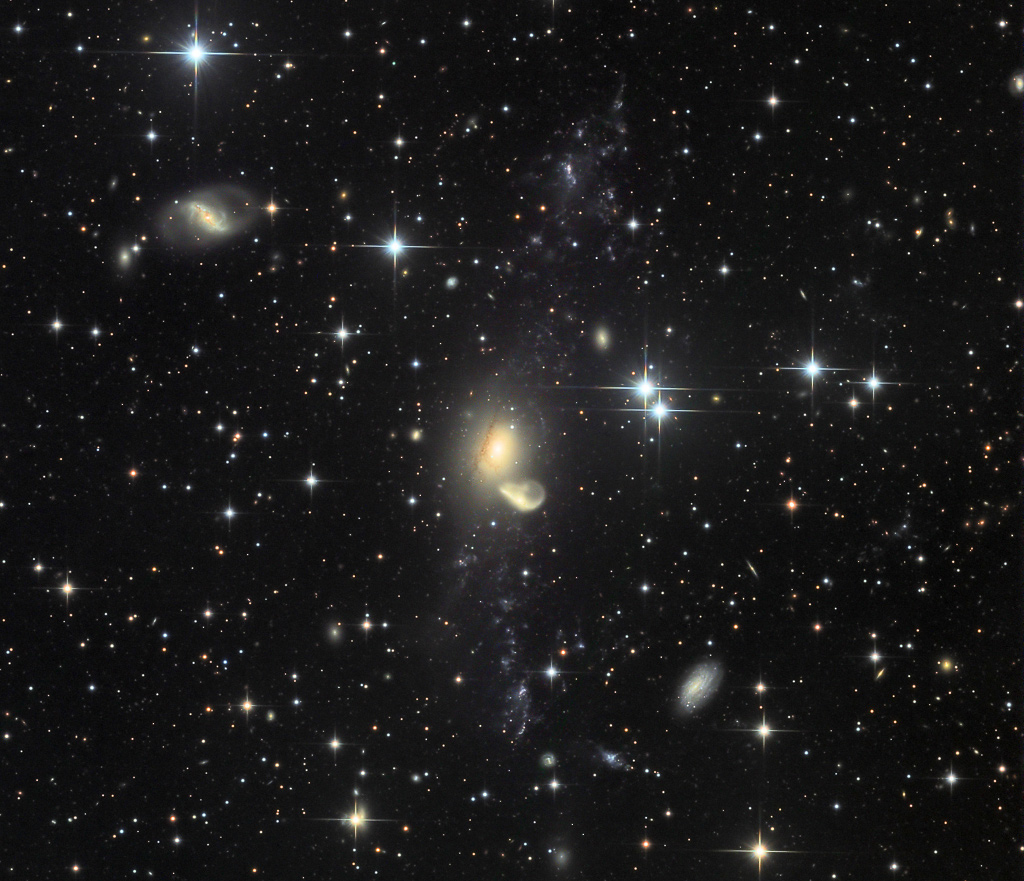
Following an ancient galaxy-galaxy collision 200 million light-years from Earth, debris from a gas-rich galaxy, NGC 5291, was flung far into intergalactic space. NGC 5291 and the likely interloper, also known as the "Seashell" galaxy, are captured near the center of this spectacular scene. The sharp, ground-based telescopic image looks toward the galaxy cluster Abell 3574 in the southern constellation Centaurus. Stretched along the 100,000 light-year long tidal tails, are clumps resembling dwarf galaxies, but lacking old stars, apparently dominated by young stars and active star forming regions. Found to be unusually rich in elements heavier than hydrogen and helium, the dwarf galaxies were likely born in intergalactic space, recycling the enriched debris from NGC 5291 itself. via NASA http://ift.tt/1jcVCee

Leonids and Friends Leonids and Friends


Leonid meteors rained down on planet Earth this week, the annual shower of dusty debris from the orbit of Comet 55P/Tempel-Tuttle. Leonids streak through this composite night skyview from a backyard observatory in southern Ontario. Recorded with camera fixed to a tripod, the individual frames capture the bright meteor activity throughout the night of November 16/17, about a day before the shower's very modest peak. The frames are registered to the fixed field of view, so the meteor trails are not all aligned to the background star field recorded that same evening when nebula-rich Orion stood above the southern horizon. As a result, the trails don't appear to point back to the shower's radiant in Leo, situated off the left edge of the star field frame. In fact, some trails could be of Taurid meteors, a shower also active in November, or even sporadic meteors, including a bright fireball with its reflection near the horizon. via NASA http://ift.tt/1Mrzass

Centaurus A Centaurus A


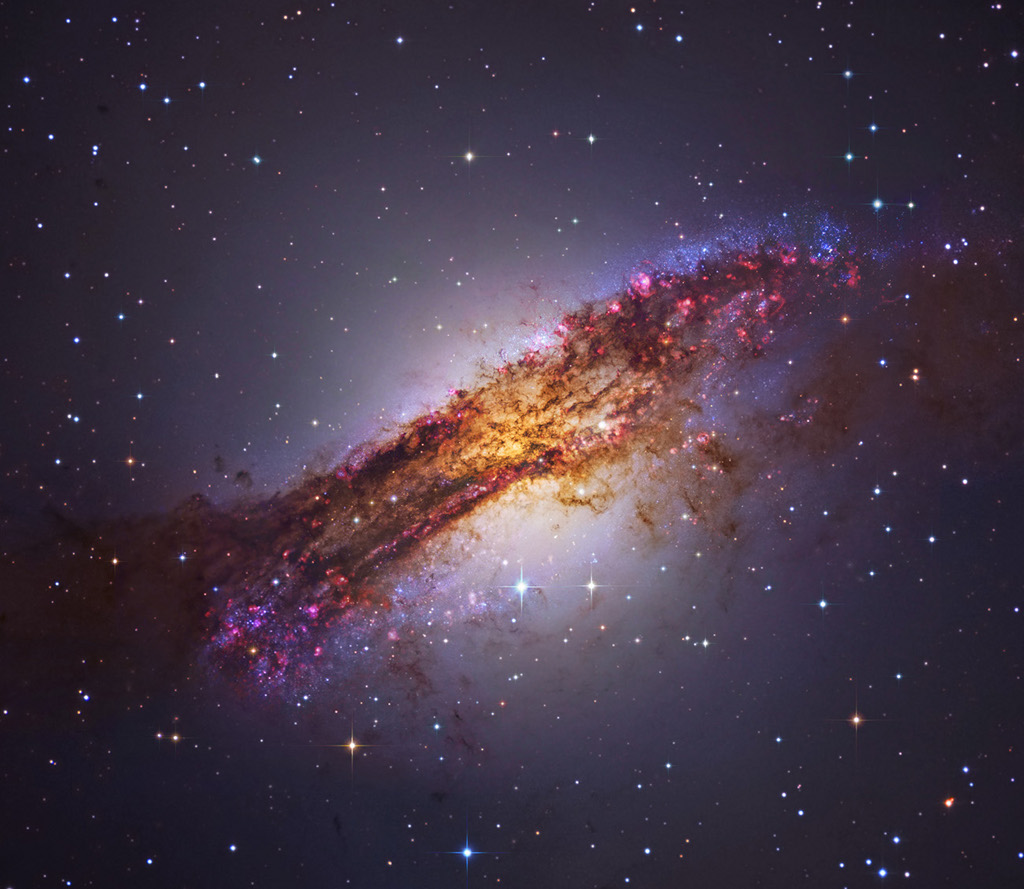
What's the closest active galaxy to planet Earth? That would be Centaurus A, only 11 million light-years distant. Spanning over 60,000 light-years, the peculiar elliptical galaxy is also known as NGC 5128. Forged in a collision of two otherwise normal galaxies, Centaurus A's fantastic jumble of young blue star clusters, pinkish star forming regions, and imposing dark dust lanes are seen here in remarkable detail. The colorful galaxy portrait is a composite of image data from space- and ground-based telescopes large and small. Near the galaxy's center, left over cosmic debris is steadily being consumed by a central black hole with a billion times the mass of the Sun. As in other active galaxies, that process generates the radio, X-ray, and gamma-ray energy radiated by Centaurus A. via NASA http://ift.tt/1HaMCSx

A Sudden Jet on Comet 67P A Sudden Jet on Comet 67P


There she blows! A dramatic demonstration of how short-lived some comet jets can be was documented in late July by the robotic Rosetta spacecraft orbiting the nucleus of Comet 67P/Churyumov-Gerasimenko. The featured animation depicts changes in the rotating comet with three illuminating stills. Although the first frame shows nothing unusual, the second frame shows a sudden strong jet shooting off the 67P's surface only 20 minutes later, while the third frame -- taken 20 minutes after that -- shows but a slight remnant of the once-active jet. As comets near the Sun, they can produce long and beautiful tails that stream across the inner Solar System. How comet jets produce these tails is a topic of research -- helped by images like this. Another recent Rosetta measurement indicates that the water on Earth could not have come from comets like 67P because of significant differences in impurities. Comet 67P spans about four kilometers, orbits the Sun between Earth and Jupiter, and has been the home for ESA's Rosetta spaceship since 2014 August. Rosetta is currently scheduled to make a slow crash onto Comet 67P's surface in late 2016. via NASA http://ift.tt/1kEvF96

The Pelican Nebula in Gas Dust and Stars The Pelican Nebula in Gas Dust and Stars


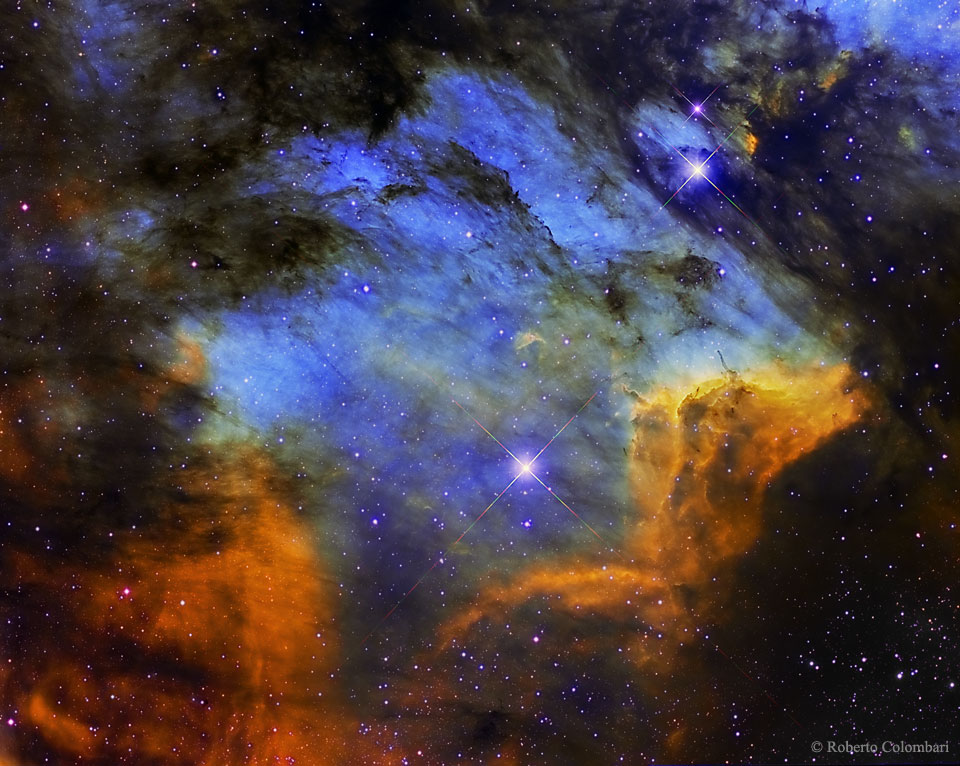
The Pelican Nebula is slowly being transformed. IC 5070, the official designation, is divided from the larger North America Nebula by a molecular cloud filled with dark dust. The Pelican, however, receives much study because it is a particularly active mix of star formation and evolving gas clouds. The featured picture was produced in three specific colors -- light emitted by sulfur, hydrogen, and oxygen -- that can help us to better understand these interactions. The light from young energetic stars is slowly transforming the cold gas to hot gas, with the advancing boundary between the two, known as an ionization front, visible in bright orange on the right. Particularly dense tentacles of cold gas remain. Millions of years from now this nebula might no longer be known as the Pelican, as the balance and placement of stars and gas will surely leave something that appears completely different. via NASA http://ift.tt/1N8VqLd

A Blazing Fireball between the Orion Nebula and Rigel A Blazing Fireball between the Orion Nebula and Rigel


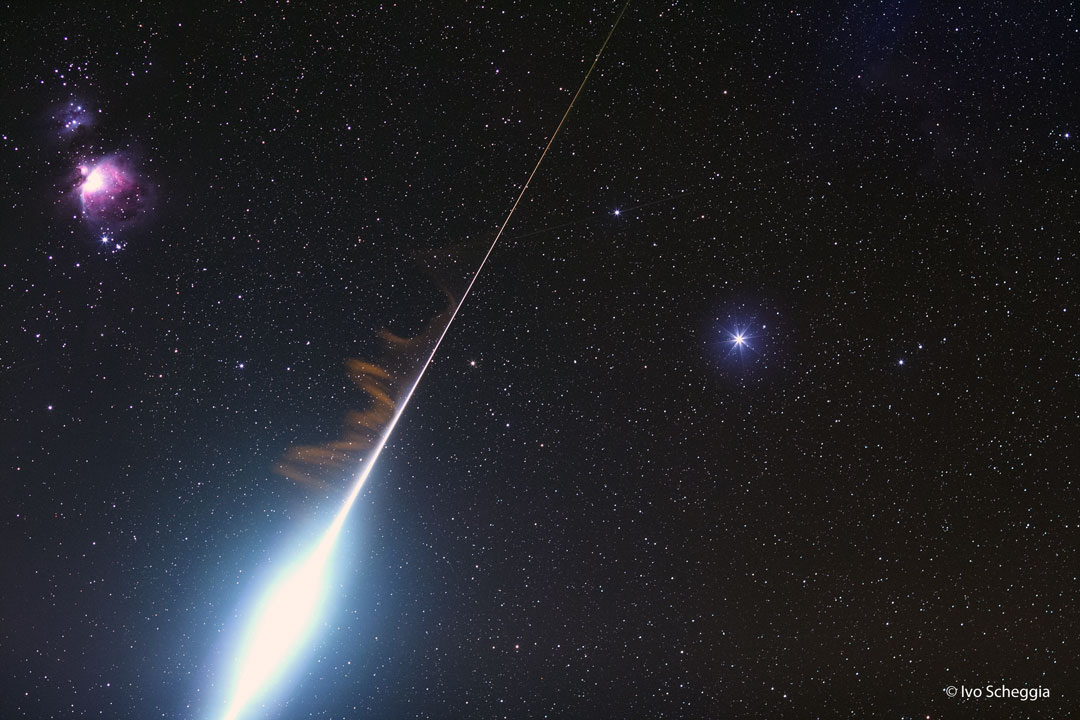
What's happening to that meteor? A few days ago, a bright fireball was photographed from the Alps mountain range in Switzerland as it blazed across the sky. The fireball, likely from the Taurids meteor shower, was notable not only for how bright it was, but for the rare orange light it created that lingered for several minutes. Initially, the orange glow made it seem like the meteor trail was on fire. However, the orange glow, known as a persistent train, originated neither from fire nor sunlight-reflecting smoke. Rather, the persistent train's glow emanated from atoms in the Earth's atmosphere in the path of the meteor -- atoms that had an electron knocked away and emit light during reacquisition. Persistent trains often drift, so that the long 3-minute exposure actually captured the initial wind-blown displacement of these bright former ions. The featured image was acquired when trying to image the famous Orion Nebula, visible on the upper left. The bright blue star Rigel, part of the constellation of Orion, is visible to the right. This week the fireball-rich Taurids meteor shower continues to be active even though it has passed its peak, while the more active Leonids meteor shower is just peaking. via NASA http://ift.tt/1ObABvI

Leonids Over Monument Valley Leonids Over Monument Valley


There was a shower over Monument Valley -- but not water. Meteors. The featured image -- actually a composite of six exposures of about 30 seconds each -- was taken in 2001, a year when there was a very active Leonids shower. At that time, Earth was moving through a particularly dense swarm of sand-sized debris from Comet Tempel-Tuttle, so that meteor rates approached one visible streak per second. The meteors appear parallel because they all fall to Earth from the meteor shower radiant -- a point on the sky towards the constellation of the Lion (Leo). The yearly Leonids meteor shower peaks again this week. Although the Moon's glow should not obstruct the visibility of many meteors, this year's shower will peak with perhaps 15 meteors visible in an hour, a rate which is good but not expected to rival the 2001 Leonids. By the way -- how many meteors can you identify in the featured image? via NASA http://ift.tt/1MPLL5H

Wright Mons on Pluto Wright Mons on Pluto


Long shadows are cast by a low Sun across this rugged looking terrain. Captured by New Horizons, the scene is found just south of the southern tip Sputnik Planum, the informally named smooth, bright heart region of Pluto. Centered is a feature provisionally known as Wright Mons, a broad, tall mountain, about 150 kilometers across and 4 kilometers high, with a 56 kilometer wide, deep summit depression. Of course, broad mountains with central craters are found elsewhere in the Solar System, like Mauna Loa on planet Earth and Olympus Mons on Mars. In fact, New Horizons scientists announced the striking similarity of Pluto's Wright Mons, and nearby Piccard Mons, to large shield volcanoes strongly suggests the two could be giant cryovolcanoes that once erupted molten ice from the interior of the cold, distant world. via NASA http://ift.tt/1H20qyF

The Tadpoles of IC 410 The Tadpoles of IC 410


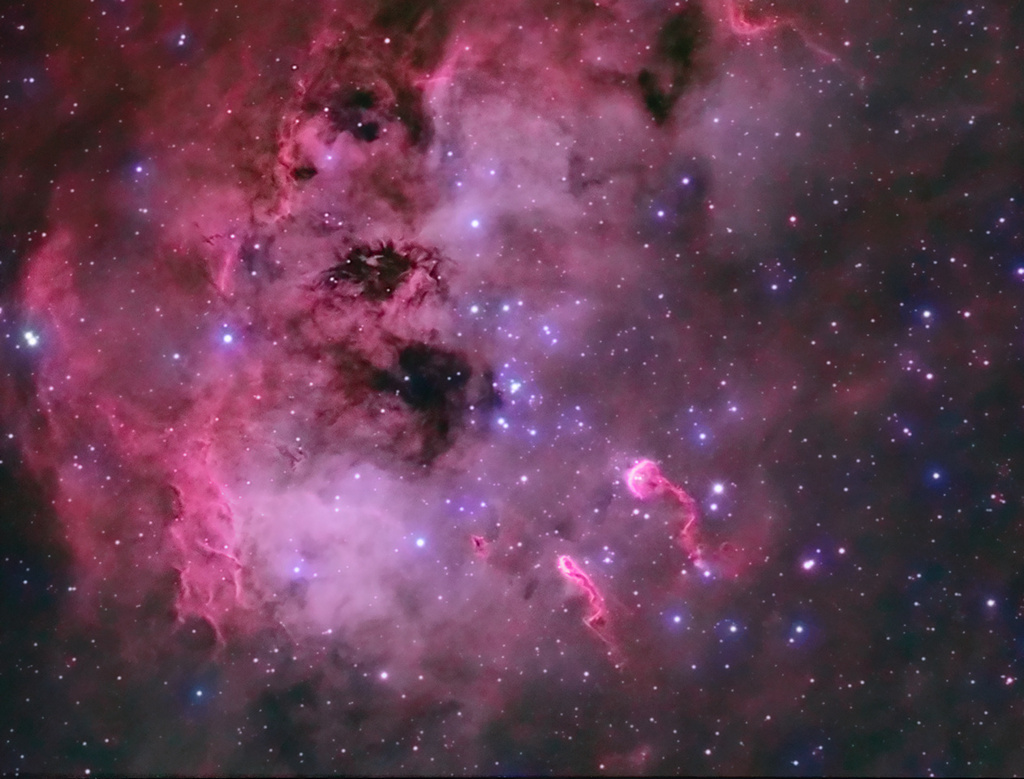
This telescopic close-up shows off the otherwise faint emission nebula IC 410. It also features two remarkable inhabitants of the cosmic pond of gas and dust below and right of center, the tadpoles of IC 410. Partly obscured by foreground dust, the nebula itself surrounds NGC 1893, a young galactic cluster of stars. Formed in the interstellar cloud a mere 4 million years ago, the intensely hot, bright cluster stars energize the glowing gas. Composed of denser cooler gas and dust, the tadpoles are around 10 light-years long and are likely sites of ongoing star formation. Sculpted by winds and radiation from the cluster stars, their heads are outlined by bright ridges of ionized gas while their tails trail away from the cluster's central region. IC 410 lies some 10,000 light-years away, toward the nebula-rich constellation Auriga. via NASA http://ift.tt/1OIsvOj

Kenya Morning Moon, Planets and Taurid Kenya Morning Moon, Planets and Taurid


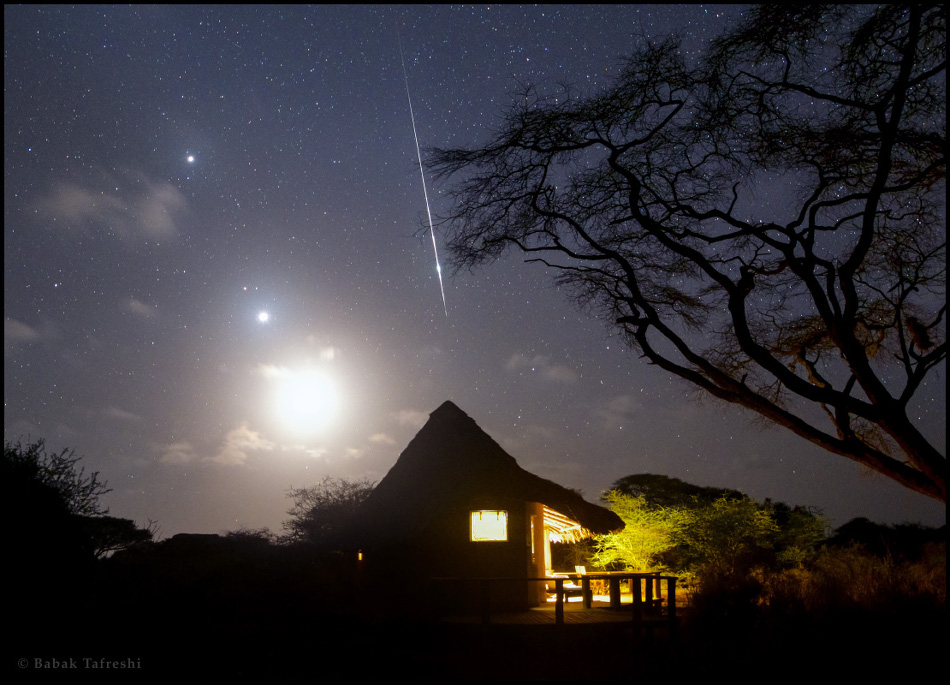
On November 8, a waning crescent Moon joined the continuing parade of planets in Earth's early morning skies. Captured here from Amboseli National Park, Kenya, even the overexposed moonlight can't washout brilliant Venus though, lined up near the ecliptic plane with faint Mars and bright Jupiter above. As if Moon and planets aren't enough, a comparably bright Taurid meteor also streaks through the scene. In fact November's Taurid meteor showers have had a high proportion of bright fireballs. Apparently streaming from radiants in Taurus, the meteors are caused by our fair planet's annual passage through debris from Comet 2P/Encke. The comet's dust grains are catching up with Earth's atmosphere at a relatively low speed of about 27 kilometers per second. via NASA http://ift.tt/1O5pLr7