Pages

Milky Way over Uluru Milky Way over Uluru


The central regions of our Milky Way Galaxy rise above Uluru/Ayers Rock in this striking night skyscape. Recorded on July 13, a faint airglow along the horizon shows off central Australia's most recognizable landform in silhouette. Of course the Milky Way's own cosmic dust clouds appear in silhouette too, dark rifts along the galaxy's faint congeries of stars. Above the central bulge, rivers of cosmic dust converge on a bright yellowish supergiant star Antares. Left of Antares, wandering Saturn shines in the night. via NASA http://ift.tt/1H4Flwz

The Deep Lagoon The Deep Lagoon


Ridges of glowing interstellar gas and dark dust clouds inhabit the turbulent, cosmic depths of the Lagoon Nebula. Also known as M8, The bright star forming region is about 5,000 light-years distant. But it still makes for a popular stop on telescopic tours of the constellation Sagittarius, toward the center of our Milky Way Galaxy. Dominated by the telltale red emission of ionized hydrogen atoms recombining with stripped electrons, this stunning, deep view of the Lagoon's central reaches is about 40 light-years across. Near the center of the frame, the bright hourglass shape is gas ionized and sculpted by energetic radiation and extreme stellar winds from a massive young star. via NASA http://ift.tt/1IpRahC

Rainbows and Rays over Bryce Canyon Rainbows and Rays over Bryce Canyon


What's happening over Bryce Canyon? Two different optical effects that were captured in one image taken earlier this month. Both effects needed to have the Sun situated directly behind the photographer. The nearest apparition was the common rainbow, created by sunlight streaming from the setting sun over the head of the photographer, and scattering from raindrops in front of the canyon. If you look closely, even a second rainbow appears above the first. More rare, and perhaps more striking, are the rays of light that emanate out from the horizon above the canyon. These are known as anticrepuscular rays and result from sunlight streaming though breaks in the clouds, around the sky, and converging at the point 180 degrees around from the Sun. Geometrically, this antisolar point must coincide with the exact center of the rainbows. Located in Utah, USA, Bryce Canyon itself contains a picturesque array of ancient sedimentary rock spires known as hoodoos. via NASA http://ift.tt/1evEkqq

Milky Way and Aurora over Antarctica Milky Way and Aurora over Antarctica


It has been one of the better skies of this long night. In parts of Antarctica, not only is it winter, but the Sun can spend weeks below the horizon. At China's Zhongshan Station, people sometimes venture out into the cold to photograph a spectacular night sky. The featured image from one such outing was taken in mid-July, just before the end of this polar night. Pointing up, the wide angle lens captured not only the ground at the bottom, but at the top as well. In the foreground is a colleague also taking pictures. In the distance, a spherical satellite receiver and several windmills are visible. Numerous stars dot the night sky, including Sirius and Canopus. Far in the background, stretching overhead from horizon to horizon, is the central band of our Milky Way Galaxy. Even further in the distance, visible as extended smudges near the top, are the Large and Small Magellanic Clouds, satellite galaxies near our huge Milky Way Galaxy. via NASA http://ift.tt/1OJw2s8

The Sombrero Galaxy from Hubble The Sombrero Galaxy from Hubble


Why does the Sombrero Galaxy look like a hat? Reasons include the Sombrero's unusually large and extended central bulge of stars, and dark prominent dust lanes that appear in a disk that we see nearly edge-on. Billions of old stars cause the diffuse glow of the extended central bulge. Close inspection of the bulge in the above photograph shows many points of light that are actually globular clusters. M104's spectacular dust rings harbor many younger and brighter stars, and show intricate details astronomers don't yet fully understand. The very center of the Sombrero glows across the electromagnetic spectrum, and is thought to house a large black hole. Fifty million-year-old light from the Sombrero Galaxy can be seen with a small telescope towards the constellation of Virgo. via NASA http://ift.tt/1GPP4Xq

Infrared Trifid Infrared Trifid


The Trifid Nebula, also known as Messier 20, is easy to find with a small telescope, a well known stop in the nebula rich constellation Sagittarius. But where visible light pictures show the nebula divided into three parts by dark, obscuring dust lanes, this penetrating infrared image reveals filaments of glowing dust clouds and newborn stars. The spectacular false-color view is courtesy of the Spitzer Space Telescope. Astronomers have used the Spitzer infrared image data to count newborn and embryonic stars which otherwise can lie hidden in the natal dust and gas clouds of this intriguing stellar nursery. As seen here, the Trifid is about 30 light-years across and lies only 5,500 light-years away. via NASA http://ift.tt/1D0ldk5

Jul 25, 2015

Ultraviolet Rings of M31 Ultraviolet Rings of M31


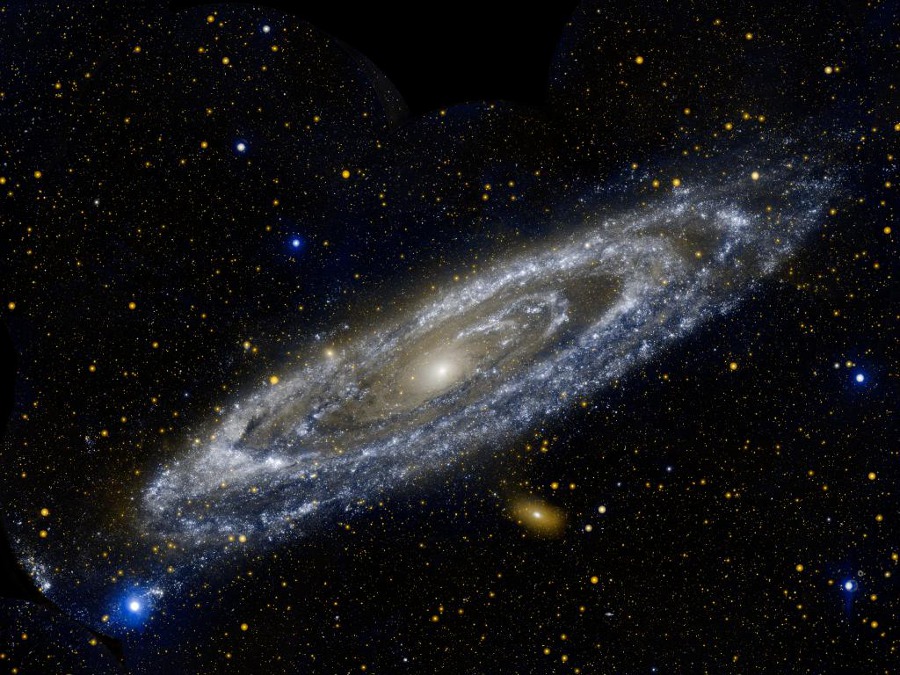
A mere 2.5 million light-years away the Andromeda Galaxy, also known as M31, really is just next door as large galaxies go. So close and spanning some 260,000 light-years, it took 11 different image fields from the Galaxy Evolution Explorer (GALEX) satellite's telescope to produce this gorgeous portrait of the spiral galaxy in ultraviolet light. While its spiral arms stand out in visible light images of Andromeda, the arms look more like rings in the GALEX ultraviolet view, a view dominated by the energetic light from hot, young, massive stars. As sites of intense star formation, the rings have been interpreted as evidence Andromeda collided with its smaller neighboring elliptical galaxy M32 more than 200 million years ago. The large Andromeda galaxy and our own Milky Way are the most massive members of the local galaxy group. via NASA http://ift.tt/1MLHC4N

Comet PanSTARRS, Moon, and Venus Comet PanSTARRS, Moon, and Venus


It is the object to the left of the big tree that's generating much recent excitement. If you look closely, there you can see Comet PanSTARRS, complete with two tails. During July, this comet has increased markedly in brightness and has just passed its closest approach to Earth. The statuesque tree in the center is a Norfolk Island Pine, and to either side of this tree are New Zealand Pohutukaw trees. Over the trees, far in the distance, are bright Venus and an even brighter crescent Moon. If you look even more closely, you can find Jupiter hidden in the branches of the pine. The featured image was taken a few days ago in Fergusson Park, New Zealand, looking over Tauranga Harbour Inlet. In the coming days and weeks, Comet C/2014 Q1 (PANSTARRS) will slowly move away from the Sun and the Earth, drift deep into southern skies, and fade. via NASA http://ift.tt/1DwLGRg

Comet Tails and Star Trails Comet Tails and Star Trails


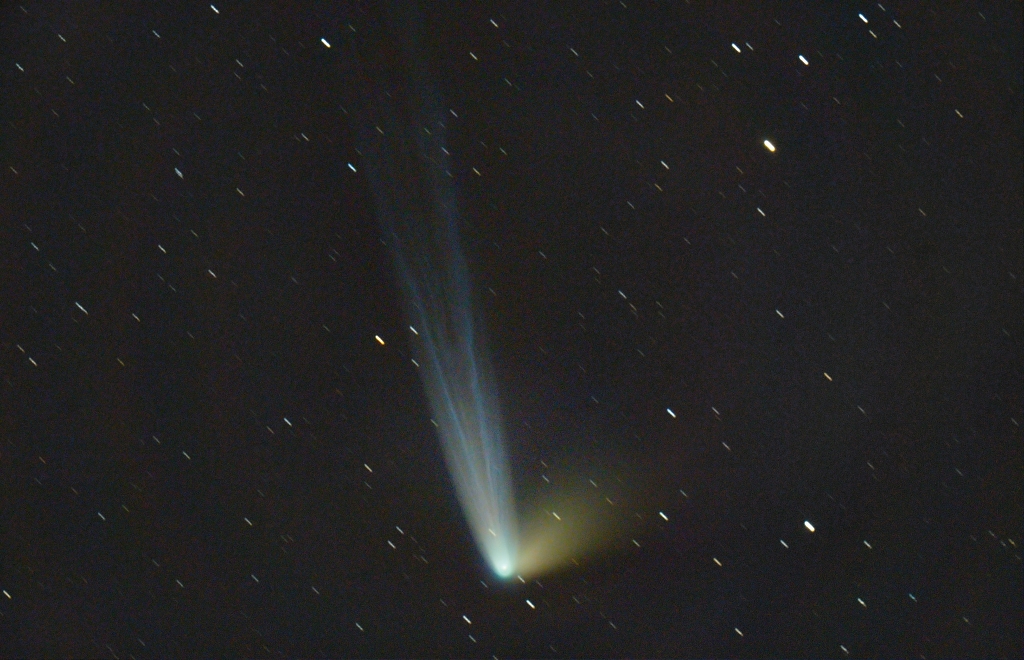
After grazing the western horizon on northern summer evenings Comet PanSTARRS (also known as C/2014 Q1) climbed higher in southern winter skies. A visitor to the inner Solar System discovered in August 2014 by the prolific panSTARRS survey, the comet was captured here on July 17. Comet and colorful tails were imaged from Home Observatory in Mackay, Queensland, Australia. The field of view spans just over 1 degree. Sweeping quickly across a the sky this comet PanSTARRS was closest to planet Earth about 2 days later. Still, the faint stars of the constellation Cancer left short trails in the telescopic image aligned to track the comet's rapid motion. PanSTARRS' bluish ion tails stream away from the Sun, buffetted by the solar wind. Driven by the pressure of sunlight, its more diffuse yellowish dust tail is pushed outward and lags behind the comet's orbit. A good target for binoculars from southern latitudes, in the next few days the comet will sweep through skies near Venus, Jupiter, and bright star Regulus. via NASA http://ift.tt/1CMulZO

Comet PanSTARRS and a Crescent Moon Comet PanSTARRS and a Crescent Moon


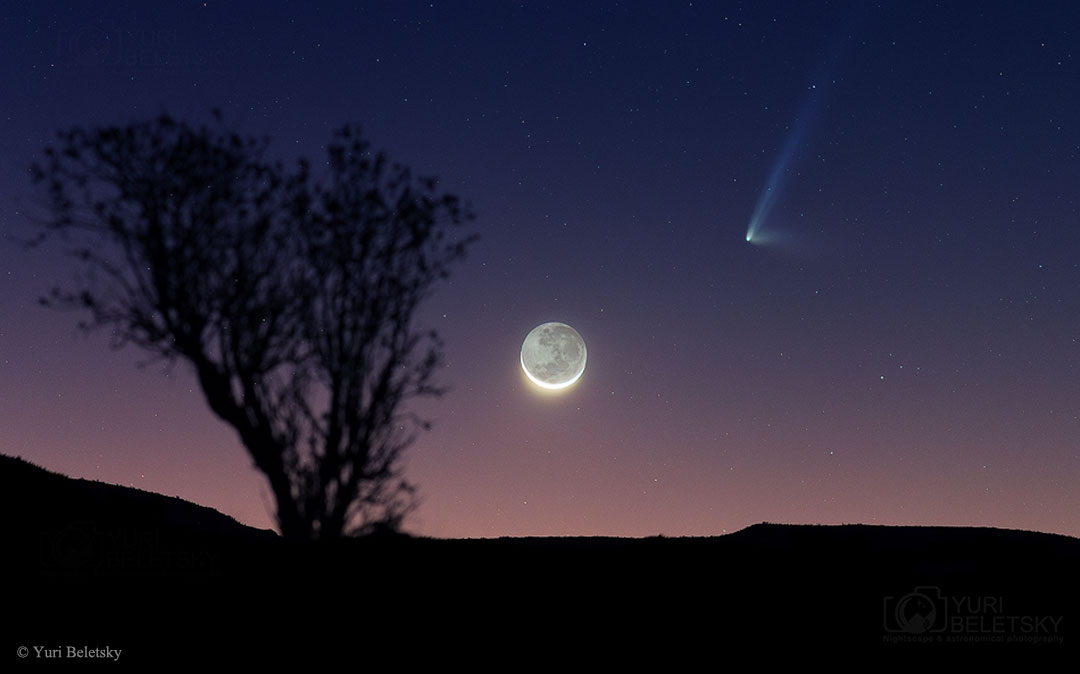
A comet has brightened quickly and unexpectedly. Discovered last year, Comet C/2014 Q1 (PanSTARRS) is expected to be visible now for a few days to the unaided eye, just after sunset, from some locations. The comet rounded the Sun on July 6 and apparently has shed quite a bit of gas and dust. Today it is now as close as it will ever get to the Earth, which is another factor in its recent great apparent brightness and the large angular extent of its tails. In the featured image taken two days ago, Comet PanSTARRS is seen sporting a short white dust tail fading to the right, and a long blue ion tail pointing away from the recently set Sun. A crescent moon dominates the image center. Tomorrow, Comet PannSTARRS will pass only 7 degrees away from a bright Jupiter, with even brighter Venus nearby. Due to its proximity to the Sun, the comet and its tails may best be seen in the sunset din with binoculars or cameras using long-duration exposures. via NASA http://ift.tt/1GuFMQv

The First Rocket Launch from Cape Canaveral The First Rocket Launch from Cape Canaveral


A new chapter in space flight began this week in 1950 July with the launch of the first rocket from Cape Canaveral, Florida: the Bumper V-2. Shown above, the Bumper V-2 was an ambitious two-stage rocket program that topped a V-2 missile base with a WAC Corporal rocket. The upper stage was able to reach then-record altitudes of almost 400 kilometers, higher than even Space Shuttles once flew. Launched under the direction of the General Electric Company, the Bumper V-2 was used primarily for testing rocket systems and for research on the upper atmosphere. Bumper V-2 rockets carried small payloads that allowed them to measure attributes including air temperature and cosmic ray impacts. Seven years later, the Soviet Union launched Sputnik I and Sputnik II, the first satellites into Earth orbit. In response in 1958, the US created NASA. via NASA http://ift.tt/1MBa8WB

Charon Charon


Icy world Charon is 1,200 kilometers across. That makes Pluto's largest moon only about 1/10th the size of planet Earth but a whopping 1/2 the diameter of Pluto itself. Charon is seen in unprecedented detail in this image from New Horizons. The image was captured late July 13 during the spacecraft's flight through the Plutonian system from a range of less than 500,000 kilometers. For reference, the distance separating Earth and Moon is less than 400,000 kilometers. Charonian terrain, described as surprising, youthful, and varied, includes a 1,000 kilometer swath of cliffs and troughs stretching below center, a 7 to 9 kilometer deep canyon cutting the curve of the upper right edge, and an enigmatic dark north polar region unofficially dubbed Mordor. via NASA http://ift.tt/1Gps8Op

50 Miles on Pluto 50 Miles on Pluto


A 50 mile (80 kilometer) trip across Pluto would cover the distance indicated by the scale bar in this startling image. The close-up of the icy world's rugged equatorial terrain was captured when the New Horizons spacecraft was about 47,800 miles (77,000 kilometers) from the surface, 1.5 hours before its closest approach. Rising to an estimated 11,000 feet (3,500 meters) the mountains are likely composed of water ice. Suggesting surprising geological activity, they are also likely young with an estimated age of 100 million years or so based on the apparent absence of craters. The region pictured is near the base of Pluto's broad, bright, heart-shaped feature. via NASA http://ift.tt/1M74PAm

Pluto Resolved Pluto Resolved


New Horizons has survived its close encounter with Pluto and has resumed sending back images and data. The robotic spacecraft reported back on time, with all systems working, and with the expected volume of data stored. Featured here is the highest resolution image of Pluto taken before closest approach, an image that really brings Pluto into a satisfying focus. At first glance, Pluto is reddish and has several craters. Toward the image bottom is a surprisingly featureless light-covered region that resembles an iconic heart, and mountainous terrain appears on the lower right. This image, however, is only the beginning. As more images and data pour in today, during the coming week, and over the next year, humanity's understanding of Pluto and its moons will likely become revolutionized. via NASA http://ift.tt/1MtRDn8

New Horizons Passes Pluto and Charon New Horizons Passes Pluto and Charon


Will the New Horizons spacecraft survive its closest approach to Pluto and return useful images and data? Humanity will know in a few hours. Regardless of how well it functions, New Horizon's rapid speed will take it whizzing past Pluto and its moons today, with the time of closest approach being at 11:50 UT (7:50 am EDT). To better take images and data, though, the robotic spacecraft was preprogrammed and taken intentionally out of contact with the Earth until about 1:00 am UT July 15, which corresponds to about 9:00 pm EDT on July 14. Therefore, much of mankind will be holding its breath through this day, hoping that the piano-sized spacecraft communicates again with ground stations on Earth. Hopefully, at that time, New Horizons will begin beaming back new and enlightening data about a world that has remained remote and mysterious since its discovery 85 years ago. Featured above is a New Horizons composite image of the moon Charon (left) and Pluto (right) taken 3 days ago, already showing both worlds in unprecedented detail. via NASA http://ift.tt/1HsjikF

Last Look at Plutos Charon Side Last Look at Plutos Charon Side


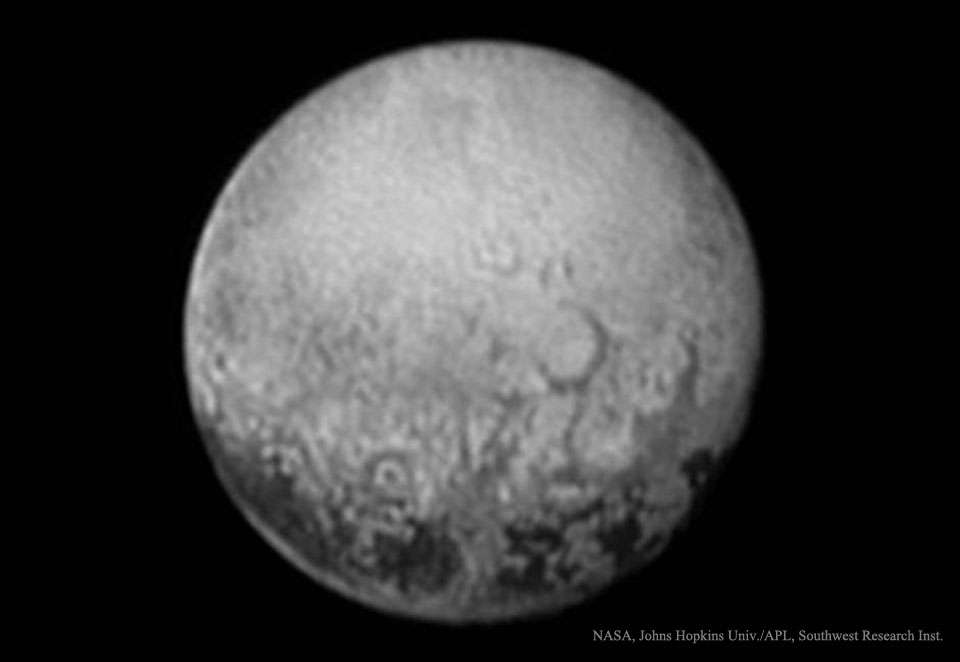
Pluto surface is strange. As the robotic New Horizons barrels toward its closest approach to Pluto and its moons tomorrow, images already coming back show Pluto's surface to be curiouser and curiouser. The featured image, taken two days ago, shows the side of Pluto that always faces Pluto's largest moon Charon. Particularly noteworthy is the dark belt near the bottom that circles Pluto's equator. It is currently unclear whether regions in this dark belt are mountainous or flat, why boundaries are so sharply defined, and why the light regions seem to be nearly evenly spaced. As New Horizons will be flying past the other side of Pluto, this should be the best image of this distant landscape that humanity sees for a long time. Assuming the robotic spacecraft operates as hoped, images taken of the other side of Pluto, taken near closest approach, will be about 300 times more detailed. via NASA http://ift.tt/1M0TYb0

Destination: Pluto. The New Horizons spacecraft roared off its launch pad at Cape Canaveral in Florida, USA in 2006 toward adventures in the distant Solar System. The craft is the fastest spaceships ever launched by humans, having passed the Moon only nine hours after launch, and Jupiter only a year later. After spending almost a decade crossing the Solar System, New Horizons will fly past Pluto on Tuesday. Pluto, officially a planet when New Horizons launched, has never been visited by a spacecraft or photographed up close. After Pluto, the robot spaceship will visit one or more Kuiper Belt Objects orbiting the Sun even further out than Pluto. Pictured, the New Horizons craft launches into space atop a powerful Atlas V rocket. via NASA http://ift.tt/1HWe4RZ