Pages

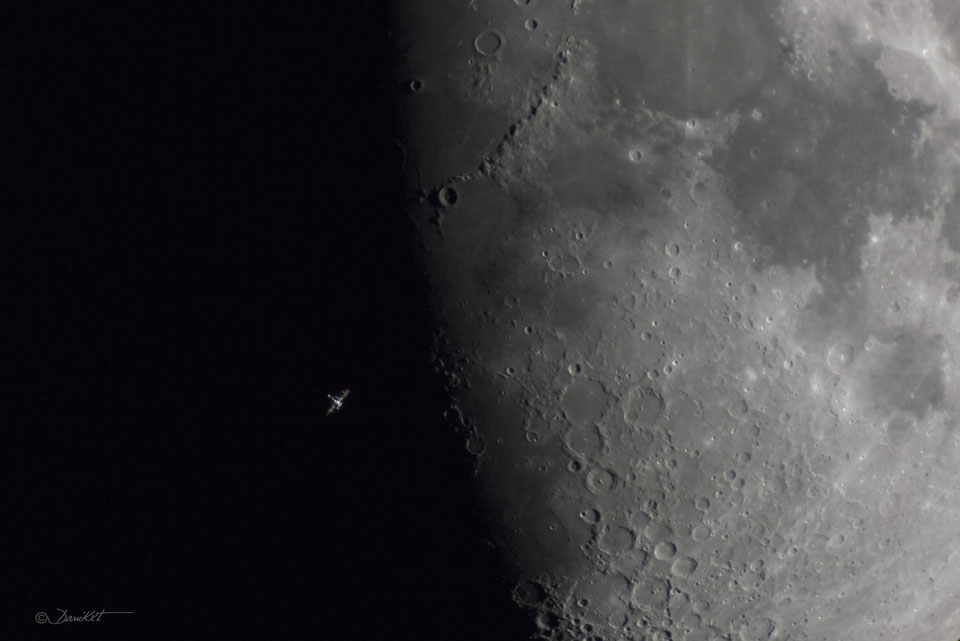
Space Station over Lunar Terminator Space Station over Lunar Terminator


What's that in front of the Moon? It's the International Space Station. Using precise timing, the Earth-orbiting space platform was photographed in front of a partially lit Moon last year. The featured image was taken from Madrid, Spain with an exposure time of only 1/1000 of a second. In contrast, the duration of the transit of the ISS across the entire Moon was about half a second. The sun-glinting station can be seen just to the dark side of the day / night line known as the terminator. Numerous circular craters are visible on the distant Moon, as well as comparatively rough, light colored terrain known as highlands, and relatively smooth, dark colored areas known as maria. On-line tools can tell you when the International Space Station will be visible from your area. via NASA http://ift.tt/1KmcckE

Planetary Nebula Mz3: The Ant Nebula Planetary Nebula Mz3: The Ant Nebula


Why isn't this ant a big sphere? Planetary nebula Mz3 is being cast off by a star similar to our Sun that is, surely, round. Why then would the gas that is streaming away create an ant-shaped nebula that is distinctly not round? Clues might include the high 1000-kilometer per second speed of the expelled gas, the light-year long length of the structure, and the magnetism of the star visible above at the nebula's center. One possible answer is that Mz3 is hiding a second, dimmer star that orbits close in to the bright star. A competing hypothesis holds that the central star's own spin and magnetic field are channeling the gas. Since the central star appears to be so similar to our own Sun, astronomers hope that increased understanding of the history of this giant space ant can provide useful insight into the likely future of our own Sun and Earth. via NASA http://ift.tt/1E7nJCe

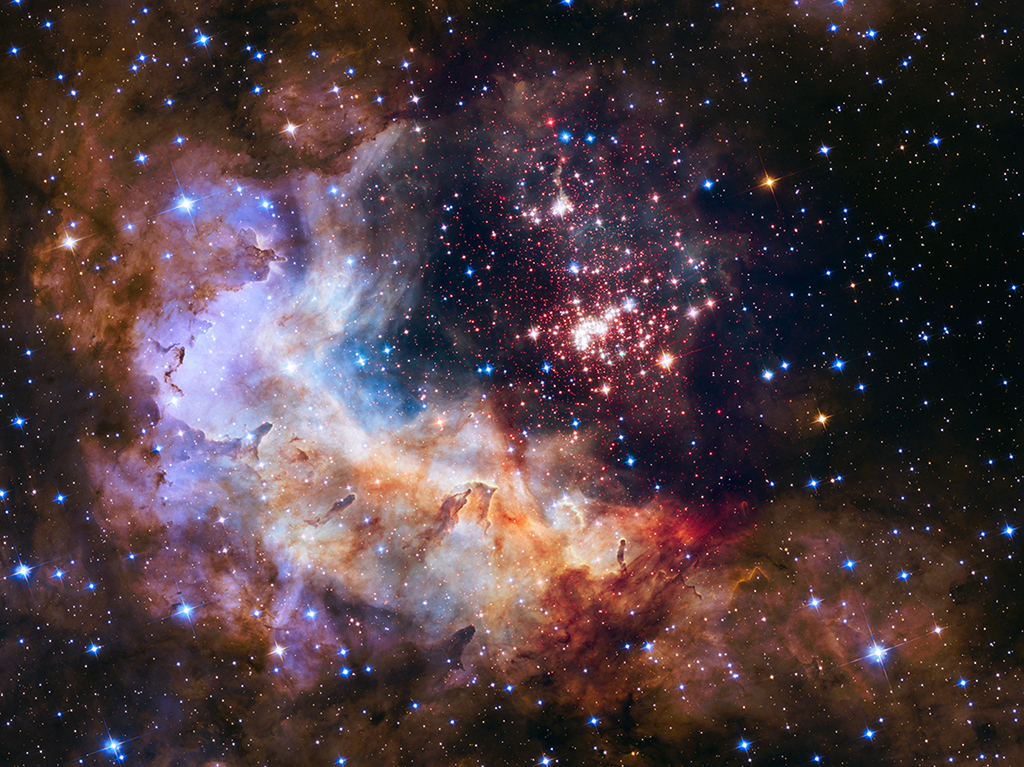
Cluster and Starforming Region Westerlund 2 Cluster and Starforming Region Westerlund 2


Located 20,000 light-years away in the constellation Carina, the young cluster and starforming region Westerlund 2 fills this cosmic scene. Captured with Hubble's cameras in near-infrared and visible light, the stunning image is a celebration of the 25th anniversary of the launch of the Hubble Space Telescope on April 24, 1990. The cluster's dense concentration of luminous, massive stars is about 10 light-years across. Strong winds and radiation from those massive young stars have sculpted and shaped the region's gas and dust, into starforming pillars that point back to the central cluster. Red dots surrounding the bright stars are the cluster's faint newborn stars, still within their natal gas and dust cocoons. But brighter blue stars scattered around are likely not in the Westerlund 2 cluster and instead lie in the foreground of the Hubble anniversary field of view. via NASA http://ift.tt/1aZXkM1

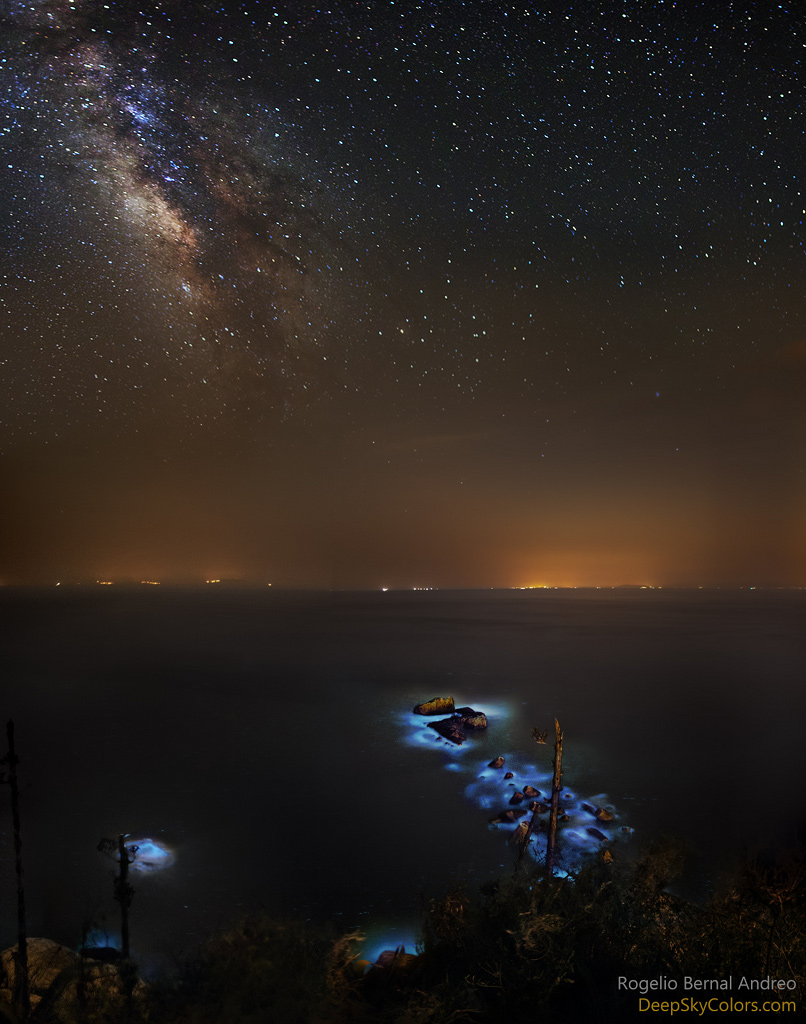
Blue Tears and the Milky Way Blue Tears and the Milky Way


Lapping at rocks along the shore of the Island of Nangan, Taiwan, planet Earth, waves are infused with a subtle blue light in this sea and night skyscape. Composed of a series of long exposures made on April 16 the image captures the faint glow from Noctiluca scintillans. Also known as sea sparkles or blue tears, the marine plankton's bioluminescence is stimulated by wave motion. City lights along the coast of mainland China shine beneath low clouds in the west but stars and the faint Milky Way still fill the night above. Over the horizon the galaxy's central bulge and dark rifts seem to echo the rocks and luminous waves. via NASA http://ift.tt/1ExrgNs

Meteor in the Milky Way Meteor in the Milky Way


Earth's April showers include the Lyrid Meteor Shower, observed for more than 2,000 years when the planet makes its annual passage through the dust stream of long-period Comet Thatcher. A grain of that comet's dust, moving 48 kilometers per second at an altitude of 100 kilometers or so, is swept up in this night sky view from the early hours of April 21. Flashing toward the southeastern horizon, the meteor's brilliant streak crosses the central region of the rising Milky Way. Its trail points back toward the shower's radiant in the constellation Lyra, high in the northern springtime sky and off the top of the frame. The yellowish hue of giant star Antares shines to the right of the Milky Way's bulge. Higher still is bright planet Saturn, near the right edge. Seen from Istra, Croatia, the Lyrid meteor's greenish glow reflects in the waters of the Adriatic Sea. via NASA http://ift.tt/1HoENaF

Colorful Star Clouds in Cygnus Colorful Star Clouds in Cygnus


Stars can form in colorful surroundings. Featured here is a star forming region rich in glowing gas and dark dust toward the constellation of the Swan (Cygnus), near the bright star Sadr. This region, which spans about 50 light years, is part of the Gamma Cygni nebula which lies about 1,800 light years distant. Toward the right of the image is Barnard 344, a dark and twisted dust cloud rich in cool molecular gas. A dramatic wall of dust and red-glowing hydrogen gas forms a line down the picture center. While the glowing red gas is indicative of small emission nebulas, the blue tinted areas are reflection nebulas -- starlight reflecting from usually dark dust grains. The Gamma Cygni nebula will likely not last the next billion years, as most of the bright young stars will explode, most of the dust will be destroyed, and most of the gas will drift away. via NASA http://ift.tt/1GgOTas

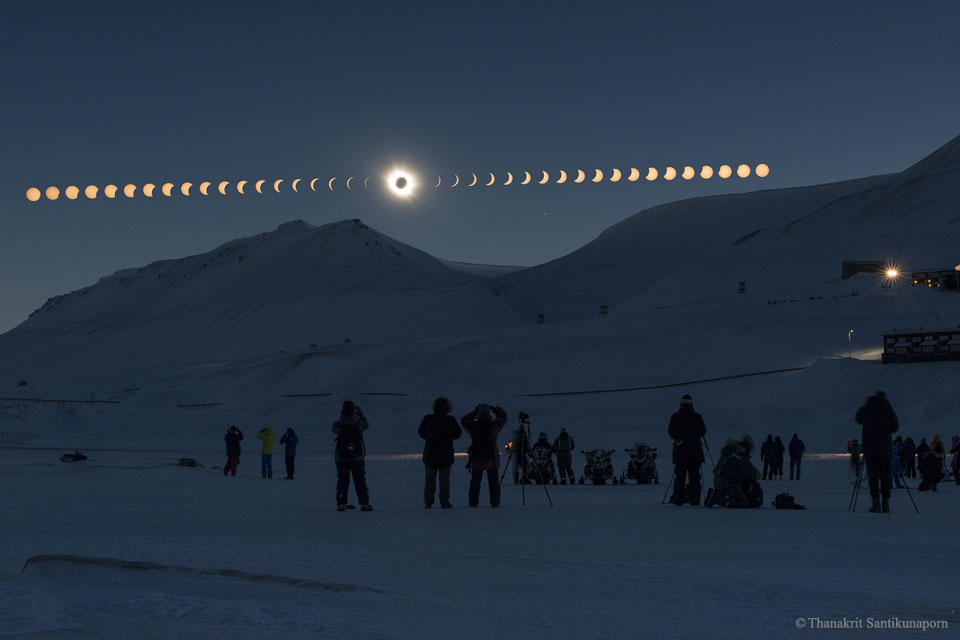
Total Solar Eclipse over Svalbard Total Solar Eclipse over Svalbard


Going, going, gone. That was the feeling in Svalbard, Norway last month during a total eclipse of the Sun by the Moon. In the featured image, the eclipse was captured every three minutes and then digitally merged with a foreground frame taken from the same location. Visible in the foreground are numerous gawking eclipse seekers, some deploying pretty sophisticated cameras. As the Moon and Sun moved together across the sky -- nearly horizontally from this far north -- an increasing fraction of the Sun appears covered by the Moon. In the central frame, the Moon's complete blockage of the disk of the Sun makes the immediate surroundings appear like night during the day. The exception is the Moon itself, which now appears surrounded by the expansive corona of the Sun. Of course, about 2.5 minutes later, the surface of the Sun began to reappear. The next total eclipse of the Sun will occur in 2016 March and be visible from Southeast Asia. via NASA http://ift.tt/1Q80TAK

Ring Galaxy AM 0644 741 from Hubble Ring Galaxy AM 0644 741 from Hubble


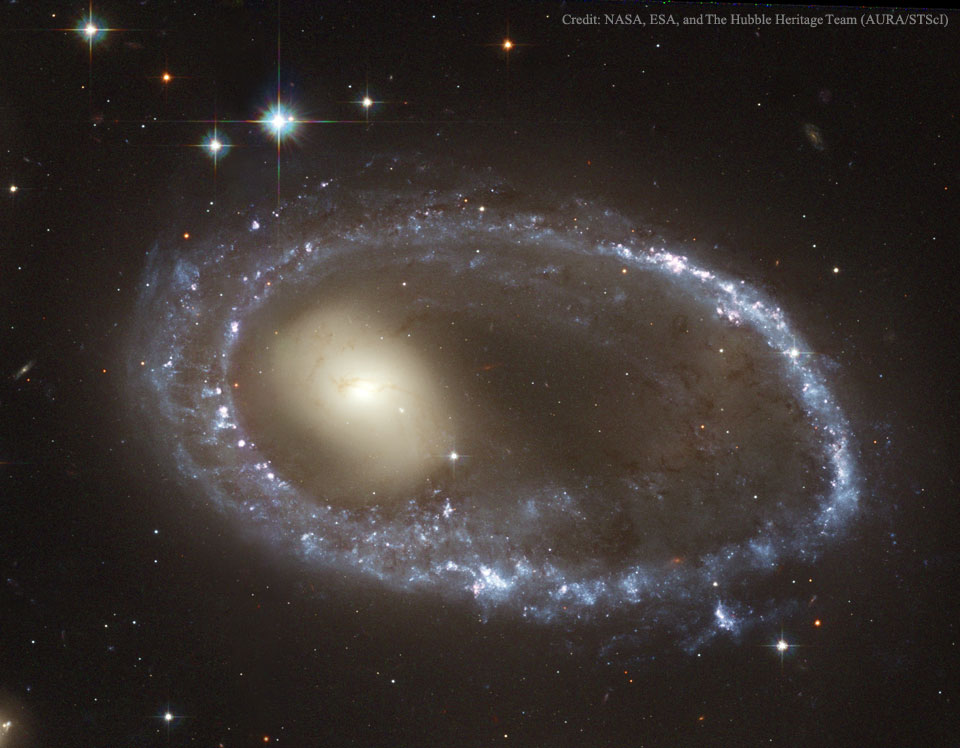
How could a galaxy become shaped like a ring? The rim of the blue galaxy pictured on the right is an immense ring-like structure 150,000 light years in diameter composed of newly formed, extremely bright, massive stars. That galaxy, AM 0644-741, is known as a ring galaxy and was caused by an immense galaxy collision. When galaxies collide, they pass through each other -- their individual stars rarely come into contact. The ring-like shape is the result of the gravitational disruption caused by an entire small intruder galaxy passing through a large one. When this happens, interstellar gas and dust become condensed, causing a wave of star formation to move out from the impact point like a ripple across the surface of a pond. The intruder galaxy is just outside of the frame taken by the Hubble Space Telescope. This featured image was taken to commemorate the anniversary of Hubble's launch in 1990. Ring galaxy AM 0644-741 lies about 300 million light years away. via NASA http://ift.tt/1OWthnF

Apr 19, 2015

The Great Crater Hokusai The Great Crater Hokusai


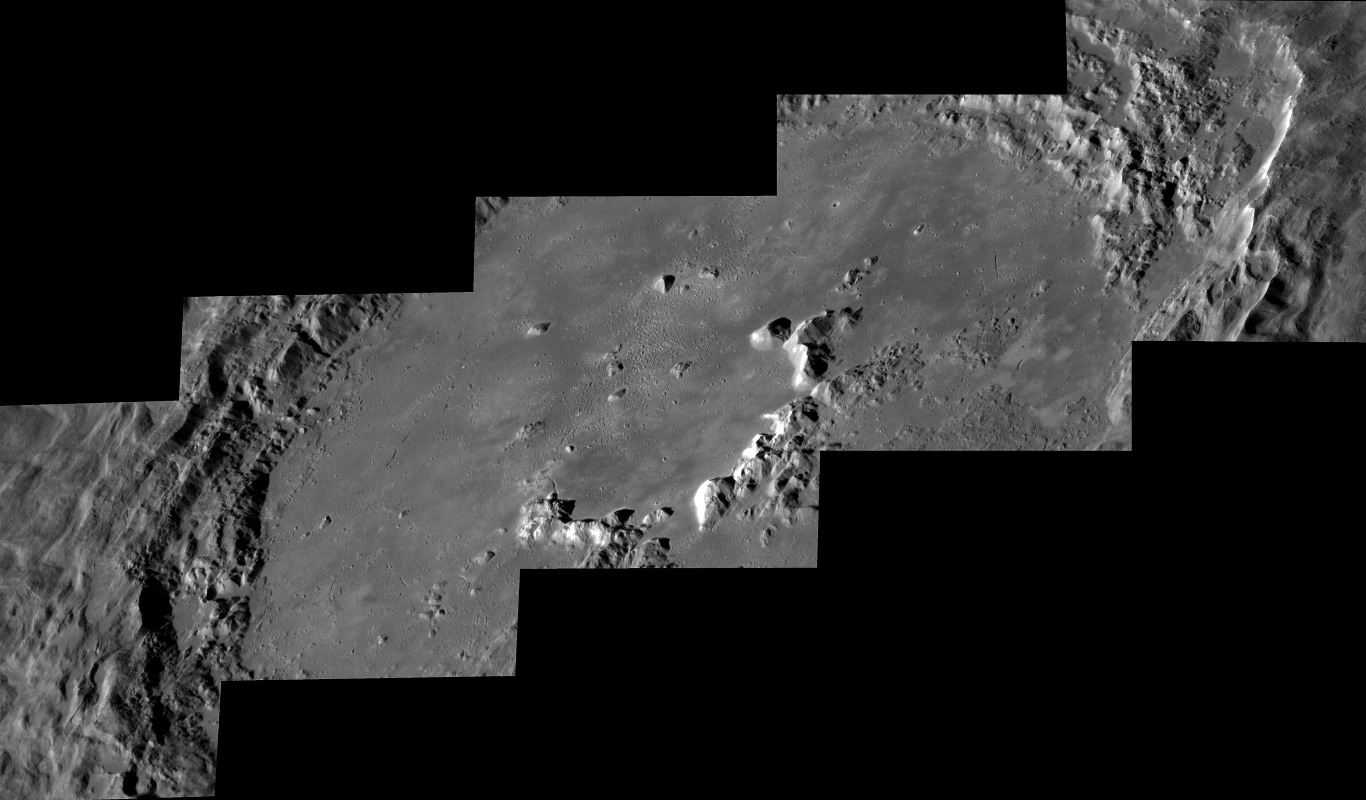
One of the largest young craters on Mercury, 114 kilometer (71 mile) diameter Hokusai crater's bright rays are known to extend across much of the planet. But this mosaic of oblique views focuses on Hokusai close up, its sunlit central peaks, terraced crater walls, and frozen sea of impact melt on the crater's floor. The images were captured by the MESSENGER spacecraft. The first to orbit Mercury, since 2011 MESSENGER has conducted scientific explorations, including extensive imaging of the Solar System's innermost planet. Now running out of propellant and unable to counter orbital perturbations caused by the Sun's gravity, MESSENGER is predicted to impact the surface of Mercury on April 30. via NASA http://ift.tt/1JS7via

M46 Plus Two M46 Plus Two


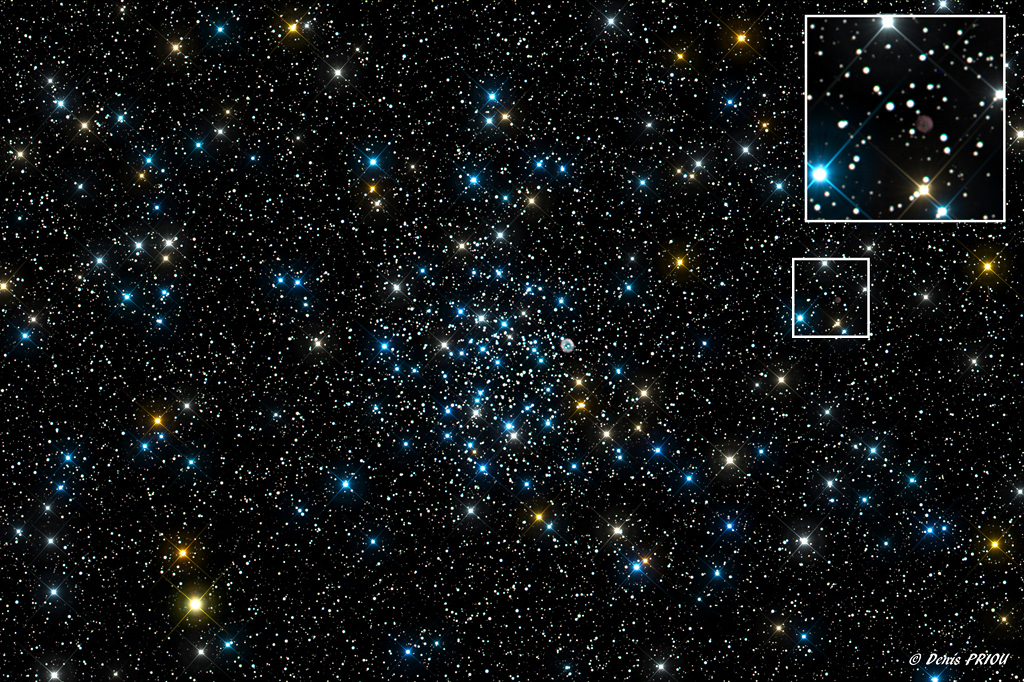
Galactic or open star clusters are young. These swarms of stars are born together near the plane of the Milky Way, but their numbers steadily dwindle as cluster members are ejected by galactic tides and gravitational interactions. In fact, this bright open cluster, known as M46, is around 300 million years young. It still contains a few hundred stars within a span of 30 light-years or so. Located about 5,000 light-years away toward the constellation Puppis, M46 also seems to contain contradictions to its youthful status. In this pretty starscape, the colorful, circular patch above and right of the center of M46 is the planetary nebula NGC 2438. Fainter still, a second planetary nebula, PK231+4.1, is identified by the box at the right and enlarged in the inset. Planetary nebulae are a brief, final phase in the life of a sun-like star a billion years old or more, whose central reservoir of hydrogen fuel has been exhausted. NGC 2438 is estimated to be only 3,000 light-years distant, though, and moves at a different speed than M46 cluster members. Along with its fainter cohort, planetary nebula NGC 2438 is likely only by chance appearing near our line-of-sight to the young stars of M46. via NASA http://ift.tt/1CUGJ2I

One-Armed Spiral Galaxy NGC 4725 One-Armed Spiral Galaxy NGC 4725


While most spiral galaxies, including our own Milky Way, have two or more spiral arms, NGC 4725 has only one. In this sharp color composite image, the solo spira mirabilis seems to wind from a prominent ring of bluish, newborn star clusters and red tinted star forming regions. The odd galaxy also sports obscuring dust lanes a yellowish central bar structure composed of an older population of stars. NGC 4725 is over 100 thousand light-years across and lies 41 million light-years away in the well-groomed constellation Coma Berenices. Computer simulations of the formation of single spiral arms suggest that they can be either leading or trailing arms with respect to a galaxy's overall rotation. Also included in the frame, sporting a noticably more traditional spiral galaxy look, is a more distant background galaxy. via NASA http://ift.tt/1J5wFJ7

Mystic Mountain Dust Pillars Mystic Mountain Dust Pillars


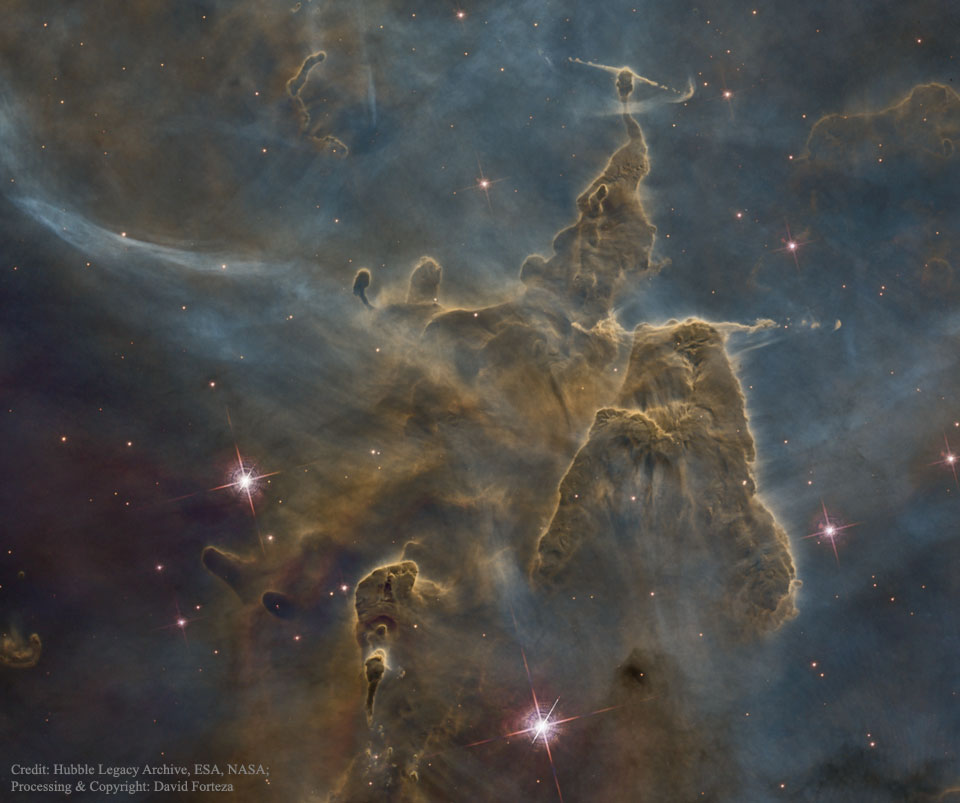
It's stars versus dust in the Carina Nebula and the stars are winning. More precisely, the energetic light and winds from massive newly formed stars are evaporating and dispersing the dusty stellar nurseries in which they formed. Located in the Carina Nebula and known informally as Mystic Mountain, these pillar's appearance is dominated by the dark dust even though it is composed mostly of clear hydrogen gas. Dust pillars such as these are actually much thinner than air and only appear as mountains due to relatively small amounts of opaque interstellar dust. About 7,500 light-years distant, the featured image was taken with the Hubble Space Telescope, digitally reprocessed by an industrious amateur, and highlights an interior region of Carina which spans about three light years. Within a few million years, the stars will likely win out completely and the entire dust mountain will be destroyed. via NASA http://ift.tt/1EDpfOa

Milky Way over Erupting Volcano Milky Way over Erupting Volcano


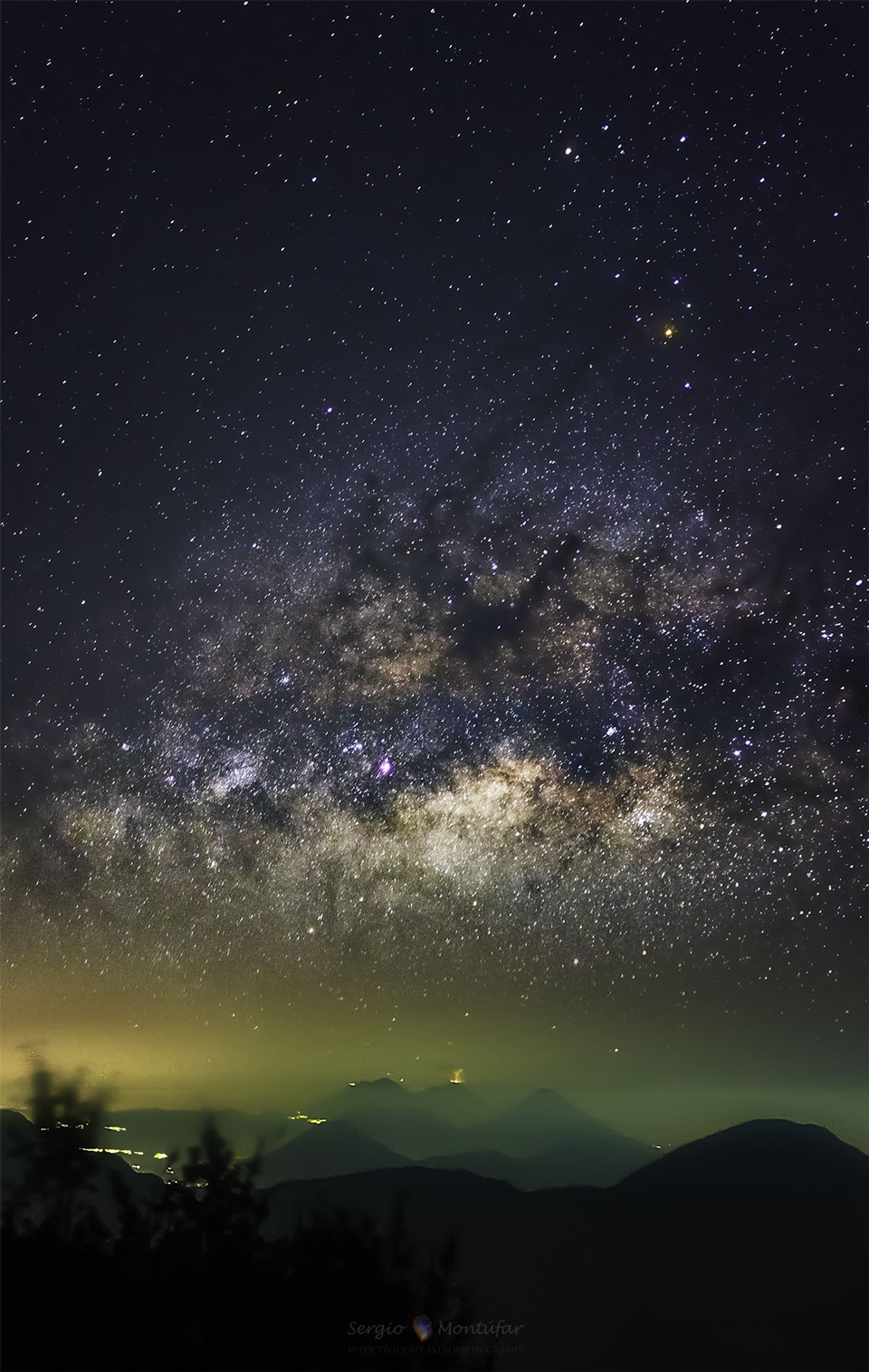
The view was worth the trip. Battling high winds, cold temperatures, and low oxygen, the trek to near the top of the volcano Santa Maria in Guatemala -- while carrying sensitive camera equipment -- was lonely and difficult. Once set up, though, the camera captured this breathtaking vista during the early morning hours of February 28. Visible on the ground are six volcanoes of the Central America Volcanic Arc, including Fuego, the Volcano of Fire, which is seen erupting in the distance. Visible in the sky, in separate exposures taken a few minutes later, are many stars much further in the distance, as well as the central band of our Milky Way Galaxy situated horizontally overhead. via NASA http://ift.tt/1I8rbwY

Sentinels of the Arctic Sentinels of the Arctic


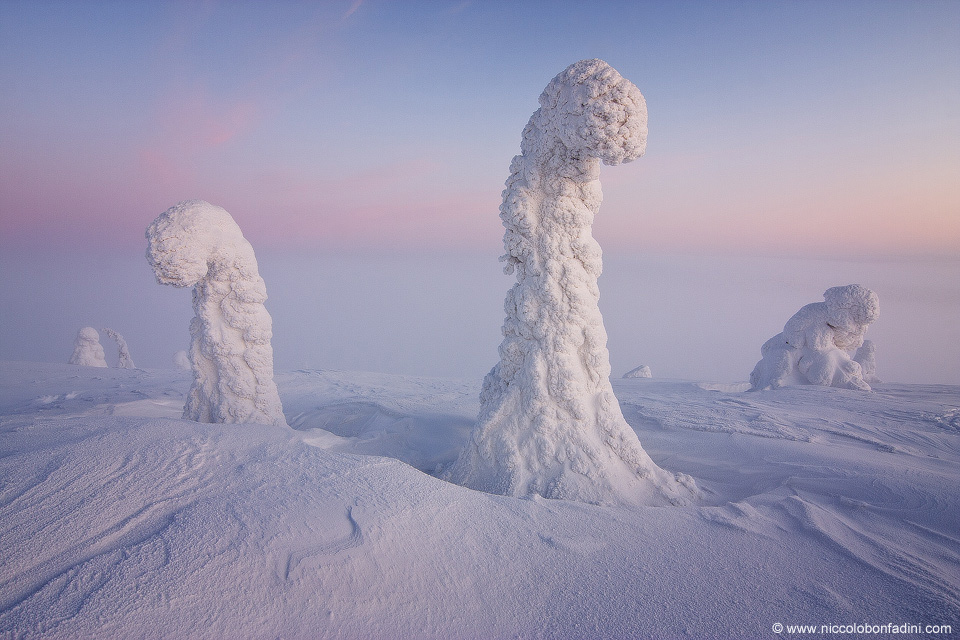
Who guards the north? Judging from the above photograph, possibly giant trees covered in snow and ice. The featured picture was taken a few winters ago in Finnish Lapland where weather can include sub-freezing temperatures and driving snow. Surreal landscapes sometimes result, where common trees become cloaked in white and so appear, to some, as watchful aliens. Far in the distance, behind this uncommon Earthly vista, is a more common sight -- a Belt of Venus that divided a darkened from sunlit sky as the Sun rose behind the photographer. Of course, in the spring, the trees thaw and Lapland looks much different. via NASA http://ift.tt/1FMlJQ9

Venus in the West Venus in the West


In the coming days, Venus shines near the western horizon at sunset. To find Earth's sister planet in twilight skies just look for the brilliant evening star. Tonight very close to the Pleiades star cluster, Venus dominates this springtime night skyscape taken only a few days ago near the town of Lich in central Germany. Also known as the Seven Sisters, the stars of the compact Pleiades cluster appear above Venus in this picture. The budding tree branches to its left frame bright star Aldebaran, the eye of Taurus the Bull, and the V-shaped Hyades star cluster. via NASA http://ift.tt/1I1ozBb

NGC 2903: A Missing Jewel in Leo NGC 2903: A Missing Jewel in Leo


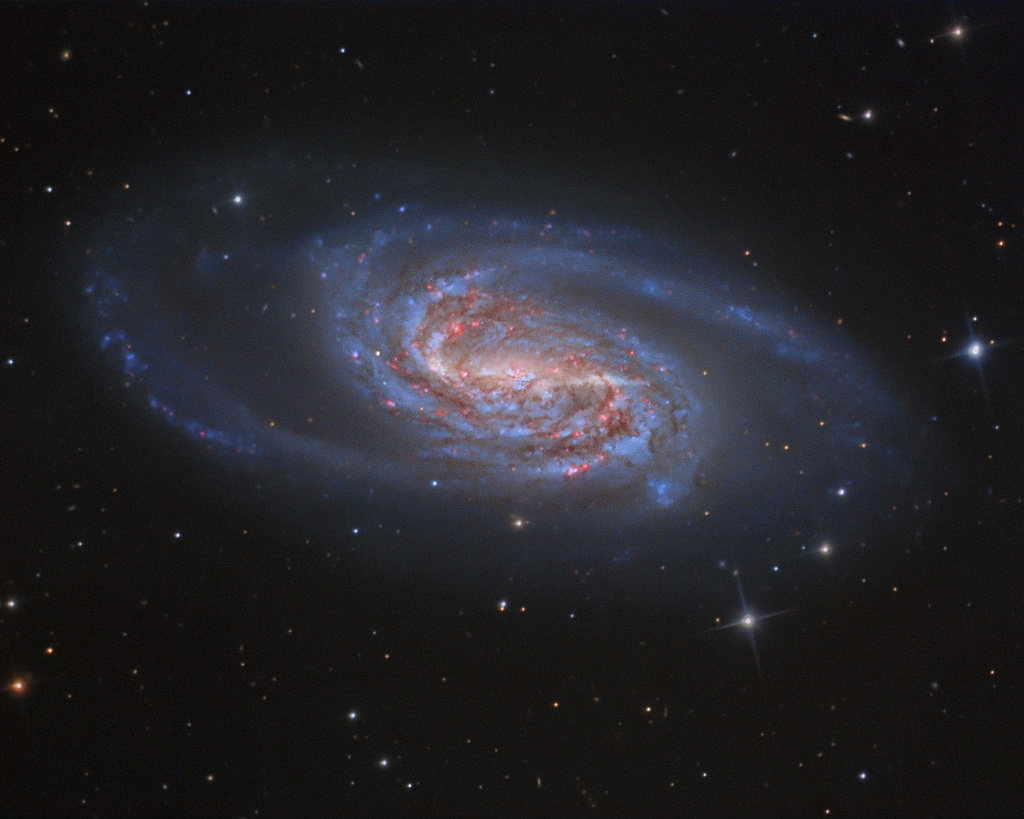
Barred spiral galaxy NGC 2903 is only some 20 million light-years distant. Popular among amateur astronomers, it shines in the northern spring constellation Leo, near the top of the lion's head. That part of the constellation is sometimes seen as a reversed question mark or sickle. One of the brighter galaxies visible from the northern hemisphere, NGC 2903 is surprisingly missing from Charles Messier's catalog of lustrous celestial sights. This colorful image from a small ground-based telescope shows off the galaxy's gorgeous spiral arms traced by young, blue star clusters and pinkish star forming regions. Included are intriguing details of NGC 2903's bright core, a remarkable mix of old and young clusters with immense dust and gas clouds. In fact, NGC 2903 exhibits an exceptional rate of star formation activity near its center, also bright in radio, infrared, ultraviolet, and x-ray bands. Just a little smaller than our own Milky Way, NGC 2903 is about 80,000 light-years across. via NASA http://ift.tt/1HXGmZK