Pages

Long Lovejoy and Little Dumbbell Long Lovejoy and Little Dumbbell


Buffeted by the solar wind, Comet Lovejoy's crooked ion tail stretches over 3 degrees across this telescopic field of view, recorded on February 20. The starry background includes awesome bluish star Phi Persei below, and pretty planetary nebula M76 just above Lovejoy's long tail. Also known as the Little Dumbbell Nebula, after its brighter cousin M27 the Dumbbell Nebula, M76 is only a Full Moon's width away from the comet's greenish coma. Still shining in northern hemisphere skies, this Comet Lovejoy (C/2014 Q2) is outbound from the inner solar system some 10 light-minutes or 190 million kilometers from Earth. But the Little Dumbbell actually lies over 3 thousand light-years away. Now sweeping steadily north toward the constellation Cassiopeia Comet Lovejoy is fading more slowly than predicted and is still a good target for small telescopes. via NASA http://ift.tt/1wtBkn2

Love and War by Moonlight Love and War by Moonlight


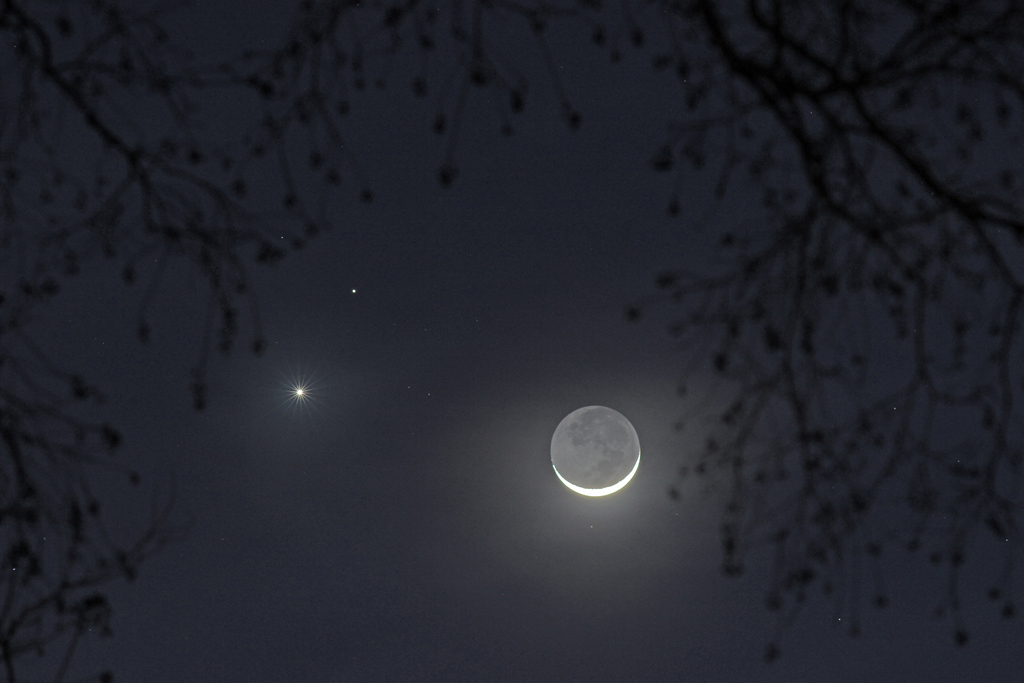
Venus, named for the Roman goddess of love, and Mars, the war god's namesake, came together by moonlight in this lovely skyview, recorded on February 20 from Charleston, South Carolina, USA, planet Earth. Made in twilight with a digital camera, the three second time exposure also records earthshine illuminating the otherwise dark surface of the young crescent Moon. Of course, the Moon has moved on from this much anticipated triple conjunction. Venus still shines in the west though as the evening star, third brightest object in Earth's sky, after the Sun and the Moon itself. Seen here within almost a Moon's width of Venus, much fainter Mars approached even closer on the following evening. But Mars has since been moving slowly away from brilliant Venus, though Mars is still visible too in the western twilight. via NASA http://ift.tt/1MTykFj

The Rosette Nebula in Hydrogen and Oxygen The Rosette Nebula in Hydrogen and Oxygen


The Rosette Nebula is not the only cosmic cloud of gas and dust to evoke the imagery of flowers -- but it is the most famous. At the edge of a large molecular cloud in Monoceros, some 5,000 light years away, the petals of this rose are actually a stellar nursery whose lovely, symmetric shape is sculpted by the winds and radiation from its central cluster of hot young stars. The stars in the energetic cluster, cataloged as NGC 2244, are only a few million years old, while the central cavity in the Rosette Nebula, cataloged as NGC 2237, is about 50 light-years in diameter. The nebula can be seen firsthand with a small telescope toward the constellation of the Unicorn (Monoceros). via NASA http://ift.tt/1Bq8g1Q

Unusual Plumes Above Mars Unusual Plumes Above Mars


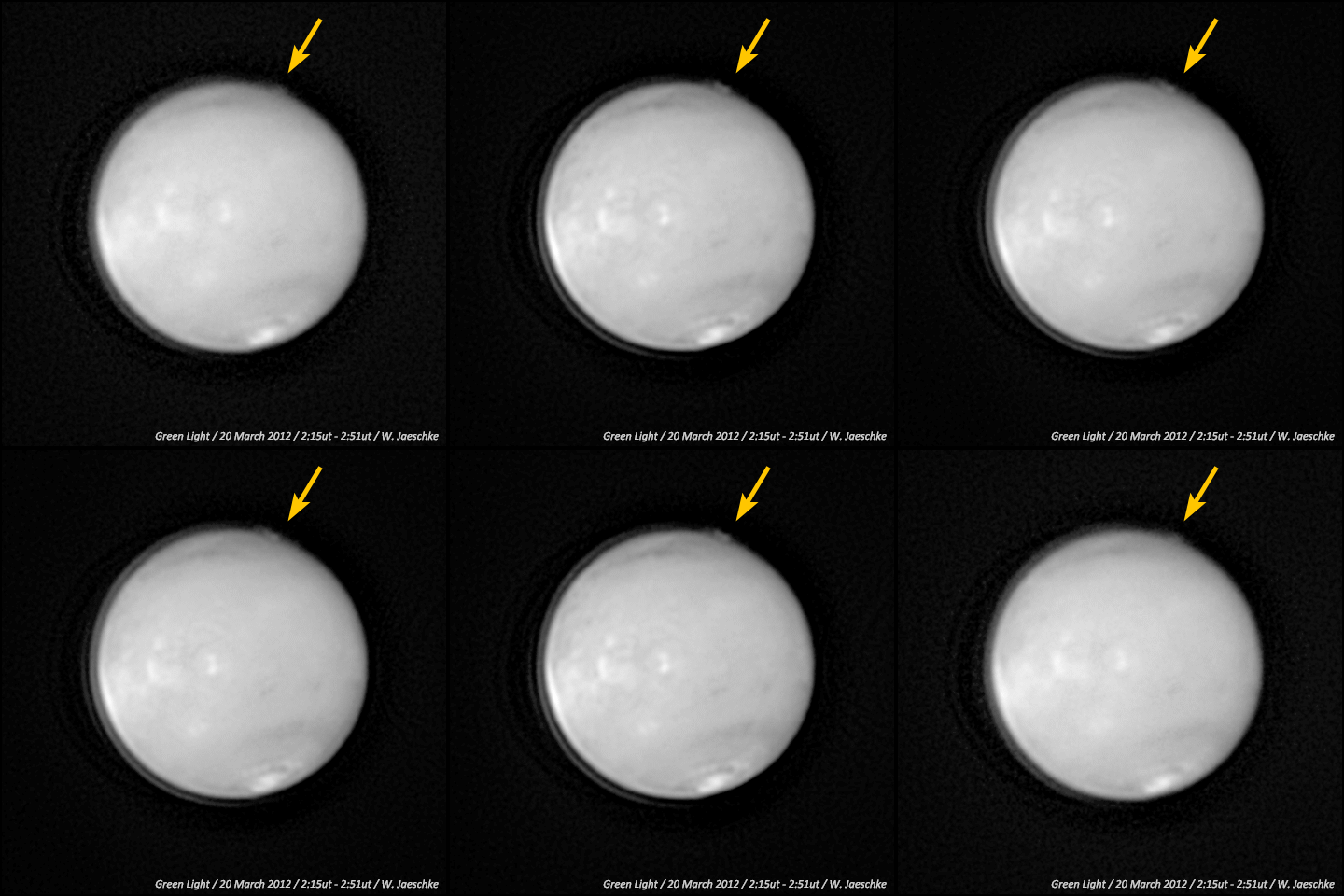
What is creating unusual plumes on Mars? No one is sure. Noted and confirmed by a global contingent of amateur astronomers on photos of the red planet in March 2012, possibly similar plumes have now been found on archived images as far back as 1997. Since the plumes reach 200 kilometers up, they seem too high to be related to wind-blown surface dust. Since one plume lasted for eleven days, it seemed too long lasting to be related to aurora. Amateur astronomers will surely continue to monitor the terminator and edge regions of Mars for new high plumes, and the armada of satellites orbiting Mars may be called upon to verify and study any newly reported plume that become visible. The featured 35-minute time-lapse animation was taken on 2012 March 20 by the plume's discoverer -- an attorney from Pennsylvania, USA. via NASA http://ift.tt/1A2p3kk

The Milky Way Over the Arizona Toadstools The Milky Way Over the Arizona Toadstools


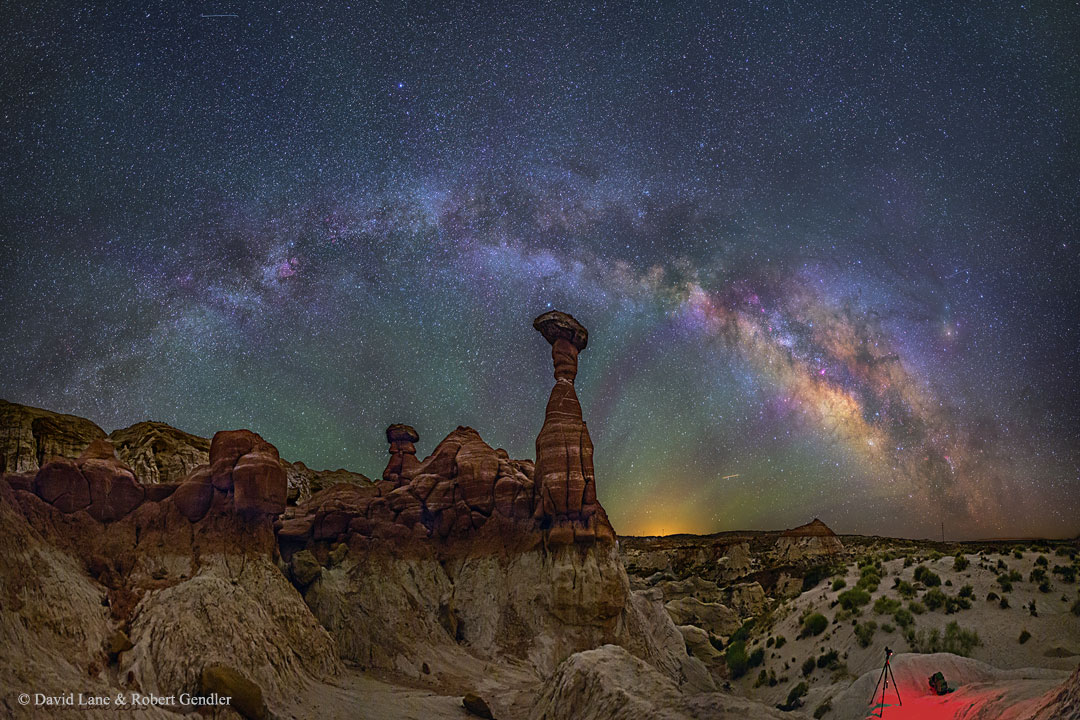
Which is older -- the rocks you see on the ground or the light you see from the sky? Usually it’s the rocks that are older, with their origin sediments deposited well before light left any of the stars or nebulas you see in the sky. However, if you can see, through a telescope, a distant galaxy far across the universe -- further than Andromeda or spiral galaxy NGC 7331 (inset) -- then you are seeing light even more ancient. Featured here, the central disk of our Milky Way Galaxy arches over Toadstool hoodoos rock formations in northern Arizona, USA. The unusual Toadstool rock caps are relatively hard sandstone that wind has eroded more slowly than the softer sandstone underneath. The green bands are airglow, light emitted by the stimulated air in Earth's atmosphere. On the lower right is a time-lapse camera set up to capture the sky rotating behind the picturesque foreground scene. via NASA http://ift.tt/17LEjv7

The Dark River to Antares The Dark River to Antares


Connecting the Pipe Nebula to the colorful region near bright star Antares is a dark cloud dubbed the Dark River, flowing from the picture's left edge. Murky looking, the Dark River's appearance is caused by dust obscuring background starlight, although the dark nebula contains mostly hydrogen and molecular gas. Surrounded by dust, Antares, a red supergiant star, creates an unusual bright yellowish reflection nebula. Above it, bright blue double star Rho Ophiuchi is embedded in one of the more typical bluish reflection nebulae, while red emission nebulae are also scattered around the region. Globular star cluster M4 is just seen above and right of Antares, though it lies far behind the colorful clouds, at a distance of some 7,000 light-years. The Dark River itself is about 500 light years away. The colorful skyscape is a mosaic of telescopic images spanning nearly 10 degrees (20 Full Moons) across the sky in the constellation of the Scorpion (Scorpius). via NASA http://ift.tt/1B3A4ZG

45 Days in the Sun 45 Days in the Sun


From January 11 to February 25 2013, a pinhole camera sat in a field near Budapest, Hungary, planet Earth to create this intriguing solargraph. And for 45 days, an old Antonov An-2 biplane stood still while the Sun rose and set. The camera's continuous exposure began about 20 days after the northern hemispere's winter solstice, so each day the Sun's trail arcs steadily higher through the sky. These days in the Sun were recorded on a piece of black and white photosensitive paper tucked in to the simple plastic film container. The long exposure produced a visible color image on the paper that was then digitally scanned. Of course, cloudy days left gaps in the solargraph's Sun trails. via NASA http://ift.tt/1vmNiy5

An Evening Sky Conjunction An Evening Sky Conjunction


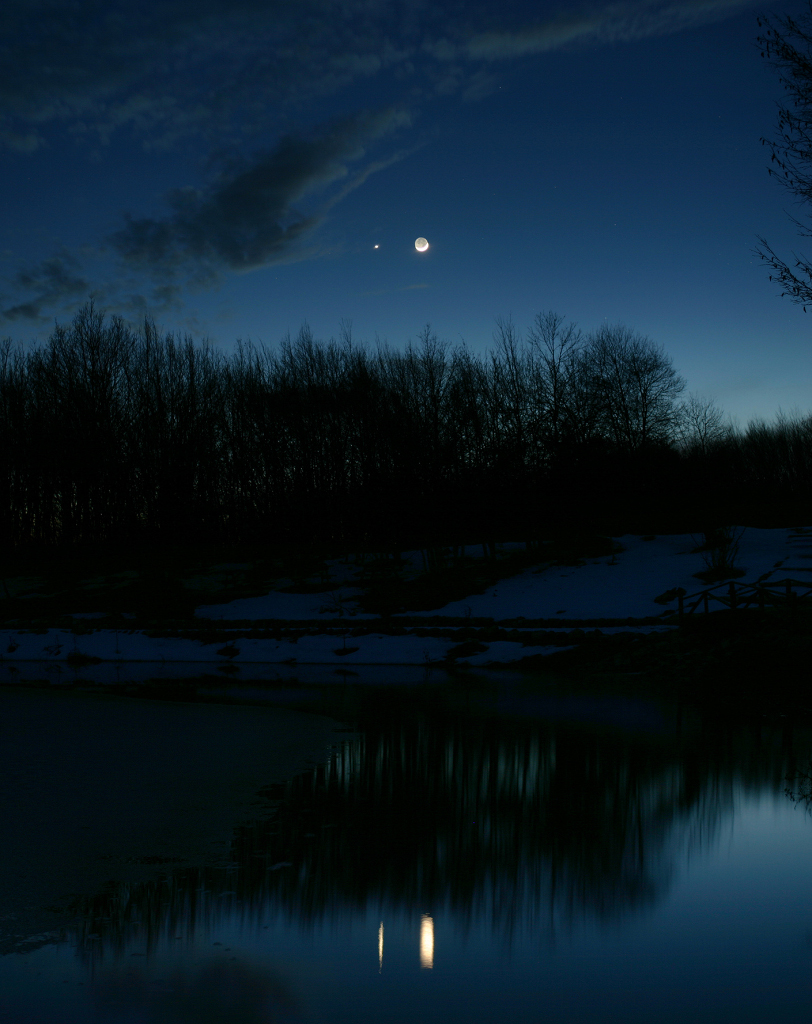
Eight years ago, an evening sky held this lovely pairing of a young crescent Moon and brilliant Venus. Seen near the western horizon, the close conjunction and its wintry reflection were captured from Bolu, Turkey, planet Earth on February 19, 2007. In the 8 Earth years since this photograph was taken Venus has orbited the Sun almost exactly 13 times, so the Sun and Venus have now returned to the same the configuration in Earth's sky. And since every 8 years the Moon also nearly repeats its phases for a given time of year, a very similar crescent Moon-Venus conjunction will again appear in planet Earth's evening skies tonight. But the February 20, 2015 version of the conjunction will also include planet Mars. Much fainter Mars will wander even closer to Venus by the evening of February 21. via NASA http://ift.tt/17yarSS

Palomar 12 Palomar 12


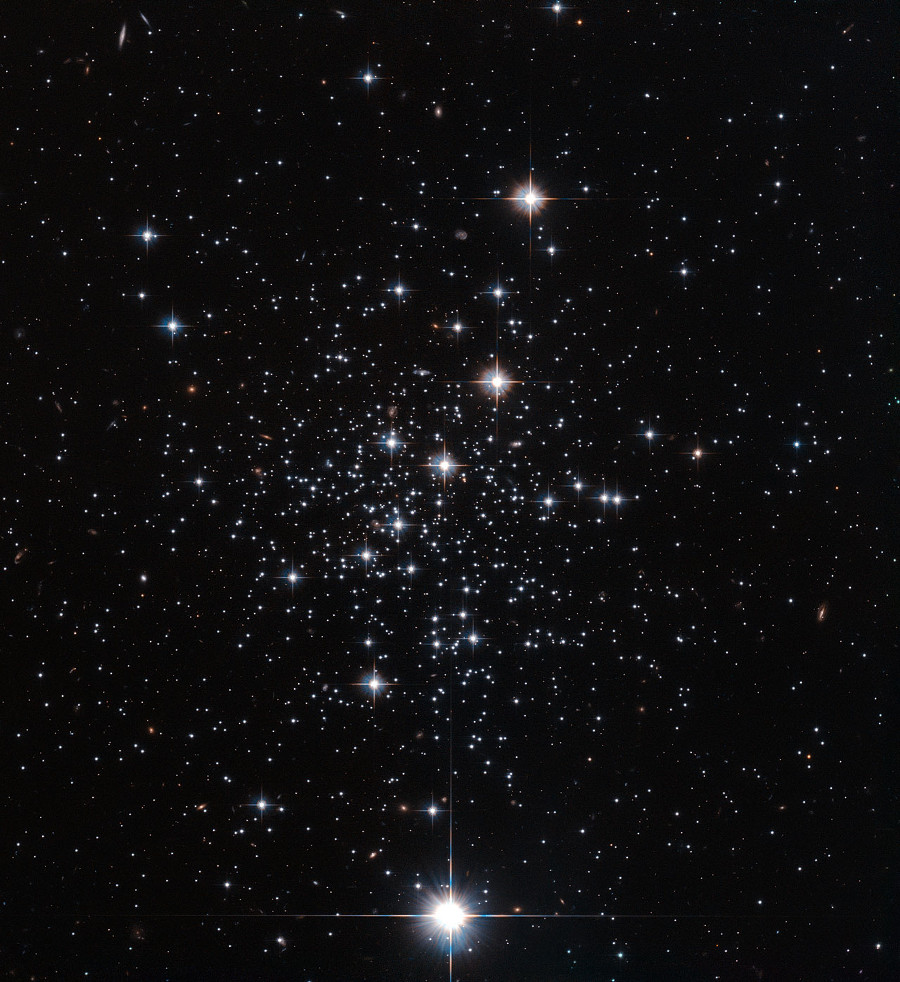
Palomar 12 was not born here. The stars of the globular cluster, first identified in the Palomar Sky Survey, are younger than those in other globular star clusters that roam the halo of our Milky Way Galaxy. Palomar 12's position in our galaxy and measured motion suggest its home was once the Sagittarius Dwarf Elliptical Galaxy, a small satellite of the Milky Way. Disrupted by gravitational tides during close encounters the satellite galaxy has lost its stars to the larger Milky Way. Now part of the Milky Way's halo, the tidal capture of Palomar 12 likely took place some 1.7 billion years ago. Seen behind spiky foreground stars in the sharp Hubble image, Palomar 12 spans nearly 60 light-years. Still much closer than the faint, fuzzy, background galaxies scattered throughout the field of view, it lies about 60,000 light-years away, toward the constellation Capricornus. via NASA http://ift.tt/1AIGbm6

Dark Craters and Bright Spots Revealed on Asteroid Ceres Dark Craters and Bright Spots Revealed on Asteroid Ceres


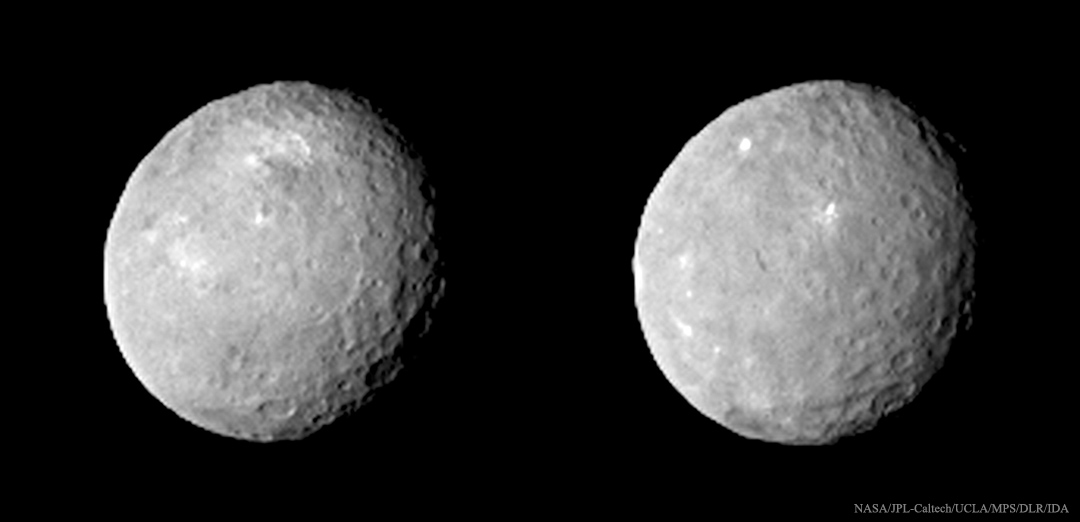
What are those bright spots on asteroid Ceres? As the robotic spacecraft Dawn approaches the largest asteroid in the asteroid belt, the puzzle only deepens. Sharper new images taken last week and released yesterday indicate, as expected, that most of the surface of dwarf planet Ceres is dark and heavily cratered like our Moon and the planet Mercury. The new images do not clearly indicate, however, the nature of comparatively bright spots -- although more of them are seen to exist. The enigmatic spots were first noticed on Texas-sized Ceres a few weeks ago during Dawn's approach. The intriguing mystery might well be solved quickly as Dawn continues to advance toward Ceres, being on schedule to enter orbit on March 6. via NASA http://ift.tt/19v3l3c

Fibrils Flower on the Sun Fibrils Flower on the Sun


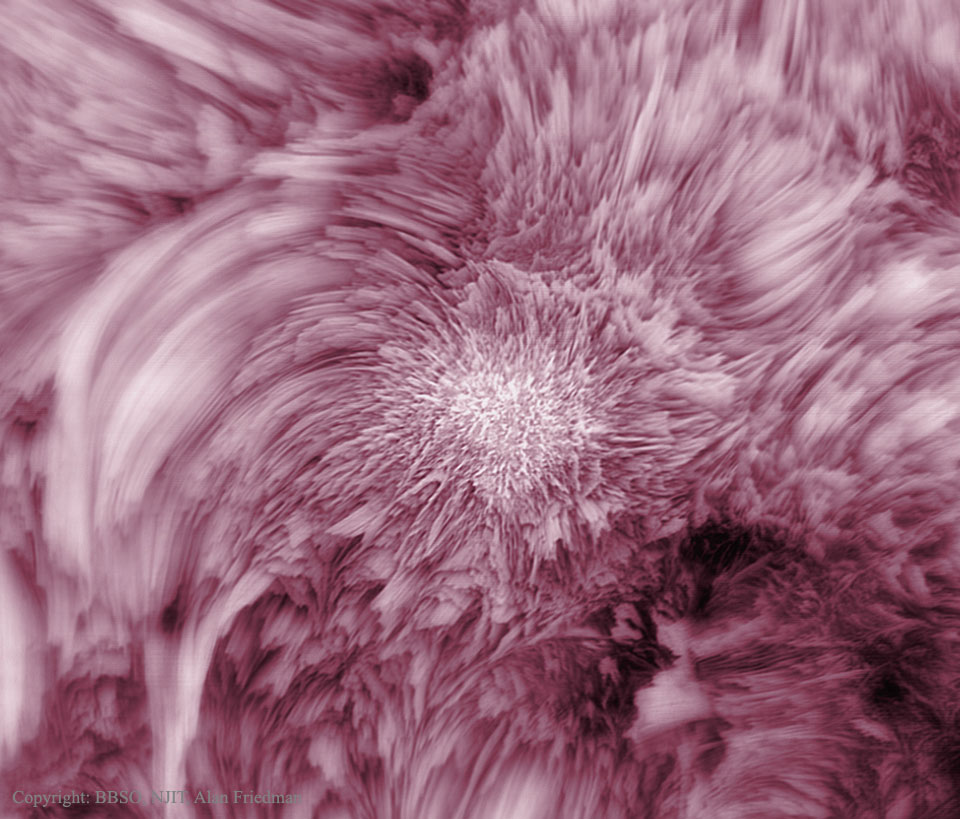
When does the Sun look like a flower? In a specific color of red light emitted by hydrogen, as featured here, some regions of the solar chromosphere may resemble a rose. The color-inverted image was taken in 2014 October and shows active solar region 2177. The petals dominating the frame are actually magnetically confined tubes of hot plasma called fibrils, some of which extend longer the diameter of the Earth. In the central region many of these fibrils are seen end-on, while the surrounding regions are typically populated with curved fibrils. When seen over the Sun's edge, these huge plasma tubes are called spicules, and when they occur in passive regions they are termed mottles. Sunspot region 2177 survived for several more days before the complex and tumultuous magnetic field poking through the Sun's surface evolved yet again. via NASA http://ift.tt/1FlCbJj

M106: A Spiral Galaxy with a Strange Center M106: A Spiral Galaxy with a Strange Center


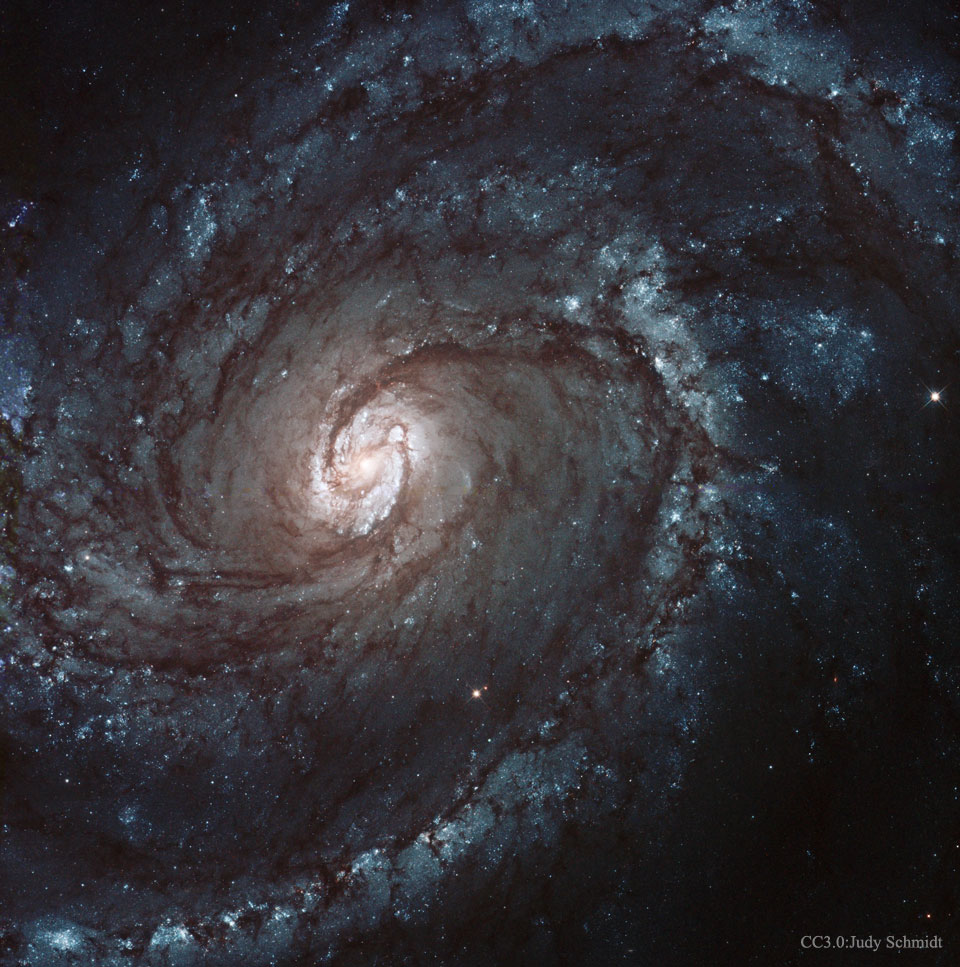
What's happening at the center of spiral galaxy M106? A swirling disk of stars and gas, M106's appearance is dominated by blue spiral arms and red dust lanes near the nucleus, as shown in the featured image. The core of M106 glows brightly in radio waves and X-rays where twin jets have been found running the length of the galaxy. An unusual central glow makes M106 one of the closest examples of the Seyfert class of galaxies, where vast amounts of glowing gas are thought to be falling into a central massive black hole. M106, also designated NGC 4258, is a relatively close 23.5 million light years away, spans 60 thousand light years across, and can be seen with a small telescope towards the constellation of the Hunting Dogs (Canes Venatici). via NASA http://ift.tt/17fSLLF

Two Hours Before Neptune Two Hours Before Neptune


Two hours before closest approach to Neptune in 1989, the Voyager 2 robot spacecraft snapped this picture. Clearly visible for the first time were long light-colored cirrus-type clouds floating high in Neptune's atmosphere. Shadows of these clouds can even be seen on lower cloud decks. Most of Neptune's atmosphere is made of hydrogen and helium, which is invisible. Neptune's blue color therefore comes from smaller amounts of atmospheric methane, which preferentially absorbs red light. Neptune has the fastest winds in the Solar System, with gusts reaching 2000 kilometers per hour. Speculation holds that diamonds may be created in the dense hot conditions that exist under the cloud tops of Uranus and Neptune. Twenty-six years later, NASA's New Horizons is poised to be the first spacecraft to zoom past Pluto this July. via NASA http://ift.tt/1A9qmkJ

Solar System Portrait Solar System Portrait


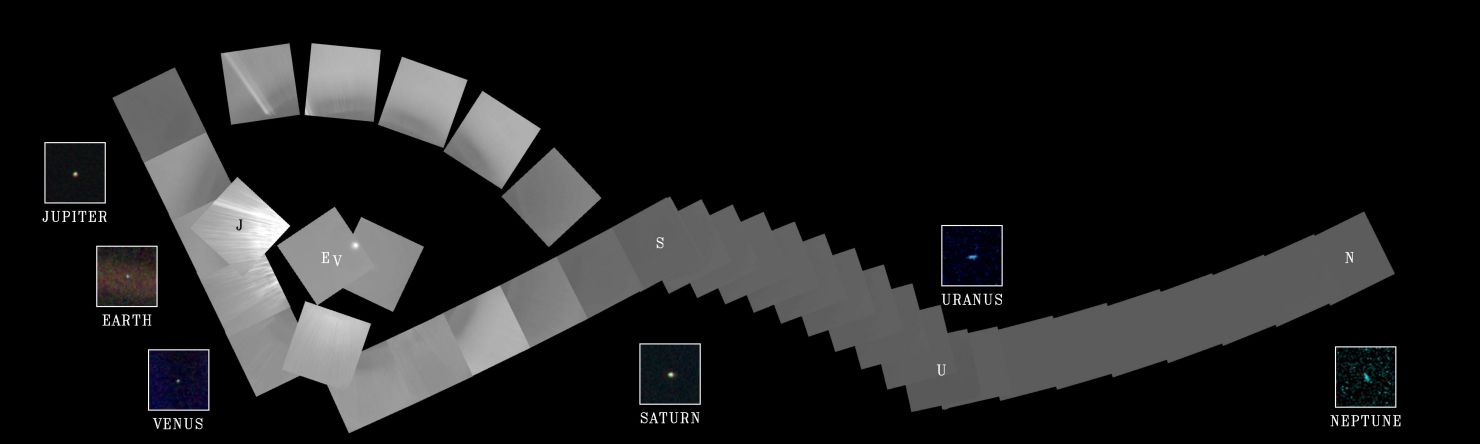
On another Valentine's Day 25 years ago, cruising four billion miles from the Sun, the Voyager 1 spacecraft looked back one last time to make this first ever Solar System family portrait. The complete portrait is a 60 frame mosaic made from a vantage point 32 degrees above the ecliptic plane. In it, Voyager's wide angle camera frames sweep through the inner Solar System at the left, linking up with gas giant Neptune, the Solar System's outermost planet, at the far right. Positions for Venus, Earth, Jupiter, Saturn, Uranus, and Neptune are indicated by letters, while the Sun is the bright spot near the center of the circle of frames. The inset frames for each of the planets are from Voyager's narrow field camera. Unseen in the portrait are Mercury, too close to the Sun to be detected, and Mars, unfortunately hidden by sunlight scattered in the camera's optical system. Closer to the Sun than Neptune at the time, small, faint Pluto's position was not covered. via NASA http://ift.tt/1DQ6S7v

Aurora on Ice Aurora on Ice


Not from a snowglobe, this expansive fisheye view of ice and sky was captured on February 1, from Jökulsárlón Beach, southeast Iceland, planet Earth. Chunks of glacial ice on the black sand beach glisten in the light of a nearly full moon surrounded by a shining halo. The 22 degree lunar halo itself is created by ice crystals in high, thin clouds refracting the moonlight. Despite the bright moonlight, curtains of aurora still dance through the surreal scene. In early February, their activity was triggered by Earth's restless magnetosphere and the energetic wind from a coronal hole near the Sun's south pole. Bright Jupiter, also near opposition, is visible at the left, beyond the icy lunar halo. via NASA http://ift.tt/1B4UFfv
Exploring the Antennae Exploring the Antennae


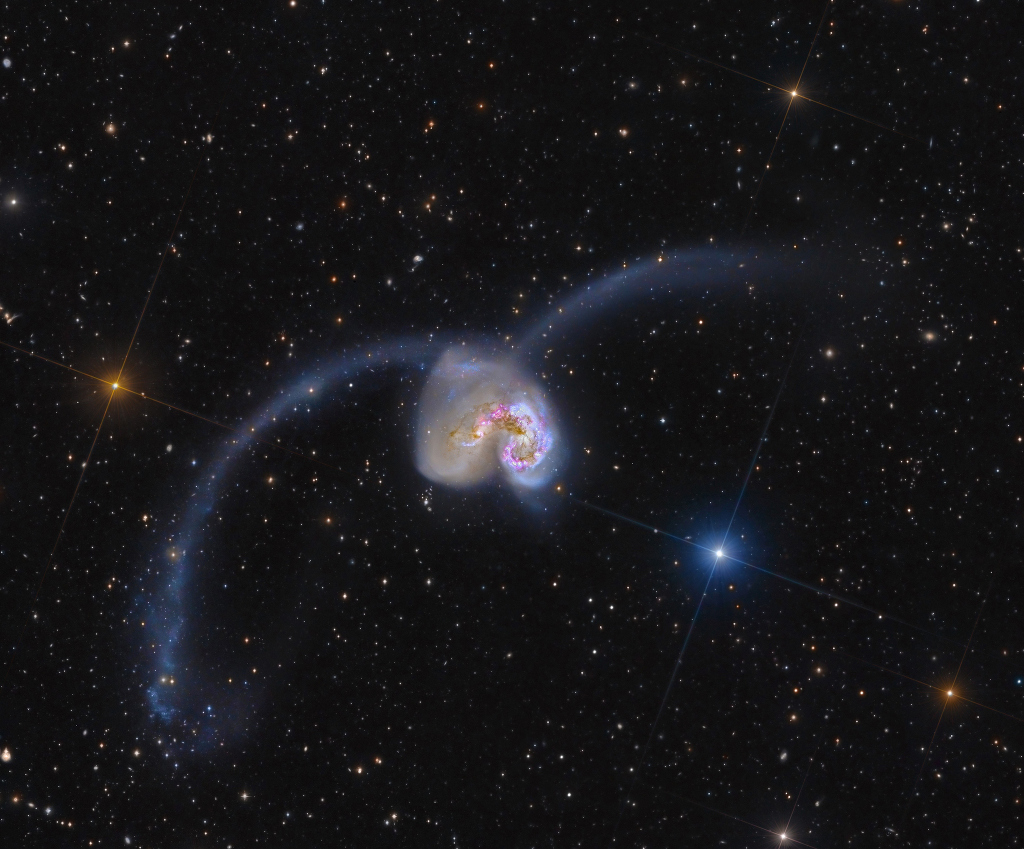
Some 60 million light-years away in the southerly constellation Corvus, two large galaxies are colliding. The stars in the two galaxies, cataloged as NGC 4038 and NGC 4039, very rarely collide in the course of the ponderous cataclysm, lasting hundreds of millions of years. But their large clouds of molecular gas and dust often do, triggering furious episodes of star formation near the center of the cosmic wreckage. Spanning about 500 thousand light-years, this stunning composited view also reveals new star clusters and matter flung far from the scene of the accident by gravitational tidal forces. The remarkable collaborative image is a mosaic constructed using data from small and large ground-based telescopes to bring out large-scale and faint tidal streams, composited with the bright cores imaged in extreme detail by the Hubble Space Telescope. Of course, the suggestive visual appearance of the extended arcing structures gives the galaxy pair its popular name - The Antennae. via NASA http://ift.tt/1F0oGhN

M100: A Grand Design Spiral Galaxy M100: A Grand Design Spiral Galaxy


Majestic on a truly cosmic scale, M100 is appropriately known as a grand design spiral galaxy. It is a large galaxy of over 100 billion stars with well-defined spiral arms that is similar to our own Milky Way Galaxy. One of the brightest members of the Virgo Cluster of galaxies, M100 (alias NGC 4321) is 56 million light-years distant toward the constellation of Berenice's Hair (Coma Berenices). This Hubble Space Telescope image of M100 was made in 2009 and reveals bright blue star clusters and intricate winding dust lanes which are hallmarks of this class of galaxies. Studies of variable stars in M100 have played an important role in determining the size and age of the Universe. If you know exactly where to look, you can find a small spot that is a light echo from a bright supernova that was recorded a few years before the image was taken. via NASA http://ift.tt/1vixXcG

An Extremely Long Filament on the Sun An Extremely Long Filament on the Sun


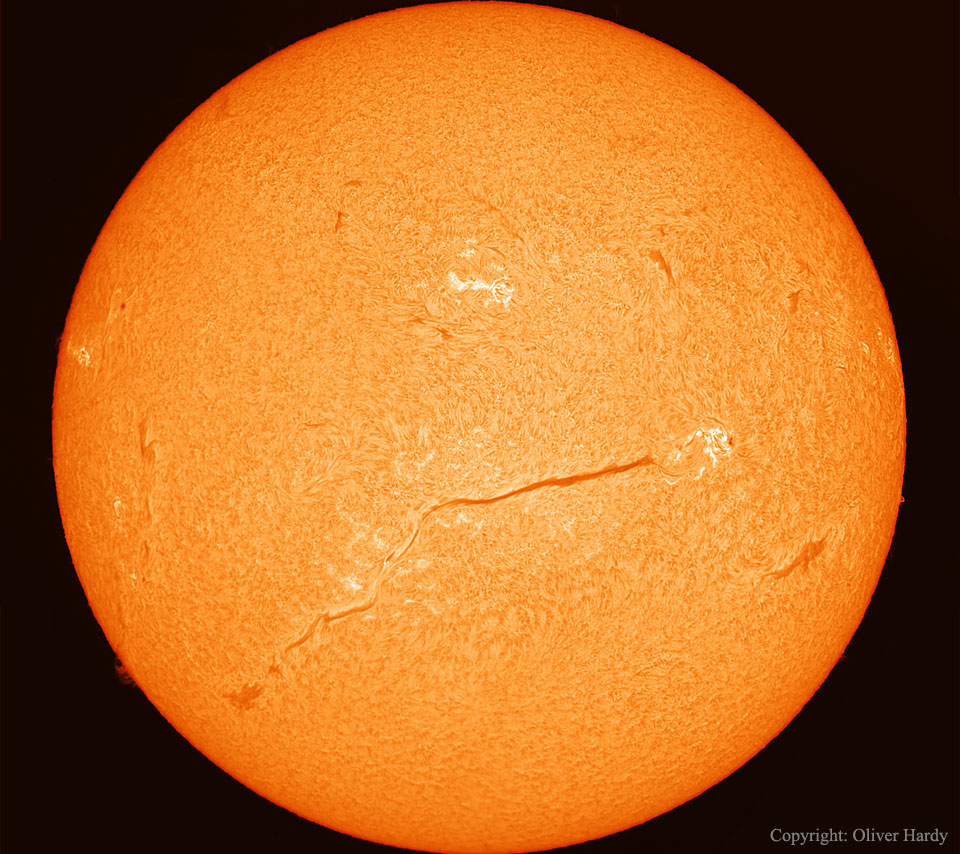
Yesterday, the Sun exhibited one of the longest filaments ever recorded. It may still be there today. Visible as the dark streak just below the center in the featured image, the enormous filament extended across the face of the Sun a distance even longer than the Sun's radius -- over 700,000 kilometers. A filament is actually hot gas held aloft by the Sun's magnetic field, so that viewed from the side it would appear as a raised prominence. The featured image shows the filament in light emitted by hydrogen and therefore highlights the Sun's chromosphere. Sun-following telescopes including NASA's Solar Dynamics Observatory (SDO) are tracking this unusual feature, with SDO yesterday recording a spiraling magnetic field engulfing it. Since filaments typically last only from hours to days, parts of this one may collapse or erupt at any time, either returning hot plasma back to the Sun or expelling it into the Solar System. Is the filament still there? You can check by clicking on SDO's current solar image. via NASA http://ift.tt/1E0Wes9