Pages

Observatory, Mountains, Universe Observatory, Mountains, Universe


The awesomeness in this image comes in layers. The closest layer, in the foreground, contains the Peak Terskol Observatory located in the northern Caucasus Mountains of Russia. The white dome over the 2-meter telescope is clearly visible. The observatory is located on a shoulder of Mt. Elbrus, the highest mountain in Europe, with other peaks visible in a nearby background layer. Clouds are visible both in front of and behind the mountain peaks. The featured three-image composite panorama was taken in 2014 August. Far in the distance is the most distant layer: the stars and nebulas of the night sky, with the central band of the Milky Way rising on the image right. via NASA http://antwrp.gsfc.nasa.gov/apod/ap141230.html

Dec 30, 2014

The Sun in X rays from NuSTAR The Sun in X rays from NuSTAR


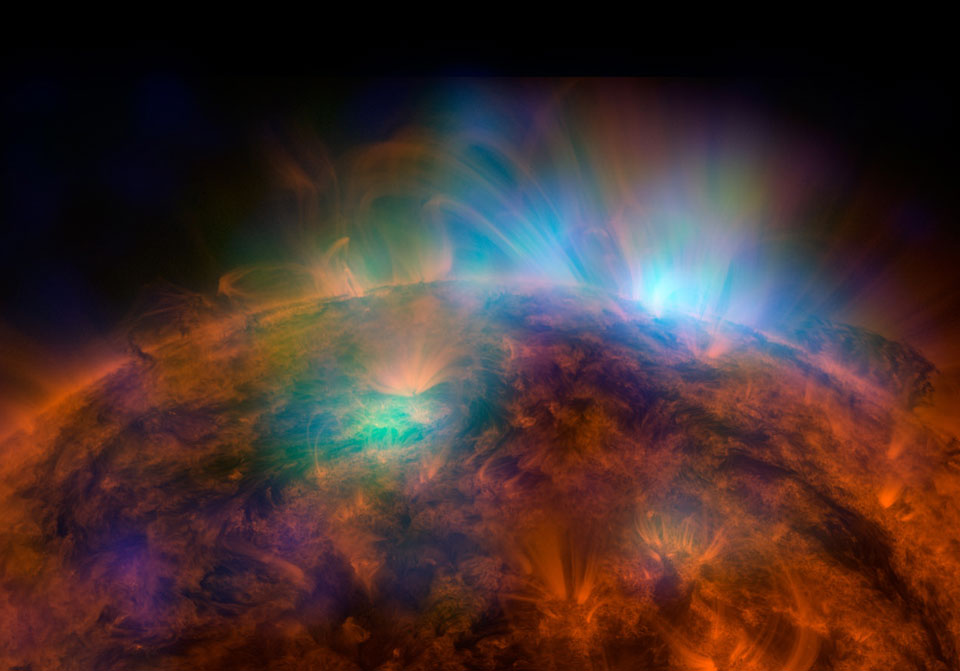
Why are the regions above sunspots so hot? Sunspots themselves are a bit cooler than the surrounding solar surface because the magnetic fields that create them reduce convective heating. It is therefore unusual that regions overhead -- even much higher up in the Sun's corona -- can be hundreds of times hotter. To help find the cause, NASA directed the Earth-orbiting Nuclear Spectroscopic Telescope Array (NuSTAR) satellite to point its very sensitive X-ray telescope at the Sun. Featured above is the Sun in ultraviolet light, shown in a red hue as taken by the orbiting Solar Dynamics Observatory (SDO). Superimposed in false-colored green and blue is emission above sunspots detected by NuSTAR in different bands of high-energy X-rays, highlighting regions of extremely high temperature. Clues about the Sun's atmospheric heating mechanisms may not only come from this initial image, but future NuSTAR images aimed at finding hypothesized nanoflares, brief bursts of energy that may drive the unusual heating. via NASA http://antwrp.gsfc.nasa.gov/apod/ap141229.html

Dec 29, 2014

Unusual Light Pillars over Latvia Unusual Light Pillars over Latvia


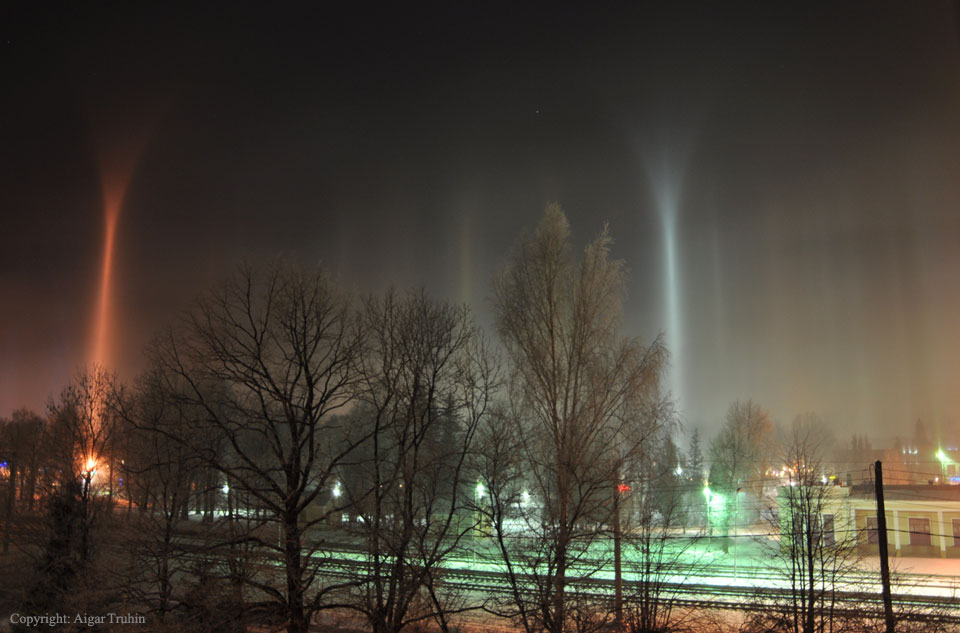
What's happening over that town? Close inspection shows these strange columns of light occur over bright lights, and so likely are light pillars that involve falling ice crystals reflecting back these lights. The above image and several similar images were taken with a standard digital camera in Sigulda, Latvia in late 2009. The reason why these pillars fan out at the top, however, remains a topic for speculation. The air was noted to be quite cold and indeed filled with small ice crystals, just the type known to create several awe-inspiring but well known sky phenomena such as light pillars, sun pillars, sun dogs, and moon halos. The cold and snowy winter occurring this year in parts of Earth's northern hemisphere is giving sky enthusiasts new and typically unexpected opportunities to see several of these unusual optical atmospheric phenomena for themselves. via NASA http://antwrp.gsfc.nasa.gov/apod/ap141228.html

The Winter Shower The Winter Shower


Known in the north as a winter meteor shower, the 2014 Geminids rain down on this rugged, frozen landscape. The scene was recorded from the summit of Mt. Changbai along China's northeastern border with North Korea as a composite of digital frames capturing bright meteors near the shower's peak. Orion is near picture center above the volcanic cater lake. The shower's radiant in the constellation Gemini is to the upper left, at the apparent orgin of all the meteor streaks. Paying the price for such a dreamlike view of the celestial spectacle, photographer Jia Hao reports severe wind gusts and wintery minus 34 degree C temperatures near the summit. via NASA http://antwrp.gsfc.nasa.gov/apod/ap141227.html

Cetus Duo M77 and NGC 1055 Cetus Duo M77 and NGC 1055


At the top right, large spiral galaxy NGC 1055 joins spiral Messier 77 in this sharp cosmic view toward the aquatic constellation Cetus. The narrowed, dusty appearance of edge-on spiral NGC 1055 contrasts nicely with the face-on view of M77's bright nucleus and spiral arms. Both over 100,000 light-years across, the pair are dominant members of a small galaxy group about 60 million light-years away. At that estimated distance, M77 is one of the most remote objects in Charles Messier's catalog and is separated from fellow island universe NGC 1055 by at least 500,000 light-years. The field of view is about the size of the full Moon on the sky and includes colorful foreground Milky Way stars (with diffraction spikes) along with more distant background galaxies. via NASA http://ift.tt/13IqD2v

This Comet Lovejoy This Comet Lovejoy


Comet Lovejoy, C/2014 Q2, is framed like a cosmic Christmas tree with starry decorations in this colorful telescopic portrait, snapped on December 16th. Its lovely coma is tinted green by diatomic C2 gas fluorescing in sunlight. Discovered in August of this year, this Comet Lovejoy is currently sweeping north through the constellation Columba, heading for Lepus south of Orion and bright enough to offer good binocular views. Not its first time through the inner Solar System, this Comet Lovejoy will pass closest to planet Earth on January 7, while its perihelion (closest point to the Sun) will be on January 30. Of course, planet Earth's own 2015 perihelion passage is scheduled for January 4. A long period comet, this Comet Lovejoy should return again ... in about 8,000 years. via NASA http://ift.tt/1B4nWDf

IC 1795: The Fishhead Nebula IC 1795: The Fishhead Nebula


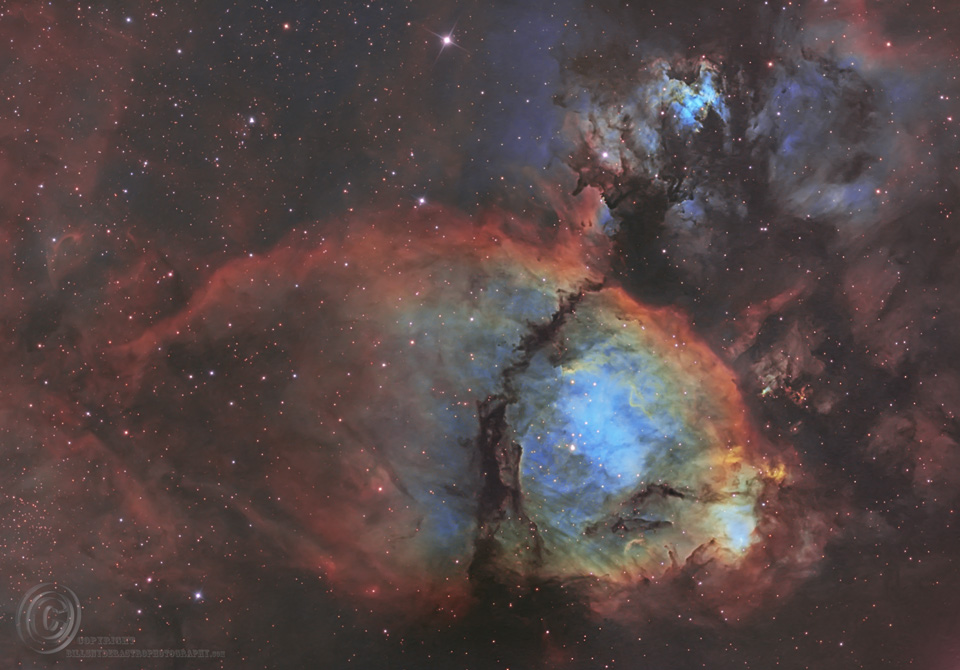
To some, this nebula looks like the head of a fish. However, this colorful cosmic portrait really features glowing gas and obscuring dust clouds in IC 1795, a star forming region in the northern constellation Cassiopeia. The nebula's colors were created by adopting the Hubble false-color palette for mapping narrow emission from oxygen, hydrogen, and sulfur atoms to blue, green and red colors, and further blending the data with images of the region recorded through broadband filters. Not far on the sky from the famous Double Star Cluster in Perseus, IC 1795 is itself located next to IC 1805, the Heart Nebula, as part of a complex of star forming regions that lie at the edge of a large molecular cloud. Located just over 6,000 light-years away, the larger star forming complex sprawls along the Perseus spiral arm of our Milky Way Galaxy. At that distance, this picture would span about 70 light-years across IC 1795. via NASA http://ift.tt/13DcvY9

The Cliffs of Comet Churyumov Gerasimenko The Cliffs of Comet Churyumov Gerasimenko


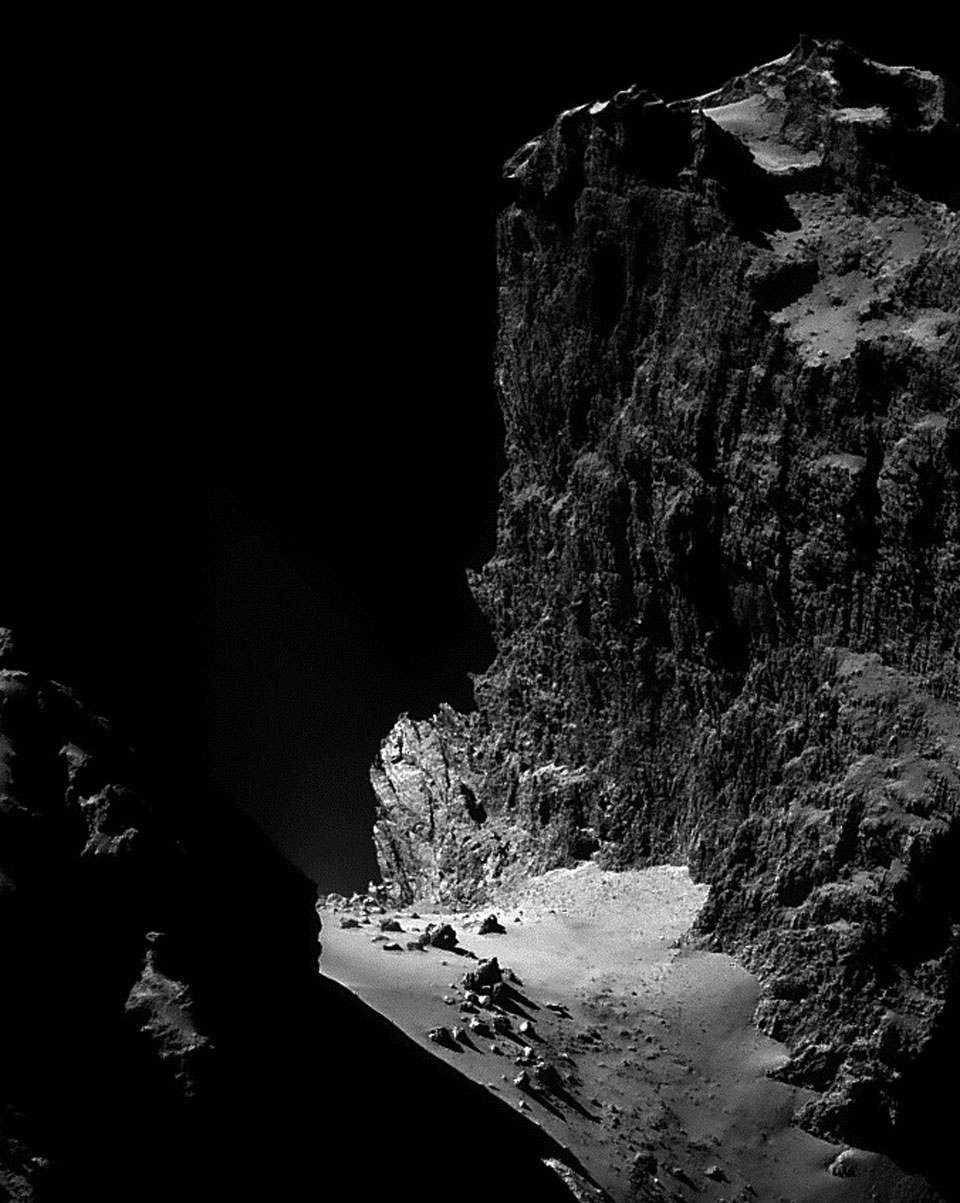
These high cliffs occur on the surface of a comet. They were discovered to be part of the dark nucleus of Comet Churyumov–Gerasimenko (CG) by Rosetta, a robotic spacecraft launched by ESA which began orbiting the comet in early August. The ragged cliffs, as featured here, were imaged by Rosetta about two weeks ago. Although towering about one kilometer high, the low surface gravity of Comet CG would likely make a jump from the cliffs, by a human, survivable. At the foot of the cliffs is relatively smooth terrain dotted with boulders as large as 20 meters across. Data from Rosetta indicates that the ice in Comet CG has a significantly different deuterium fraction -- and hence likely a different origin -- than the water in Earth's oceans. The Rosetta spacecraft is scheduled to continue to accompany the comet as it makes its closest approach to the Sun in 2015 August. via NASA http://ift.tt/13sGGB1

The Mysterious Methane of Mars The Mysterious Methane of Mars


What's creating methane on Mars? Recent measurements from the robotic Curiosity rover currently rolling across Mars indicate a surprising 10-fold increase in atmospheric methane between measurements only months apart. Life is a major producer of methane on Earth, and so speculation is rampant that some sort of life -- possibly microbial life -- is creating methane beneath the surface of Mars. Other possibilities do exist, though, with a leading model being the sudden release of methane produced by the mixing of specific soil chemicals with underground water. Proposed origins of Martian methane are depicted in the featured illustration. The origin of Mars' methane is a very active area of research, with missions like Curiosity and India's Mars Orbiter Mission searching for clues by measuring methane abundance changes and possible byproducts of different methane-producing processes. via NASA http://ift.tt/1GMyiLv

Tyrrhenian Sea and Solstice Sky Tyrrhenian Sea and Solstice Sky


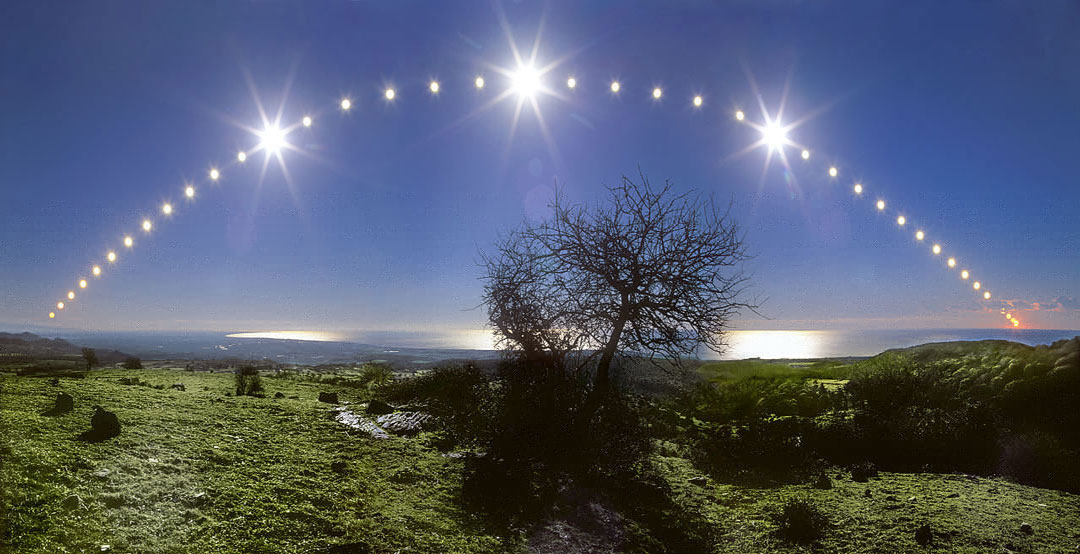
Today the solstice occurs at 23:03 Universal Time, the Sun reaching its southernmost declination in planet Earth's sky. Of course, the December solstice marks the beginning of winter in the northern hemisphere and summer in the south. When viewed from northern latitudes, and as shown in the above horizontally compressed image, the Sun will make its lowest arc through the sky along the southern horizon. So in the north, the solstice day has the shortest length of time between sunrise and sunset and fewest hours of daylight. This striking composite image follows the Sun's path through the December solstice day of 2005 in a beautiful blue sky, looking down the Tyrrhenian Sea coast from Santa Severa toward Fiumicino, Italy. The view covers about 115 degrees in 43 separate, well-planned exposures from sunrise to sunset. via NASA http://ift.tt/1CgOHZ3

Apollo 11 Landing Site Panorama Apollo 11 Landing Site Panorama


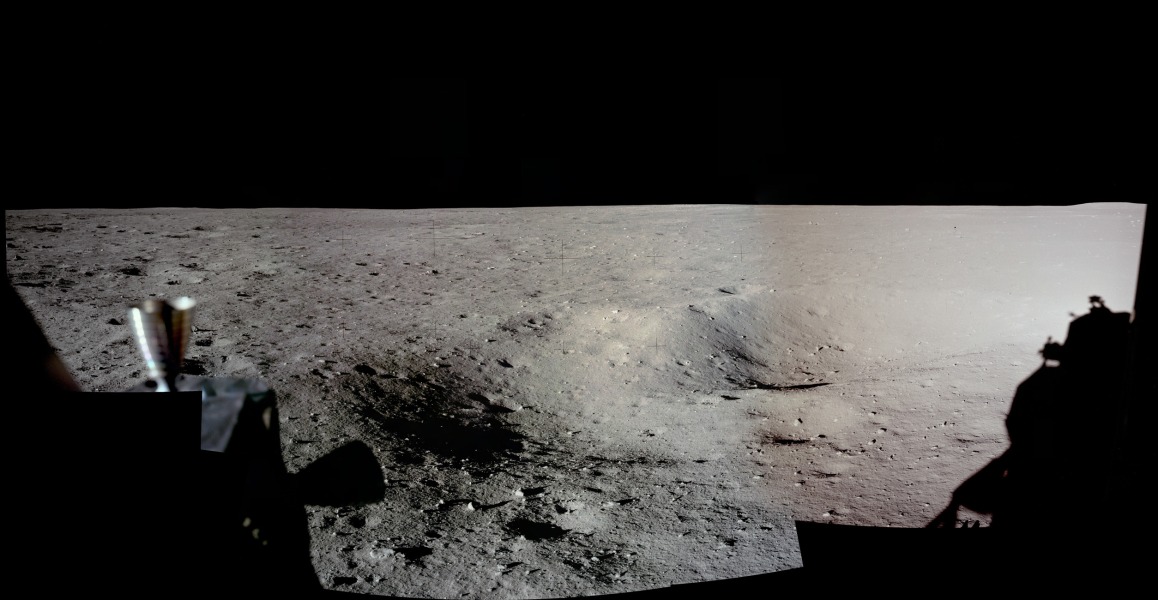
Have you seen a panorama from another world lately? Assembled from high-resolution scans of the original film frames, this one sweeps across the magnificent desolation of the Apollo 11 landing site on the Moon's Sea of Tranquility. Taken by Neil Armstrong looking out his window of the Eagle Lunar Module, the frame at the far left (AS11-37-5449) is the first picture taken by a person on another world. Toward the south, thruster nozzles can be seen in the foreground on the left, while at the right, the shadow of the Eagle is visible toward the west. For scale, the large, shallow crater on the right has a diameter of about 12 meters. Frames taken from the Lunar Module windows about an hour and a half after landing, before walking on the lunar surface, were intended to initially document the landing site in case an early departure was necessary. via NASA http://ift.tt/1wwI01I

Reflections on the 1970s Reflections on the 1970s


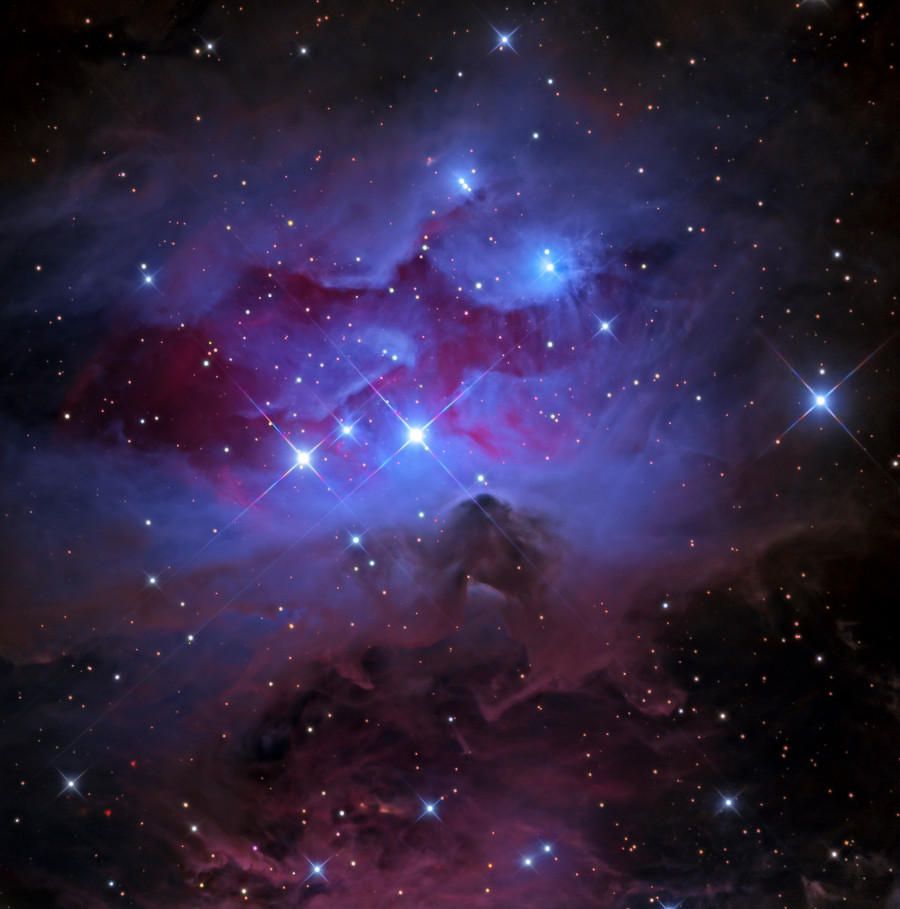
The 1970s are sometimes ignored by astronomers, like this beautiful grouping of reflection nebulae in Orion - NGC 1977, NGC 1975, and NGC 1973 - usually overlooked in favor of the substantial glow from the nearby stellar nursery better known as the Orion Nebula. Found along Orion's sword just north of the bright Orion Nebula complex, these reflection nebulae are also associated with Orion's giant molecular cloud about 1,500 light-years away, but are dominated by the characteristic blue color of interstellar dust reflecting light from hot young stars. In this sharp color image a portion of the Orion Nebula appears along the bottom border with the cluster of reflection nebulae at picture center. NGC 1977 stretches across the field just below center, separated from NGC 1973 (above right) and NGC 1975 (above left) by dark regions laced with faint red emission from hydrogen atoms. Taken together, the dark regions suggest to many the shape of a running man. via NASA http://ift.tt/1w4DDpt

NGC 7331 and Beyond NGC 7331 and Beyond


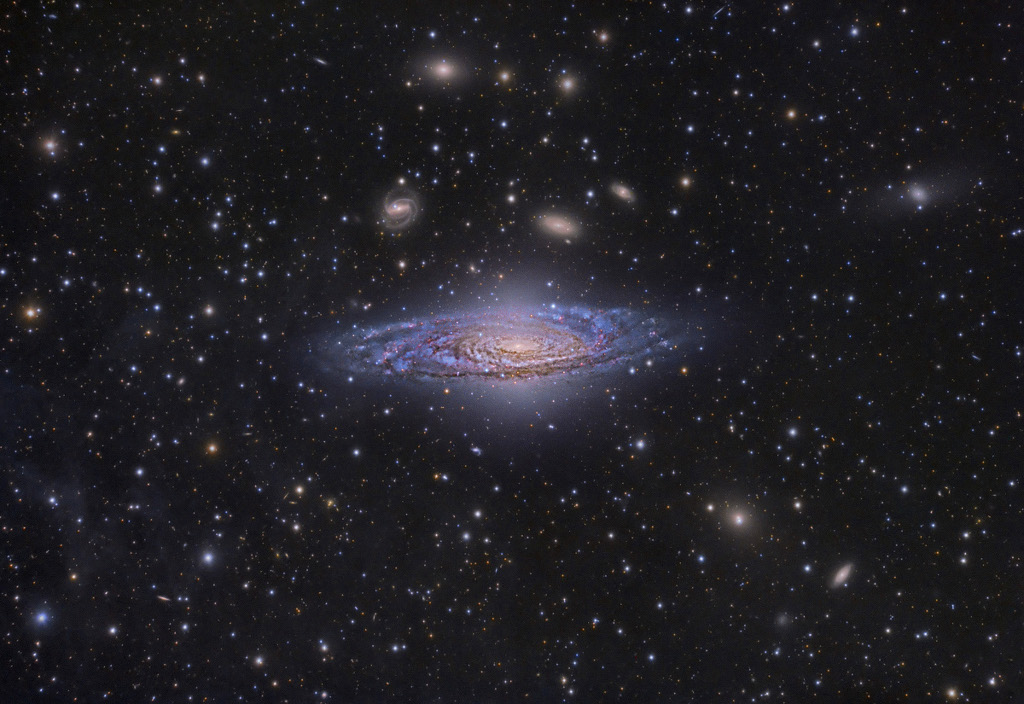
Big, beautiful spiral galaxy NGC 7331 is often touted as an analog to our own Milky Way. About 50 million light-years distant in the northern constellation Pegasus, NGC 7331 was recognized early on as a spiral nebula and is actually one of the brighter galaxies not included in Charles Messier's famous 18th century catalog. Since the galaxy's disk is inclined to our line-of-sight, long telescopic exposures often result in an image that evokes a strong sense of depth. The effect is further enhanced in this sharp image from a small telescope by galaxies that lie beyond the gorgeous island universe. The most prominent background galaxies are about one tenth the apparent size of NGC 7331 and so lie roughly ten times farther away. Their close alignment on the sky with NGC 7331 occurs just by chance. Seen through faint foreground dust clouds lingering above the plane of Milky Way, this visual grouping of galaxies is known as the Deer Lick Group. via NASA http://ift.tt/1AshhCs

Geminid Fireball over Mount Balang Geminid Fireball over Mount Balang


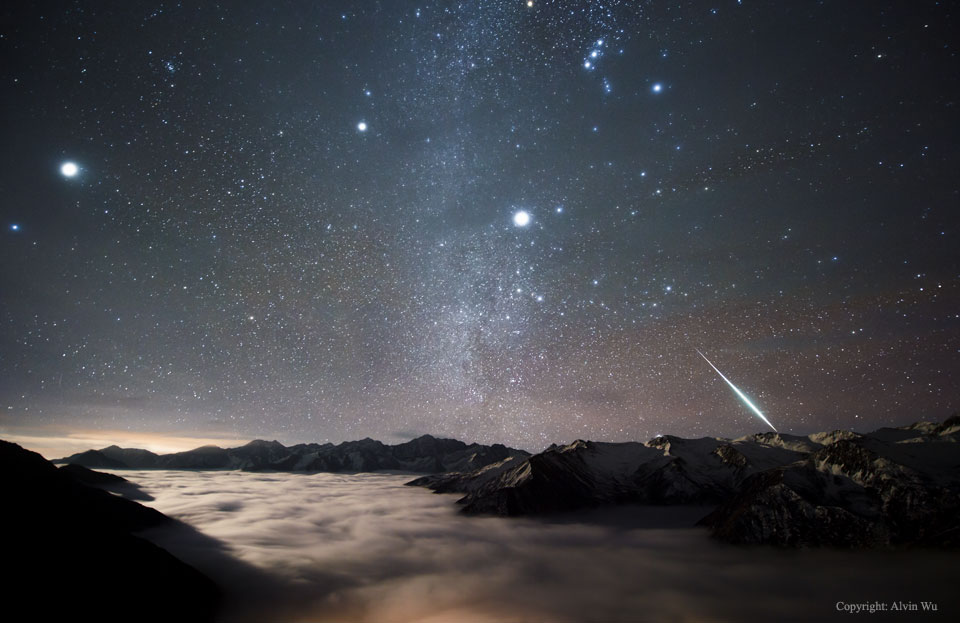
This was a sky to remember. While viewing the Geminids meteor shower a few days ago, a bright fireball was captured over Mt. Balang, China with particularly picturesque surroundings. In the foreground, a sea of light clouds slowly floated between dark mountain peaks. In the background, the constellation of Orion shone brightly, with the familiar three stars of Orion's belt visible near the image top right. Sirius, the brightest star in the night sky, is visible near the image center. The bright fireball flashed for only a fraction of second on the lower right. The source of the fireball was a pebble that intersected the protective atmosphere of Earth, originally expelled by the Sun-orbiting asteroid-like object 3200 Phaethon. via NASA http://ift.tt/1zqefAD

W5: Pillars of Star Formation W5: Pillars of Star Formation


How do stars form? Images of the star forming region W5 like those in the infrared by NASA's Wide Field Infrared Survey Explorer (WISE) satellite provide clear clues with indications that massive stars near the center of empty cavities are older than stars near the edges. A likely reason for this is that the older stars in the center are actually triggering the formation of the younger edge stars. The triggered star formation occurs when hot outflowing gas compresses cooler gas into knots dense enough to gravitationally contract into stars. In the featured scientifically-colored infrared image, spectacular pillars, left slowly evaporating from the hot outflowing gas, provide further visual clues. W5 is also known as IC 1848, and together with IC 1805 form a complex region of star formation popularly dubbed the Heart and Soul Nebulas. The above image highlights a part of W5 spanning about 2,000 light years that is rich in star forming pillars. W5 lies about 6,500 light years away toward the constellation of Cassiopeia. via NASA http://ift.tt/1yWVaa2

The Potsdam Gravity Potato The Potsdam Gravity Potato


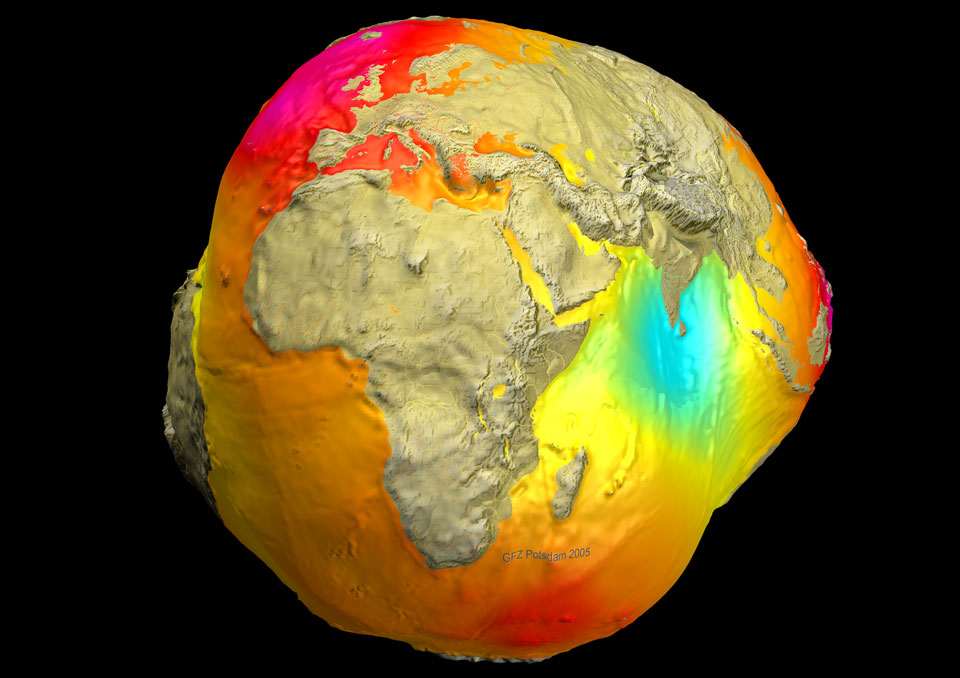
Why do some places on Earth have higher gravity than others? Sometimes the reason is unknown. To help better understand the Earth's surface, sensitive measurements by the orbiting satellites GRACE and CHAMP were used to create a map of Earth's gravitational field. Since a center for studying this data is in Potsdam, Germany, and since the result makes the Earth look somewhat like a potato, the resulting geoid has been referred to as the Potsdam Gravity Potato. High areas on this map, colored red, indicate areas where gravity is slightly stronger than usual, while in blue areas gravity is slightly weaker. Many bumps and valleys on the Potsdam Gravity Potato can be attributed to surface features, such as the North Mid-Atlantic Ridge and the Himalayan Mountains, but others cannot, and so might relate to unusually high or low sub-surface densities. Maps like this also help calibrate changes in the Earth's surface including variable ocean currents and the melting of glaciers. The above map was made in 2005, but more recent and more sensitive gravity maps of Earth was produced in 2011. via NASA http://ift.tt/12RLHmB

Molecular Cloud Barnard 68 Molecular Cloud Barnard 68


Where did all the stars go? What used to be considered a hole in the sky is now known to astronomers as a dark molecular cloud. Here, a high concentration of dust and molecular gas absorb practically all the visible light emitted from background stars. The eerily dark surroundings help make the interiors of molecular clouds some of the coldest and most isolated places in the universe. One of the most notable of these dark absorption nebulae is a cloud toward the constellation Ophiuchus known as Barnard 68, pictured above. That no stars are visible in the center indicates that Barnard 68 is relatively nearby, with measurements placing it about 500 light-years away and half a light-year across. It is not known exactly how molecular clouds like Barnard 68 form, but it is known that these clouds are themselves likely places for new stars to form. In fact, Barnard 68 itself has been found likely to collapse and form a new star system. It is possible to look right through the cloud in infrared light. via NASA http://ift.tt/1z8HkAd

The Infrared Visible Andromeda The Infrared Visible Andromeda


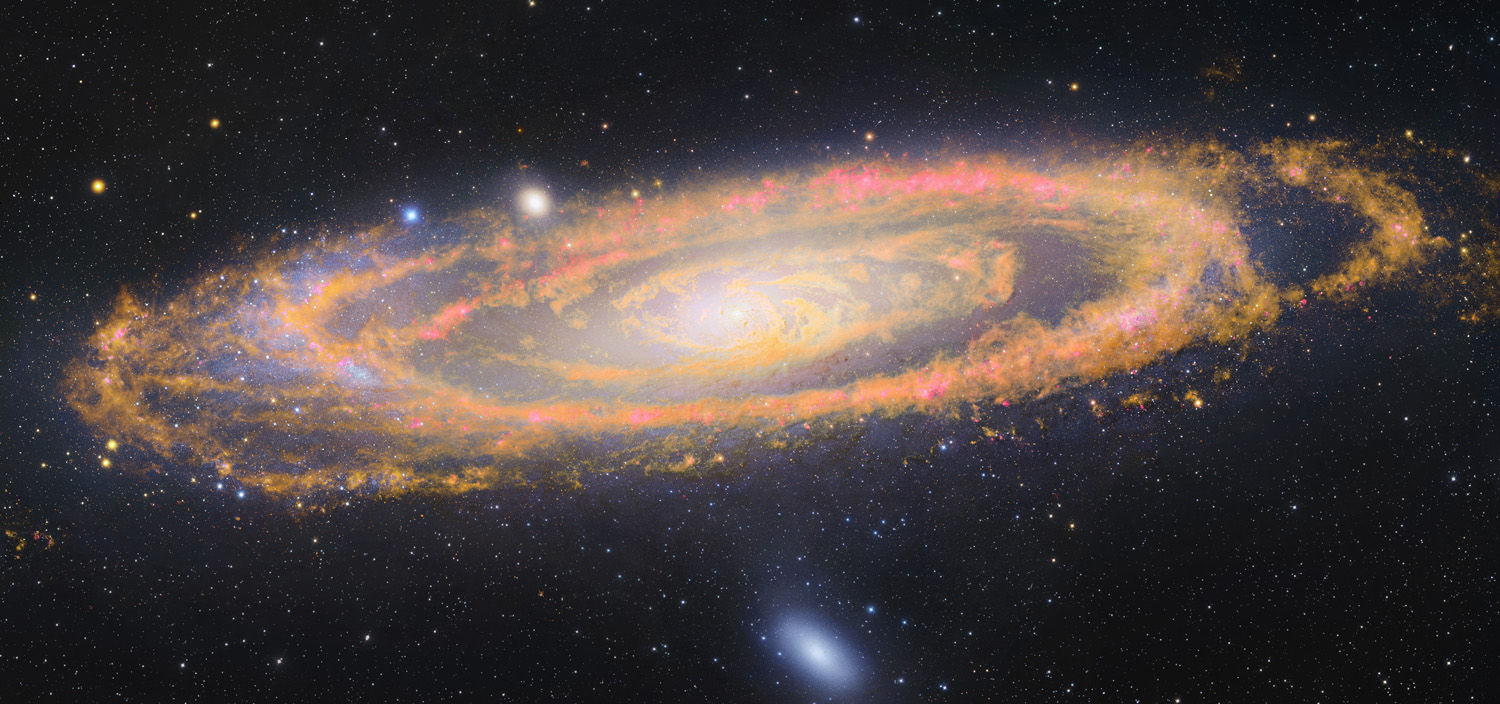
This remarkable synthetic color composite image was assembled from archives of visible light and infrared astronomy image data. The field of view spans the Andromeda Galaxy (M31), a massive spiral a mere 2.5 million light-years away. In fact, with over twice the diameter of our own Milky Way, Andromeda is the largest nearby galaxy. Andromeda's population of bright young blue stars lie along its sweeping spiral arms, with the telltale reddish glow of star forming regions traced in space- and ground-based visible light data. But infrared data from the Spitzer Space Telescope, also blended directly into the detailed composite's red and green color channels, highlight the the lumpy dust lanes warmed by the young stars as they wind even closer to the galaxy's core. Otherwise invisible at optical wavelengths, the warm dust takes on orange hues. Two smaller companion galaxies, M110 (below) and M32 (above) are also included in the frame. via NASA http://ift.tt/1BFEEwd

Crystals on Mars Crystals on Mars


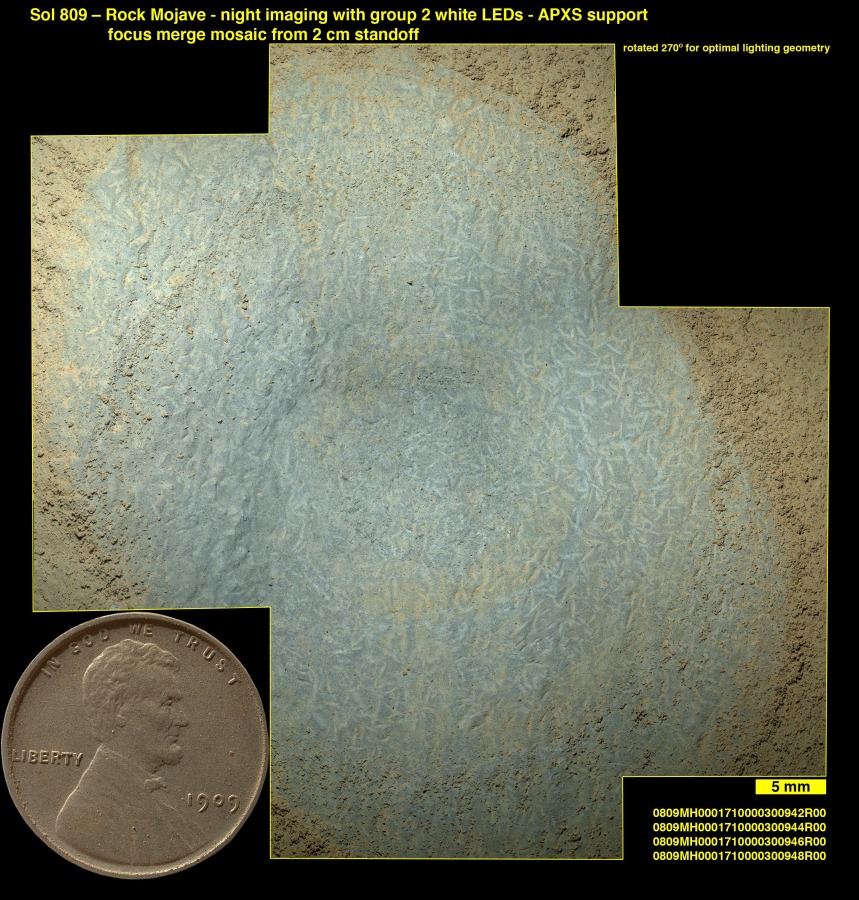
This extreme close-up, a mosaic from the Mars Hand Lens Imager (MAHLI) on the Curiosity rover, spans a breathtaking 5 centimeters. It captures what appear to be elongated crystal shapes formed by the precipitation of minerals dissolved in water, a likely result of the evaporation of ancient lake or river from the Martian surface. Brushed by a dust removal tool and illuminated by white LEDs, the target rock named Mojave was found on the Pink Cliffs outcrop of the Pahrump Hills at the base of Mount Sharp. The MAHLI images were acquired on Curiosity's sol 809, known on planet Earth as November 15, 2014. Of course, the inset 1909 Lincoln Cent image is provided for a comparison scale. Covered with Mars dust itself, the penny is a MAHLI calibration target attached to the rover. via NASA http://ift.tt/1zX2zU2