Pages

3D 67P 3D 67P


Get out your red/blue glasses and float next to a comet! The Rosetta mission lander Philae's ROLIS camera snapped the two frames used to create this stereo anaglyph for 3D viewing during its November 12 descent to the nucleus of Comet 67P/Churyumov-Gerasimenko. The comet's curious double lobed nucleus is seen nearly end on from a distance of about 3 kilometers, about 1 hour before Philae arrived at the surface. Philae's initial landing site is near the center of the front facing lobe. Part of a landing gear foot cuts across the upper right corner, in the close foreground of the 3D-view. Philae bounced twice in the comet's weak gravity after its first contact with the surface. Using high resolution camera images from the Rosetta orbiter along with data from the lander's instruments, controllers have followed Philae's impromptu journey over the comet's surface and have identified a likely area for its final resting place. via NASA http://antwrp.gsfc.nasa.gov/apod/ap141129.html

Portrait of NGC 281 Portrait of NGC 281


Look through the cosmic cloud cataloged as NGC 281 and you might miss the stars of open cluster IC 1590. But, formed within the nebula, that cluster's young, massive stars ultimately power the pervasive nebular glow. The eye-catching shapes looming in this portrait of NGC 281 are sculpted columns and dense dust globules seen in silhouette, eroded by intense, energetic winds and radiation from the hot cluster stars. If they survive long enough, the dusty structures could also be sites of future star formation. Playfully called the Pacman Nebula because of its overall shape, NGC 281 is about 10,000 light-years away in the constellation Cassiopeia. This sharp composite image was made through narrow-band filters, combining emission from the nebula's hydrogen, sulfur, and oxygen atoms in green, red, and blue hues. It spans over 80 light-years at the estimated distance of NGC 281. via NASA http://ift.tt/1zBXmQP

Galileo s Europa Remastered Galileo s Europa Remastered


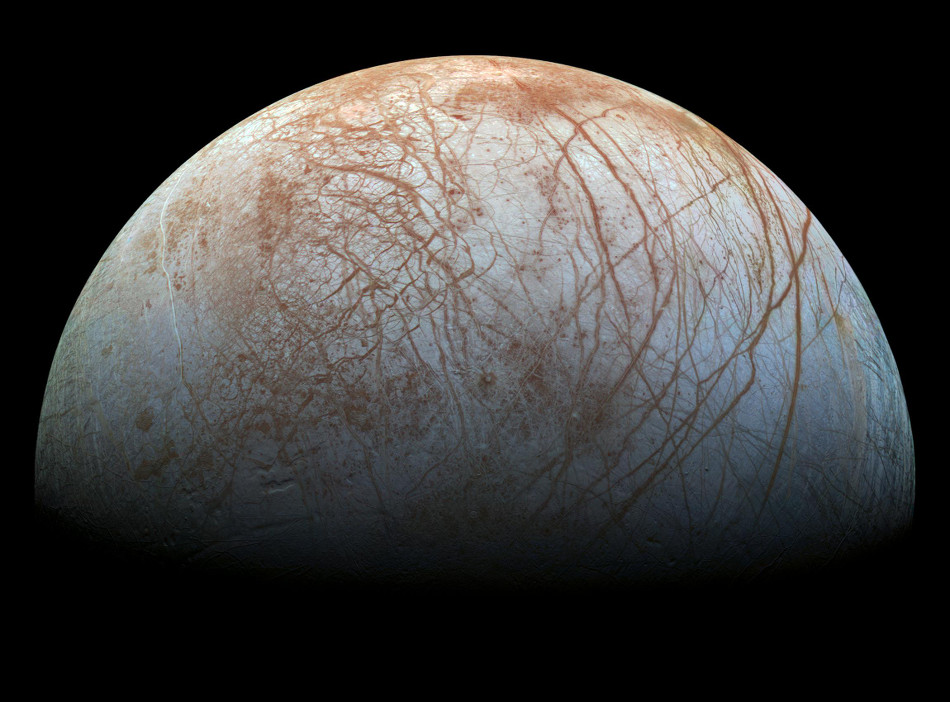
Looping through the Jovian system in the late 1990s, the Galileo spacecraft recorded stunning views of Europa and uncovered evidence that the moon's icy surface likely hides a deep, global ocean. Galileo's Europa image data has been newly remastered here, using improved new calibrations to produce a color image approximating what the human eye might see. Europa's long curving fractures hint at the subsurface liquid water. The tidal flexing the large moon experiences in its elliptical orbit around Jupiter supplies the energy to keep the ocean liquid. But more tantalizing is the possibility that even in the absence of sunlight that process could also supply the energy to support life, making Europa one of the best places to look for life beyond Earth. What kind of life could thrive in a deep, dark, subsurface ocean? Consider planet Earth's own extreme shrimp. via NASA http://ift.tt/1vnilHS

Io and Callisto Mutual Event Io and Callisto Mutual Event


A 24 minute sequence from top to bottom, this intriguing series of telescopic frames tracks the occultation of Io by Callisto, two of Jupiter's Galilean moons, from San Pietro Polesine, Italy, planet Earth. A challenging observational project using a small telescope, the two contrasting Jovian worlds are both slightly larger than Earth's Moon. In fact, bright, volcanic Io and dark, cratered Callisto are about 3,640 and 4,820 kilometers in diameter respectively. With Earth itself now crossing near the orbital plane of Jupiter's moons, astronomers are enjoying a season of Galilean moon mutual events ranging from eclipses to occultations. The series of orbital plane crossings produce a mutual event season every 5 to 6 years. via NASA http://ift.tt/1CdOXZv

The Creature from the Red Lagoon The Creature from the Red Lagoon


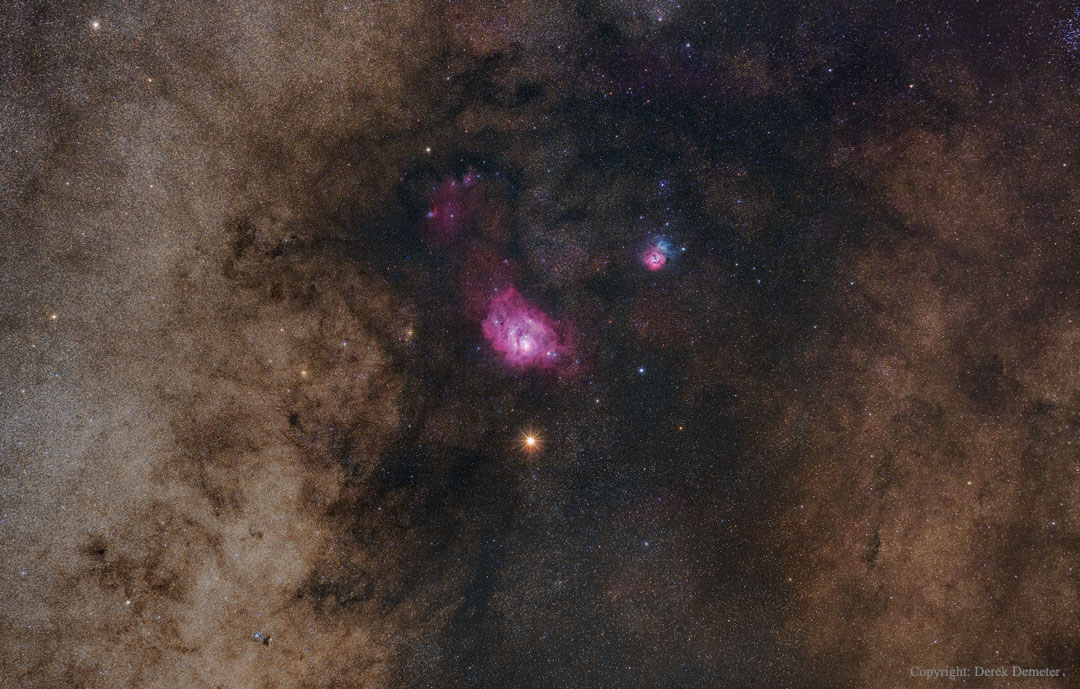
What creature lurks near the red Lagoon nebula? Mars. This gorgeous color deep-sky photograph has captured the red planet passing below two notable nebulae -- cataloged by the 18th century cosmic registrar Charles Messier as M8 and M20. M20 (upper right of center), the Trifid Nebula, presents a striking contrast in red/blue colors and dark dust lanes. Just below and to the left is the expansive, alluring red glow of M8, the Lagoon Nebula. Both nebulae are a few thousand light-years distant. By comparison, temporarily situated below them both, is the dominant "local" celestial beacon Mars. Taken late last month while near its closest approach to the Earth, the red planet was only a few light-minutes away. via NASA http://ift.tt/1ALafw8

Tornado and Rainbow Over Kansas Tornado and Rainbow Over Kansas


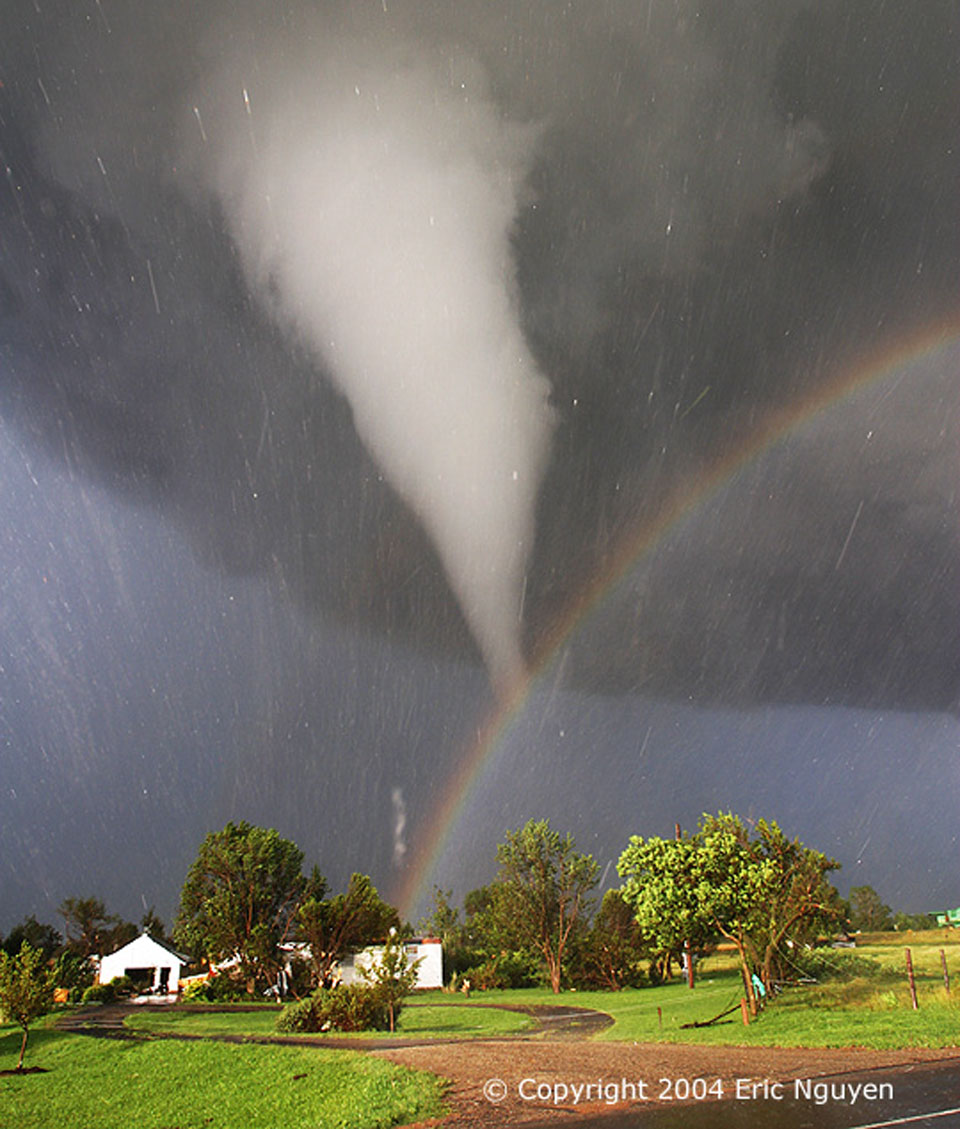
The scene might have been considered serene if it weren't for the tornado. During 2004 in Kansas, storm chaser Eric Nguyen photographed this budding twister in a different light -- the light of a rainbow. Featured here, a white tornado cloud descends from a dark storm cloud. The Sun, peeking through a clear patch of sky to the left, illuminates some buildings in the foreground. Sunlight reflects off raindrops to form a rainbow. By coincidence, the tornado appears to end right over the rainbow. Streaks in the image are hail being swept about by the high swirling winds. Over 1,000 tornadoes, the most violent type of storm known, occur on Earth every year, many in tornado alley. If you see a tornado while driving, do not try to outrun it -- park your car safely, go to a storm cellar, or crouch under steps in a basement. via NASA http://ift.tt/1uUeel3

Solar Flare from a Sharper Sun Solar Flare from a Sharper Sun


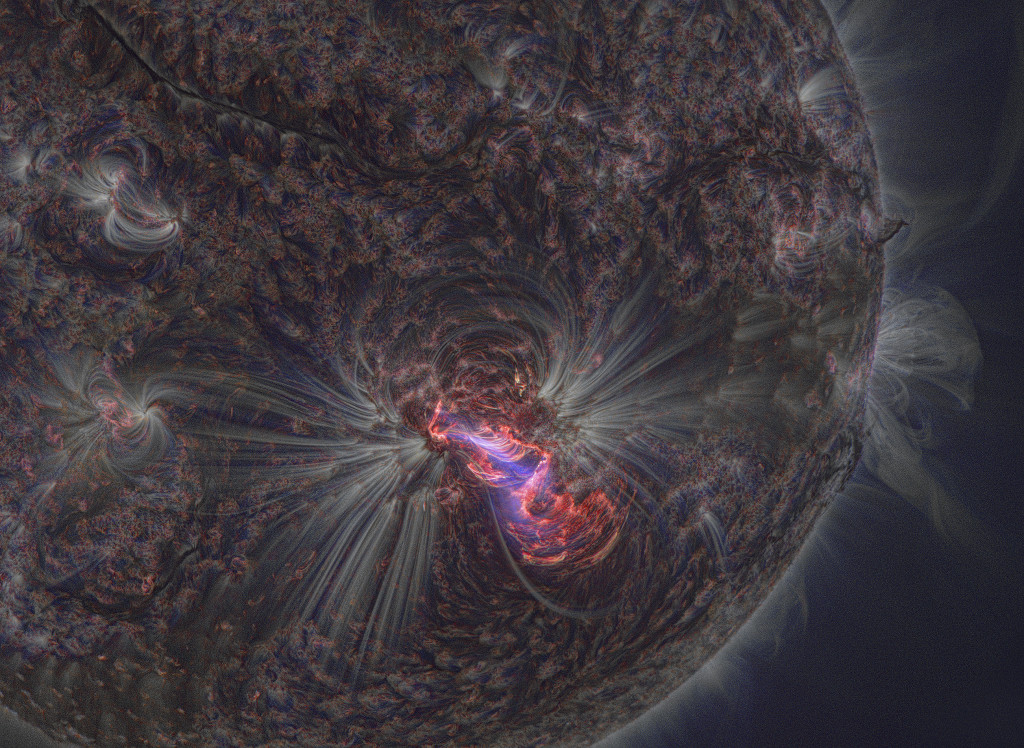
Solar active region AR2192 was the largest recorded sunspot group of the last 24 years. Before rotating off the Earth-facing side of the Sun at the end of October, it produced a whopping six energetic X-class flares. Its most intense flare was captured on October 24 in this stunning view from the orbiting Solar Dynamics Observatory. The scene is a color combination of images made at three different wavelengths of extreme ultraviolet light; 193 angstroms shown in blue, 171 angstroms in white, and 304 angstroms in red. The emission, from highly ionized Iron and Helium atoms, traces magnetic field lines looping through the hot plasma of the Sun's outer chromosphere and corona. Beneath, the cooler solar photosphere appears dark at extreme ultraviolet wavelengths. The exceptionally sharp composite image has been processed with a new mathematical algorithm (NAFE) that adapts to noise and brightness in extreme ultraviolet image data to reliably enhance small details. via NASA http://ift.tt/1HxEKrf

M1: The Crab Nebula M1: The Crab Nebula


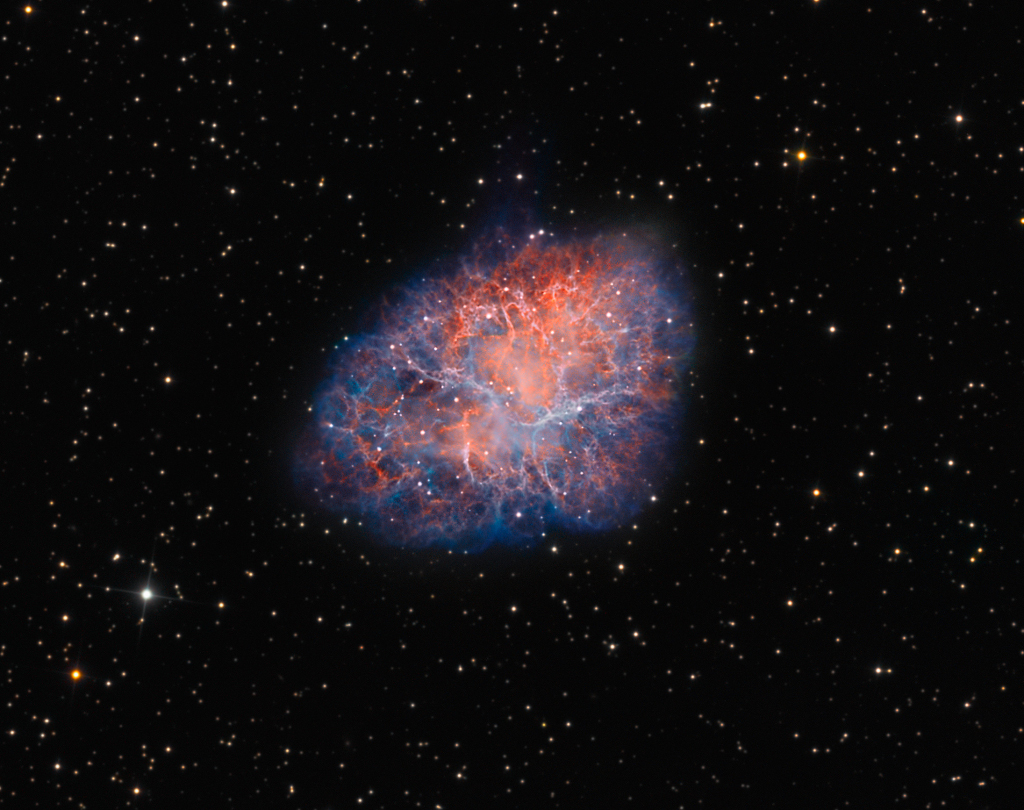
The Crab Nebula is cataloged as M1, the first object on Charles Messier's famous 18th century list of things which are not comets. In fact, the Crab is now known to be a supernova remnant, debris from the death explosion of a massive star, witnessed by astronomers in the year 1054. This sharp, ground-based telescopic view uses narrowband data to track emission from ionized oxygen and hydrogen atoms (in blue and red) and explore the tangled filaments within the still expanding cloud. One of the most exotic objects known to modern astronomers, the Crab Pulsar, a neutron star spinning 30 times a second, is visible as a bright spot near the nebula's center. Like a cosmic dynamo, this collapsed remnant of the stellar core powers the Crab's emission across the electromagnetic spectrum. Spanning about 12 light-years, the Crab Nebula is a mere 6,500 light-years away in the constellation Taurus. via NASA http://ift.tt/1F6VGkm

LDN 988: Dark Nebula in Cygnus LDN 988: Dark Nebula in Cygnus


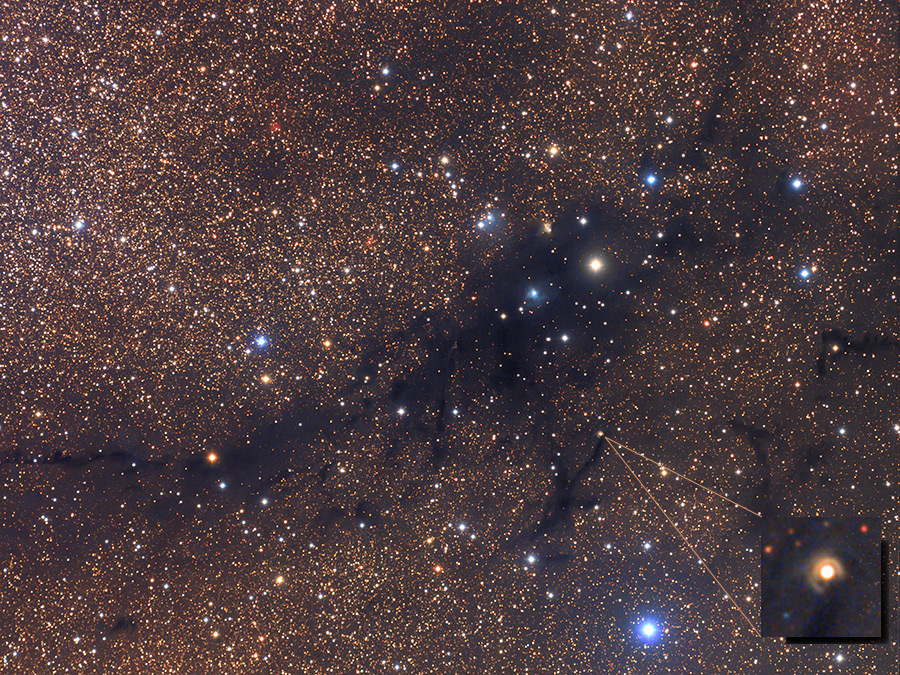
Obscuring the rich starfields of northern Cygnus, dark nebula LDN 988 lies near the center of this cosmic skyscape. Composed with telescope and camera, the scene is some 2 degrees across. That corresponds to 70 light-years at the estimated 2,000 light-year distance of LDN 988. Stars are forming within LDN 988, part of a larger complex of dusty molecular clouds along the plane of our Milky Way galaxy sometimes called the Northern Coalsack. In fact, nebulosities associated with young stars abound in the region, including variable star V1331 Cygni shown in the inset. At the tip of a long dusty filament and partly surrounded by a curved reflection nebula, V1331 is thought to be a T Tauri star, a sun-like star still in the early stages of formation. via NASA http://ift.tt/1yVkqK0

Bright Spiral Galaxy M81 Bright Spiral Galaxy M81


One of the brightest galaxies in planet Earth's sky is similar in size to our Milky Way Galaxy: big, beautiful M81. This grand spiral galaxy can be found toward the northern constellation of the Great Bear (Ursa Major). This superbly detailed view reveals M81's bright yellow nucleus, blue spiral arms, and sweeping cosmic dust lanes with a scale comparable to the Milky Way. Hinting at a disorderly past, a remarkable dust lane actually runs straight through the disk, to the left of the galactic center, contrary to M81's other prominent spiral features. The errant dust lane may be the lingering result of a close encounter between M81 and its smaller companion galaxy, M82. Scrutiny of variable stars in M81 has yielded one of the best determined distances for an external galaxy -- 11.8 million light-years. via NASA http://ift.tt/1uH8tbP

Star Formation in the Tadpole Nebula Star Formation in the Tadpole Nebula


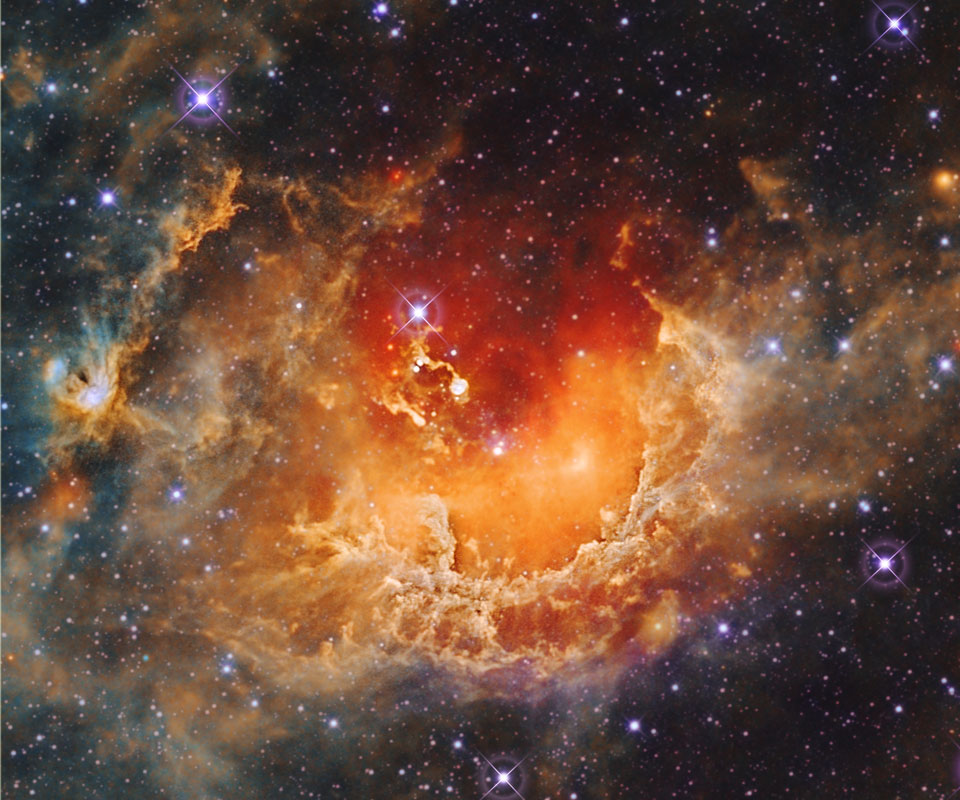
Dusty emission in the Tadpole nebula, IC 410, lies about 12,000 light-years away in the northern constellation Auriga. The cloud of glowing gas is over 100 light-years across, sculpted by stellar winds and radiation from embedded open star cluster NGC 1893. Formed in the interstellar cloud a mere 4 million years ago, bright cluster stars are seen all around the star-forming nebula. Notable near the image center are two relatively dense streamers of material trailing away from the nebula's central regions. Potentially sites of ongoing star formation in IC 410, these cosmic tadpole shapes are about 10 light-years long. The featured image was taken in infrared light by NASA's Wide Field Infrared Survey Explorer (WISE) satellite. via NASA http://ift.tt/1t0IGXN

The Double Dust Disks of HD 95086 The Double Dust Disks of HD 95086


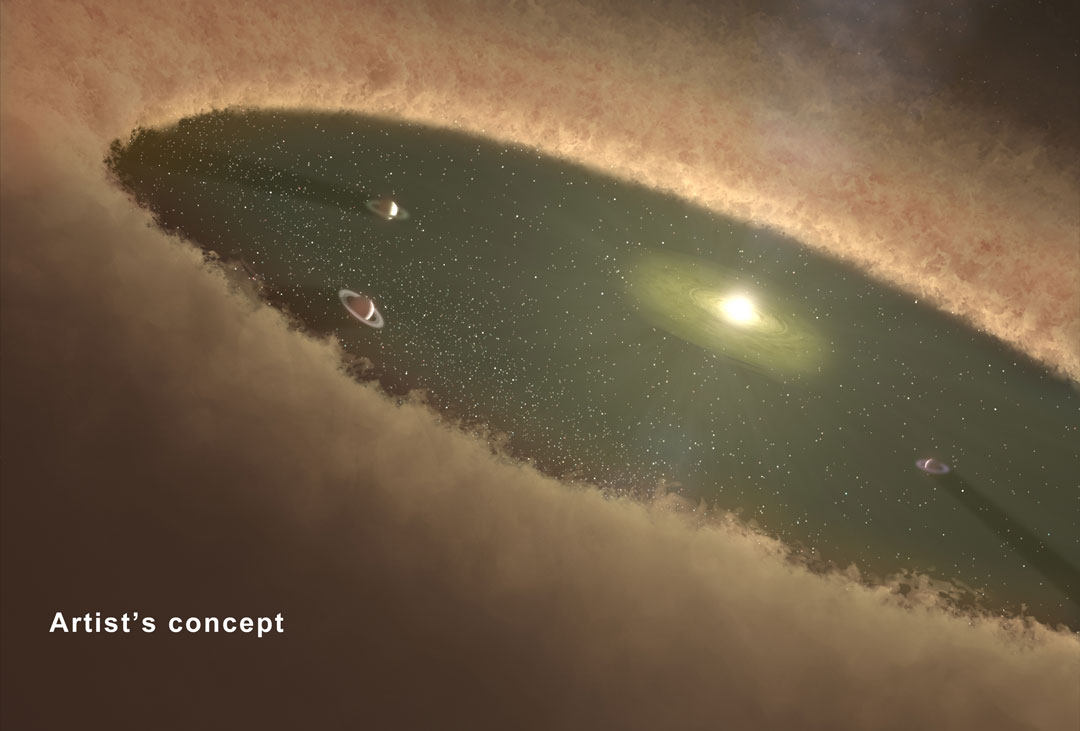
What do other star systems look like? To help find out, astronomers are carrying out detailed observations of nearby stars in infrared light to see which have dust disks that might be forming planets. Observations by NASA's Spitzer Space Telescope and ESA's Herschel Space Observatory have found that planetary system HD 95086 has two dust disks: a hot one near the parent star and a cooler one farther out. An artist's illustration of how the system might appear is featured here, including hypothetical planets with large rings that orbit between the disks. The planets may have created the large gap between the disks by absorbing and deflecting dust with their gravity. HD 95086 is a blue star about 60 percent more massive than our Sun that lies about 300 light years from Earth and is visible with binoculars toward the constellation of Carina. Studying the HD 95086 system may help astronomers better understand the formation and evolution of our own Solar System as well as the Earth. via NASA http://ift.tt/1H7EezW

Leonids Above Torre de la Guaita Leonids Above Torre de la Guaita


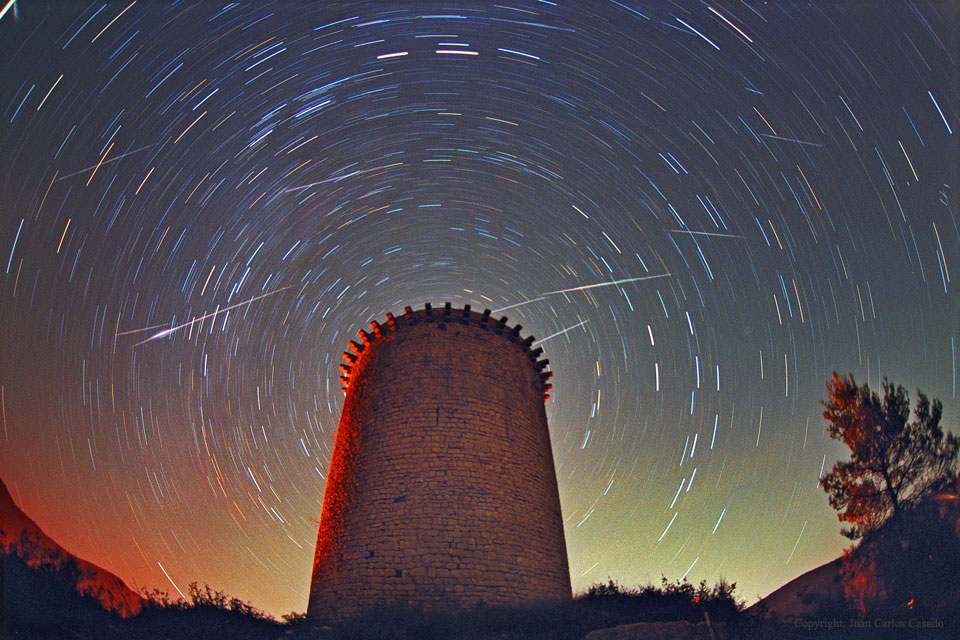
Leonids Meteor Shower came to an impressive crescendo in 1999. Observers in Europe saw a sharp peak in the number of meteors visible around 0210 UTC during the early morning hours of November 18. Meteor counts then exceeded 1000 per hour - the minimum needed to define a true meteor storm. At other times and from other locations around the world, observers typically reported respectable rates of between 30 and 100 meteors per hour. This photograph is a 20-minute exposure ending just before the main Leonids peak began. Visible are at least five Leonid meteors streaking high above the Torre de la Guaita, an observation tower used during the 12th century in Girona, Spain. In 2014, over the next few nights, the Leonids meteor shower will again peak. This year, although the crescent Moon should not create much competing skyglow, the Earth is predicted to pass through a more moderate stream of debris left over from Comet Tempel-Tuttle than in 1999, perhaps resulting in as many as 15 visible meteors per hour from dark locations. via NASA http://ift.tt/11dQ9e8

The Tulip in the Swan The Tulip in the Swan


Framing a bright emission region this telescopic view looks out along the plane of our Milky Way Galaxy toward the nebula rich constellation Cygnus the Swan. Popularly called the Tulip Nebula the glowing cloud of interstellar gas and dust is also found in the 1959 catalog by astronomer Stewart Sharpless as Sh2-101. About 8,000 light-years distant and 70 light-years across the complex and beautiful nebula blossoms at the center of this composite image. Red, green, and blue hues map emission from ionized sulfur, hydrogen, and oxygen atoms. Ultraviolet radiation from young, energetic stars at the edge of the Cygnus OB3 association, including O star HDE 227018, ionizes the atoms and powers the emission from the Tulip Nebula. HDE 227018 is the bright star very near the blue arc at the cosmic tulip's center. Glowing across the electromagnetic spectrum, microquasar Cygnus X-1 and a curved shock front created by its powerful jets lie toward the top and right. via NASA http://ift.tt/1sPhuv1

Welcome to a Comet Welcome to a Comet


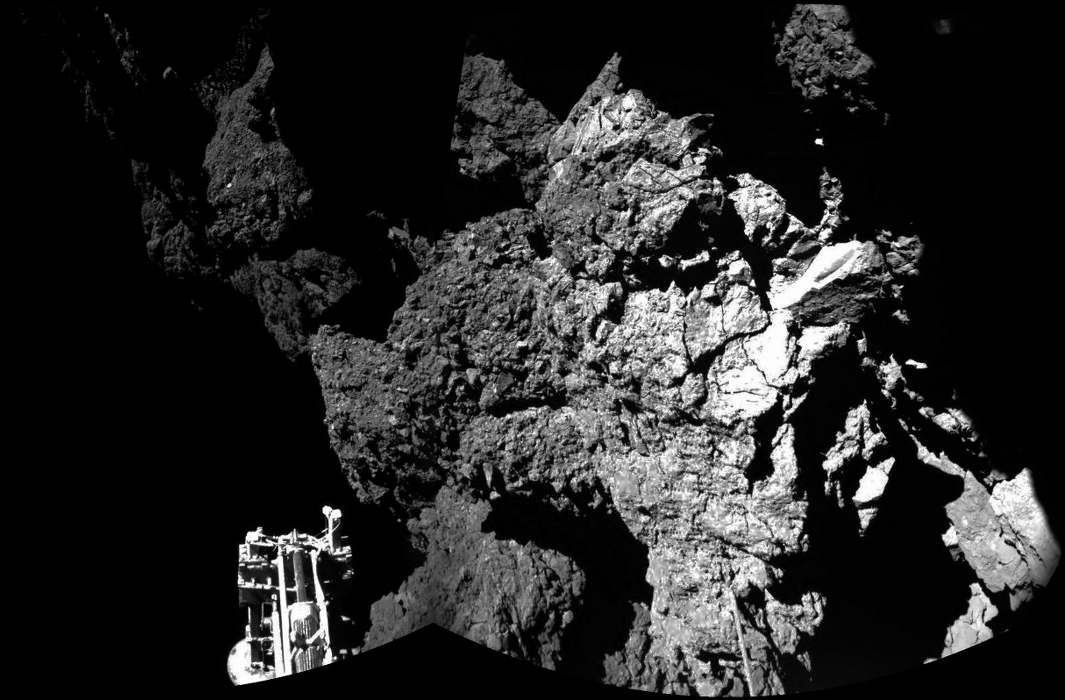
The Rosetta Mission lander is safely on a comet. One of Philae's feet appears at the bottom left of this spectacular image of the surface of C67/P Churyumov-Gerasimenko. Still a happy lander, Philae bounced twice before settling and returning images from the surface, traveling a kilometer or so after initially touching at the targeted site Agilkia. A surface panorama suggests that the lander has come to rest tilted and near a shadowing wall, with its solar panels getting less illumination that hoped. Philae's science instruments are working as planned and data is being relayed during communications windows, when the Rosetta spacecraft is above the lander's new horizon. via NASA http://ift.tt/1BlG3cf

Descent to a Comet Descent to a Comet


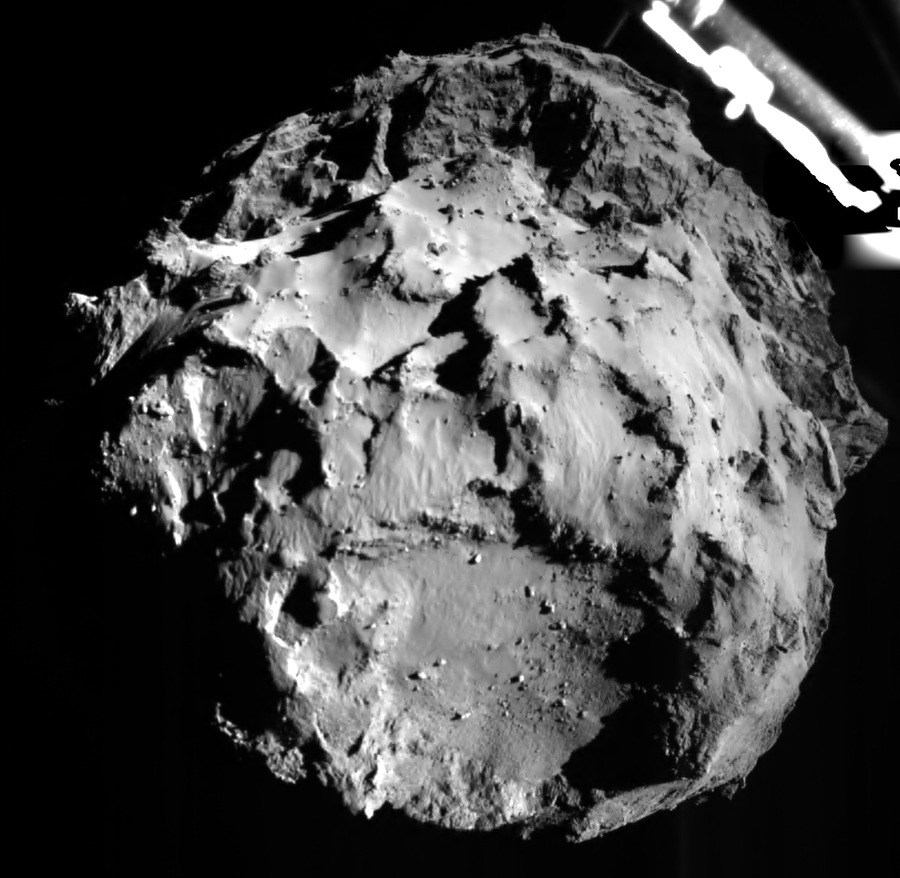
Yesterday, the first soft landing on a comet took place some 500 million kilometers from planet Earth as the Rosetta mission lander Philae settled on the nucleus of C67/P Churyumov-Gerasimenko. The landing site, dubbed Agilkia, is located near the center of this remarkable image snapped by Philae's ROLIS (ROsetta Lander Imaging System) camera. Taken from a distance of about 3 kilometers the image has a resolution of about 3 meters per pixel at the surface. After Philae's release from the orbiter, its seven-hour long descent was made without propulsion or guidance. Following its descent the lander is in place, though its anchoring harpoon system did not fire. For 2.5 days the lander is intended to conduct its main science mission returning extensive images and data. An extended surface mission may be possible if sunlight and dust conditions allow solar panels to recharge Philae's battery. via NASA http://ift.tt/1BdDcls

Philae Attempts Comet Nucleus Landing Philae Attempts Comet Nucleus Landing


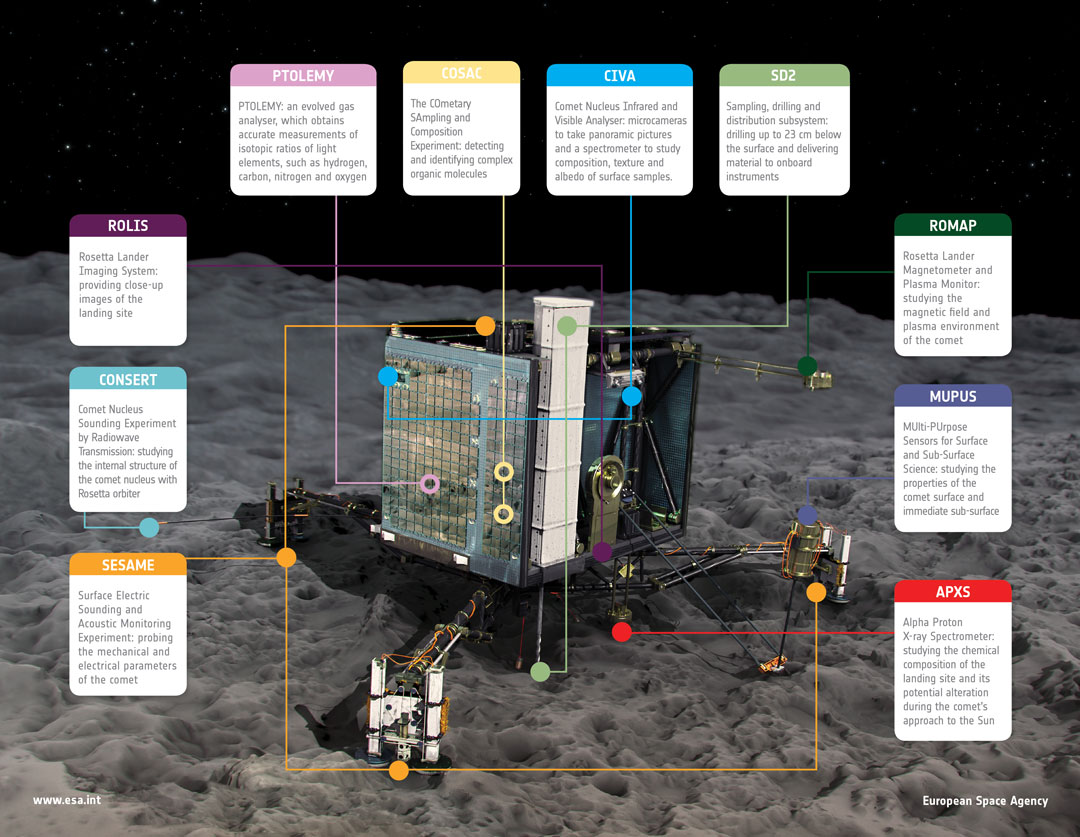
Today humanity will make its first attempt to land a probe on the nucleus of a comet. As the day progresses, the Philae (fee-LAY) lander will separate from the Rosetta spacecraft and head down to the surface of Comet 67P/Churyumov–Gerasimenko. Since the texture of the comet's surface is unknown and its surface gravity is surely low, Philae will then attempt to harpoon itself down, something that has never been done before. Featured here is an artist's illustration of dishwasher-sized Philae as it might look on Comet Churyumov–Gerasimenko's surface, along with explanation balloons detailing onboard scientific instruments. Many people on a blue planet across the Solar System will be eagerly awaiting news and updates. Whether Philae actually lands, whether it lands on a smooth patch, whether the harpoons take hold, and how far the robotic lander sinks into the surface should all become known as events unfold today. via NASA http://ift.tt/1ulak5I

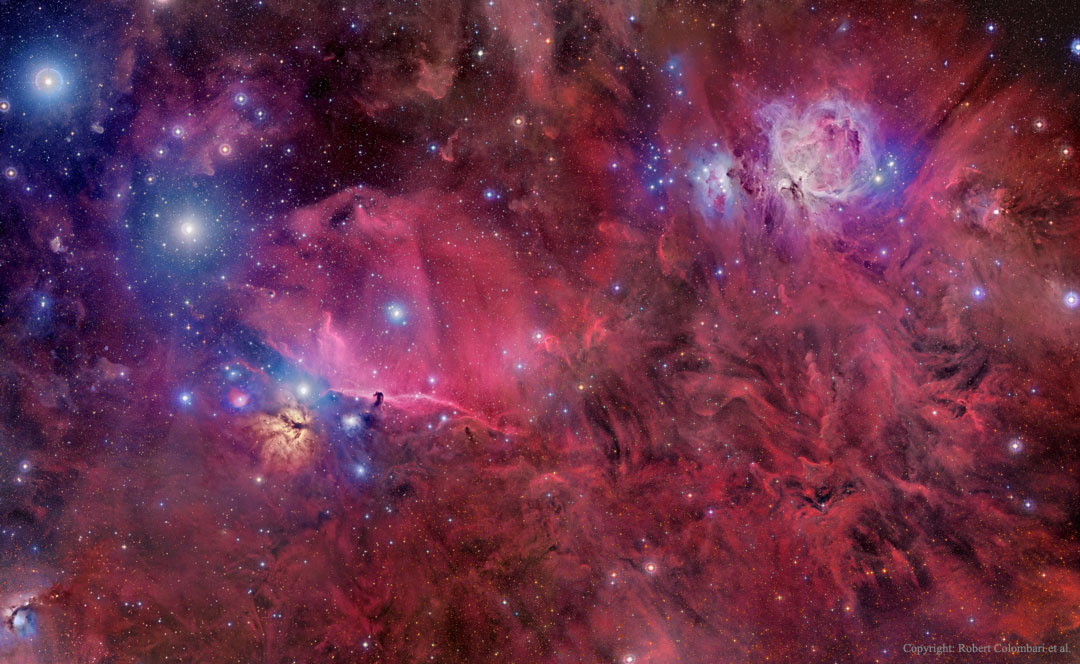
Orion in Gas, Dust, and Stars Orion in Gas, Dust, and Stars


The constellation of Orion holds much more than three stars in a row. A deep exposure shows everything from dark nebula to star clusters, all embedded in an extended patch of gaseous wisps in the greater Orion Molecular Cloud Complex. The brightest three stars on the far left are indeed the famous three stars that make up the belt of Orion. Just below Alnitak, the lowest of the three belt stars, is the Flame Nebula, glowing with excited hydrogen gas and immersed in filaments of dark brown dust. Below and left of the frame center and just to the right of Alnitak lies the Horsehead Nebula, a dark indentation of dense dust that has perhaps the most recognized nebular shapes on the sky. On the upper right lies M42, the Orion Nebula, an energetic caldron of tumultuous gas, visible to the unaided eye, that is giving birth to a new open cluster of stars. Immediately to the left of M42 is a prominent bluish reflection nebula sometimes called the Running Man that houses many bright blue stars. The featured image covers an area with objects that are roughly 1,500 light years away and spans about 75 light years. via NASA http://ift.tt/1wdzRus