Pages

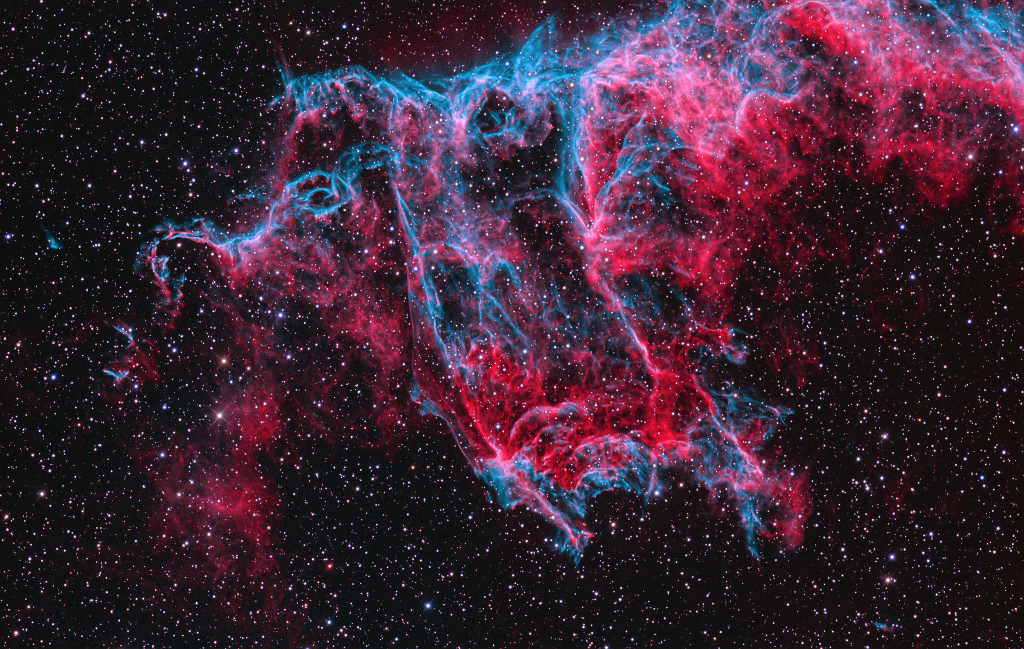
A Spectre in the Eastern Veil A Spectre in the Eastern Veil


Frightening forms and scary faces are a mark of the Halloween season. They also haunt this cosmic close-up of the eastern Veil Nebula. The Veil Nebula itself is a large supernova remnant, the expanding debris cloud from the death explosion of a massive star. While the Veil is roughly circular in shape and covers nearly 3 degrees on the sky in the constellation Cygnus, this portion of the eastern Veil spans only 1/2 degree, about the apparent size of the Moon. That translates to 12 light-years at the Veil's estimated distance, a reassuring 1,400 light-years from planet Earth. In the composite of image data recorded through broad and narrow band filters, emission from hydrogen atoms in the remnant is shown in red with strong emission from oxygen atoms in blue-green hues. Of course, in the western part of the Veil lies another seasonal apparition, the Witch's Broom. via NASA http://ift.tt/1q1lTtw

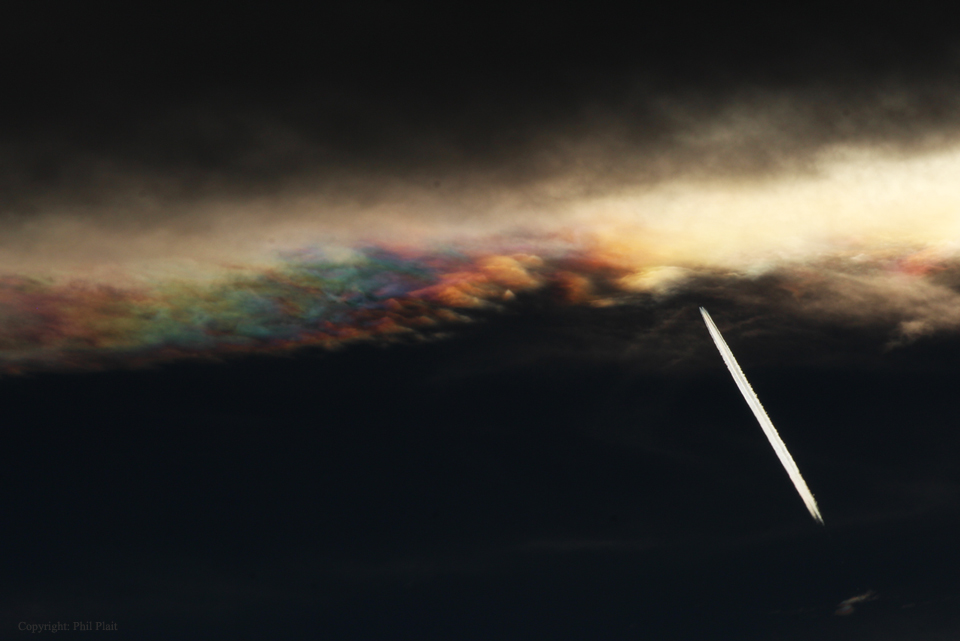
Iridescent Cloud Edge Over Colorado Iridescent Cloud Edge Over Colorado


Sometimes your eclipse viewing goes bad in an interesting way. While watching and photographing last Thursday's partial solar eclipse, a popular astronomy blogger suffered through long periods of clouds blocking the Sun. Unexpectedly, however, a nearby cloud began to show a rare effect: iridescence. Frequently part of a more familiar solar corona effect, iridescence is the diffraction of sunlight around a thin screen of nearly uniformly-sized water droplets. Different colors of the sunlight become deflected by slightly different angles and so come to the observer from slightly different directions. This display, featured here, was quite bright and exhibited an unusually broad range of colors. On the right, the contrails of an airplane are also visible. via NASA http://ift.tt/1tJ7ad5

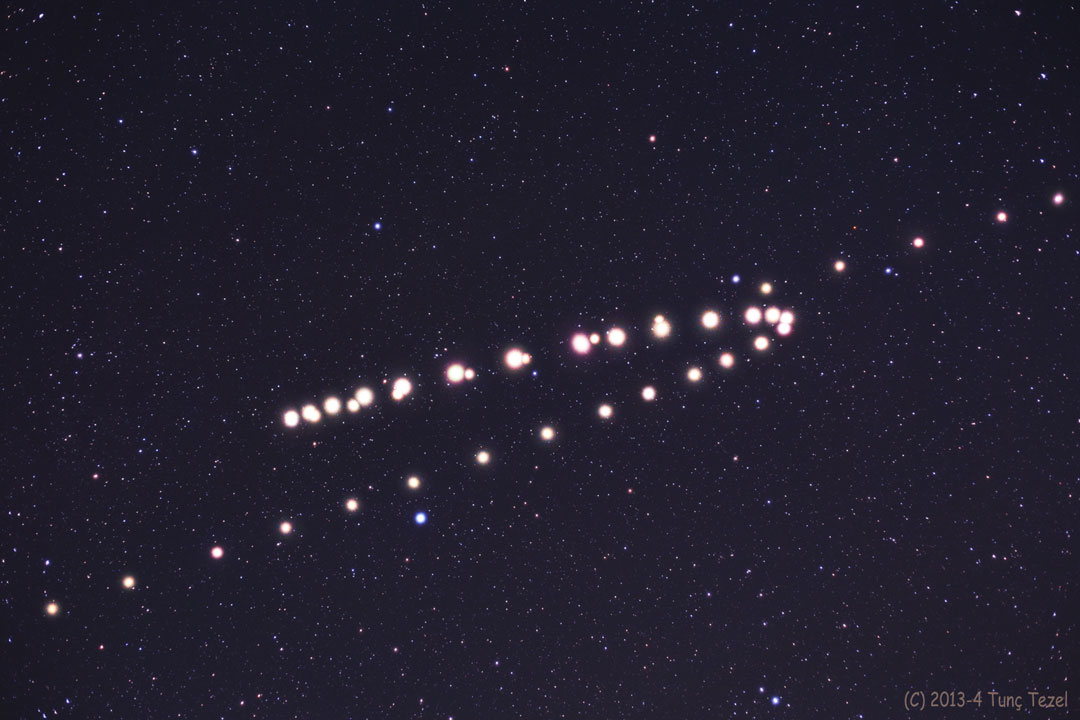
Retrograde Mars Retrograde Mars


Why would Mars appear to move backwards? Most of the time, the apparent motion of Mars in Earth's sky is in one direction, slow but steady in front of the far distant stars. About every two years, however, the Earth passes Mars as they orbit around the Sun. During the most recent such pass starting late last year, Mars as usual, loomed large and bright. Also during this time, Mars appeared to move backwards in the sky, a phenomenon called retrograde motion. Featured here is a series of images digitally stacked so that all of the stars coincide. Here, Mars appears to trace out a narrow loop in the sky. At the center of the loop, Earth passed Mars and the retrograde motion was the highest. Retrograde motion can also be seen for other Solar System planets. via NASA http://ift.tt/1DV3Du8

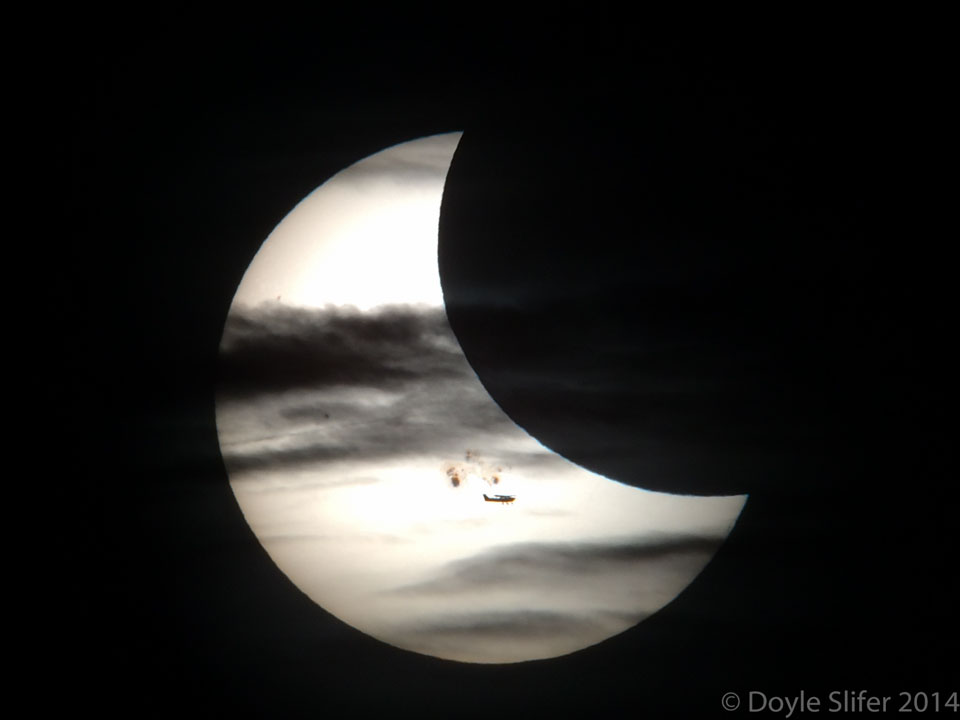
Plane, Clouds, Moon, Spots, Sun Plane, Clouds, Moon, Spots, Sun


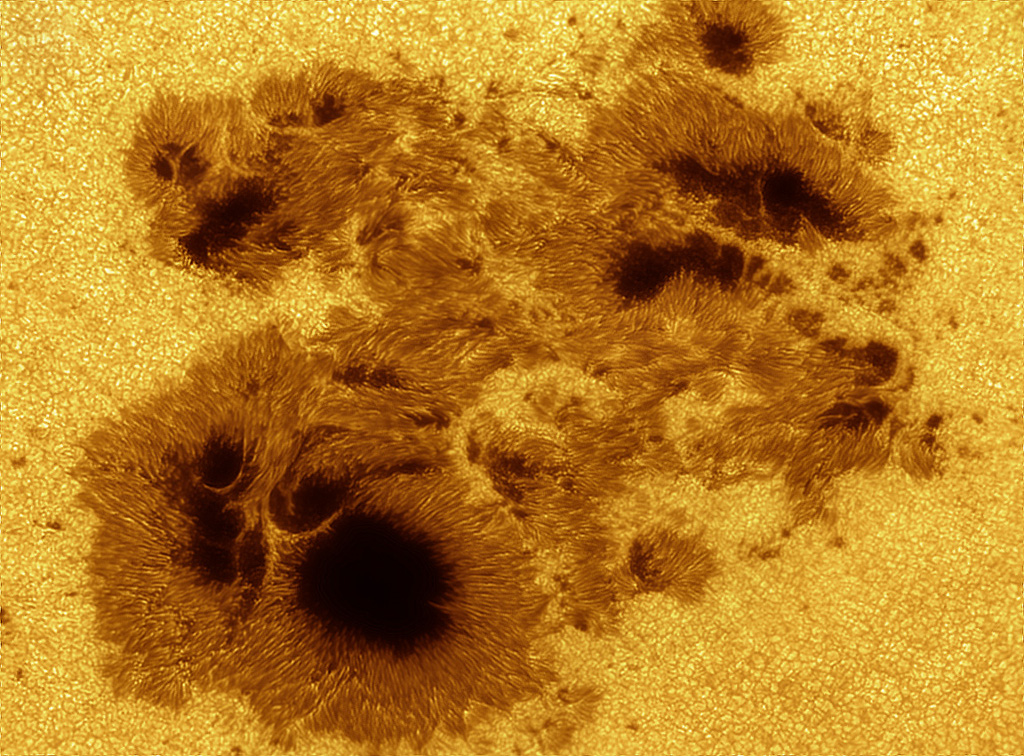
What's that in front of the Sun? The closest object is an airplane, visible just below the Sun's center and caught purely by chance. Next out are numerous clouds in Earth's atmosphere, creating a series of darkened horizontal streaks. Farther out is Earth's Moon, seen as the large dark circular bite on the upper right. Just above the airplane and just below the Sun's surface are sunspots. The main sunspot group captured here, AR 2192, is one of the largest ever recorded and has been crackling and bursting with flares since it came around the edge of the Sun early last week. Taken last Thursday, this show of solar silhouettes was unfortunately short-lived. Within a few seconds the plane flew away. Within a few minutes the clouds drifted off. Within a few hours the partial solar eclipse of the Sun by the Moon was over. Only the sunspot group remains, but within a few more days even AR 2192 will disappear around the edge of the Sun. Fortunately, when it comes to the Sun, even unexpected alignments are surprisingly frequent. via NASA http://ift.tt/1oNEuOT

Too Close to a Black Hole Too Close to a Black Hole


What would you see if you went right up to a black hole? Featured is a computer generated image highlighting how strange things would look. The black hole has such strong gravity that light is noticeably bent towards it - causing some very unusual visual distortions. Every star in the normal frame has at least two bright images - one on each side of the black hole. Near the black hole, you can see the whole sky - light from every direction is bent around and comes back to you. The original background map was taken from the 2MASS infrared sky survey, with stars from the Henry Draper catalog superposed. Black holes are thought to be the densest state of matter, and there is indirect evidence for their presence in stellar binary systems and the centers of globular clusters, galaxies, and quasars. via NASA http://ift.tt/1t4wS8Q

Sunspots and Solar Eclipse Sunspots and Solar Eclipse


A New Moon joined giant sunspot group AR 2192 to dim the bright solar disk during Thursday's much anticipated partial solar eclipse. Visible from much of North America, the Moon's broad silhouette is captured in this extreme telephoto snapshot near eclipse maximum from Santa Cruz, California. About the size of Jupiter, the remarkable AR 2192 itself darkens a noticeable fraction of the Sun, near center and below the curved lunar limb. As the sunspot group slowly rotates across the Sun and out of view in the coming days its activity is difficult to forecast. But the timing of solar eclipses is easier to predict. The next will be a total solar eclipse on March 20, 2015. via NASA http://ift.tt/1skb2KM

AR 2192: Giant on the Sun AR 2192: Giant on the Sun


As you (safely!) watched the progress of yesterday's partial solar eclipse, you probably also spotted a giant sunspot group. Captured in this sharp telescopic image from October 22nd the complex AR 2192 is beautiful to see, a sprawling solar active region comparable in size to the diameter of Jupiter. Like other smaller sunspot groups, AR 2192 is now crossing the Earth-facing side of the Sun and appears dark in visible light because it is cooler than the surrounding surface. Still, the energy stored in the region's twisted magnetic fields is enormous and has already generated powerful explosions, including two X-class solar flares this week. Coronal mass ejections (CMEs) associated with the flares have not affected planet Earth, so far. The forecast for further activity from AR 2192 is still significant though, as it swings across the center of the solar disk and Earth-directed CMEs become possible. via NASA http://ift.tt/1tPQWQ6

Galaxies in Pegasus Galaxies in Pegasus


This wide, sharp telescopic view reveals galaxies scattered beyond the stars and faint dust nebulae of the Milky Way at the northern boundary of the high-flying constellation Pegasus. Prominent at the upper right is NGC 7331. A mere 50 million light-years away, the large spiral is one of the brighter galaxies not included in Charles Messier's famous 18th century catalog. The disturbed looking group of galaxies at the lower left is well-known as Stephan's Quintet. About 300 million light-years distant, the quintet dramatically illustrates a multiple galaxy collision, its powerful, ongoing interactions posed for a brief cosmic snapshot. On the sky, the quintet and NGC 7331 are separated by about half a degree. via NASA http://ift.tt/1mZrII2

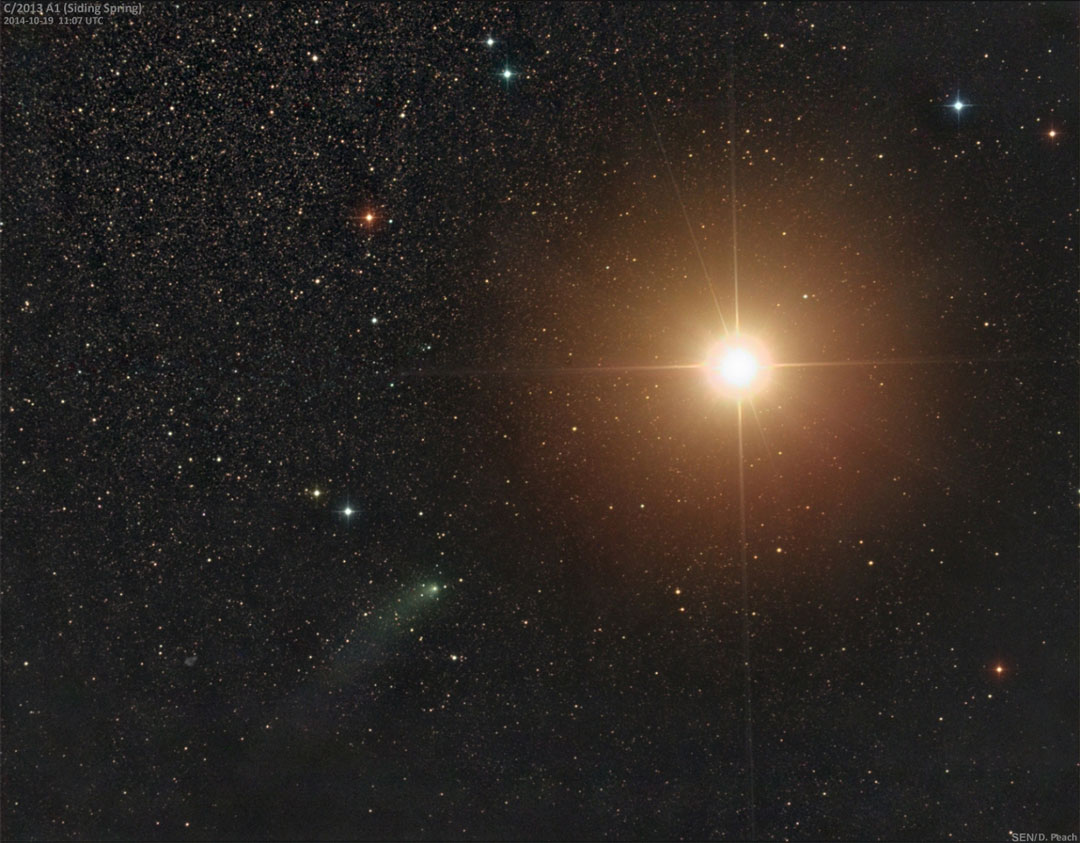
Comet Siding Spring Passes Mars Comet Siding Spring Passes Mars


Yesterday, a comet passed very close to Mars. In fact, Comet C/2013 A1 (Siding Spring) passed closer to the red planet than any comet has ever passed to Earth in recorded history. To take advantage of this unique opportunity to study the close interaction of a comet and a planet, humanity currently has five active spacecraft orbiting Mars: NASA's MAVEN, MRO, Mars Odyssey, as well as ESA's Mars Express, and India's Mars Orbiter. Most of these spacecraft have now sent back information that they have not been damaged by small pieces of the passing comet. These spacecraft, as well as the two active rovers on the Martian surface -- NASA's Opportunity and Curiosity -- have taken data and images that will be downloaded to Earth for weeks to come and likely studied for years to come. The featured image taken yesterday, however, was not taken from Mars but from Earth and shows Comet Siding Spring on the lower left as it passed Mars, on the upper right. via NASA http://ift.tt/11Um6sU

Comet McNaught Over New Zealand Comet McNaught Over New Zealand


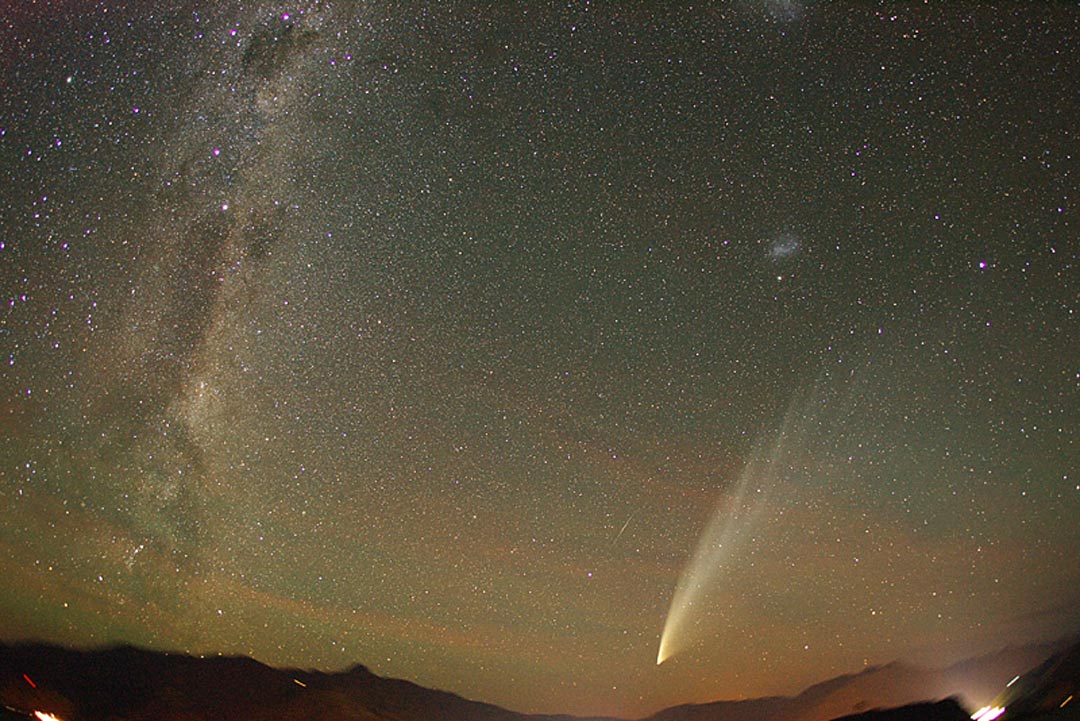
Comet McNaught was perhaps the most photogenic comet of modern times -- from Earth. After making quite a show in the northern hemisphere in early January of 2007, the comet moved south and developed a long and unusual dust tail that dazzled southern hemisphere observers. In late January 2007, Comet McNaught was captured between Mount Remarkable and Cecil Peak in this spectacular image taken from Queenstown, South Island, New Zealand. The bright comet dominates the right part of the above image, while the central band of our Milky Way Galaxy dominates the left. Careful inspection of the image will reveal a meteor streak just to the left of the comet. Today, Comet Siding Spring may become the most photogenic comet of modern times -- from Mars. via NASA http://ift.tt/1ohO7Fd

Melotte 15 in the Heart Melotte 15 in the Heart


Cosmic clouds form fantastic shapes in the central regions of emission nebula IC 1805. The clouds are sculpted by stellar winds and radiation from massive hot stars in the nebula's newborn star cluster, Melotte 15. About 1.5 million years young, the cluster stars are toward the right in this colorful skyscape, along with dark dust clouds in silhouette against glowing atomic gas. A composite of narrowband and broadband telescopic images, the view spans about 30 light-years and includes emission from ionized hydrogen, sulfur, and oxygen atoms mapped to green, red, and blue hues in the popular Hubble Palette. Wider field images reveal that IC 1805's simpler, overall outline suggests its popular name - The Heart Nebula. IC 1805 is located about 7,500 light years away toward the boastful constellation Cassiopeia. via NASA http://ift.tt/1sSWBCx

Messier 6 and Comet Siding Spring Messier 6 and Comet Siding Spring


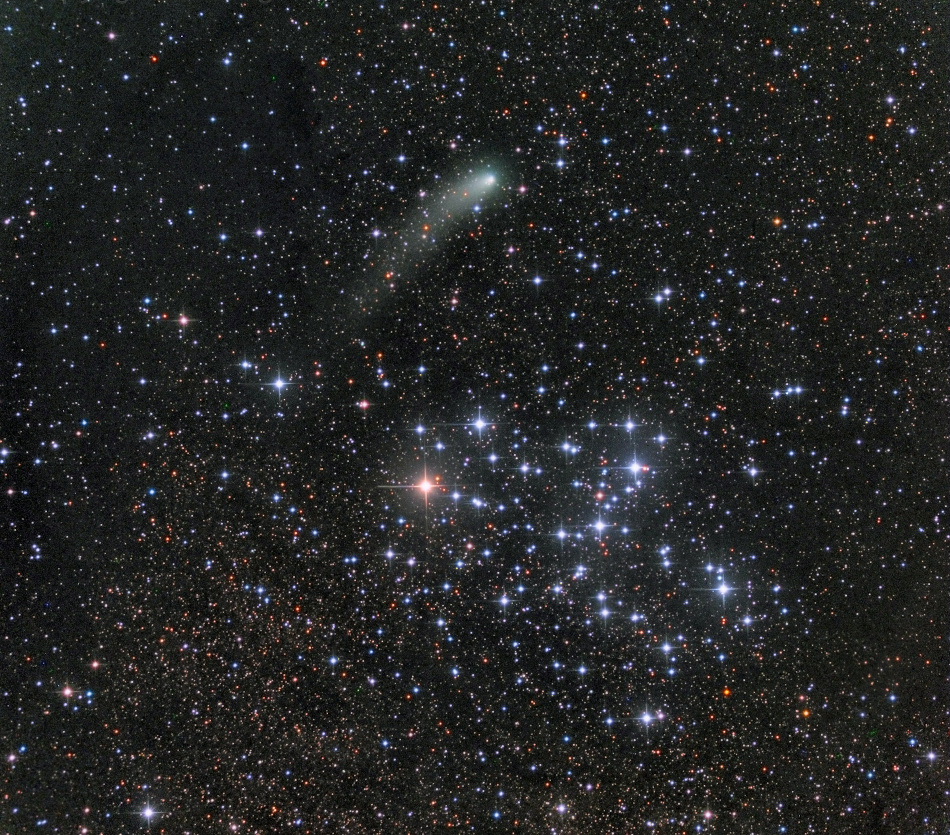
This looks like a near miss but the greenish coma and tail of Comet Siding Spring (C/2013 A1) are really 2,000 light-years or so away from the stars of open cluster Messier 6. They do appear close together though, along the same line-of-sight in this gorgeous October 9th skyscape toward the constellation Scorpius. Still, on Sunday, October 19th this comet really will be involved in a near miss, passing within only 139,500 kilometers of planet Mars. That's about 10 times closer than any known comet flyby of planet Earth, and nearly one third the Earth-Moon distance. While an impact with the nucleus is not a threat the comet's dust, moving with a speed of about 56 kilometers per second relative to the Red Planet, and outskirts of its gaseous coma could interact with the thin Martian atmosphere. Of course, the comet's close encounter will be followed intently by spacecraft in Martian orbit and rovers on the surface. via NASA http://ift.tt/1piHLQG

Rosetta's Selfie Rosetta's Selfie


This Rosetta spacecraft selfie was snapped on October 7th. At the time the spacecraft was about 472 million kilometers from planet Earth, but only 16 kilometers from the surface of comet 67P/Churyumov-Gerasimenko. Looming beyond the spacecraft near the top of the frame, dust and gas stream away from the comet's curious double-lobed nucleus and bright sunlight glints off one of Rosetta's 14 meter long solar arrays. In fact, two exposures, one short and one long, were combined to record the dramatic high contrast scene using the CIVA camera system on Rosetta's still-attached Philae lander. Its chosen primary landing site is visible on the smaller lobe of the nucleus. This is the last image anticipated from Philae's cameras before the lander separates from Rosetta on November 12. Shortly after separation Philae will take another image looking back toward the orbiter, and begin its descent to the nucleus of the comet. via NASA http://ift.tt/1rwxZu2

Mysterious Changing feature on Titan Mysterious Changing feature on Titan


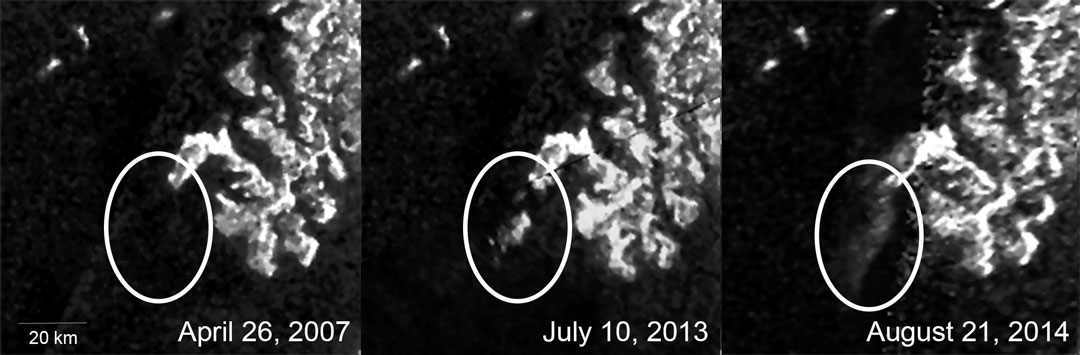
What is that changing object in a cold hydrocarbon sea of Titan? Radar images from the robotic Cassini spacecraft orbiting Saturn have been recording the surface of the cloud-engulfed moon Titan for years. When imaging the flat -- and hence radar dark -- surface of the methane and ethane lake called Ligeia Mare, an object appeared in 2013 just was not there in 2007. Subsequent observations in 2014 found the object remained -- but had changed! The featured image shows how the 20-km long object has appeared and evolved. Current origin speculative explanations include bubbling foam and floating solids, but no one is sure. Future observations may either resolve the enigma or open up more speculation. via NASA http://ift.tt/1sJMQI0

Auroral Corona over Norway Auroral Corona over Norway


Higher than the highest mountain lies the realm of the aurora. Auroras rarely reach below 60 kilometers, and can range up to 1000 kilometers. Aurora light results from energetic electrons and protons striking atoms and molecules in the Earth's atmosphere. Somewhat uncommon, an auroral corona appears as a center point for a surrounding display and may occur when an aurora develops directly overhead, or when auroral rays are pointed nearly toward the observer. This picturesque but brief green and purple aurora exhibition occurred last month high above Kvaløya, Tromsø, Norway. The Sessøyfjorden fjord runs through the foreground, while numerous stars are visible far in the distance. via NASA http://ift.tt/1vpkEeB

The Helix Nebula from Blanco and Hubble The Helix Nebula from Blanco and Hubble


How did a star create the Helix nebula? The shapes of planetary nebula like the Helix are important because they likely hold clues to how stars like the Sun end their lives. Observations by the orbiting Hubble Space Telescope and the 4-meter Blanco Telescope in Chile, however, have shown the Helix is not really a simple helix. Rather, it incorporates two nearly perpendicular disks as well as arcs, shocks, and even features not well understood. Even so, many strikingly geometric symmetries remain. How a single Sun-like star created such beautiful yet geometric complexity is a topic of research. The Helix Nebula is the nearest planetary nebula to Earth, lies only about 700 light years away toward the constellation of Aquarius, and spans about 3 light-years. via NASA http://ift.tt/1sAFDc9